


On 2 September 1945, Hồ Chí Minh stood in Ba Đình Square, Hanoi, and proclaimed the Declaration of Independence of the Democratic Republic of Vietnam.
From Hunger to Harvest, and the Decade Ahead
In September 1945, as Vietnam declared its independence, the country faced one of its darkest chapters. That same year, the Great Famine swept through the north, claiming nearly two million lives. It was a crisis of hunger, poverty, and vulnerability — the legacy of French colonial rule and a broken food system. For Vietnam, independence was not only about sovereignty; it was about survival.
Eighty years later, the story could not be more different. Vietnam has transformed from a nation struggling with famine into one of the world’s leading agricultural exporters. Rice, coffee, pepper, seafood, cashew, and fruit from Vietnam now feed families across more than 190 countries. What once symbolised fragility has become a hallmark of resilience.
This journey — from hunger to harvest — captures the spirit of Vietnam’s development: determined, adaptive, and globally connected. And as the country celebrates its 80th Independence Day, the question is not only what Vietnam has achieved, but what lies ahead in the next decade.
From Survival to Global Supplier
Few nations have experienced such a dramatic reversal of fortune. Agriculture was once a matter of survival for Vietnam’s population. Today, it is a matter of global relevance. Agriculture contributes around 12–15% of GDP, but its impact stretches far wider — providing livelihoods for millions, securing rural development, and strengthening food security beyond Vietnam’s borders.
Vietnam is now the world’s second-largest exporter of rice, the top exporter of cashew, and one of the leading suppliers of coffee and seafood. Vietnam’s fruits and vegetables increasingly appearing in supermarkets across Asia, Europe, and North America.
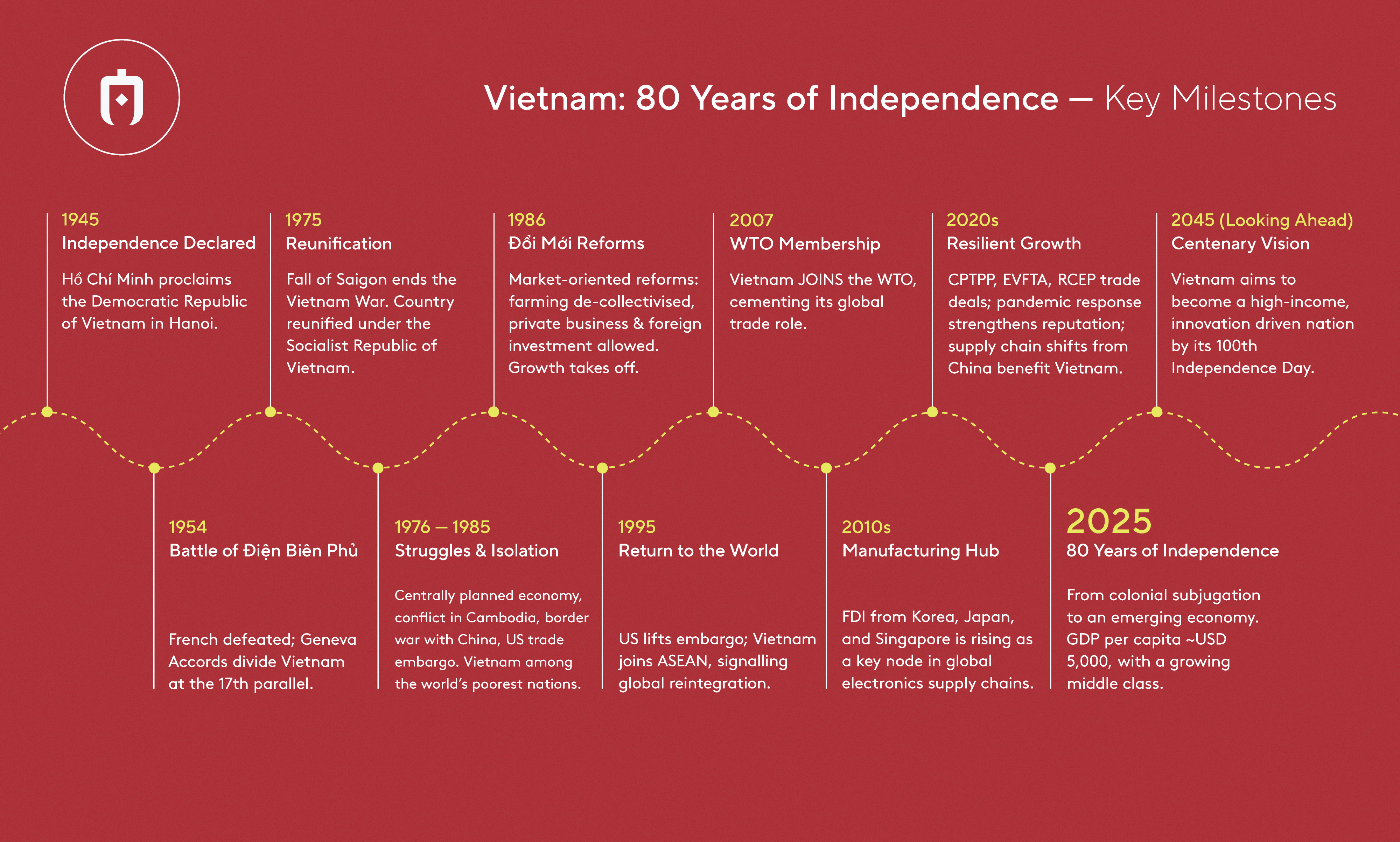
This success is not accidental. It has been built on decades of reform, from Đổi Mới in the 1980s to ongoing integration into global trade agreements. Where there was once scarcity, there is now abundance. Where Vietnam was once dependent, it has become indispensable.
The Next Decade: From Volume to Value
Yet the real story is just beginning. The sheer volume of exports will not define Vietnam’s future in agriculture;, rather, value creation, sustainability, and innovation will propel it forward.
- Upgrading the value chain: Moving from raw exports to branded, processed, and traceable products will allow Vietnam to capture more of the consumer premium in global markets.
- Sustainability as necessity: Climate change is not an abstract challenge. The Mekong Delta — Vietnam’s rice bowl — is among the most climate-vulnerable regions in the world. Success in adaptation and resilience here will matter not only for Vietnam but for global food security.
- Technology and innovation: Digital platforms, precision agriculture, and biotechnology are already beginning to transform how Vietnamese farmers grow and how consumers trust what they eat.
Beyond agriculture, Vietnam’s economic story is diversifying. Manufacturing, services, and the digital economy are taking the lead. Yet agriculture remains a powerful symbol of national resilience — a reminder of how far the country has come and what it can still achieve.
An Investor’s Perspective: Why Vietnam Matters
For international investors, Vietnam’s story is both inspiring and pragmatic. It is a nation that has proven its ability to adapt, to reform, and to integrate with the world. Looking to the next decade, there are four reasons why Vietnam will remain at the forefront of opportunity:
- Stability and resilience
Vietnam offers a rare combination of political stability, strong social fabric, and commitment to global trade partnerships. These factors anchor long-term investment confidence.
- Demographics and consumption
A rising middle class — expected to reach more than 50% of the population by the 2030s — will drive demand for higher-quality food, healthcare, housing, and lifestyle goods. Domestic consumption is becoming as important as exports.
- Green and sustainable growth
As Vietnam commits to net-zero by 2050, opportunities are emerging in renewable energy, sustainable agriculture, water management, and green logistics. These align with global capital flows seeking impact alongside returns.
- Global integration
Vietnam’s role in supply chain realignments — particularly in Asia’s “China+1” strategy — is accelerating foreign direct investment. The country’s openness to free trade agreements makes it one of the most globally integrated economies in the region.
For investors, Vietnam represents not only growth, but also a chance to participate in one of the most remarkable national transformations of the 21st century.
Looking Forward: 80 Years and Beyond
Vietnam’s 80th Independence Day is more than a milestone. It is a moment to reflect on a nation that has risen from hunger to become a global supplier, and from poverty to prosperity.
If 1945 was the year of famine, and 2025 the year of global relevance, then 2035 could be the year Vietnam emerges as a model of sustainable growth. A country that balances its agricultural heritage with technological innovation, its manufacturing strength with environmental stewardship, and its cultural resilience with global ambition.
For Vietnam, independence has never been a static achievement — it has been a living, evolving project. For investors, the lesson is clear: the next decade is not just about witnessing Vietnam’s rise, but about engaging with it.
From famine to feast, from survival to sustainability, Vietnam embodies the power of resilience and renewal. The journey of the last 80 years offers a powerful reminder: Vietnam is not just rising — it is shaping the future.