


NB – this was written in August 2021
In the summer of 1990, I explored some of the mysteries of South America on a solo student jaunt around Venezuela and Peru. The trip yielded lasting memories.
In the steamy riverine jungles, beneath the tepuis, the massive flat-topped mountains of Venezuela’s Canaima national park that inspired Sir Arthur Conan Doyle’s ‘The Lost World’, and at the foot of the 979-meter-tall Angel Falls, I swapped Graham Greene’s ‘Brighton Rock’ with a young American traveler for ‘100 Years of Solitude’ and discovered Magical Realism in the pages of Gabriel Garcia Marquez’s imaginary Macondo — set in neighboring Colombia.
Peru was in an election year, amid hyperinflation and subject to random killings by the Sendero Luminoso “Shining Path” guerrillas. In a district on the outskirts of Lima I almost got arrested on a falsified drugs charge and narrowly avoided being an early star of ‘banged-up-abroad’. I then ran out of food on the five-day Inca Trail — a famous mountainous hike abandoned by tourists during the dark days of Shining Path — and had to scavenge leftovers from the few more well-heeled tourists’ plates on arrival at Machu Picchu. A few weeks later, and running out of money, I borrowed $100 from another traveler to hire a plane to view the curious geoglyphs (motifs) drawn in the Nazca Desert.
These youthful discoveries didn’t stop on my return to the UK. After I had paid off my travelling debts, I was intrigued enough to invest in the growth of South America and bought my first Investment Trust: The Latin American Investment Trust. The share price of the newly launched trust was about $1, and I poured a significant part of my student loan into it. By the time I sold the trust — just last month (in 2021), after more than 30 years — it was paying a 5% annual dividend and had risen by more than 500 per cent in value. It was a fun part of a portfolio and helped contribute to the cost of my children’s university fees.
I have found investment trusts to be a fantastic way to invest in otherwise remote geographies of interest. Typically closed-ended (meaning the number of shares is fixed, and once listed investors can buy and sell the shares on the stock market), they are a vehicle that gives easy access to investors who want fund management specialists to build and curate a portfolio of investments in companies in a specific sector, region, or country. Over the years I have bought many closed-end investment trusts in a personal capacity. In a professional capacity, I am one of two executive directors of the investment manager for Vietnam Holding Limited (LSE: VNH) a closed-end UK investment trust focused exclusively on Vietnam.
One of the ‘features’ of most investment trusts is that they can trade at a discount to the prevailing Net Asset Value of the underlying investments (though some do trade at premiums). These discounts vary, but they can be as wide as 30% (even higher in times of distress) and as low as single digits for some trusts. According to Andrew McHattie, author of “Investment Trusts: A Complete Guide”, the average discount for investment trusts is 5.8%* (now, closer to 15%). The reasons for discounts vary. Sometimes there is a concern that the underlying investments are illiquid, and therefore cannot be realised at the value of all the underlying equities. Sometimes there is a concern over governance of the investment trust — after all, these are companies with the power invested in the boards of directors to make decisions on behalf of the shareholders — or that risk exists due to the nature and style of the investment manager appointed by the board to carry out the investment strategy on behalf of the company. Usually, however, discounts exist due to imbalances in the supply and demand for the investment trust’s shares, despite what is happening at the underlying ‘asset’ level.
Boards of investment trusts have hard and soft measures to try and control the discount. One common soft measure is through share-buybacks when the investment trust purchases its own shares on the open market and cancels them, taking up some selling demand and creating an increased net asset value per share. This action is accretive to the performance of the fund on a per-share basis as you end up with the same net asset value of investments but with a smaller number of shares. Another measure is using Tender Offers, where the board, with shareholder approval, offers to buy back a certain percentage of the investment trust’s shares from participating shareholders at a price closer to the Net Asset Value than the prevailing share price.
When you have an interesting investment geography, an active local stock market with high-growth companies, an experienced investment manager, and a qualified and independent board, you might expect discounts to be low, but that’s not always the case. For example, discounts persist across all three London-listed Vietnam-focused investment trusts, despite Vietnam being one of the world’s best-performing stock markets and despite all three funds posting positive returns of between 46% and 92% over the last twelve months (see chart below).
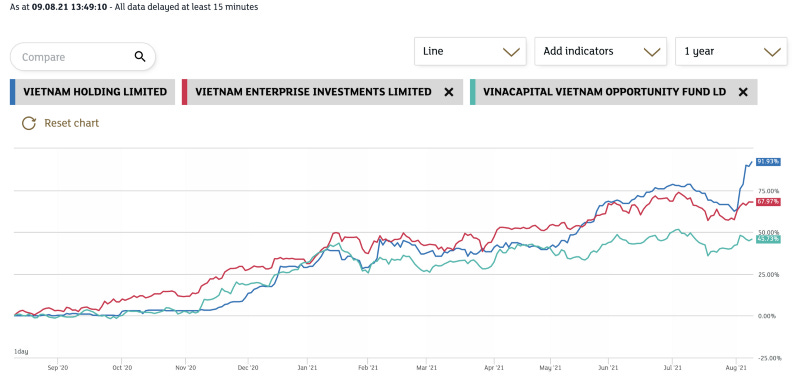
Last week, Vietnam Holding’s board announced a tender offer for 30% of the investment trust’s shares, at a discount of 2% to the Net Asset Value on 31st August. Shareholders who were on the register on the 2nd of August have until 26th August to vote for the tender and to tender their shares. Although the board recommends that investors vote for the tender, they cannot advise individual investors on what to do. It was interesting to see an article in the Investors Chronicle last week, written by the much-followed Simon Thompson, who said that the tender was good for shareholders. Vietnam Holding had already generated ‘eye-catching returns’ for investors during the year.
I recently bought the first edition of Andrew McHattie’s Introduction to the World of Investment Trusts as a graduation gift for my children, whose education in part has been funded by such investment trusts. I hope that they, like me, find them a source of adventure and long-term financial return.
Important Note: This article was written in August 2021, and a lot has happened in the past five years. I still hold Vietnam Holding (LSE: VNH) in my own portfolio. Now, as then, this is not investment advice. Investment Trusts can be an interesting part of a diversified portfolio, but the fun is in the research. Go and explore.