


- Social Moats is Key: AI dramatically reduces game development costs and timelines, making casual titles vulnerable. However, it fails to replicate the deep social relationships, obligation loops, and player networks that protect franchises like Honor of Kings.
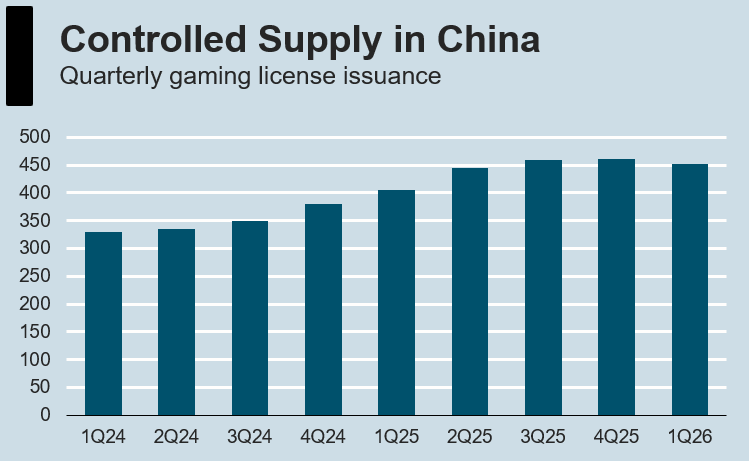
- Regulatory Insulation via the Banhao System: China’s game license system creates an artificial ceiling on total supply, mitigating the risk of an flood of AI-generated titles and acts as a barrier to entry that favors established incumbents like Tencent and NetEase.
- Winners and Losers: Large-cap platforms capture AI cost efficiencies while remaining shielded by distribution and regulatory moats. Conversely, per-seat SaaS engines (Unity), mid-tier studios lacking proprietary IP, and outsourced QA/art providers face challenges.
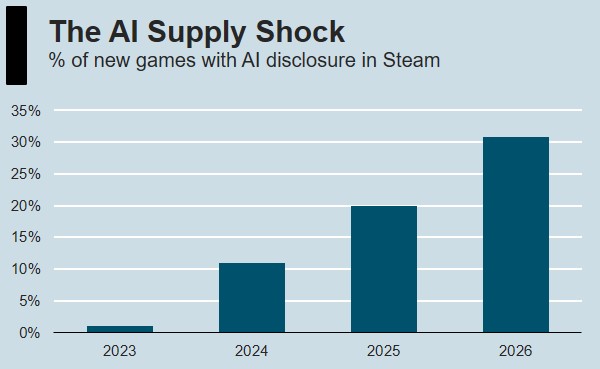
OpenAI’s latest GPT-6 Astra model marks a structural inflection point for the gaming industry. It can generate a full game in minutes. Many users were posting playable 3D games built from voice prompts shortly after launch.
AI’s disruption to the gaming sector is not entirely new. In the 2026 State of the Game Industry survey, over 52% of respondents stated that generative AI is having a negative impact on the industry.
The key question is how significant the disruption will be. Specifically, will it exert the same deflationary pressure seen across enterprise software markets like SAP, Oracle, and Adobe?
The Production Cost Collapse
AI is collapsing the cost of creating a game.
GPT-6 Astra can generate a playable grey-box prototype from a text prompt and iterate on it via conversational feedback. Playco, a cloud gaming studio that partnered with OpenAI on early testing, reported that Astra cut prototyping time and reduced manual fixes by 50% compared to their previous workflow.
In China, 37 Interactive Entertainment (002255.SZ) developed its mini-game “Moonlight Palace” using AI in 10 days, compared to roughly a month under a traditional pipeline. NetEase (9999 HK) uses proprietary AI models to improve R&D efficiency by roughly 30%; task-script generation in Justice Online fell from two weeks to three days.
At the individual developer level, costs collapse even further. Two office workers with no coding experience built an “Internet simulation game” entirely with AI tools in seven days, attracting over 50,000 page views on launch day. Another near-fully AI-generated title, Cell Defense, took sixty hours to make and reached 10,000 downloads.
Gaming Industry Cost Spectrum
| Game tier | Cost | Time |
|---|---|---|
| AI-generated mini-games | under $3K | 7–14 days |
| Casual & 2D Mobile Games | $20K–$80K | 2–4 months |
| Mid-tier AA games | $1M–$10M | 18–36 months |
| High-End Independent (“Triple-I”) Games | $10M–$30M | 3–4 years |
| Cross-Platform Gacha & Mid-Core Mobile Games | $30M–$100M | 2–4 years |
| Flagship AAA Franchise Games | $150M–$300M+ | 5+ years |
| Persistent Live-Service & UGC Ecosystems | $500M+ | Continuous (5–10+ yrs) |
Which Games Are Most Threatened by AI?
Not all games are equally exposed. The impact depends entirely on the game’s core value proposition:
Casual games are vulnerable: The production barrier is now essentially zero. About 80% of Douyin’s new casual titles are AI-assisted and produced in two weeks at a cost of roughly $1K.
Titles with strong IP and deep social engagement are the least disrupted: Franchises like GTA, Zelda, and Call of Duty carry established IP that AI cannot fabricate. MMOs, competitive team games, and live-service titles derive value from interpersonal relationships: guilds, rivalries, and shared history. Tencent’s Honor of Kings has remained the top-grossing mobile game for years because its social fabric is woven directly into WeChat. AI cannot replicate the social ties that keep players logging in.
Single-player narrative games occupy the middle ground: AI accelerates asset creation and world-building, but narrative coherence, pacing, and emotional design still require human direction. The likely outcome is compression rather than wholesale replacement: smaller teams and faster shipping cycles.
AI compresses the asset and code production layer, not the social or operational layer. The more a title relies on community relationships and cultural accumulation, the more resilient it remains.
The Social Layer: Where AI Hits a Wall
AI can generate content; it cannot generate relationships.
Tencent’s WeChat reaches 1.4 billion MAU. Its mini-game platform has engaged 2.5 billion cumulative users. Its flagship title, Honor of Kings, averages 233 million daily sessions, with retention anchored by social mechanics.
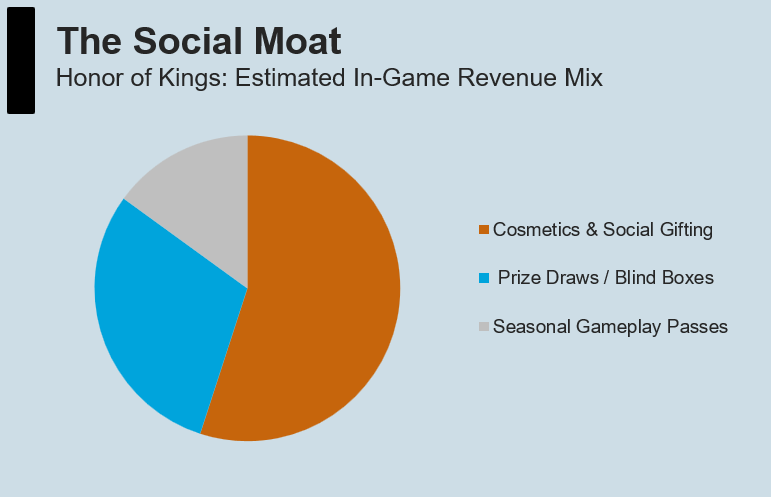
Social validation: Honor of Kings operates a monetisation model driven by social validation rather than gameplay advantages or pay-to-win mechanics. The vast majority of its revenue comes from character skins and cosmetic enhancements. Gifting skins to friends is a cultural behaviour rooted in WeChat’s community, where the skin’s value reflects the real-world relationship.
Ranked social status displays: The leaderboard and ranking systems create a visible social hierarchy within friend groups. When opening WeChat, users immediately see which friends are online, their competitive tiers, and their win rates. Status disparity (“My colleague is Diamond rank while I am still Platinum”) drives engagement and spend independent of underlying gameplay quality.
Guild obligation loops: Daily tasks, party queues, and competitive leagues establish obligation structures that ensure recurring log-ins. The social friction of inactivity (letting down teammates, losing guild standing) often outweighs pure entertainment value.

The Mini-Game Amplification
Social mechanics drive organic acquisition and retention. Snipe Aliens, a casual mini-game, saw daily active users jump from 100K to over 1M after introducing peer-challenge mechanics, with roughly 40% of returning users acquired via social fission.
AI cannot fabricate social obligations or switching costs measured in real-world relationships. When personal identities and peer groups are anchored inside WeChat, churning from a game is a social sacrifice, not a software preference.
Discord/Xbox/PlayStation: Similar features, different integration
The Western gaming ecosystem has comparable features. Discord has guilds with voice channels and role hierarchies; Xbox and PlayStation have leaderboards and achievement systems; Fortnite has in-game gifting. The features exist. The integration does not.
In WeChat, the social graph and game distribution are the same entity, and the same app holds your messages and daily activity. A friend who receives a gifted skin is the same person you message every morning.
On Discord, you gift a skin to someone you chat with inside Discord, but you socialise with other friends via WhatsApp. The social layer is fragmented across apps, and each fragmentation point leaks intent. It cannot replicate the ambient social pressure of seeing a friend’s rank alongside their messages and daily activity inside the same app.
Roblox is an exception. It integrates gaming and social features in one platform. But its social graph is built around UGC creation, not a social network that spans daily life.
The Catch: China’s Banhao System
China’s domestic market diverges sharply from global open distribution.
Every game monetised in China requires an official publication licence (banhao). Without it, in-app purchases and commercial distribution remain illegal.
The National Press and Publication Administration (NPPA) has maintained a steady cadence of roughly 350–450 game licences issued per quarter. This regulatory quota acts as an artificial ceiling on total market supply, dampening the threat of an AI-driven title flood. Furthermore, regulators have tightened scrutiny on AI-generated content, adding evaluation layers that dilute AI’s speed advantage.
Incumbent’s strategy: Owning the Stack
Incumbents are not waiting to be disrupted; they are operationalising AI across the value chain:
Model Layer: Tencent’s proprietary HunYuan 3D engine creates an ecosystem of developers building on its infrastructure. DeepSeek integrations into Peacekeeper Elite and Honor of Kings power dynamic bot squads and complex NPC behaviours.
Development Layer: Prototyping cycles that previously took weeks now conclude in hours, allowing rapid internal testing.
Distribution Layer: WeChat’s recommendation engine leverages deep behavioural signals from game engagement (play duration, peer interactions, spending velocity) to deliver personalised feeds. This fuels a compounding loop: more user data yields superior algorithmic matching, which drives engagement and captures further data. As a result, games with strong social mechanics see 30–50% of registered users arriving through social channels (card titles hit 70–80%).
Winners and Losers
Chinese Large-Cap Platforms (Tencent, NetEase) — Structural winners: Tencent controls distribution and the social moat via WeChat; NetEase commands strong IP (Fantasy Westward Journey, Justice Online) with proprietary AI engines. Both operate behind the banhao moat, capturing the cost benefits of AI production while remaining insulated from an influx of AI games.
UGC platforms (Roblox, Minecraft) — The community moat. Similar to Tencent, both enjoy strong user communities. Roblox (RBLX US) and Minecraft function as virtual places driven by peer presence rather than gameplay alone. AI cannot fabricate shared player histories or genuine social networks. Having said that, their social integration is not as strong as Tencent’s. WeChat is part of daily life and gaming rides on top of it. Roblox and Minecraft only hold the friendship layer inside a game. Friends can move to another platform when a better one appears.
AAA franchises with strong IP and platform lock-in (GTA, CoD, Fortnite, etc) — Safe near term. Strong IP, console exclusivity, and subscription lock-in (Game Pass, PS Plus) protect them today. AI cannot fabricate decades of brand equity, nor established multiplayer social graphs.
The long-term challenge is that AAA publishers remain trapped in multi-year development cycles large capex. As generative AI allows leaner, mid-tier competitors to deliver 80% of AAA visual fidelity at a fraction of the cost and time, consumer willingness to pay upfront erodes.
Game engines (Unity, Unreal) — The Monetisation Divergence
While frontier AI models still rely on runtimes like Unity (U US) and Unreal for physics, collision, and real-time rendering, their monetisation models create a sharp divergence:
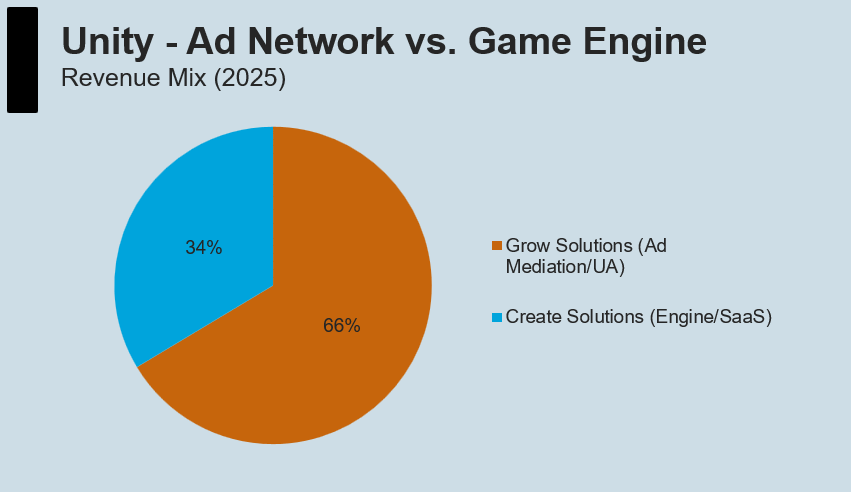
- Unity: Monetises engine access through per-seat SaaS subscriptions, exposing it to structural seat contraction as AI shrinks development team sizes. This is partially offset downstream, where the flood of AI-generated casual titles could drive ad-bidding volume into its ad-mediation segment.
- Unreal: It charges a royalty on gross revenue rather than billing by seat, making it defensive against AI impact.
Small and mid-tier studios — The Squeezed Middle. No owned distribution, no regulatory or social shielding. Their major edge was being cheaper and faster than AAA games. AI takes that away first. In addition, as more AI-generated games flooding the market, they might become more difficult to acquire new users without sizable marketing budgets.
Outsourced service providers (Winking Studios (WKS SG), Pole To Win (3657 TKO), Technicolor Creative Studios) — Structural risk. Their business relies on supporting large publishers in bug testing (QA), language translation, and 3D art design. AI models can now perform these functions for minimal cost. Major publishers might bring these automated tasks in-house, putting pressure on billable hours and profit margins.
This article is a “periodical publication” for information only and is not investment advice or a solicitation to buy or sell securities. This article does not constitute a “personal recommendation” or “investment advice” under UK FCA regulations. Investing in equities involves significant risk. The author holds NO position in the securities mentioned. There is no warranty as to completeness or correctness. Please do your own due diligence or consult a licensed financial adviser. Please read the Full Disclaimer before acting on any information. Images created with the assistance of AI.
Article provided by Asia Pulse.