


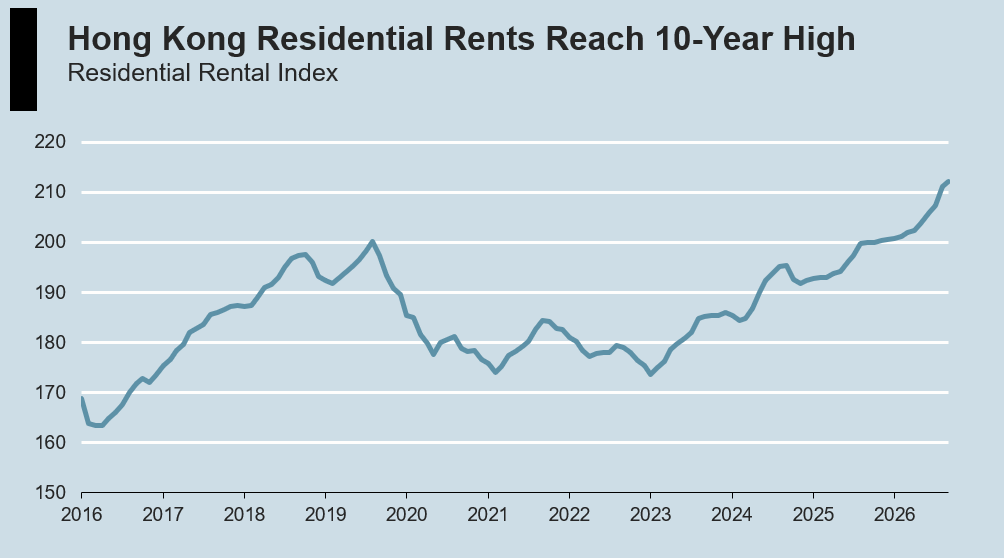
- Decoupled from China property: Hong Kong’s rental index is at 10-year high driven by over 300,000 mainland talent arrivals and rising non-local higher education students without halls. Resilient GDP growth and a robust IPO market are supporting financial-sector incomes, prime office, and mid-to-high-end residential.
- Supply is contracting: Private completions peak at 24,300 units in 2024 and will drop to 12,600 per year over 2027-36, about 30% below the historical average.
- Positioning for the Turnaround: The market turnaround offers targeted opportunities across large-cap developers and operators converting underutilised commercial real estate into high-yield student accommodation.
For the past few years, investors have heavily underweighted Chinese real estate amid a prolonged downturn. By extension, many bypassed Hong Kong property altogether, dismissing it as a proxy for the mainland crisis.
The data tells a completely different story.
Hong Kong’s residential rental index has surged 22% since 2023, surpassing its 2019 peak to reach a 10-year high.
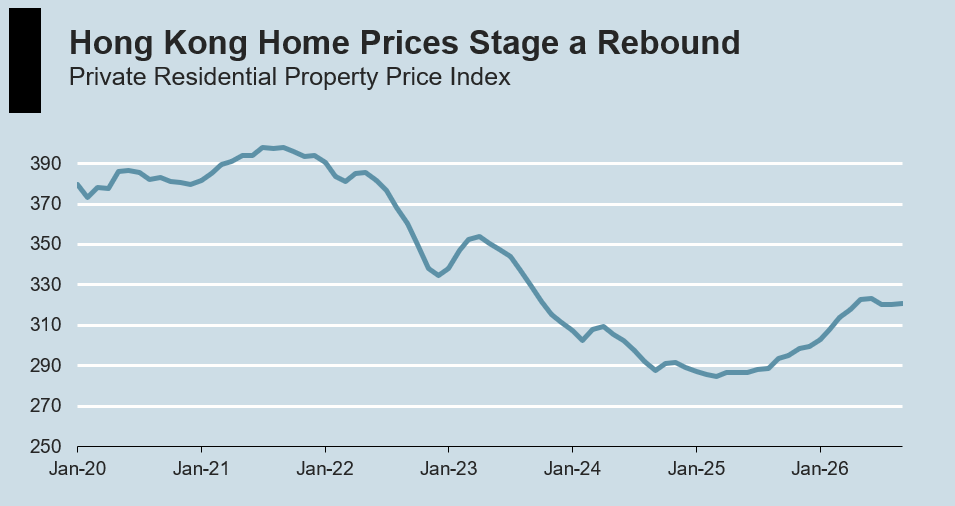
Home prices have also staged a turnaround since mid-2025, halting a 3.5-year slump that began in 2022.
While commercial office and retail rents remain soft, the residential segment has quietly decoupled from broader China sentiment.
The Demand Tailwinds
The residential rental surge is supported by two primary demand drivers:
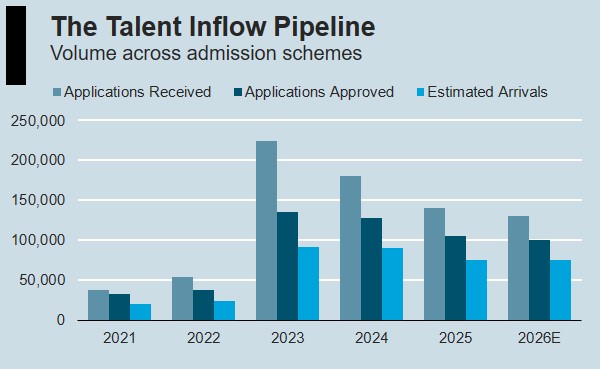
The Talent Influx: The Hong Kong government has launched various talent initiatives to attract mainland professionals to work and live in Hong Kong in recent years. These schemes have recorded over 450,000 approvals and 300,000 arrivals, with more than 50,000 approvals granted in the first half of 2026 alone.
Among these schemes, the largest is Top Talent Pass Scheme (TTPS) introduced in Dec 2022. The TTPS alone has achieved over 150,000 applications, 120,000 approvals, and 100,000 arrivals.
Jones Lang LaSalle estimates that 70% of holders rent rather than buy, leading to about 12,000 units of net annual leasing demand.
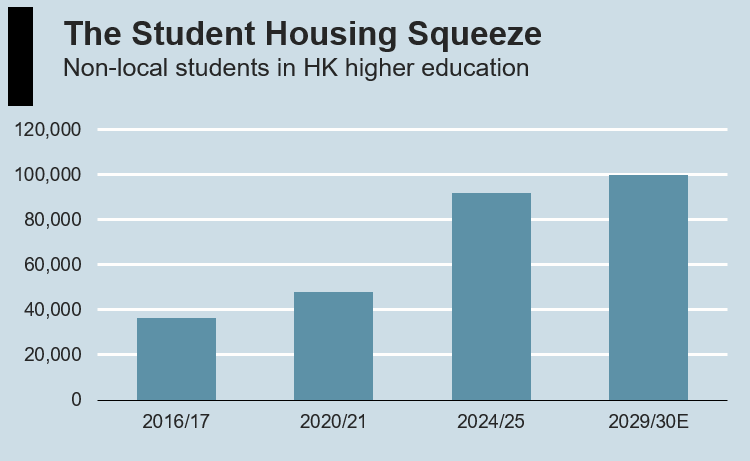
The Student Pipeline: Non-local student enrolment across Hong Kong’s higher education institutions surged from 48,000 in 2020/21 to roughly 92,000 in 2024/25, nearly doubling in four years.
Under the government’s five-year action agenda to develop an international education hub, non-local enrolment is targeted to reach 100,000 by 2029/30 across three dedicated university towns.
As dormitory capacity has lagged enrolment growth, roughly 65% of these students enter the private market, generating structural demand for approximately 2,300 private flats per year by government’s estimates.
The Supply Squeeze
Demand is accelerating but the private supply pipeline is contracting
Over the past decade, private residential completions averaged roughly 18,000 units annually. After peaking at 24,300 units in 2024, annual completions are projected to ease to around 17,000 in 2026 due to reduced land supplies in recent years.
Long-term supply is set to decline further.
Under the government’s 10-year Long Term Housing Strategy, it targets 420,000 total housing units and a 70:30 public-to-private ratio. Private supply will be about 126,000 units over the next decade, or 12,600 units per year, roughly 30% below the 18,000-unit historical average.
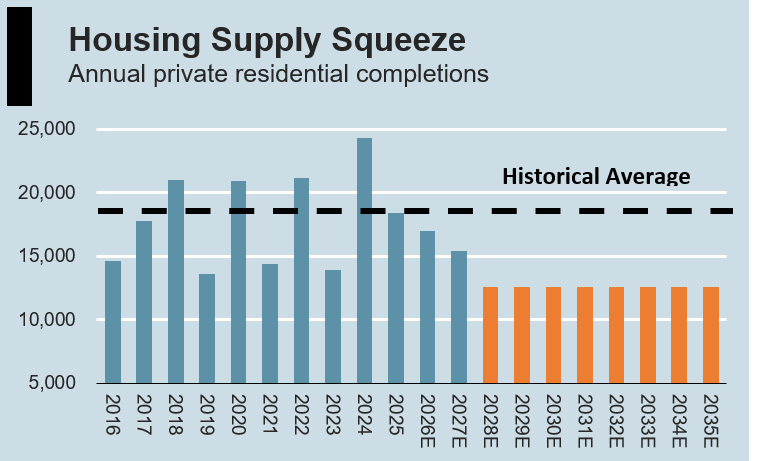
Sources: Rating and Valuation Department, Housing Bureau, AP
Macro Resilience and Capital Markets
The economic backdrop has reinforced the physical market:
GDP expanded by 5.9%, 4.2%, and 5.2% year-on-year in 1Q26, 2Q26, and 3Q26 respectively, prompting the government to upgrade its full-year growth forecast to 3.5–4.5% vs 2.5-3.5% previously.
Growth has been driven by strong exports (merchandise exports grew 65% in Sept, driven by AI-related electronics), stable unemployment, and low inflation.
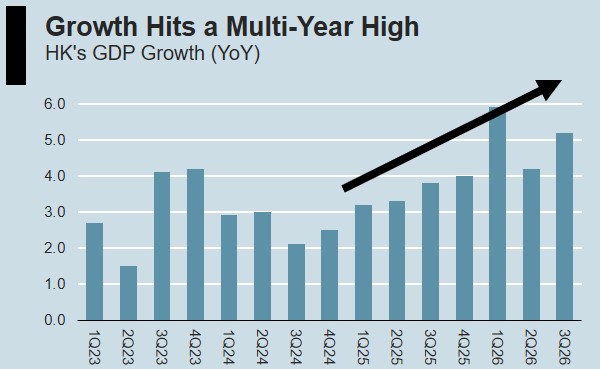
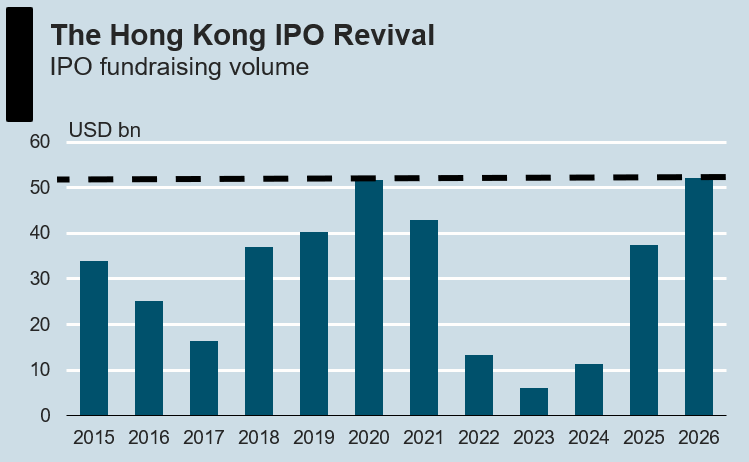
Capital markets have rebounded sharply, with the Hong Kong IPO market raising USD 52bn in 2026 YTD, surpassing the 2020 record of USD 51.6bn. Supported by major listings in artificial intelligence, semiconductors, and advanced technology, the robust IPO pipeline bolsters financial sector incomes, underpinning prime office rents and the mid-to-high-end residential segment
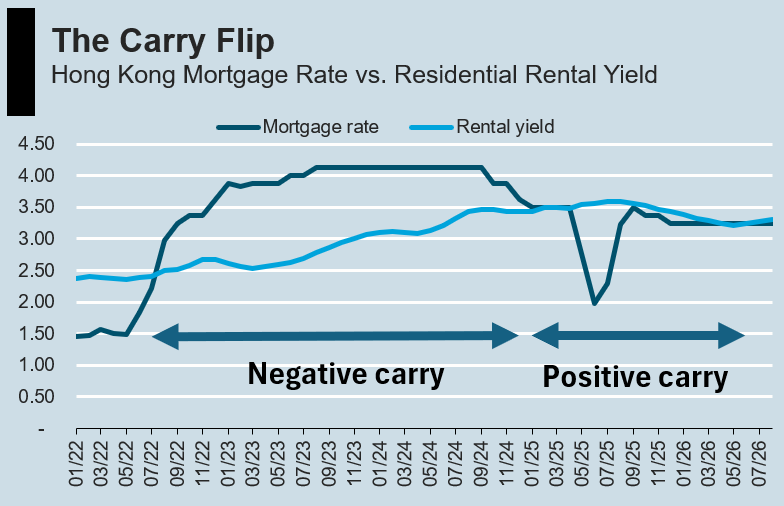
The Carry Flip
The monetary cycle has shifted from a headwind into a tailwind:
2022–2024 (The Negative Carry): Under the Linked Exchange Rate System, HKD interest rates tracked the Federal Reserve’s 11 consecutive rate hikes during the period. Mortgage rates spiked faster than rental yields, widening the negative carry to a trough of −1.4 percentage points in mid-2023, making renting substantially cheaper than owning.
2025–2026 (The Positive Carry): As the Fed commenced its easing cycle in late 2024, Hong Kong mortgage rates declined. Falling borrowing costs alongside climbing rental yields have pushed net residential carry back into positive territory, shifting the equation back in favour of home purchases and supporting asset values.
The Catch: Tightened Enforcement on Offshore Wealth
On the flip side, Beijing has stepped up enforcement of worldwide taxation on mainland residents’ offshore earnings and assets.
Chinese tax authorities have expanded compliance checks using Common Reporting Standard (CRS) data, directly contacting high-net-worth individuals to self-declare offshore personal income. In addition, new tax guidelines introduced in mid-2026 targeted offshore trust structures with a 20% income tax.
For mainland investors holding Hong Kong real estate, the implications are as follows:
While Hong Kong imposes no local capital gains tax, mainland tax residents are legally liable for taxes on both overseas rental incomes and realised capital gains.
Historically, cross-border enforcement on residential property assets was limited. However, as policies tighten, any aggressive enforcement on offshore property holdings could dampen cross-border capital flows and weigh on mid-to-luxury housing sentiment.
Positioning for the Turnaround: From Developers to PBSA
The market turnaround offers targeted opportunities across large-cap developers and operators converting underutilised commercial real estate into high-yield student accommodation.
Large-Cap Residential Developers: Hong Kong’s top-tier developers including CK Asset (1113), Sun Hung Kai Properties (16.HK), Sino Land (83.HK), and Henderson Land (12.HK) offer direct exposure to the Hong Kong residential property market. Having said that, their business mix (residential/commercial), landbank portfolio, and development pipeline shape how each captures the residential turnaround differently.
Purpose-Built Student Accommodation (PBSA) & Conversions: The strong student housing demand has prompted various players into this emerging market.
- China Merchants Commercial REIT (1503.HK): Operates the dedicated CM+U brand; running CM+U Tsim Sha Tsui at full occupancy and recently acquired CM+U Hung Hom for HK$528.5 million within walking distance of PolyU and HKMU.
- Far East Consortium International (0035.HK): Demonstrates an asset-light conversion business model. It recently sold the 268-room former Silka Seaview Hotel in Yau Ma Tei for HK$750mn to JD.com for conversion into student accommodation, while retaining a three-year management agreement.
- Wee Hur Holdings (SGX: E3B): The Singapore-listed group is building a 746-bed Hong Kong PBSA portfolio, comprising a 246-bed flagship (Starvia by Y Suites on Fortress Hill) and an office-to-student conversion in Tai Kok Tsui (~500 beds) targeted for completion in 1H28.
- CapitaLand Investment (SGX: 9CI): Reportedly acquired the former ibis Hong Kong Central & Sheung Wan Hotel for HK$2.3 billion with plans to convert the property into student apartments, highlighting international fund appetite for Hong Kong living assets.
This article is a “periodical publication” for information only and is not investment advice or a solicitation to buy or sell securities. This article does not constitute a “personal recommendation” or “investment advice” under UK FCA regulations. Investing in equities involves significant risk. The author holds NO position in the securities mentioned. There is no warranty as to completeness or correctness. Please do your own due diligence or consult a licensed financial adviser. Please read the Full Disclaimer before acting on any information. Images created with the assistance of AI.
Article provided by Asia Pulse.