
Toyota to invest $500m into Uber, shares rise

Toyota (TYO: 7203) has announced plans to invest $500 million (£387 million) in Uber.
Both firms view the deal as an opportunity to work on the “mass-production” of autonomous vehicles and catch up with rivals in the market.
“This agreement and investment marks an important milestone in our transformation to a mobility company as we help provide a path for safe and secure expansion of mobility services like ride-sharing,” said Shigeki Tomoyama, the executive vice president of Toyota.
“Uber’s advanced technology and Toyota’s commitment to safety and its renowned manufacturing prowess make this partnership a natural fit,” said Uber CEO Dara Khosrowshahi. “I look forward to seeing what our teams accomplish together.”
Uber, which will be valued at $72 billion despite the increaing losses, has scaled back on its ambitious autonomous vehicle driving tests following the fatal crash that killed a pedestrian.
Alphabet’s (NASDAQ: GOOG) Waymo has continued to develop their driverless car and appears to be steaming ahead.
The deal between Uber and the Japanese vehicle manufacturer will ease pressure off of Uber, who is reportedly spending between $1-2 million into its autonomy work every single day.
The deal will appease Uber’s investors as the group prepares to go into public next year.
Gill Pratt, Toyota Research Institute CEO, said: “Uber’s automated driving system and Toyota’s guardian system will independently monitor the vehicle environment and real-time situation, enhancing overall vehicle safety for both the automated driver and the vehicle.”
On Monday, Uber announced plans to focus more on its electric scooter and bike business and less on cars, despite the fact it would hurt short-term profits.
Shares in Toyota spiked at the news. They are currently trading up 0.86 percent at 7.026 (0821GMT).
US and Mexico reach preliminary Nafta deal
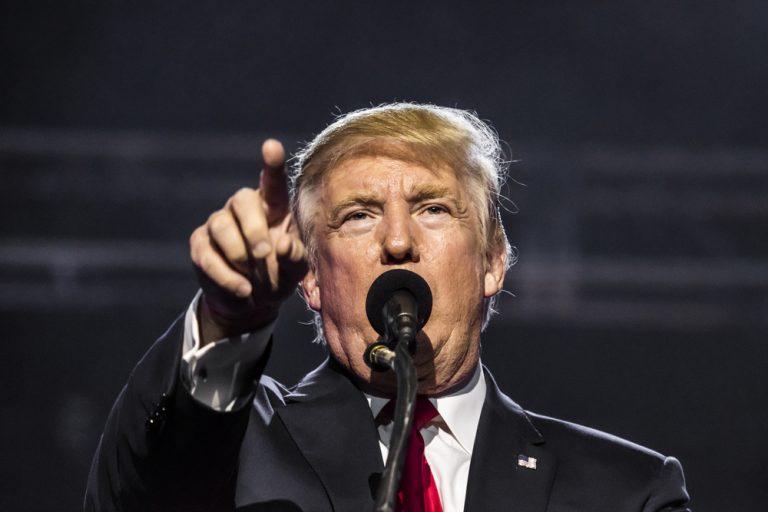
The US and Mexico have reached a preliminary agreement that resolves key bilateral trade issues.
Donald Trump said on Monday that both countries will be entering into a new trade deal called the United States-Mexico trade agreement.
“They used to call it Nafta,” said the US President. “We’re going to call it the United States Mexico Trade Agreement,” adding that the term Nafta had “a bad connotation” for the US.
The preliminary agreement excludes Canada, will need sign-off from the third country in the treaty.
Trump has long criticised the existing agreement and has demanded renegotiations of the 1994 agreement over the past year.
No details of the new deal have yet emerged but are expected to be shared shortly in a news conference.
A spokesman for Canadian Foreign Minister Chrystia Freeland has said that Canada will continue to work toward an agreement and is in contact with trading partners.
“We will only sign a new NAFTA that is good for Canada and good for the middle class. Canada’s signature is required,” said a spokesman in an email.
outgoing Mexican President, Enrique Peña Nieto, said that he has also spoken to Canadian prime minister, Justin Trudeau and that they are working toward a three-way agreement by the end of this week.
“I expressed the importance of his reinstatement in the process,” said Nieto said. “In order to conclude a trilateral negotiation this week.”
“It is our wish, Mr. President, that now Canada will also be able to be incorporated in all this,” Nieto added through a translator. “I assume that they are going to carry out negotiations of the sensitive bilateral issues between Canada and the United States.”
On Monday morning, Trump tweeted, “A big deal looking good with Mexico!”German industry chief warns against no-deal Brexit
A German industry chief has warned against the dangers of a no-deal Brexit.
Joachim Lang, the head of the Federation of German Industries (BDI), has said that many businesses in Germany are hoping for the UK to reverse its decision on leaving the EU.
“The risk of a hard [no-deal] Brexit is growing by the day. Every business would do well to prepare for this worst-case scenario,” he said in an interview with the Rheinische Post newspaper.
“What’s new is that the British government itself is now warning about the possibility of a hard Brexit It is carefully preparing its population for that.”
“We suspect that the effects of a hard Brexit will be considerably more serious than the British government is currently telling its citizens. And above all, in Britain itself. The British have already gone from a growth engine to the worst performers in Europe,” Lang added.
When asked about whether the UK should have a second referendum on the Brexit vote, Lang said: “Voters voted for Brexit, that should be respected. But it would save a lot of businesspeople sleepless nights if the British stayed in the EU.”
“[Britain is] an exceptionally liberal and market-orientated country. We would like to continue with them as a partner in the EU. That’s why many in [German] industry want the British to reconsider leaving. Whether that’s realistic or romantic is another kettle of fish. We’re telling our businesses: prepare for the worst, and hope that it turns out better,” he added.
The UK however, remains confident.
A Downing Street spokeswoman said: “We have always said the United Kingdom would continue to thrive in the event of a no-deal Brexit.”
“But we are confident of getting a good deal – one that delivers for every part of the United Kingdom and takes back control of our money, laws and our borders. That is what this government will deliver,” the spokesperson added.
Bushveld Minerals set to benefit from higher Vanadium price
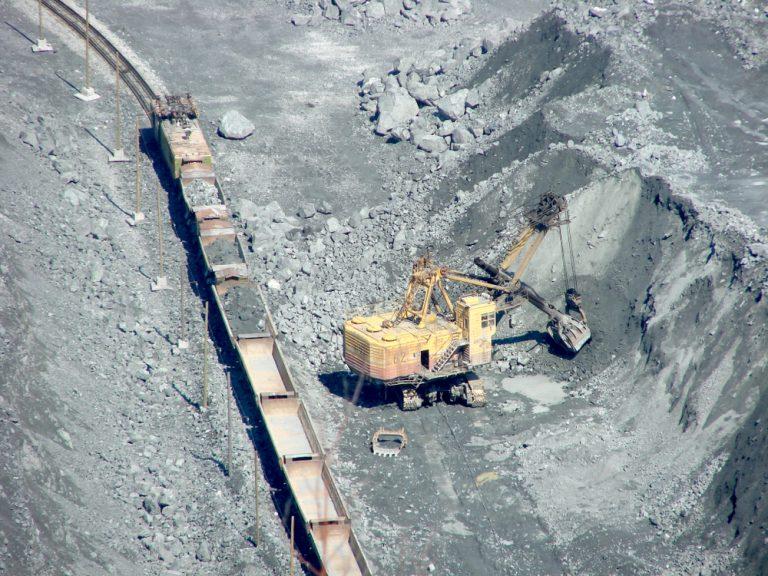
Bushveld Minerals (LON:BMN) is set to benefit from a higher average Vanadium price when it reports half year results in the coming months.
Ferro-Vanadium price are up over 150% in the past year as recorded by the Metal Bulletin which is set to boost revenue achieved from Bushveld’s Vametco mine in South Africa.
Vanadium is used in alloys with engineering applications due to its durability. More recently has been applied to power storage as a possible alternative to Lithium, presenting the potential for significant demand in the coming years.
In a recent Operational Update the mining company said total production guidance for the year had been lowered to 2,850 and 3,000 mtV. Despite the lowering of guided production, the higher end of this range would represent a 13% jump on 2017 production.
In addition to the forecast 13% jump on last year’s output, the firm has said it see’s production increasing to an annualised production rate of 3,750 mtV in the coming months.
The potential for higher production rates given this year’s exponential rally in Vanadium prices sets Bushveld up for a sharp increase in revenue in the next market update.
 CEO Fortune Mojapelo said of the recent progress:
 CEO Fortune Mojapelo said of the recent progress:
“Bushveld Vametco’s operating performance during the first six months under Bushveld Minerals control and a new management team has benefitted from a rising vanadium price resulting in significantly higher profit margins relative to the first half of 2017.”
“I am pleased to see the completion of Phase Two of the Vametco multi-phased expansion project, which was successfully completed on time and within budget, bringing Vametco’s annual production run rate to 3,750 mtV. The slower than expected ramp up to this production capacity has been disappointing contributing to the revised production guidance. Notwithstanding the 2018 production guidance revision, we remain confident that the Company’s expansion efforts remain on track to grow Vametco’s production capacity to 5,000 mtV per annum to further strengthen our competitive position in a favourable market environment.
“Meanwhile, we are very pleased with the recent positive drilling results at the Brits Vanadium Project, which has shown similar mineralisation to Vametco with vanadium grades in magnetite of 1.54-2.09% V2O5.”
Broker targets
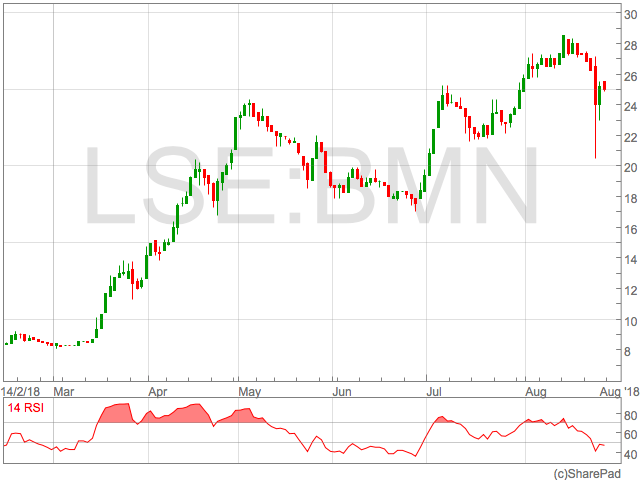
Broker SP Angel have a 30.5p price target on Bushveld Minerals having recently lowered it from 33.6p following the latest operational update in which production guidance was lowered. SP Angel’s price target represents a potential 22.4% upside from the closing price 24th August 2018.Uber to focus on bikes and scooters, despite short-term loss
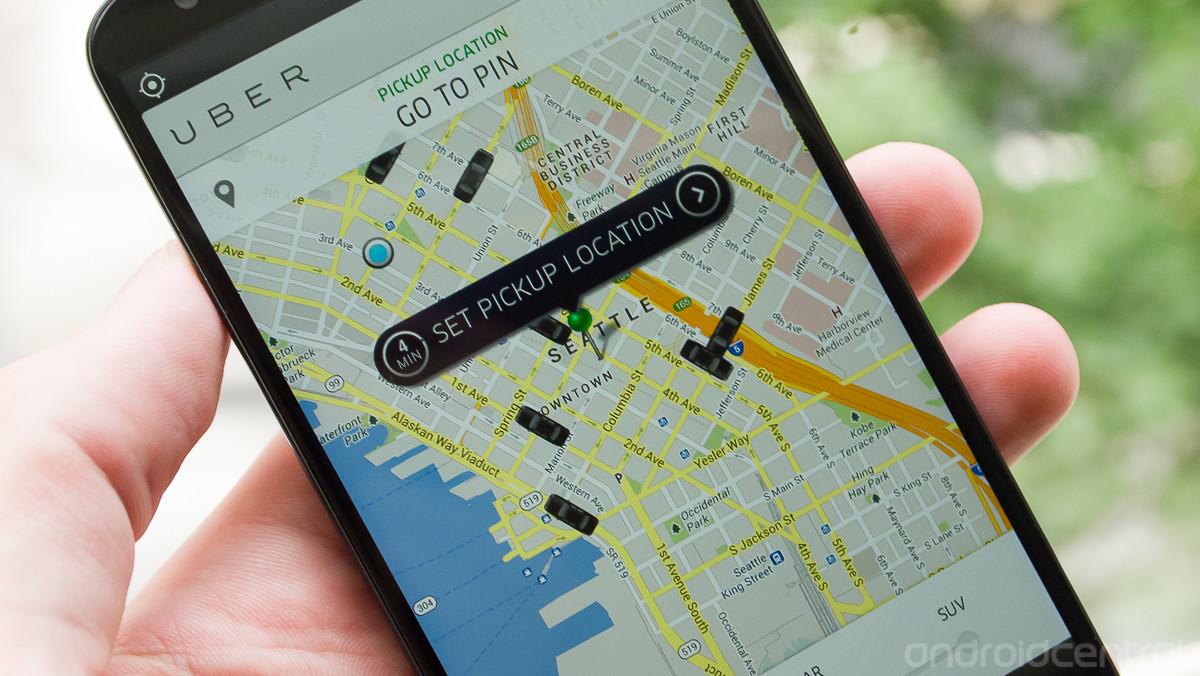
Uber has announced plans to focus on its electric scooter and bike business over cars.
The taxi app’s chief executive, Dara Khosrowshahi, told the Financial Times that individual modes of transport are more suited to inner-city travel.
“During rush hour, it is very inefficient for a one-ton hulk of metal to take one person 10 blocks,” he said.
“Short-term financially, maybe it’s not a win for us, but strategically long term we think that is exactly where we want to head.”
The Uber boss admitted that the move would lead to a short-term loss for the company.
The group lost $4.5 billion (£3.5 billion) last year and plans to go public in 2019.
Khosrowshahi said that whilst Uber will make less money from a bike ride compared to car journey, he expects the cost to be offset by customers using the app for bike journeys much more frequently.
“I’ve found in my career that engagement over the long term wins wars and sometimes it’s worth it to lose battles in order to win wars.”
Uber has invested in a number of bike firms over the last year including Jump electric bikes, which are available in US cities including New York and Washington.
The group acquired Jump bikes in April for $200 million (£155 million).
“We’re committed to bringing together multiple modes of transportation within the Uber app – so that you can choose the fastest or most affordable way to get where you’re going, whether that’s in an Uber, on a bike, on the subway, or more,” said Khosrowshahi at the time.
The bike-sharing market is growing by an estimated 20 percent a year and by 2020 is expected to be worth between €3.6 billion (£3.1 billion) and €5.3 billion.
In June, Westminster overturned a ban on Uber and granted a 15-month licence to operate in the capital.
Tesla is “better off as a public company”, says Musk

Elon Musk has said he will no longer be taking Tesla private after current investors have persuaded him to keep the electric car company as a listed business.
The founder of the electric car company wrote in a post published on the company’s site that the plan was cancelled and “given the feedback, it’s apparent that most of Tesla’s existing shareholders believe we are better off as a public company”.
“Earlier this month, I announced that I was considering taking Tesla private. As part of the process, it was important to understand whether our current investors believed this would be a good strategic move and whether they would want to participate in a private Tesla,” he wrote.
“Our investors are extremely important to me. Almost all have stuck with us from the time we went public in 2010 when we had no cars in production and only a vision of what we wanted to be. They believe strongly in our mission to advance sustainable energy and care deeply about our success,” added Musk.
It was only earlier this month that Musk announced on Twitter that he had acquired the funding to take Tesla private at a value of $72 billion (£57 billion).
Following the shock announcement, it was soon revealed Musk had not closed a deal with Saudi Arabia’s sovereign wealth fund and the founder had investors start a series of lawsuits against him.
Shares in the group increased following Musk’s tweet about taking Tesla private, however, have continued to fall since then.
Shares in the group continued to fall following Musk’s interview to the New York Times, where he said he was working 120 hour weeks and barely leaving the office whilst having to take sedatives.
Shares in the group (NASDAQ: TSLA) are currently trading up 0.85 percent at 322,82 (0959GMT).
Wonga explores options as short-term lender is ‘on the brink of collapse’
A report by Sky News has suggested that payday lender Wonga is on the brink of collapse.
Following a surge in compensation claims against the firm, the short-term lender has called upon the accountancy firm Grant Thornton to handle the possible administration of the group.
The decision for Wonga to appointment administrators comes just weeks following the report revealing an emergency £10 million cash injection to keep it afloat.
A spokesman said at the time that the firm was facing “a marked increase in claims related to legacy loans, driven principally by claims management company activity”.
A Wonga spokesman said: “Wonga recently raised £10m from existing shareholders to address the significant increase in legacy loan complaints seen across the UK short-term credit industry.
“Since then, the number of complaints related to UK loans taken out before the current management team joined in 2014 has accelerated further, driven by claims management company activity.
“Against this claims backdrop, the Wonga board continues to assess all options regarding the future of the group and all of its entities.”
If the short-term lender is to fall into administration it will mark a huge difference from where they were stood five years ago, when the group one of the fastest-growing financial companies in the UK.
Executives from the group are understood to have been in talks with the Financial Conduct Authority in order to discuss the company’s options.
The FCA introduced a cap on the cost of credit in 2014. This was seen to be responsible for pushing smaller payday firms out of the market.
In 2014, the FCA ordered Wonga to pay £2.6 million to compensate the 45,000 customers.
According to Sky, the short-term lender is exploring the possibility of a pre-pack administration process that was similar to the one used recently by the House of Fraser.
FTSE 100 Housebuilders fall on EU migrant statistics

FTSE 100 homebuilders Berkeley Group Holdings (LON:BKG), Taylor Wimpey (LON:TW), Barratt Developments (LON:BDEV) and Persimmon (LON:PSN) fell sharply on Friday morning after statistics revealed the number of EU workers entering the UK labor force fell.
A reduction in EU workers provides a headache for homebuilders who have been relying on skilled migrant workers to drive forward record completions to meet demand supported by the governments Help to Buy scheme.
Costs have been rising in the industry for sometime now and have squeezed margins despite higher average sales prices.
With recent data showing house prices in the UK are now set in a downtrend having fallen for five consecutive months, house builders face the perfect storm of falling sales prices and rising costs.
This would confirm fears from Berkeley Groups CEO who highlighted the dependency on EU workers in their recent final results.
Berkeley CEO Robin Perrrins said: “Looking forward, we remain concerned that the impact of recognised skills gap in the UK construction workforce may become more pronounced as the UK exits the European Union. While this is hard to predict, it is a fact that over half of London’s site labour comes from the EU. This needs to be addressed by a combination of continued access to EU labour, skills training and innovation in construction if the industry is to achieve its medium term production aspirations.”
London house prices have been particularly heavily hit with some areas seeing falls in the region of 15%-20%.
Shares in Persimmon, Barratt Developments, Berkeley Group and Taylor Wimpey were down between 1%-2%.
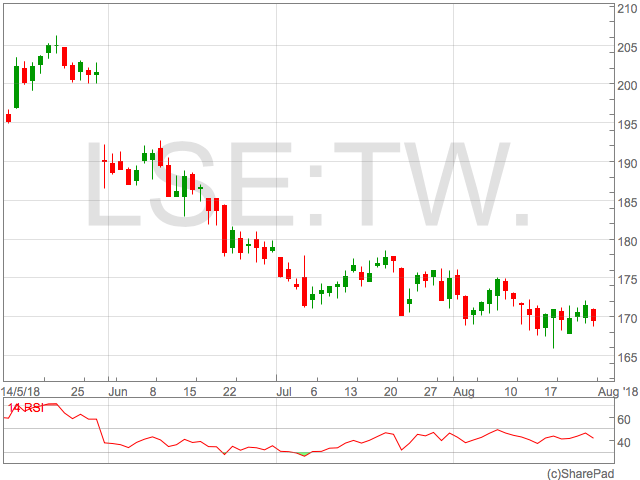 Shares in Persimmon, Barratt Developments, Berkeley Group and Taylor Wimpey were down between 1%-2%.
 Bayer shares plunge as lawsuits reach 8,000

Monsanto, the agro-chemicals company, is facing a surge in lawsuits that could cost parent company Bayer (ETR: BAYN) billions in damages.
The number of US lawsuits against the company has jumped to an estimated 8,000 over the alleged cancer risks of the group’s glyphosate-based weedkillers.
Chief executive Werner Baumann said that at the time of acquisition, Bayer “could not foresee the scope of the current lawsuits.”
The deal was worth $63 billion completed earlier this month.
“In the course of the acquisition, we carried out due diligence as is standard practice when taking over a listed company. In doing so, we of course also considered the legal risks,” he said.
“The number of plaintiffs in both state and federal litigation is approximately 8,000 as of end-July. These numbers may rise or fall over time but our view is that the number is not indicative of the merits of the plaintiffs’ cases,” he added in a conference call on Thursday.
Last month the group lost $289 million (£225 million) to a court case where its products Roundup and RangerPro had led to a man’s terminal cancer.
Shares in the group have lost 11 percent since it lost this case over the groundskeeper Dewayne Johnson. Shares in Bayer fell a further 1.7 percent on Thursday.
Liam Condon, head of Bayer’s Crop Science division said: “Nothing whatsoever has changed in the regulatory status of the product. There is simply very high demand, and has been for many decades, for glyphosate. It is an invaluable tool for growers.”
Scientifically, the opinion is divided. The US Environmental Protection Agency concluded last year that that glyphosate is not likely to be carcinogenic to humans.
The World Health Organization classified glyphosate as “probably carcinogenic to humans,” in 2015.
Ryanair to introduce new restrictions on cabin luggage

Ryanair (LON: RYA) has announced plans to tighten rules on what passengers are allowed to bring onto aircrafts.
According to the airline, the scheme that allows people to hand in their smaller cases in the hold for free at the boarding gate is causing delays.
From November, Ryanair will charge passengers for 10kg cases to be taken onto the plane, with a small suitcase still allowed free of charge.
“This new policy will speed up the boarding and cut flight delays. 60 percent of customers will be unaffected by these changes and we expect that the other 40 percent will either choose to buy priority boarding or a 10kg check bag, or will choose to travel with only one free small bag,” said Kenny Jacobs, Ryanair’s chief marketing officer.
Ryanair has said that most of its customers will not be affected by the bag policy change. According to the airline, 30 percent of travellers have already bought priority boarding and another 30 percent already travel with only one small carry-on bag.
The airline insists that the move is not about making money but intends to “improve punctuality and reduce boarding gate delays”.
This is the second time in a year that the airline has altered its cabin luggage policy.
The first change that was introduced in January saw small carry-on cases taken at the gate and put in the aircraft hold for free. Only those with priority boarding were able to put cases in the cabin’s overhead lockers.
The move was accepted with equanimity but did not solve delays at the gate.
From November, if passengers arrive at the boarding gate with a carry on bag that is over 20 litres but haven’t paid for the priority boarding status, the bag will be placed in the hold and passengers will be charged £25.
Shares in the group are trading down 1.12 percent at 13,72 (0857GMT).