Share Tip: Harworth Group trading update preview

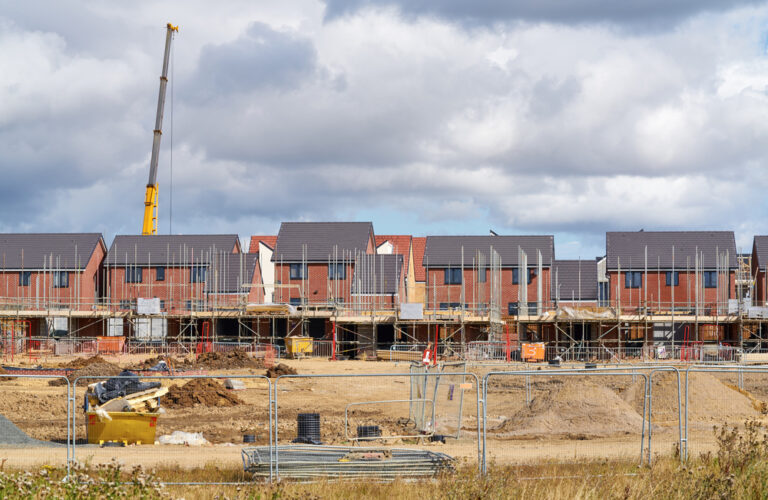
This group is a leading sustainable regenerator of land and property for development and investment which owns, develops and manages a portfolio of over 14,000 acres of land on over 100 sites located throughout the North of England and Midlands.  
Harworth Group (LON:HWG) specialises in the regeneration of large, complex sites, in particular former industrial sites, into new Industrial & Logistics and Residential developments to create sustainable places where people want to live and work, supporting new homes, jobs and communities across the regions and delivering long-term valu...

The crucial role of e-waste recycling in ensuring a sustainable future

The extraction of critical minerals for clean energy technologies and electronic devices presents significant environmental challenges for our planet. For example, extracting a single ounce of gold can generate up to 20 tons of waste rock and tailings, often containing hazardous chemicals like cyanide and mercury used in processing. 

Similarly, platinum and palladium mining, essential for catalytic converters and electronics, also involves highly energy-intensive processes.

This blog post dives into the environmental costs of mining, sheds light on the different types of waste it generates, and highlights how recycling electronic waste or otherwise commonly known as e-waste, could significantly reduce our reliance on mining for new materials.

Environmental impact of critical mineral mining

Governments worldwide have identified critical materials essential for national security and economic stability, developing official lists of these materials to prioritise domestic production or sourcing through allied nations. These lists, such as the US Critical Minerals List (2022) and the UK Critical Minerals Strategy (2021), include key materials like lithium, cobalt, rare earth elements, and copper. 

However, there are only two ways to source these critical materials: mining and recycling.

When it comes to mining, the environmental costs are both vast and varied, leaving an indelible mark on our planet and future generations. Extracting critical minerals essential for modern technologies requires moving mountains – literally. 

Now, to put this in perspective, producing just one kilogramme of gold—the amount needed to manufacture approximately 100,000 mobile phones—requires processing a staggering 3 million kilogrammes of mineral ore. That’s the equivalent of moving the weight of 750 fully loaded garbage trucks just to extract enough gold for a fraction of the devices we use daily

The impact begins with the land itself. Vast swathes of forests and ecosystems are cleared to make way for open-pit mines, resulting in habitat destruction and the fragmentation of wildlife corridors. In fact, studies show that 8% of invertebrate species are threatened by mining activities, as disrupted ecosystems ripple far beyond the immediate excavation sites.

Then there’s the water. Mining operations often pollute local waterways through acid mine drainage, a chemical reaction that occurs when exposed sulphide minerals produce sulphuric acid. This toxic runoff dissolves heavy metals, poisoning rivers and groundwater for decades, if not centuries, after the mines have shut down.

Air quality isn’t spared either. Dust from excavation and ore crushing fills the air, while smelting and refining processes release a cocktail of pollutants. For workers and nearby communities, this can mean increased risks of respiratory diseases and other health complications.

The role of e-waste recycling in reducing mining impact

This is where recycling comes in. 

Recycling, specifically e-waste recycling offers a promising pathway to reduce the environmental burden of critical mineral extraction. Through urban mining – the process of recovering valuable materials from discarded electronic devices – we can significantly decrease the need for primary mineral extraction and mitigate its devastating environmental impacts. What’s more, the intrinsic properties of recycled materials remain undiminished, providing our finite resources with an undeniable and sustainable second life.

According to the Global E-Waste Monitor 2024, e-waste recycling has prevented the need to extract approximately 900 billion kilogrammes of ore through traditional mining methods. This reduction in mining activity equates to avoiding an estimated 52 billion kilogrammes of CO₂-equivalent emissions, a significant step toward addressing the environmental challenges of critical mineral sourcing. The majority of these savings stem from the recovery of copper (50%), followed by gold (20%) and iron (10%).

Moreover, e-waste recycling helps curtail the release of hazardous substances into the environment. Unmanaged e-waste currently emits 58 thousand kilogrammes of mercury and approximately 45 million kilogrammes of plastics containing brominated flame retardants annually. By implementing advanced recycling systems, these toxic materials can be safely captured and repurposed, preventing their harmful effects on ecosystems.

“The numbers speak volumes,” says Peter Lai, Founder and CEO of Majestic Corporation. “Every kilogramme of e-waste recycled is a step toward mitigating the environmental destruction caused by traditional mining. Recycling is not just about resource recovery – it’s about rewriting the rules for how we sustain our planet.”

The environmental damage wrought by critical mineral mining – deforestation, water pollution, and air quality degradation – demands urgent action. E-waste recycling by companies like Majestic Corporation (AQSE:MCJ) offers a tangible solution by reducing the demand for primary mineral extraction while simultaneously addressing the challenges posed by unmanaged e-waste.

Please view the article on Majestic Corporation’s website here.

Sources:

https://api.globalewaste.org/publications/file/297/Global-E-waste-Monitor-2024.pdf

https://iea.blob.core.windows.net/assets/3af7fda6-8fd9-46b7-bede-395f7f8f9943/RecyclingofCriticalMinerals.pdf

https://www.cam.ac.uk/research/news/thousands-of-birds-and-fish-threatened-by-mining-for-clean-energy-transition#:~:text=New%20research%20has%20found%20that,drilling%20for%20oil%20and%20gas.

https://www.cell.com/action/showPdf?pii=S0960-9822%2824%2900895-9

Broadening applications in the fight against sodium overconsumption with MicroSalt

The UK Investor Magazine was delighted to welcome Rick Guiney, CEO of MicroSalt, back to the podcast to review the low-sodium salt company’s progress in 2024 and outline what investors can expect in 2025.

We start with a review of the progress the company made in 2024 following MicroSalt’s IPO in February 2024. 

Rick provides an overview of recent developments, including the launch of ‘MicroSalt Premium’ and the inroads the company is making with new applications, including French fries, in the fast food industry.

We conclude with a rundown of what investors have to look forward to in the year ahead.

HarbourVest Global Private Equity records fifth consecutive month of positive net cash flow as M&A activity picks up

HarbourVest Global Private Equity’s monthly NAV update revealed strong underlying exit activity across their portfolio in December, bolstering the cash pool available for share buybacks.

The HarbourVest Global Private Equity (HVPE) Investment Trust provides public market investors with exposure to private equity through four key stages of valuation creation: Commitments, Investment, Growth, and Realisation. It is the last of these stages, the realisation of investments, that saw a big uptick in December, underpinning the current value in the trust’s share price.

HVPE reported a 0.9% decrease in its estimated Net Asset Value (NAV) per share to $52.38 in December, primarily due to unfavourable foreign exchange movements and declines in its Fund of Funds portfolio.

Despite the monthly dip, the company’s long-term performance remains strong, with a 10-year NAV growth rate of 13% annually and a total return of 233% over the same period. The share price has delivered a 13% return in sterling terms over the past year.

Realisation activity showed robust momentum in December, with the company receiving $89 million in distributions, more than double November’s figure. The company reported 43 exit transactions, significantly above the 12-month average of 33, indicating healthy market conditions. Of the 43 transactions in December, 42 were M&A, and one was an IPO.

There is a large disconnect between the underlying performance of the HVPE portfolio and the current share price, which is represented by a substantial share price discount to NAV some investors will see as an opportunity.

HVPE continues its active share buyback programme, deploying $15 million in December alone. Since launching its Distribution Pool mechanism in February 2024, the company has repurchased over $90 million worth of shares, adding 1.4% to NAV per share.

Total buybacks since September 2022 have reached $148 million, contributing a 3.1% increase to NAV per share.

HVPE’s Distribution Pool balance stood at $52.2 million at year-end, with the board indicating continued deployment for share buybacks in an effort to reduce the current share price discount to NAV.

As the Distribution Pool programme approaches its first anniversary, the board is actively engaging with shareholders to evaluate its effectiveness in managing the company’s discount to NAV.

Premier African Minerals completes interim fundraising after recent failure

After failing to secure the required amount during a recent attempt at a fundraise, Premier African Minerals has completed a much smaller placing at a much lower level. The amount raised is being seen as ‘interim’ financing, and the company will need to explore other options.

Premier African Minerals has secured £540,000 through a subscription of 2.7 billion new ordinary shares at 0.02p per share. Today’s placing follows a botched attempt to raise £3.5m last week to complete the necessary work at their lithium plant to meet the terms of a financially crippling offtake agreement.

Shareholders seem to be turning their backs on Premier African Minerals.

The company is in ongoing discussions with its prepayment and offtake partner, who recently reaffirmed their commitment to the Zulu project on 20 January. Premier is working to resolve any remaining uncertainties with this partner and continues to maintain essential operations at the Zulu Lithium and Tantalum project.

However, the company notes that this funding round is a temporary measure and does not fully meet the group’s immediate financial needs. This would suggest the next placing could be substantially lower than 0.02p if they were unable to secure the required amount at this level, and the cash raised today will do little more than keep the lights on.

“This subscription will provide working capital to both support essential operational requirements at Zulu and also allow an initial start to the infrastructure and other associated requirements for the installation of the additional float cells and assist in plant readiness for the limited test run that has been planned,” said George Roach, CEO.

“I would also like to take this opportunity to confirm that the planned management and board changes discussed in our previous announcements are expected to proceed and a further announcement in this regard will be made at the appropriate time.”

AIM movers: GENinCode reimbursement news and Revolution Beauty disappoints

1

GENinCode (LON: GENI) says that its heart disease risk assessment product CARDIO inCode is included in the US 2025 Clinical Lab Fee Schedule enabling reimbursement from Medicare and Medicaid. The price varies from $450-$570. It is also being used to prevent heart disease in Catalonia. The share price jumped 122.7% to 7.125p.

Empyrean Energy (LON: EME) has completed the acquisition of an option to participate in the Wilson River project. The share price soared 43.8% to 0.115p.

Rental housing and student accommodation developer Watkin Jones (LON: WJG) reported better than expected 2023-24 pre-tax profit of £9.2m, following the previous year’s loss. The new Refresh business generated initial revenues, and this could be a bigger opportunity than originally anticipated. Institutional investment should recover when interest rates fall. Net cash rose to £83.4m despite a £16m cash outflow for cladding remediation work provided for in the accounts previously. The share price recovered 22.5% to 24.3p.

Floorcoverings supplier Airea (LON: AIEA) had a much better second half growing by 6% and full year revenues were 0.6% ahead at £21.2m. International sales were still lower in 2024 despite a 11.8% increase in the second half. Inventory levels have been reduced. There will be non-recurring costs. The equipment is expected to be installed in the new manufacturing facility during the second quarter. An investment property worth £4.1m is still up for sale. David and Monique Newlands increased their shareholding from 11.1% to 12.4%. The share price improved 17.5% to 23.5p.

Mindflair (LON: MFAI) investee company Sure Valley Ventures has made a £1.5m investment in Vizgard, which is an AI company involved in distributed solutions for defence and public safety applications. Mindflair has also clarified the condition for the third tranche of options issued to director Nicholas Lee. This requires the share price to be above 4p for five consecutive days for the options to vest. The share price rose 16.7% to 1.225p.

FALLERS

Quantum Blockchain Technologies (LON: QBT) has raised £2m at 1.15p/share so that it can invest in its Bitcoin mining technology. Last week, it announced a breakthrough for its Bitcoin Artificial Intelligence model mining tool. The Method C AI Oracle provides a 30% improved performance compared with other methods. The company is seeking a chip manufacturing partner to produce a commercial product. The share price has lost 25.4% to 1.175p, but it is still 62% higher over the past week.

Revolution Beauty (LON: REVB) is having a poor fourth quarter to February 2025 with some retail launched delayed until the first quarter of 2025-26. This includes a launch in Walmart in the US. Online trading was also weaker than expected. Full year revenues are forecast to fall by one-quarter to £143.6m and a profit is no longer expected. A £1.6m loss is likely. The 2025-26 pre-tax profit forecast has been more than halved from £5m to £2.4m. Net debt is set to stay around £25m. The share price declined 20.3% to 11.25p.

Despite the full year results being in line with expectations shares in electronic and electro-mechanical components supplier LPA Group (LON: LPA) have slipped 14.2% to 51.5p. Revenues were 8% higher at £23.5m and the pre-tax loss was £200,000, although a R&D tax credit meant that there was a post-tax profit. A complementary line of power supply products has been acquired. A 2024-25 pre-tax profit of £400,000. It will take time for the new chief executive Philo Daniel-Tran to influence the results.

AI-technology services provider Pri0r1ty Intelligence (LON: PR1) is forming a strategic partnership with Funding Circle, the small business loans provider. Pri0r1ty Intelligence clients will be provided access to loans of up to £750,000 via its platform. Pri0r1ty Intelligence will get an introducer commission of up to 6.5%. The share price fell a further 10.7% to 6.25p. The fundraising for the reversal of the business into the previously listed shell Alteration Earth was done at 13.5p.

Ex-dividends

Brickability (LON: BRCK) is paying an interim dividend of 1.12p/share and the share price is down 2p to 57.8p.

Elixirr International (LON: ELIX) is paying an interim dividend of 6.3p/share and the share price declined 9p to 721p.

Gooch & Housego (LON: GHH) is paying a final dividend of 8.3p/share and the share price fell 9p to 451p.

Origin Enterprises (LON: OGN) is paying a final dividend of 13.65 cents/share and the share price is unchanged at 272 cents.

Solid State (LON: SOLI) is paying an interim dividend of 0.83p/share and the share price is unchanged at 152.5p.

Tracsis (LON: TRCS) is paying a final dividend of 1.3p/share and the share price is unchanged at 432.5p.

M Winkworth (LON: WINK) is paying a dividend of 3.3p/share and the share price is unchanged at 200p.

FTSE 100 flat as AB Foods weighs

The FTSE 100 took a step back in early trade on Thursday as retail stocks weighed on the index and investors further assessed what Donald Trump could mean for stocks.

London’s flagship index was down six points at 8,538 on Thursday despite US markets hitting record highs overnight.

Markets globally are breathing a sigh of relief as it becomes increasingly clear Donald Trump’s campaign tactics and initial America First policies were designed to revive his popularity with his core base and may not necessarily result in actions that could send shock waves through the global economy.

Much of the action he has taken so far avoids meaningful economic consequences, and investors will hope campaign rhetoric around tariffs proves to be just that and his newly appointed advisors provide adequate counsel on the potential damage they may cause. 

That said, the new President is famously unpredictable, which is reflected in the marginal retreat for the FTSE 100 on Thursday. 

“Investors are still weighing Trump’s tariff talk, though history suggests his bark often echoes louder than his bite,” said Matt Britzman, senior equity analyst, Hargreaves Lansdown.

“Across Europe, markets have hit the pause button on their recent rally, with hopes pinned on further ECB rate cuts to keep the party going. Markets are getting wise to President Trump’s negotiation tactics, with investors gradually shrugging off his strong tariff rhetoric as a calculated bargaining ploy.

“This measured response helped the S&P 500 hit an all-time intraday high, though it failed to close at a new peak, fuelled by early earnings showing 6.4% profit growth and an 18.5% rise in revenue year-on-year. Tech stocks stole the spotlight, with standout performances in Semiconductors, Software, and the Mag 7 driving the Nasdaq higher, even as most sectors closed in the red.”

Corporate updates didn’t help the FTSE 100’s cause, with a soft update from AB Foods dragging the sector down.

AB Foods shares fell 2% after announcing slowing Primark sales amid a ‘challenging’ retail environment. The negativity seeped into the share prices of other retailers, including JD Sports, Marks & Spencer and Tesco, all of which fell on the day. JD Sports dropped 3% as it contends with problems similar to Primark’s.

Entain, dropping 4%, was the top faller after reports of a probe into its auditor. Intermediate Capital Group continued yesterday’s rally with a 1.6% rise.

Associated British Foods reports mixed performance amid UK retail challenges

Associated British Foods plc has reported its latest trading figures for the 16 weeks to 4 January 2025, revealing a challenging period for its UK retail operations despite growth in other markets. 

Slowing sales in AB Food’s retail business will be a cause for concern for investors given it accounts for around 45% of group revenue.

The group’s overall revenue declined by 2.2% at actual currency rates, though it showed a modest 0.5% increase at constant currency.

Primark, the group’s retail division, experienced a notable downturn in its UK and Irish markets, with sales falling by 4% and like-for-like sales dropping by 6.4% in the UK. This decline was attributed to cautious consumer sentiment and unusually mild autumn weather affecting seasonal purchases. However, the retail chain saw stronger performance during the Christmas period and continued success with its Click & Collect service, now available in 113 stores.

In contrast to UK performance, Primark demonstrated robust growth in other territories, particularly in Spain and Portugal where sales increased by 9%, and in the US which saw a 17% rise. The company’s expansion continues apace in America, where it now operates 29 stores with plans for further growth.

“Primark owner, Associated British Foods (ABF) enjoyed mixed trading this festive season, as revenue only edged slightly higher. Primark continues to be the main story, bringing in around half of the group’s revenue, but even here performance was varied across regions,” said Aarin Chiekrie, equity analyst, Hargreaves Lansdown.

“Weak consumer sentiment, a strong comparative period, and unfavourable weather were all blamed for keeping Christmas shoppers from flocking to its stores in the UK, which saw the group lose market share and like-for-like sales fall 6.4% on home soil. Primark’s international performance was much better though, more than offsetting this decline. That’s thanks to the group pressing ahead with its store rollout programme, opening seven new stores across the US and Europe over the period. Despite this, Primark’s full-year revenue guidance has been lowered slightly from mid single-digit to low single-digit growth.”

The group’s other divisions showed varying results. The Grocery segment achieved 1% growth, driven by strong international performance from brands such as Twinings and Ovaltine. The Ingredients division posted 4% growth, while the Sugar and Agriculture segments experienced declines of 2.1% and 4.1% respectively at constant currency.

AB Foods shares were down 2.4% at the time of writing.

The ‘total return kings’ revisited

Since we believe that fund manager ‘start of year outlooks’ are rarely of any use, we do not intend adding to the dozens that have already been published. Instead, our natural contrarian instincts inspire us to look backwards rather than forwards, so below we review what we were saying early last year and how it has turned out.

In one of our newsletter articles last year, called ‘The return of the total return kings’, we identified two catalysts that we thought could realise some of the significant levels of value that we observed in the UK equity market – corporate takeovers and share buybacks. So how did that work out?

1. Corporate takeovers

In the previous note, we stated the following:

“The relentless selling of UK equities has driven valuations to such low levels that overseas corporates have spotted an opportunity to acquire UK assets at prices that offer serious future return potential.”

Indeed, 2024 turned out to be a year in which UK plc had its ‘Barbarians at the gate’ moment1 as overseas corporate buyers and private equity firms took advantage of the low valuations of UK businesses created by the valuation-agnostic selling of UK equities. The trust benefited from this activity, with IDS and Direct Line being taken over, whilst Currys and Anglo American received approaches that they successfully rebuffed.

2. Share buybacks

In the same note, we demonstrated how firms consistently buying back lowly valued shares can create significant value through the case study of Next plc, highlighting how some of our current investments had the ability to replicate this (hence the title ‘The return of the total return kings’.)

Having urged many of the companies that we invest in to take advantage of their lowly valued shares, we were delighted to see many of them implement share buyback policies in 2024, often with considerable benefits to remaining shareholders. The biggest successes were NatWest and Barclays, which reduced their share count by 9% and 5% respectively and saw their share prices rise by 83% and 72%2.

Where does this leave us now?

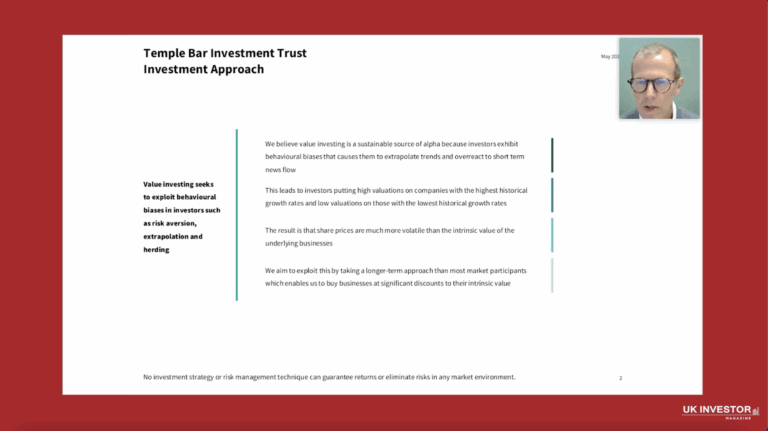
As previously mentioned, the share prices of several stocks in the trust portfolio rose considerably during 2024. Some were the result of bid activity, others were beneficiaries of consistent and sizeable share buybacks. This may prompt some investors to reflect on their strategy as we transition from one year to the next, but we believe this would be a mistake driven by a cognitive bias known as anchoring.

The anchoring effect is “a psychological phenomenon in which an individual’s judgments or decisions are influenced by a reference point or ‘anchor’ which can be completely irrelevant”.3 In one famous study by Amos Tversky and Daniel Kahneman4, participants were asked to estimate the percentage of African countries in the United Nations. Before estimating, the participants first observed a ‘wheel of fortune’ that was rigged to stop on either 10 or 65. Participants whose wheel stopped on 10 guessed lower values (25% lower on average) than participants whose wheel stopped at 65 (45% higher on average). Thus, their estimates were influenced or ‘anchored’ off a data point that had no relevance to what they were being asked to forecast.

Similarly in the stock market, investors tend to anchor off certain share prices which actually contain little information about the value of the stock they are analysing. Instead, we would argue that current valuations are a better guide to future returns than historic or current share prices.

Despite the strong performance seen in 2024, we believe the valuations of the shares in the Temple Bar portfolio are still at very attractive levels, as demonstrated in the table below. This, more than anything else, should give investors optimism about the future long-term returns that these stocks could deliver.

Conclusion

In a world in which many investors seem obsessed with the large US technology companies (colloquially known as ‘The Magnificent Seven’), it is worth noting that some of the Temple Bar portfolio holdings produced returns last year that were on a par with them. And yet, in contrast to the reassurance we find in the low PEs and high dividend yields evident in the portfolio, the high valuations of the Magnificent Seven stocks should give investors pause for thought about how sustainable these returns can be.

To conclude therefore, in looking back at the returns delivered in 2024, we find considerable fundamental reasons for confidence when looking at what the Temple Bar portfolio can deliver for shareholders in 2025 and beyond.


1 The phrase ‘Barbarians at the Gate’ originates from the title of a book by Bryan Burrough and John Helyar, chronicling the aggressive leveraged buyout of RJR Nabisco in the late 1980s – it is now regularly used to describe opportunistic corporate takeover activity.

2 Source: Bloomberg, 9 January 2025. Past performance is not a guide to the future.

3 Source: Wikipedia

4 Judgment under uncertainty: heuristics and biases, Tversky and Kahneman, 1974​


Past performance is not a guide to the future. The price of investments and the income from them may fall as well as rise and investors may not get back the full amount invested. Forecasts and estimates are based upon subjective assumptions about circumstances and events that may not yet have taken place and may never do so.

No investment strategy or risk management technique can guarantee returns or eliminate risks in any market environment. Nothing in this document should be construed as advice and is therefore not a recommendation to buy or sell shares. Information contained in this document should not be viewed as indicative of future results. The value of investments can go down as well as up.

This article is issued by RWC Asset Management LLP (Redwheel), in its capacity as the appointed portfolio manager to the Temple Bar Investment Trust Plc. Redwheel, is authorised and regulated by the UK Financial Conduct Authority and the US Securities and Exchange Commission.

Redwheel may act as investment manager or adviser, or otherwise provide services, to more than one product pursuing a similar investment strategy or focus to the product detailed in this document. Redwheel seeks to minimise any conflicts of interest, and endeavours to act at all times in accordance with its legal and regulatory obligations as well as its own policies and codes of conduct.

This document is directed only at professional, institutional, wholesale or qualified investors. The services provided by Redwheel are available only to such persons. It is not intended for distribution to and should not be relied on by any person who would qualify as a retail or individual investor in any jurisdiction or for distribution to, or use by, any person or entity in any jurisdiction where such distribution or use would be contrary to local law or regulation.

The information contained herein does not constitute: (i) a binding legal agreement; (ii) legal, regulatory, tax, accounting or other advice; (iii) an offer, recommendation or solicitation to buy or sell shares in any fund, security, commodity, financial instrument or derivative linked to, or otherwise included in a portfolio managed or advised by Redwheel; or (iv) an offer to enter into any other transaction whatsoever (each a Transaction). No representations and/or warranties are made that the information contained herein is either up to date and/or accurate and is not intended to be used or relied upon by any counterparty, investor or any other third party. Redwheel bears no responsibility for your investment research and/or investment decisions and you should consult your own lawyer, accountant, tax adviser or other professional adviser before entering into any Transaction.

THG shares drop despite revenue creeping higher on beauty strength

THG shares fell in early trade on Thursday as the company released only a very small increase in revenue driven by strength in the beauty division. Unfortunately, the nutrition business proved to be a major drag on the group’s overall performance.

THG Beauty delivered 4.6% growth in 2024, reaching £1.1bn in revenue. The division saw success across skincare, cosmetics and fragrances in the UK. Lookfantastic’s loyalty scheme grew to 2.8m members, with improved customer lifetime value. Notable achievements include becoming the first beauty retailer to partner with The White Company and strong performance during cyber sales periods.

Investors will be disappointed with the poor performance of THG Nutrition, with revenue declining 11.9% to £579.6m. While UK performance improved in Q4, Asian markets struggled due to currency fluctuations. However, offline sales grew 29% through licensing agreements and retail partnerships. The Myprotein brand maintains market leadership in the UK, ranking first in consumer loyalty and brand conversion.

Follwing the demerger of THG Ingenity, the sales of each business unit will be poured over investors for signs the company can produce attractive returns as an e-commerce business.

“There was plenty of excitement about its Ingenuity arm – seen as offering logistics solutions to third parties and compared to the out-of-box solution provided to global supermarkets by Ocado – whose star was very much in the ascendancy at the time. Now the Ingenuity arm has been spun off as a private entity, THG is being judged as a collection of beauty, health and nutrition e-commerce sites,” said AJ Bell investment director Russ Mould.

“There are no guarantees but if the company can start growing its revenue sustainably then it may in time be judged on its own merits and not on the unrealistic yardsticks in place at the time of its IPO.”

“Despite a fourth quarter drop in revenue these are actually performing OK – with the beauty side doing particularly well.”

THG expects mid-single digit revenue growth in 2025, supported by strong prestige beauty demand and anticipated recovery in Nutrition as whey prices normalise. The company aims to reduce capital expenditure to £20m annually and targets progression towards a neutral net cash position.

Investors were unimpressed and shares were down 8% at the time of writing.