


Aquis weekly movers: Board changes at Investment Evolution Credit

A purchase of 2,390 shares in Cooks Coffee Company (COOK) at 10p each pushed up the share price 7.14% to 8.5p.
Coinsilium Group Ltd (LON: COIN) has entered into a strategic advisory services agreement with Context Protocol, a Layer 1 blockchain designed to enable verified AI Domains for trusted data exchange. Coinsilium will provide guidance on tokenomics and market positioning. The share price improved 1.69% to 3p.
FALLERS
Shares in Inteliqo Ltd (LON: IQO) slumped 83.2%to 0.505p ahead of the company leaving Aquis on 14 March.
Richard Leaver has stepped down as chief executive of Investment Evolution Credit (LON: EC) and Paul Mathieson has returned to the position. Glendys Aquilera has replaced Bob Mennie as finance director. These management changes knocked 76% off the share price to 3p.
Trading in ChallengerX (LON: CXS) shares resumed after First Sentinel was reappointed as corporate adviser. The share price dived 37.5% to 0.25p. Shareholders have agreed to the acquisition of three gaming services and technology businesses and 510 million shares will be issued on completion which is likely to be 11 March. A fundraising has generated £83,000 at 0.2p/share and there is a commitment for a further £50,000. There have been 145.8 million shares to satisfy debt.
Marula Mining (LON: MARU) has signed an agency framework contract with Baosteel Resources South Africa, a subsidiary of the world’s largest steel producer, for purchase and sale of manganese from the Kilifi manganese plant in Kenya. The contract lasts five years and there will be an initial delivery of 5,000 tonnes of manganese ore by the end of April. From then on, the delivery will be 10,000 tonnes/month for 12-months and then increase the following year. The open pit mining operations have been extended at the Kinusi copper mine in Tanzania. The first copper sales are imminent. The share price declined 13.5% to 4p.
MaxRets Ventures (LON: MAX) shareholders have voted to leave the Aquis Stock Exchange on 18 March. That reduced the share price by 10% to 1.125p.
Max Capital Ltd no longer has any shares in WeCap (LON: WCAP) and Woodland Capital has taken a 3.7% stake. The share price slipped 9.3% to 0.975p.
Ananda Pharma (LON: ANA) chief executive Melissa Sturgess bought 20 million shares at 0.46p each. The share price dipped 5.94% to 0.475p.
EDX Medical (LON: EDX) has signed a master service agreement with The Royal Marsden NHS Foundation Trust, which includes an eminent cancer hospital. EDX Medical will supply diagnostics services to the NHS trust. The share price fell 3.77% to 12.75p.
Valereum (LON: VLRM) has still managed to complete the fundraising with Valereum Inc and an institutional investor. Completion was anticipated by 4 March. The share price edged down 2.38% to 20.5p.
Urban Logistics REIT enhancing earnings by buying manager

Logistics properties investor Urban Logistics REIT (LON: SHED) is internalising its management by acquiring the current asset manager Logistics Asset Management for an initial consideration of £6.8m in shares. This will reduce annual costs by £1.4m and enhance earnings.
Contingent consideration will be up to £5.6m and depends on the average closing share price for three months prior to the first anniversary of the acquisition. There will be 20% vesting if the price is 130p and this increases on a straight line basis with 100% vesting at 158p. The share issue would be based on a share price of 114.3p. The current share price is 115.4p, down 0.52%. The share price has risen 12.7% so far this year.
The company will consult with shareholders. A circular will be published, and the deal should be completed in the second quarter.
If full consideration is paid there will be a 1.28% increase in number of shares. The cost saving should add more than 3% to profit, so there is a net improvement in earnings per share. Panmure Liberum currently forecasts earnings of 7.8p/share in the year to March 2026. The NAV forecast is 160p/share at the end of March 2026. The dividend is forecast at 7.6p/share, which is a forecast yield of 6.6%.
AIM movers: APQ Global rises despite proposed AIM departure and Premier African secures interim funding

APQ Global (LON: APQ) is asking for shareholder agreement for its departure from AIM and unusually the share price jumped 83.3% to 0.55p. The book value was 17.9p/share at the end of November 2024. There have been five trades today with a total value of just over £230. Lack of liquidity and the cost of the quotation are the reasons for leaving. There are also plans to change the convertible unsecured loan notes settlement date to the end of 2025. The interest rate will increase from 6% to 10% between the end of March and the end of December 2025. The company is trying to refinance the £26m plus owed.
Investment manager AssetCo has been readmitted to AIM as River Global following a share reorganisation into A shares (LON: RVRG) and B shares (LON: RVRB). The A shares have the same rights as the previous ordinary shares. The B shares will receive dividends relating to the 30% stake in Parmenion Capital Partners or capital distributions if the business is sold. The B share is 36.5p, a notional increase of 25.9%, while the A share is deemed to be one-third lower at 7p. So, the overall improvement is around 10%.
Avacta (LON: AVCT) says its lead peptide drug conjugate (PDC) AVA6000 has completed phase 1a dose escalation with encouraging data in patients with salivary gland cancers. There were no observed events of severe cardiac toxicity. Enrolment in phase 1b has commenced. Avacta has agreed to sell Launch Diagnostics for £12.9m to Duomed Belgium NV. This will provide enough cash until the first quarter of 2026. The share price is 4.83% higher at 38p.
North Sea oil and gas producer Serica Energy (LON: SQZ) is in talks about a potential merger with EnQuest. This will increase the scale of the business and enable cost savings. EnQuest would acquire Serica Energy, whose shareholders would receive a cash distribution as part of the transaction. This is an alternative to Serica Energy moving to the Main Market. The share Serica Energy share price rose 4.02% to 125.35p. EnQuest shares jumped 14.5% to 12.48p.
Empyrean Energy (LON: EME) has signed the farm in agreement for ATP1173 and will part fund the drilling of the Wilson River-1 well in Queensland in return for a 52.8% working interest. The share price improved 3.64% to 0.1425p.
FALLERS
Premier African Minerals (LON: PREM) has raised interim funding of £600,000 at 1.25p/share and £230,000 of invoices have been settled by the issue of 1.84 million shares. The board is still trying to secure funding that will enable the reopening of the Zulu lithium and tantalum mine. The share price slipped 32.9% to 0.01275p.
Indus Gas Ltd (LON: INDI) is still awaiting the extension of the production sharing contract (PSC) for Block RJ-ON/6. Gas sales are low, and the PSC extension will enable the company to agree a renewed sales contract with GAIL. The share price declined 17.2% to 6p.
Bad news for Jersey Oil & Gas (LON: JOG) concerning the decision by Dana Petroleum to terminate the agreement with NEO Energy over the purchase of the Western Isles FPSO vessel. This is due to uncertainty about government policy ahead of the consultation on fiscal policy for the oil and gas sector. This will delay the Buchan joint venture’s ability to commit to buying the FPSO. Jersey Oil & Gas will receive $20m on final investment decision on the Buchan field as part of the farm-out agreement. The share price has fallen 9.92% to 54.5p.
Oil and gas company Tower Resources (LON: TRP) is purchasing an additional 5% interest in the PEL96 licence offshore Namibia for $375,000. A farm-out agreement for the licence may be completed by the end of March. In Cameroon, farm-out agreement documentation has been submitted, and Tower Resources is awaiting government approval for drilling the NJOM-3 well. The share price is 2.08% lower at 0.0235p.
Vietnam doubles down on its energy transition commitment

With the Year of the Snake underway, Vietnam is pursuing numerous ambitious projects across multiple industries. The energy sector is no exception, with the high-profile renewed campaign for nuclear energy grabbing headlines and the revised National Power Development Plan 8 (PDP8) providing more room for solar and onshore wind development.
Striving for Nuclear Energy
In 2016, the National Assembly canceled two planned nuclear power plants in Ninh Thuan Province due to cost concerns. At the time, Russia and Japan were expected to support the development of one plant each, but the expected budgets kept growing.
This also aligned with a global downturn in interest in nuclear energy in the wake of the 2011 Fukushima disaster in Japan.
Almost a decade later, nuclear energy is back in vogue internationally as countries strive to decarbonize their base-load power systems and reduce emissions.
In that context, the National Assembly approved the resumption of nuclear energy planning – specifically the two Ninh Thuan plants – late last year. Prime Minister Pham Minh Chinh has since hit the accelerator on these ambitions, ordering that both plants be completed by December 31, 2031, at the latest.
EVN has been named the Ninh Thuan 1 Nuclear Power Plant investor, while PetroVietnam will hold this role for the Ninh Thuan 2 Nuclear Power Plant.
These plants are expected to produce a combined 4,000 MW of energy once online, though Vietnam will need substantial foreign technical and financial assistance to reach that stage. This month, government stakeholders are expected to hold talks with partners, including Russia, Japan, South Korea, France, and the United States.
Russia appears to have one foot in the door already: in January, Russia’s state-owned nuclear energy company Rosatom signed a nuclear energy cooperation agreement with EVN.
Currently, the expected cost of these projects is unknown, as are technical details such as the types of reactors that will be used.
Revising PDP8
More broadly, the Vietnamese government is revising PDP8 to integrate nuclear energy and make other adjustments based on current progress – or, in some cases, lack thereof.
The latest draft of the revised PDP8 in late February proposed to increase solar power capacity dramatically to 34,000MW, an increase of more than 25,000MW compared to the previous plan. Additionally, pumped storage hydropower and battery storage are proposed to increase six-fold from 2,700MW to 15,250MW. This helps raise the solar power ratio from only 5.7% of the power structure to 16% when adjusting the planning.
Giles Cooper, a Hanoi-based partner at Allens and energy expert, wrote on LinkedIn: “Progress is accelerating on revising Vietnam’s PDP8, which is positive. Although the process is far from complete, it’s not a surprise to see utility-scale solar make a comeback in the draft revised targets to 2030 given delays developing offshore wind and LNG projects and the continual growth in energy demand. Developers need to be poised for a kick off in new greenfield project development (particularly onshore wind) in the coming months.”
The most significant downward revision to the existing PDP8 is for offshore wind, which has been reduced to zero installed capacity through this decade, down from 6 gigawatts. Offshore wind is arguably the most troubled of Vietnam’s planned energy generation sources, as regulations governing seabed surveying to build wind turbines still have not been completed. The development of this sector has been pushed to the 2030s.
Over the past two years, foreign wind power companies, including Orsted, have paused development or exited Vietnam entirely.
New Decrees Boosting Renewable Energy
To further accelerate its clean energy transition, the Vietnamese government issued two new decrees, Decree 57/2025 and Decree 58/2025, effective March 3, 2025, aimed at boosting renewable energy development and market liberalization.
Decree 57/2025 introduces the Direct Power Purchase Agreement (DPPA) mechanism, allowing large electricity consumers to buy power directly from renewable energy producers. Decree 58/2025 further strengthens the renewable energy landscape by incentivizing the development of solar, wind, hydrogen, and battery storage.
These all come amid fast-rising demand for electricity, which is growing by at least 10% annually. Last October, PM Chinh demanded no power shortages in 2025 under any circumstances while noting the importance of energy infrastructure for further economic growth.
The power shortages that hit northern Vietnam in the summer of 2023 negatively impacted the country’s image in the eyes of foreign investors, and officials have gone to great lengths to avoid a repeat. A stable power supply is especially important as the government strives to draw further investment in energy-intensive sectors like semiconductors and artificial intelligence.
As ever, it’s an exciting time to follow the country’s fast-evolving energy picture.
Writing credit Michael Tatarski

Three investment trusts for income

Investment Trusts are a great vehicle to include in an income portfolio. Many have steadily increasing dividends that are well covered by the trust’s current income and reserves from prior years.
In this article, we highlight three income investment trusts that are ideal pillars for investors seeking long-term investments that provide a blend of capital appreciation and stable dividend income.
Income Investment Trusts:
- abrdn Equity Income Trust
- CT Private Equity Trust
- JPMorgan Global Emerging Markets Income Investment Trust
abrdn Equity Income Trust – 6.3% yield
The abrdn Equity Income Trust has notched up 24 years of continuous dividend per share growth and even increased dividends during the pandemic when many companies slashed their payouts.
Perhaps the most interesting observation is that the dividend has been covered by earnings each year of the manager’s tenure, apart from two years during the pandemic.
The trust’s dividend yield is 6.3%, which is far higher than the FTSE All-share benchmark yield and the FTSE 100.
Around 50% of the trust’s portfolio is weighted to the FTSE 100, so you’d expect to see stalwarts such as Imperial Brands, BP, HSBC, and Barclays in the top holdings. But the trust is index-agnostic and is actually underweight the FTSE 100 compared to the All-share index. This means it is overweight the midcap FTSE 250 index and small-cap index. It even has a very small proportion of the portfolio in AIM.
An unconstrained approach means the managers led by Thomas Moore are free to seek out high-yielding companies across the UK equity universe to secure benchmark-beating yields. This gives the abrdn Equity Income Trust an edge and means it is one of the highest-yielding UK equity income investment trusts available to investors.
The consistency of this trust’s dividend growth is difficult to beat, and the stability of the NAV makes it a compelling income play.
abrdn Equity Income Trust Investor Presentation:
CT Private Equity Trust – 5.9%
There’s quiet optimism that 2025 could be a good year for private equity managers. Interest rates are set to fall, and the market is ripe for a wave of M&A. This would create perfect conditions for private equity investment trusts such as CT Private Equity Trusts to realise positions and improve their cash positions.
It is estimated that in Europe and the US there are over 400,000 companies with over £10 million compared to just 11,000 public companies. This is a huge untapped pool of companies that private equity investment trusts, such as the CT Private Equity Trust, provide investors with access to companies that may otherwise be out of reach.
CT Private Equity boasts 25 years of outperformance of the FTSE Share total return and has even outperformed Berkshire Hathaway over this period. Indeed, CTPE has returned 4.1x the returns of the FTSE All Share over this period.
The trust focuses on the smaller end of the private equity market, allowing the managers to build a portfolio of over 500 underlying companies to provide diversification and flexibility.
Private equity trusts have the option to invest directly into to underlying companies or invest via other specialist private equity funds. The CTPE trust is comprised of 50% direct investments into private companies and 50% into funds allowing the managers to harness their own deep expertise as well as a wide network of private equity managers.
Not only does the trust offer an eye-catching yield, but investors buying at this point can secure deep value through the trust’s 30% discount to NAV. An improving economic outlook will likely see this narrow and provide material capital gains.
CT Private Equity Trust Investor Presentation
JPMorgan Global Emerging Markets Income Investment Trust – 4.1%
The JPMorgan Global Emerging Markets Income Investment Trust focuses on quality emerging markets companies that provide both a respectable yield and opportunity for growth.
The trust includes names such as Tencent, Samsung, Alibaba, and Infosys.
One of the pitfalls of an income strategy is selecting high-yielding stocks that turn out to be value traps. High yields often come with high risks. To mitigate this, the managers of the trust employ a stock selection strategy that largely avoids the highest-yielding stocks in the emerging market universe.
The trust targets a dividend yield of between 3% and 6% for any given company. Around 60% of the portfolio companies fall into this range, while around 20% have a yield lower than 3%, and 20% have a yield higher than 6%.
Regarding geographical breakdown, the trust is weighted to markets with a culture of paying dividends and, importantly, attractive yields. The low-yield, highly valued Indian stock market means the trust is less exposed to China, which is not only better valued on an earnings basis but it is a better place to find quality companies ramping up their shareholder distributions. Tencent and Alibaba are great examples of this.
The trust yields around 4% currently, and the opportunity for capital growth from leading emerging markets stocks over the long term makes this trust an interesting choice for those seeking exposure to EM and a blend of growth and income.
JPMorgan Global Emerging Markets Income Investment Trust Investor Presentation:
JPMorgan Global Emerging Markets Income Investment Trust Investor Presentation March 2025

Download the presentation slides.
JPMorgan Global Emerging Markets Income Investment Trust plc provides a diversified income-oriented way to tap into the growth potential of global emerging markets.
The trust primarily seeks a dividend yield which is higher than the average emerging market company but also growth companies in this exciting equity sector. This gives the fund attractive total return qualities which may help investors to look through the associated volatility on a more strategic basis.
abrdn Equity Income Trust Investor Presentation March 2025
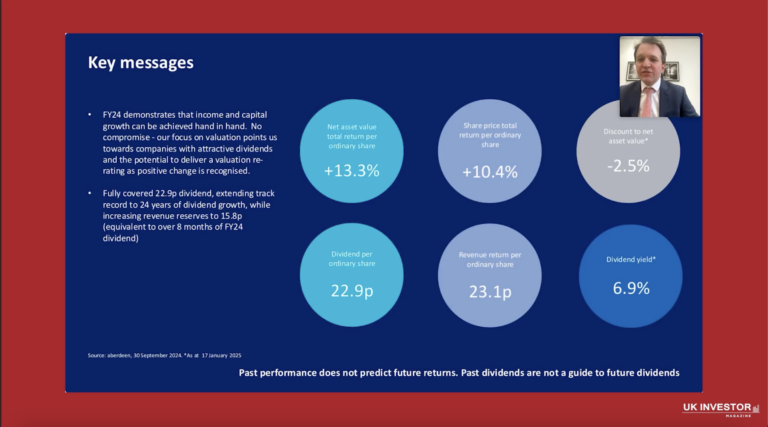
Download the presentation slides.
abrdn Equity Income Trust plc is an investment trust with a premium listing on the London Stock Exchange. Established on 14 November 1991, it offers investors access to an actively managed portfolio of UK quoted companies.
The trust employs an index-agnostic investment approach, focusing on identifying and capitalising on opportunities across the full spectrum of the UK market cap. Its strategy is centred around ‘Focus on Change’, which involves evaluating evolving corporate situations to uncover insights not fully recognised by the market. The trust is committed to delivering sustainable dividend growth and is managed by a team with extensive investment experience.
Rights and Issues Investment Trust Investor Presentation March 2025

Download the presentation slides.
Rights and Issues Investment Trust PLC managed by Jupiter, is a London listed closed ended investment company which invests in a portfolio of primarily UK Small and Mid-cap companies.