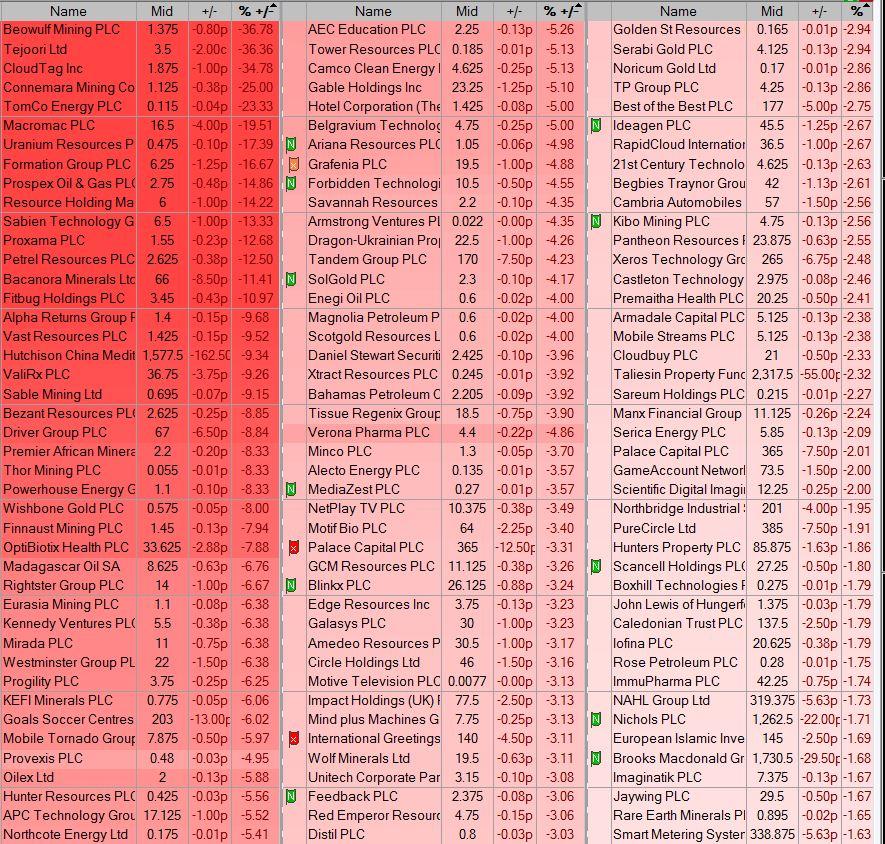
AIM movers: Image Scan upbeat and Cordel gets Network Rail approval

7

Zeus has upgraded its fair value estimate for X-ray screening systems developer Image Scan (LON: IGE) from 2.5p/share to 3.8p/share after a trading statement. The second half has been stronger and there is a better order book, including a three year, £3m contract for ThreatScan portable X-ray systems. Full year revenues will still be slightly lower at £2.9m, but improved margins mean that pre-tax profit should double to £200,000. There is £912,000 in the bank. Revenues are expected to rise to £3.5m this year. The share price rose 7.58% to 3.55p.

Transport analytics company Cordel (LON: CRDL) has gained Network Rail approval for the Electrification (Overhead Line Equipment OLE) Cordel Connect module. This monitors overhead line height, stagger and deviation. The share price increased 6.52% to 6.125p.

Helium explorer Pulsar Helium Inc (LON: PLSR) joined AIM last Friday. The focus is the Topaz helium project in northern Minnesota, close to the Canadian border. So far, an appraisal well has been drilled and this confirmed the presence of helium. There were 1.47 million shares traded on the first day with another 700,000 shares traded in the following two days. Having opened on 29p the shares closed the day at 27.5p. Yesterday the share price fell to 25.5p and it has recovered 5.88% to 27p.

Franchise Brands (LON: FRAN) has appointed Peter Molloy as chief executive. He has been with the Metro Rod business since 2005. Stephen Hemsley remains as executive chairman. The board is assessing a potential move to the Main Market. Allenby has a fair value price of 330p. The share price is 4.75% higher at 165.5p.

FALLERS

Red Rock Resources (LON: RRR) is raising £200,000 at 0.0335p/share to fund accounting costs and investment in projects in West Africa, Australia and Kenya. An arbitration process is progressing in the Democratic Republic of Congo, and this could provide more cash. The share price declined 8.54% to 0.0375p.

David Blain has taken over as finance director of OptiBiotix Health (LON: OPTI). He was formerly finance director of Applied Graphene Materials. The share price fell 7.24% to 10.25p.

Shares in Optimer technology developer Aptamer (LON: APTA) dipped 6.67% to 0.21p following yesterday’s annual results. Revenues halved to £860,000 in the year to June 2024, but the order book is already worth more than that. Costs have also been reduced and the £2.8m of cash raised at 0.2p/share following the balance sheet date should last for a couple of years. Longer-term, the use of the company’s IP by clients could be highly profitable.

Rockwood Strategic (LON: RKW) has increased its stake in training and software provider Pennant International (LON: PEN) from 10.4% to 11.1%. The share price slipped 4.08% to 23.5p.

Edison has published a review of the interim results of Manx Financial Group (LON: MFX). The share price is 5.08% lower at 14p.

FTSE 100 slips despite upbeat Lloyds and Barratt Redrow update

Nerves were still evident in London-listed stocks on Wednesday, as an early gain for the FTSE 100 was quickly sold into by traders as macroeconomic considerations dented risk sentiment.

There’s no one factor driving markets on Wednesday, but rather a combination of the upcoming UK budget, geopolitical tensions, and steadily increasing uncertainty around the US election.

Donald Trump has gotten his nose in front of the polls, and investors are becoming increasingly concerned about what a second term for Trump may do to the global economy.

The IMF recently downgraded its global growth target for 2025, citing concerns about potential trade wars and their impact on growth. Donald Trump’s recent suggestions he’s going to try his hardest to ignite an outright trade war with China will have contributed to the downgrade. 

“Caution is reigning on financial markets amid growing expectations that borrowing costs might come down slower in the US, the world’s largest economy, while political uncertainty and the threat of conflict spreading in the Middle East is also keeping investors a little more wary,” said Susannah Streeter, head of money and markets, Hargreaves Lansdown.

After starting the session positively on Wednesday amid upbeat reports from Lloyds and Barratt Redrow, London’s leading index slipped back to trade down 0.2% at the time of writing.

Although the FTSE 100 was down as an index, there were some positive updates on the corporate front.

WPP shares rose 4% as revenue increased 1.4% in the third quarter, driven by robust demand in North America and Europe. The marketing giant also noted strength in its top ten clients, from which it earns a large proportion of its revenue.

Lloyds also had a positive session after reporting better-than-expected underlying profits, although provisions for bad debt were less than expected.

“There has been concern about the impact on consumer confidence from speculation ahead of the Budget but Lloyds paints a picture of improvement as its third quarter pre-tax profit beat expectations,” said Russ Mould, investment director at AJ Bell.

“The beat was driven by lower-than-expected impairments. The amount of bad debt being chalked up is still low and the bank and its customers will hope we’re now through the worst of the cost-of-living crisis.

“The other big positive surprise for investors was the quarter-on-quarter increase in the net interest margin – measuring the difference between what the bank pays out to depositors and charges those to whom it is lending money.”

Newly-merged Barratt Redrow shares ticked higher after giving investors reason to be hopeful with a decent forecast of completions for the year ahead.

Lloyds shares rise after profits beat expectations

Lloyds shares rose on Wednesday as investors digested the bank’s third-quarter earnings.

The backdrop of low UK economic growth and falling interest rates could have materially affected Lloyds’ earnings during the period, and investors would have been pleased to see Lloyds beat profit expectations amid lower-than-expected impairment charges.

Lloyds shares rose 1% despite third-quarter underlying profit slipping 8% to £1.9bn. This, however, was much better than the £1.7bn forecast by analysts.

Softer economic conditions had meant analysts had pencilled in a level of impairment charges which ultimately weren’t as bad as first thought, helping boost the bottom line.

Another major positive for investors was Lloyds’s income. There was a risk this would fall amid falling interest rates—which it did—but only marginally, from £4.5bn last year to £4.3bn this year.

The era of higher interest rates is over buu investors seem to be prepared to look through the fall profits and focus on stability.

“Lloyds is the first major UK bank to report third-quarter earnings, and it hasn’t disappointed. In tune with recent trends, impairment charges were better than expected and drove a good chunk of the pre-tax profit beat, as borrowers continue to stand firm. Loan and deposit numbers also looked encouraging, with new mortgages driving a big chunk of the loan book growth, a good sign that activity in the housing market is picking back up,” said Matt Britzman, senior equity analyst, Hargreaves Lansdown.

“Net interest margin was a touch better than expected, with deposit migration not quite as much of a headwind as some had feared. There is still an ongoing shift toward higher-rate accounts, but as rates come down that should ease.

“The decent margin performance and lower impairments should be a good read-across for names like NatWest and Barclays.”

ASA International Group – Microfinance Group Q3 Update Shows Continued Growth, Broker Going For 148p Value, Shares Now 67.50p 

I do realise that investors may well find the background of the ASA International Group (LON:ASAI) as somewhat unexciting – however, I take the view that buying into a company whose earnings are predicted to grow at 32% per annum, is really quite an attractive situation. 

The Business 

ASA International provides small socially responsible loans, bank accounts, savings and other financial services to start or grow businesses.    

ASAI is one of the world’s largest international microfinance institutions, with a strong commitment to financial inclusion and socioeconomic progress.  

The business, which has over 2,016 branches, across 13 countries, handling its 2.3m clients, operates in Pakistan, India, Sri Lanka, The Philippines, Myanmar, Ghana, Nigeria, Sierra Leone, Tanzania, Kenya, Uganda, Rwanda and Zambia.   

The company provides small, socially responsible loans to low-income, financially underserved entrepreneurs, predominantly women, across South Asia, South East Asia, West and East Africa. 

Recent Management Comment 

At the time of announcing its Interims at the end of last month, CEO Karin Kersten stated that:  

“H1 2024 saw both operational growth as well as importantly increased profitability. The overall operating environment across most of our markets improved during the first half of the year.   

Encouragingly, demand remains high for our products from clients as economic conditions, while still challenging, have eased when compared to the same period in 2023.   

Clients and staff continue to demonstrate their resilience in these economic circumstances.   

In particular, we have demonstrated improved performance in our major operating countries – Pakistan, the Philippines, Ghana, Tanzania and Kenya – almost all of which recorded excellent portfolio quality, client and OLP growth, and profitability.   

The improved performance in our major operating markets was slightly offset by FX movements in certain markets.   

Currencies in most of our markets have been relatively stable against the USD in H1 2024.  

Away from the clear operational impacts, the effects of inflation, including hyperinflation accounting, other currency movements, are expected to continue to dampen financial performance in USD terms in 2024.   

However, given the improved operating developments we have already seen in 2024, we are confident of being able to continue our strong performance for the remainder of 2024.”  

Yesterday on presenting an update on its business operations for the three-month period to end-September, the company reported that its Outstanding Loan Portfolio had increased to $420m – which was 6% higher than at the end of its first half and 16% higher than at the same time last year. 

All of the group’s operating subsidiaries achieved collection efficiency of more than 90% in Q3, with 12 countries achieving more than 95% reflecting continued normalisation of the business. 

Analyst View 

Stephen Barrett at Cavendish Capital Markets has a Price Objective out on the shares at 148p, compared to the current 67.50p. 

His estimates for the current year to end-December are for revenues of $168.2m ($148.2m), with adjusted pre-tax profits of $53.4m ($38.0m), earnings of 23.2c (15.0c) and paying out a 4.6p a share dividend (nil). 

For 2025 he looks for $183.4m revenues, $56.6m profits, 27.5c earnings and 5.7p per share dividend. 

The 2026 year is expected to report around $201.3m in revenues, $64.2m profits, 34.4c earnings and a 7.7p dividend per share. 

In My View 

The above estimates really do it for me – this really is an undervalued situation that needs to be followed. 

Its shares at 67.50p, offer at least a 50% uplift in the short-term – it just takes other investors to realise! 

Barratt Redrow investors cheer encourgaing start to merger

Barratt Redrow investors were enthused by the newly merged group’s start to life as a single entity, with shares rising 3% after the the group released a trading statement and update on the integration.

The key takeaway for investors will be the £90m in synergies the group hopes to achieve through the merger of Barrat Developments and Redrow and the upbeat predictions of 16,600 and 17,200 completions in 2025FY.

The group noted stabilising market conditions, which will please long-suffering investors who have had to contend with slowing sales rates amid rising interest rates.

The group said they were ‘encouraged by the solid trading we have experienced over recent weeks’.

In addition, the new Labour government has pledged to build 1.5 million homes over the parliament adding a fresh tailwind to housebuilders.

“In the first update since the dotted line was signed on Barratt’s acquisition of Redrow, the enlarged group signalled that it’s got big plans ahead. Together, Barratt Redrow expects to deliver between 16,600 and 17,200 new homes this year, with plans to build that figure up to 22,000 over the medium term, making it a serious force in the market. These will be spread across different geographies and with three differentiated brands under its umbrella, it’s able to meet the needs of different types of buyers at various price points,” said Aarin Chiekrie, equity analyst, Hargreaves Lansdown.

“Sales rates are well ahead of the prior year, and there’s a strong landbank ready to be unleashed when the housing market recovers. Markets are pricing in interest rate cuts at every Bank of England meeting out to March 2025, which should ease mortgage availability and affordability pressures, and Barratt Redrow looks well placed to be buoyed by the rising tide.

“The enlarged group hopes to deliver at least £90mn of cost savings by trimming the fat on overlapping processes. If operations can be streamlined and new homes delivered as expected, there’s plenty of opportunity for profits to rebound over the medium term. But as with any merger, there will be challenges along the way.”

Permanent recruitment weak at Empresaria and PCI-Pal set to move into profit

4

Payments technology developer PCI-Pal (LON: PCIP) grew full year revenues by one-fifth to £18m in 2023-24, including £700,000 delayed from last year, and they could rise by one-quarter this year. Annualised recurring revenues are £15.5m. This year PCI-Pal should move into profit. The share price rose 8.08% to 53.5p.

Cancer immunotherapies developer Scancell Holdings (LON: SCLP) has appointed Dr Phil L’Huillier as chief executive. He has been chosen because he has a track record of developing and commercialising cancer therapeutics. He replaces Professor Lindy Durrant who goes back to concentrating on the role as chief scientific officer. The share price improved 7.41% to 14.5p.

Mongolia-focused oil and gas producer Petro Matad (LON: MATD) should be producing first oil from the Heron-1 in the next few days. Subsequent drilling should boost production and there are nearby opportunities. Zeus has a risked NAV of 10.6p/share. The share price increased 6.32% to 2.525p.

Building products distributor Brickability (LON: BRCK) says first half trading is in line with expectations of revenues of more than £330m, which is a 7% like-for-like decline. Higher sales of solar PV helped to offset lower revenues from bricks and other construction materials. There was also an initial contribution from the cladding and fire remediation acquisition. EBITDA is at least £27.5m, up from £25.6m. Net debt is £56m. The share price is 4.13% higher at 63p.

Musical instruments retailer Gear4Music (LON: G4M) continues to recover with growth in the second quarter nearly offsetting the decline in the first quarter and further improvement in October. In the six months to September 2024, UK sales grew 4%, but European sales declined. Total sales were 1% lower at £61.7m. Gross margin has fallen back, but the interim loss will be reduced. Full year revenues are expected to be higher and pre-tax profit could jump from £1.1m to £2.8m. The share price firmed 3.21% to 177p.

FALLERS

Staffing firm Empresaria (LON: EMR) says permanent recruitment remains weak with net fee income 4% lower in the third quarter and the fourth quarter is likely to be worse than forecast. The German market is particularly poor. Pre-tax profit expectations have been downgraded to £2m.Net debt was £13.6m at the end of September 2024 and there is still £6.5m of debt headroom. Cavendish has a sum of the parts valuation of 53p/share. The share price dipped 23.2% to 26.5p.

The Revel Collective (LON: TRC), formerly known as Revolution Bars, has restructured its operations and reduced its outlets. In the year to June 2024, revenues fell 2% to £149.5m, while the underlying loss was £5.6m. The restructuring is complete, and management can focus on operations. Christmas bookings are positive. The loss should be reduced this year. The share price fell by one-fifth to 0.7p.

Mirriad Advertising (LON: MIRI) has replaced PwC as auditor with Cooper Parry.  PwC has nothing it believes that should be brought to shareholder attention. The share price slipped 21.6% to 0.29p.

Wellhead safety equipment supplier Plexus Holdings (LON: POS) increased full year revenues by 756% to £12.7m and that moved the business from loss to a pre-tax profit of £3.5m. The figures were boosted by major contacts and that will not be repeated this year. A loss of £3.3m is forecast. The share price declined 14.8% to 11.5p.

FTSE 100 falls in broad but contained sell off

The FTSE 100 was firmly in the red on Tuesday, with most constituents trading negatively in early trade.

London’s flagship index gave up 0.65% as investors took cash off the table amid rising tensions related to the upcoming budget and concerns about UK public borrowing.

“The FTSE 100 started Tuesday on the back foot, dragged lower by weakness in the energy and telecoms sectors,” said AJ Bell investment director Russ Mould.

“Precious metal miner Fresnillo was in demand once again as gold prices remained at record highs but otherwise the unhappy story of broad-based losses from Monday afternoon continued for the UK’s flagship index.

“There was a reminder of the pressure Chancellor Rachel Reeves is under ahead of next week’s Budget as the UK’s public borrowing exceeded official forecasts in September. However, it was below the number which less optimistic independent economic forecasters had pencilled in.”

At the time of writing, around 90 of the FTSE 100’s constituents were trading down, but the losses were largely contained, with no share falling more than 3%.

The drop represents risk aversion that was also evident in European shares and in S&P 500 futures.

In addition to telecoms and energy, the UK’s housebuilders were under pressure once more following yesterday’s soft Rightmove reading of house price growth.

As highlighted by Russ Mould, Fresnillo was again the leader of the pack, carving out another 1% gain after surging over 5% yesterday. Precious metals prices are ripping higher, and the trickle down effect is being felt by miners set to benefit from higher production margins.

With several risk events on the horizon, the drop in equities is understandable, and investors will likely be lining up potential buys for when the uncertainty decreases.

Halford shares rise despite slow first half

Halfords shares were riding higher on Tuesday after the group released its first half-year results, which revealed no growth compared to the previous year.

However, investors were clearly pleased that Halfords managed to maintain the same sales level, given the group’s strong growth in the prior year.

Halfords enjoyed reasonable growth in the auto centres unit, which was the only element of mild positivity, with group sales down 0.1% during the period.

There is a clear split between discretionary spending and necessary expenses. As Russ Mould explains below, consumers are holding off on purchasing new bikes but will always need to maintain their cars.

“Zero growth from Halfords in its first-half period isn’t as bad as it first looks. The company had tough comparative figures to beat from a year earlier, so the fact the business has managed to stand still rather than go into reverse has to be taken as a win. Indeed, investors have given the performance the thumbs-up, with a small rise in the share price,” said AJ Bell investment director Russ Mould.

“Consumers might not be feeling flush enough to splash out on expensive items like top-end bikes from Halfords, but there are certain things that need sorting out regardless. People who rely on their car to get to work need to spend on motoring essentials to ensure their vehicle is roadworthy. It’s Halfords’ job to ensure it is the company of choice to provide these services and its autocentres arm has shown progress.”

“The weak spot once again was tyres where drivers are opting for budget ranges. At the end of the market, premium products have been awash with promotions across the sector.”

Investors will also see value in the growth of Halfords’ Motoring Loyalty Club, which now has over 4 million members, securing an element of recurring revenue for the group.

Halfords shares were 5% higher at the time of writing.

Inheritance tax receipts soar as Labour gears up for tax raid

Fresh data released today reveals those in the UK are paying more than ever in inheritance tax just as Labour readies a wave of changes to take more of people’s life savings on their death.

Rising prices of property and other assets, including equities, mean more estates are being dragged into paying IHT with the thresholds frozen.

“Thanks to frozen nil-rate bands and asset price growth IHT receipts have been hitting record highs in recent years, soaring to £7.5bn in the 2023/24 tax year. This is set to rise in the current tax year too. Receipts from April 2024 to September 2024 are £4.3 billion, which is £0.4 billion higher than the same period last year,” said Rob Morgan, Chief Investment Analyst at Charles Stanley.

Morgan continued to explain that despite rising IHT receipts, the new Labour government is intent on transferring more of people’s wealth to the treasury when they die.

“Despite this, it seems inevitable inheritance tax (IHT) will be in the Chancellor’s Budget crosshairs given the extent of the government’s stated funding gap. With the ‘baby boomer’ accumulation of wealth increasingly being passed to the next generation inheritance tax rules are being closely examined.

“While it’s doubtful the rate of inheritance tax will be increased – it’s already at a very high at 40% – the various exemptions and gifting rules used to mitigate, and in some cases eliminate, the tax will surely fall under the microscope.”

There are also fears that Labour will target business relief on AIM shares, which allows investments in this junior market to be passed on free of IHT if held for more than two years.

The industry has lambasted the suggestion of removing this incentive to invest in some of the UK’s most exciting businesses for its sheer ignorance of the consequences for the wider economy.

AIM-listed companies create thousands of jobs and generate billions for the UK economy.

We will have to wait until 30 October to see whether the new Labour government actually values UK economic growth as it claims and leaves some excellent incentives to invest in early-stage companies untouched.

Deltic Energy – Selene Well could prove to be transformative, shares at 4.65p rated as a Speculative Buy by its Brokers – but with what Target Price?  

Real gamblers might like to take a look at the shares of Deltic Energy (LON:DELT) – they are currently bumping along on their backside at just 4.65p, after having fallen from the 44p last seen in mid-April this year. 

A Big Change 

Yesterday morning the group announced an Operational and Strategic Update, together with a non-executive Board change, as well as a change of Broker. 

So, it is quite a corporate change of face for the company. 

Allenby Capital will continue as its Nomad, while Canaccord Genuity will assume the role of sole broker for the company. 

The company announced that: 

“For the last decade, Deltic has invested in its UK portfolio and achieved material exploration success despite the well-publicised political and fiscal headwinds that have hampered the UK’s oil and gas industry in recent years.  

It is clear that, while this situation persists, the UK is not the ideal place in which to invest in new oil and gas exploration or appraisal opportunities.  

Therefore, the Board has carefully considered the best way to leverage the Company’s international experience and expertise to create value for shareholders going forward.” 

Concentration On Selene Well 

Deltic has a 25% working interest in the Selene licence which is located in the heart of the long-established Leman Sandstone gas play in the Southern North Sea.  

In a success case, the intention would be to proceed directly to field development planning as further appraisal drilling is not considered to be necessary to support a future development investment decision. 

Deltic holds a 25% interest in Selene after farming-out the project to Shell in 2019 and to Dana Petroleum in February this year.  

In late July Shell mobilised its Valaris 123 drilling unit to drill 2024’s first well at Deltic Energy’s Selene prospect in licence P2437. 

The well is designed to collect all key information in relation to reservoir quality and gas composition that is required to support, assuming a successful drilling outcome, a field development plan and final investment decision on the potential development of the Selene gas field without the requirement for a further appraisal well. 

Deltic estimates the Selene structure to contain gross P50 prospective resources of 318bcf of gas in the Leman Sandstone reservoir, which is the key reservoir interval in all adjacent gas fields including Barque, Clipper and West Sole. 

Earlier this year, former CEO Graham Swindells stated that: 

“We are excited to be commencing drilling operations on Selene with our partners Shell and Dana, and for which we are fully carried for the estimated success case cost. 

This will be the first exploration well spudded on the UKCS in 2024 and is an equally important milestone for Deltic.  

The Selene prospect is a high impact infrastructure-led exploration opportunity which demonstrates the strength and depth of the portfolio that we have built over the last few years, and which we estimate to be worth multiples of the company’s current market value. 

Despite ongoing political uncertainty, we look forward to commencing operations and continue to believe exploration on the UKCS has a hugely important role to play in supporting the provision of energy security, vital jobs within the energy sector and offsetting higher carbon intensity imported energy.” 

Management Comment 

Yesterday new CEO Andrew Nunn commented that: 

Our immediate focus is the ongoing Selene exploration well, where initial drilling indications are encouraging.  

I look forward to updating the market on the progress of this highly material well. 

The Board has considered the best way to deploy the Company’s experience and expertise to create value for its shareholders.  

As always, the balance of geological, operational and political risk must be considered and we are actively assessing a number of attractive opportunities in geographies where more supportive policies towards oil and gas development exist. 

The key changes we have announced today, in addition to a raft of other less significant changes, will have an immediate and material impact on the Company’s operational expenditure and are expected to result in savings of 40% compared to costs previously budgeted by management for 2025.  

These savings are key to extending the time period in which to identify and incubate those new opportunities that we believe will help towards stabilising the business and providing a platform for future growth supporting our objective of creating positive returns for shareholders.” 

Analysts Charlie Sharp and Phil Hallam at Canaccord Genuity Capital Markets rated the group’s shares as a Speculative Buy – but with an unchanged Price Objective of 80p – yes 80p! 

They consider that the ‘strategic reset’ makes sense. 

The process is still at an early stage and there is little indication of geographical focus, but they would be surprised if opportunities in sub-Saharan Africa were not high on the agenda.  

They feel that in the very short term all eyes will be on the key Selene logging/sampling results.  

The shares closed last night at 4.65p, valuing the whole company at just £4.32m.