Majestic Corporation is a unique proposition for UK investors seeking a more sustainable form of exposure to critical minerals than traditional mining companies. No other ‘urban mining’ e-waste recycling pure-play listed on London’s exchanges has successfully achieved Majestics scale, revenues and profitability.
As the world races to deploy clean energy technologies, a critical shortage of minerals threatens to derail progress.
However, a new International Energy Agency (IEA) report reveals that recycling and “urban mining” could reduce the need for new mining projects by 25-40% by 2050 while creating a market worth $200 billion and avoiding the destruction of biodiversity.
Urban mining companies such as Aquis-listed Majestic Corporation specialise in extracting valuable minerals from discarded electronics, batteries, and other waste products that contain high concentrations of critical materials. These companies are becoming increasingly important as traditional mining alone cannot meet the surging demand for minerals essential to electric vehicles (EVs), wind turbines, and solar panels. Many of the metals processed by urban miners can also be deployed in the wider economy with broad applications in construction and industry.
“Recycling is indispensable to the security and sustainability of critical minerals supply for clean energy transitions,” the IEA report states. The analysis shows that without increased recycling, mining investment requirements would be 30% higher – meaning an additional $240 billion in capital spending would be needed through 2040 to meet demand.
The economics are compelling: recycled minerals typically generate 80% lower greenhouse gas emissions compared to primary mining while using 80% less water. For copper, one of the most critical metals for electrification, recycling could provide up to 40% of supply by 2050 in a scenario aligned with countries’ climate pledges.
The surge in EV adoption is creating particularly urgent recycling needs. By 2050, end-of-life EV batteries could provide 20-30% of the lithium, nickel and cobalt required for new batteries. China currently dominates this emerging industry with over 80% of global battery recycling capacity.
However, current recycling rates are falling behind rapidly growing consumption. The report notes that copper recycling’s share of total supply dropped from 37% in 2015 to 33% in 2023, while nickel recycling declined from 33% to 26% during the same period.
The report emphasises that recycling alone cannot eliminate the need for new mines but can significantly reduce pressure on primary supply while enhancing energy security, particularly for countries that lack domestic mineral resources. For example, in Europe, secondary supply from batteries could meet about 30% of the region’s lithium and nickel demand by 2050.
The IEA’s analysis shows the recycling market is ripe for investment, with market values for recycled battery metals growing elevenfold between 2015 and 2023. This growth comes as governments worldwide implement new policies to boost collection rates and recycling infrastructure, recognising both the economic opportunity and environmental imperative of creating more circular mineral supply chains.
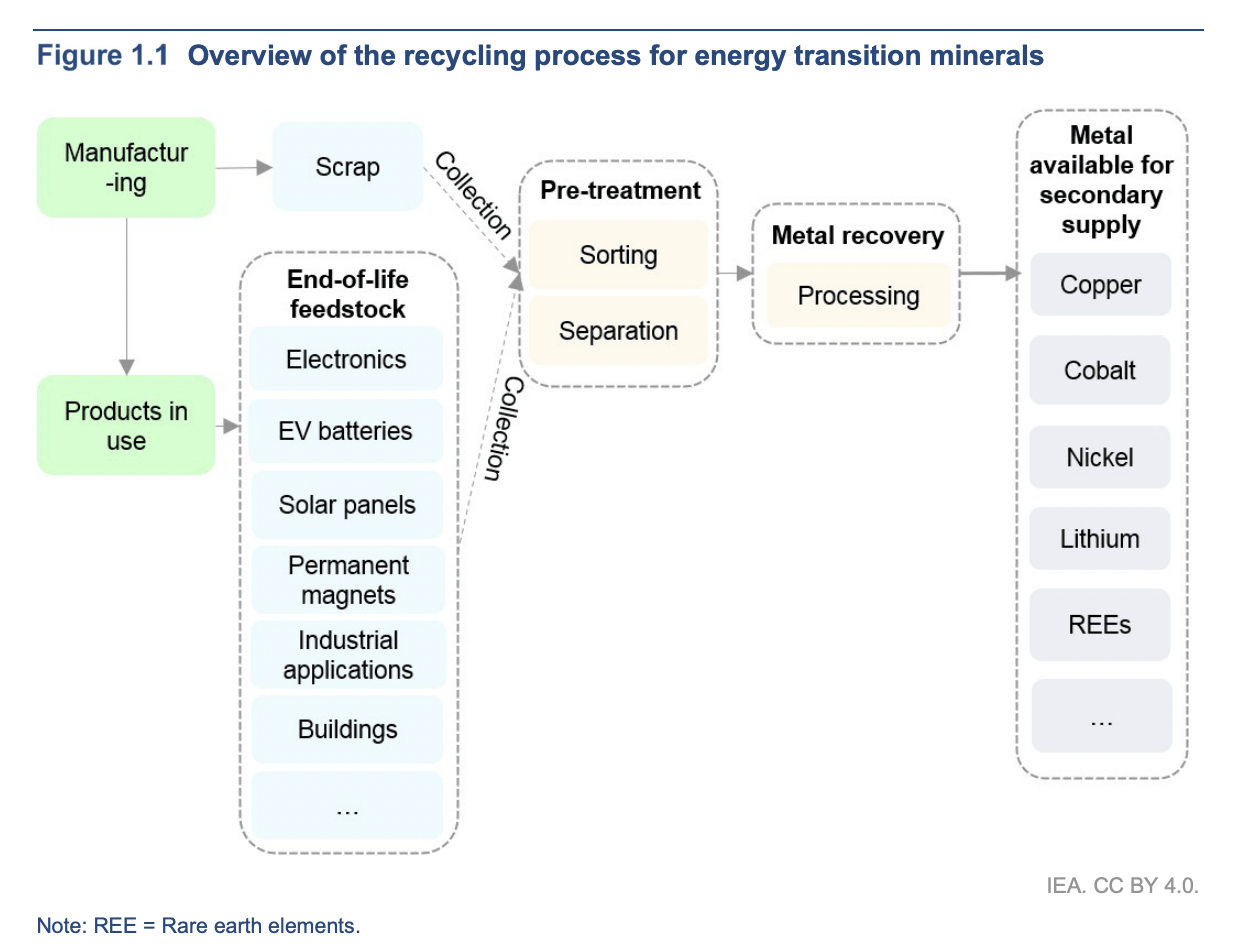
Source: IEA
The graph above illustrates the different stages of processing and recycling critical minerals. Majestic Corporation’s operations involve collecting, sorting, separating, and processing end-of-life feedstock.
Majestic has established a network of affiliates globally that collects, processes, and ships e-waste, including chipboards, EV batteries, and solar panels, to smelters that melt the metals down and return them to the supply chain.
Majestic Corporation is the foremost London-listed critical minerals recycling pureplay, generating revenues of $25m in the first half of 2024, nearly doubling the $13m revenue in the same period last year.
Having established a network that spans the US, Asia, and Europe, the company is expanding its operations in the UK through the acquisition of a facility in Deeside, Wales, to harness the opportunity in the UK’s abundance of e-waste containing critical minerals vital for the green transition and wider economic growth.
Next Tuesday morning will see the announcement of the final results for the year to end-September by the Greencore Group (LON:GNC), the world’s biggest sandwich maker.
And I am not talking about the size of its sandwiches, but instead the number that they produce for retailers of all sorts across the UK and Ireland.
The figures will be good, as we have been promoting over the last year, and should show that the group’s shares are well worth taking a bite, that is if you have not already nibbled.
The Business
As one of the leading manufacturers of convenience foods in th...
TI Fluid Systems’ steadfast approach to ABC Technologies’ takeover pursuit has secured shareholders 200p per share in a takeover deal announced on Friday.
ABC Technologies’ acquisition of TI Fluid Systems for 200p per share in an all-cash deal values the company at £1.039 billion.
The offer represents a significant premium of 54.5% over TI Fluid Systems’ 90-day average share price prior to September 13, 2024, when ABC first approached TI Fluid.
TI Fluid Systems’ board rebuffed two initial offers of 165p and 176p before ABC upped their offer to 200p.
The acquisition comes as TI Fluid Systems, a global leader in automotive fluid management systems, navigates the industry’s transition toward electric vehicles. The company has been implementing its “Take-the-Turn” strategy since 2021, focusing on expanding its thermal management products for electric vehicles and strengthening its presence in the Chinese market.
Despite showing promising progress in adapting to industry changes, TI Fluid Systems has faced challenges from ongoing disruption in the global automotive sector.
According to a statement released on Friday, global light vehicle production is expected to decrease from 90.5 million units in 2023 to approximately 88.5 million units in 2024, particularly affecting European manufacturers.
With US cash equity markets closed and households across the US preparing to carve their turkeys at Thanksgiving dinners, the FTSE 100 carved out its own gains on Thursday.
Thanksgiving is traditionally a slow day for trade, but UK and European markets showed signs of life on Thursday. Broad European indices rebounded after several days of declines, and M&A action in the UK grabbed the headlines.
Aviva has made an unsolicited offer for Direct Line, which was unsurprisingly rebuffed by the company. Still, the buzz of M&A in the sector helped support peer Admiral, which rose 3%.
“After a difficult few days, European markets had a spring in their step on Thursday,” said Dan Coatsworth, investment analyst at AJ Bell.
“The FTSE 100 advanced 0.2% to 8,290, led by Admiral which jumped 3.5% on positive read-across from Aviva’s move on Direct Line.
“It’s normal to see other companies in the same sector jump when there is takeover activity as investors consider who else might be bid targets or are trading too cheaply. There is no suggestion that someone will bid for Admiral but that hasn’t stopped it having its moment in the sun.”
It wasn’t surprising that Direct Line declined Aviva’s offer, and many investors will expect Aviva to return with an improved bid soon.
“Direct Line is playing hard to get, again, as the board rejects a tentative takeover offer from Aviva on the grounds that the 250p per share on the table significantly undervalues the company,” said Matt Britzman, senior equity analyst, Hargreaves Lansdown.
“It’s not a clean offer; the 250p would be split half as cash and half as Aviva shares, which always makes things a little more complicated. Direct Line is no stranger to takeover offers, having rejected multiple attempts from Belgian insurer Ageas earlier in the year. There’s a case to be made that Aviva is a better suiter, given it already shares markets with Direct Line in the UK, but it’ll need to up its game – and its offer – if it wants Direct Line to take the proposal seriously.”
There was also mild optimism in the financial markets after Israel agreed on a ceasefire with Hezbollah, curtailing demand for safe-haven assets.
“Looking ahead, easing tensions in the Middle East and Eastern Europe could reduce demand for safe-haven assets, including the greenback,” said Tito Iakopa, Commercial Director at FlowCommunity.
“Despite its latest retracement, the US dollar remains near a high after a strong surge since the beginning of October. However, it could remain exposed to any changing expectations regarding US monetary policy.”
The global autonomous vehicle industry is heating up with a blockbuster NASDAQ IPO by Chinese AV company Pony AI and evidence that Tesla is preparing to satisfy US state rules with remote teleoperators for their Robo taxis further strengthening the foundations of wider adoption.
Pony AI is the latest autonomous vehicle startup to win over investors as it raised $260m through its NASDAQ IPO and a further $153m in private placements to fund the expansion of its autonomous taxis in major Chinese cities.
The company has developed technology that can be installed into vehicles to make them autonomous. It has three defined markets: robotaxis, robotrucks, and personal vehicles.
The Pony AI IPO follows a Waymo private funding round and the $440m WeRide IPO, demonstrating continued strong investor demand for autonomous vehicle startups.
With the rollout of autonomous vehicles accelerating globally, Tesla has recently posted a job advert offering insight into what the rollout of autonomous vehicles in the US may look like.
The Tesla job advert seeks software engineers to develop Tesla’s teleoperations team, which will have direct access to control the firm’s robotaxis and robots.
Tesla’s job advert reads:
“Tesla AI’s Teleoperation team is charged with providing remote access to our robotaxis and humanoid robots. Our cars and robots operate autonomously in challenging environments. As we iterate on the AI that powers them, we need the ability to access and control them remotely.”
Many US states require by law that autonomous vehicles have the capability to be remotely controlled by a teleoperator who can intervene and take over control of a vehicle should it get into difficulties. There are also requirements for two-way communication between passengers and remote teleoperators.
The job advert posted by Telsa suggests that Elon Musk is preparing the required teleoperation technology to adhere to state rules as part of a nationwide rollout of Robotaxis.
Although most of the action in autonomous vehicles is happening in the US, the developments will be encouraging for followers of AIM-listed Tekcapital and their portfolio company Guident.
Guident has already deployed sophisticated teleoperations Remote Control and Monitoring Centres with capabilities to monitor and control a wide range of autonomous vehicles, including buses, shuttles and surveillance robots.
Tekcapital, which owns around 90% of Guident, has recently announced that Guident will seek an IPO in 2025.
At Pearcroft, we’re more than just a property development company—we’re on a mission to transform the way homeowners live by building carbon-neutral housing that not just looks good, but gives back to the planet. As the UK’s leading developer of net-zero homes, Pearcroft stands as a testament to the power of combining cutting-edge technology with a relentless commitment to sustainability. But we’re not just talking the talk—we’re walking the walk, and we’re setting a new benchmark for what’s possible in the world of property development.
A New Standard in Energy-Efficient Living
The homes we build at Pearcroft aren’t just about luxurious design and modern comforts; they are eco-conscious havens that actively contribute to a greener planet. Our homes are equipped with the latest in sustainable technologies and materials, ensuring that they not only reduce environmental impact but also each is fitted with MVHR systems too, ensuring fresh, pollutant-free air fills the home, providing a better quality of life for their owners.
We’ve made a bold promise to our homeowners: a 5-year energy bill guarantee. This unique promise ensures that all Pearcroft homes will generate more energy than the homeowner uses, giving them peace of mind and reducing their living costs. With EPC ratings of A+ and average carbon emissions of -0.5 tonnes, our properties exceed industry standards and demonstrate what’s truly achievable in terms of energy efficiency and sustainability. But we’re not stopping there—our vision is set on even greater achievements.
The Pearcroft Difference: Sustainability at the Core
How do we achieve this? It’s all in the details. The homes that Pearcroft build integrate advanced sustainable technologies with high-quality construction materials to create energy-efficient, comfortable living spaces. Here’s a look at how we do it:
Architectural Design: Our homes are designed to complement their surroundings, embracing modern living while respecting the area’s architectural and environmental context.
Sensitive Landscaping: We carefully consider the natural environment and local community when designing our developments, ensuring that our landscaping supports biodiversity and enhances the overall aesthetic of the area.
Solar Photovoltaic (PV) Panels with Battery Storage: Harnessing the power of the sun, our homes feature solar panels that generate electricity for lighting, appliances, and vehicle charging. Paired with battery storage, these systems ensure that energy is efficiently captured, used and shared back with the grid.
Air and Ground Source Heat Pumps: These replace traditional fossil-fuel heating systems, providing low-carbon heating and hot water in the most energy-efficient way possible.
Mechanical Ventilation and Heat Recovery (MVHR): Our homes are equipped with MVHR systems that ensure fresh, pollutant-free air and maintain optimal temperatures year-round.
High-Performance Insulation: Excellent insulation in the floors, walls, and roofs enhances thermal efficiency, ensuring the home stays warm in the winter and cool in the summer with minimal energy use.
AAA Rated Triple-Glazed Windows: Our windows are designed to keep out the cold, reduce noise, and improve energy efficiency, contributing to a more peaceful and comfortable home environment.
Smart Controls: We offer intuitive, smart home systems that allow owners to control their home’s heating, lighting, and energy use, offering ultimate convenience and personalisation.
Water saving features: Every shower and tap delivers instant hot water, saving cold run off.
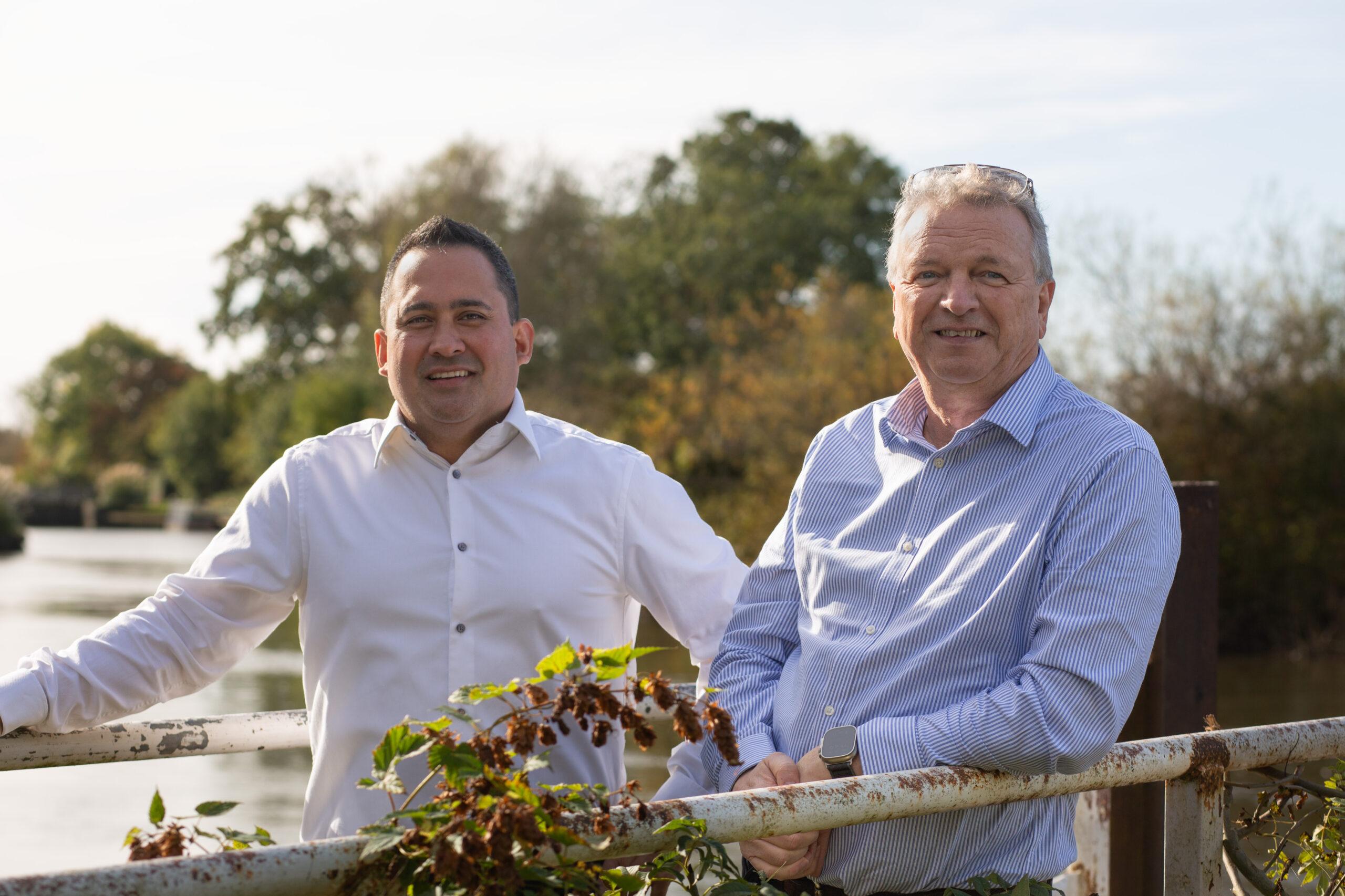
Meet the Visionaries Behind Pearcroft: Martyn Balm and Kevin Harris
The driving force behind Pearcroft is the partnership of two industry trailblazers: Martyn Balm and Kevin Harris. With a wealth of experience in property development, both men share a commitment to creating homes that don’t just meet the needs of today’s homeowners but also leave a positive legacy for the future.
Martyn Balm: The Seasoned Strategist
You wouldn’t say Martyn’s journey into property development is typical, but throughout his career, he’s gathered a wealth of knowledge and a nose for quality investment. From his early days as the top advertising salesperson at the Gloucester Citizen to becoming an award-winning insurance broker, Martyn has always had a knack for spotting opportunities and seizing them with both hands.
From Martyn’s days at art college, he’s always been creative, practical and long held a dream to build his own house. After 20 years of running his own insurance business, he sold up, brought his dream to life and caught the property developing bug.
After a few years honing his skills, Martyn became a land acquisition specialist. His ability to identify prime development opportunities and navigate complex negotiations meant demand for his help rocketed. He’s worked with some of the most prestigious names in the industry, including Hamptons International and other household names. He even featured in The Sunday Times for his innovative property development back in the 2008 recession.
For Martyn, it’s always been about doing good business with good people. He’s the first one to admit that as he’s getting on in years, he’s keener than ever to leave a positive legacy. His commitment to pushing the boundaries of what’s possible is founded on leaving the world better for everyone. And this is at the very heart of Pearcroft’s ethos.
Kevin describes Martyn succinctly as a ‘man of the world with a heart of gold.’ He enjoys a laugh and sharing his expertise, whether it’s through his fantastic stories or supportive approach. He even has a private pilot’s license!
Kevin Harris: The Dynamic Dealmaker
With a background that’s as diverse as it is impressive, Kevin brings a unique blend of financial acumen and property expertise to the table. Kevin left university to become a partner in a clothing business, heading up management and sales, but after a few years, decided property was his destiny.
He joined a leading London estate agent, where he rapidly climbed the ranks from trainee to Area Director in just six years. Managing several offices across Central London, he developed a keen understanding of the luxury property market and the art of high-value sales.
In 2017, he struck out on his own and began brokering deals worth hundreds of millions of pounds, working with clients, including Qatari princes and Russian oligarchs. His ability to secure funding and facilitate complex transactions has helped to bring some of the most ambitious development projects to life.
Kevin marks his success to being a ‘lucky get’ but that witty modesty hints at the real secret – his people skills. He’s comfortable talking to everyone from princes to plumbers, thanks to his unpretentious and affable approach. His drive and good nature are infectious.
Martyn says Kevin’s ‘entrepreneurial spirit shines through in everything he does.’ From leaving university in his early twenties, he’s consistently showed an ability to build and grow successful enterprises.
Partnership Foundations
Martyn and Kevin’s paths crossed in 2021 while they were on opposing sides of a land deal in Devon and hit it off straight away. Sharing a frustration about being the middlemen and with a vision for what sustainable property development could be, they joined forces to create something truly special.
Despite the 25-year age gap and different backgrounds, Martyn and Kevin share a pragmatic and dogged spirit of getting things done. The result is Pearcroft, luxury homes with an unrelenting innovative focus on sustainability – benefiting people and the planet.
Homes that combine high-quality materials with state-of-the-art sustainable technology, without leaving a stain on our conscience or a scar on the planet. Owners can enjoy all modern life’s little pleasures, we leave a legacy for generations, and investors benefit from ethical and strong returns.
With features in The Sunday Times and Oxfordshire Living Magazine, and a sponsorship deal with Gloucestershire County Cricket Club, Pearcroft is quickly making a name for themselves in the world of high-end, carbon neutral property.
Martyn and Kevin bring a perfect balance of experience and innovation, pragmatism and ambition, determination and vision. As they continue to push the boundaries of what’s possible, one thing is clear – Pearcroft is in very capable hands.
Hummingbird Resources (LON: HUM) has agreed a subscription with CIG and Nioko Resources Corporation. There will be 863.1 million shares issued at 2.677p each and this will facilitate the conversion of £23.1m of loan facilities into shares. The subscription will be in two tranches. The subscriber will hold 49.9% of Hummingbird after the first tranche and 71.8% after the second tranche. The share price recovered 35% to 1.85p.
Bars operator Loungers (LON: LGRS) has agreed a 310p/share cash bid from Fortress Investment, which values it at £338.3m. Irrevocable acceptances are 40.2%. Singer does not believe that this fully values the business and thinks 375p/share is a fairer value. Interim pre-tax profit grew 51% to £5.95m, while net debt was £12.2m. Like-for-like growth in revenues has been 3.9% so far in the third quarter. Full year pre-tax profit is forecast to improve from £18m to £23.8m. Despite higher National Insurance costs next year’s pre-tax profit is expected to be £27.4m. The share price jumped 29% to 307p.
Strategic Minerals (LON: SML) has extended the agreement that provides access to the Cobre magnetite stockpile in New Mexico to March 2029. There is also a new purchase order of up to 30,000 tonnes for 2025 from an existing client. The 2024 sales should exceed $4.5m. The share price improved 13.6% to 0.25p.
Orosur Mining Inc (LON: OMI) has completed the acquisition of Minera Monte Aguila giving it 100% ownership of the Anza gold project in Colombia. Drilling has commenced at Pepas. The share price increased 9.76% to 4.5p.
Animal drugs developer Eco Animal Health (LON: ECO) says the first half was tough but trading is improving. Interim revenues were 13% lower at £33.2m and the underlying loss increased from £310,000 to £2.28m. Revenues are recovering in China. Expectations were downgraded in October and full year pre-tax profit is still expected to decline from £4.2m to £3.4m. Next year there should be additional benefits from the R&D investment. The share price rose 9.16% to 71.5p.
FALLERS
Beacon Energy (LON: BCE) says reservoir performance from the SCHB-2 sidetrack well in the Erfelden field in Germany has fallen 20% to 45 barrels/day. Beacon Energy has not been able to agree a restructuring offer with Rhein Petroleum creditors. This means that some of Rhein Petroleum’s assets are being sold and it is likely to be liquidated. Beacon Energy would then be classed as a cash shell. Beacon Energy has enough cash until next summer and is assessing other opportunities. The share price slumped by one-third to 0.0035p.
Timber supplier James Latham (LON: LTHM) revenues dipped 2% to £186.6m as prices weaken, and higher overheads meant that pre-tax profit fell from £16.4m to £13.6m. The interim dividend was raised from 7.75p/share to 7.95p/share. Net cash is £66.9m. Market conditions are not expected to improve until the middle of next year. Full year results will be slightly below last year’s level. The share price fell 9.69% to 1165p.
Rare books dealer Scholium (LON: SCHO) intends to leave AIM and believes this will save at least £75,000/year. In the six months to September 2024, underlying pre-tax profit improved from £43,000 to £221,000 on revenues that improved 30% to £4.97m. A matched bargain facility will be provided by JP Jenkins. The AIM cancellation is likely to be on 6 January. NAV is 74.6p/share. The share price is 9.72% lower at 32.5p.
Ex-dividends
Calnex Solutions (LON: CLX) is paying an interim dividend of 0.31p/share and the share price is unchanged at 60.5p.
CML Microsystems (LON: CML) is paying an interim dividend of 5p/share and the share price declined 2.5p to 240p.
Craneware (LON: CRW) is paying a final dividend of 16p/share and the share price slipped 5p to 2345p.
Fiske (LON: FKE) is paying a final dividend of 0.75p/share and the share price is unchanged at 70p.
Marks Electrical (LON: MRK) is paying an interim dividend of 0.3p/share and the share price
Michelmersh Brick (LON: MBH) is paying an interim dividend of 1.6p/share and the share price
Pan African Resources (LON: PAF) is paying a final dividend of 0.96p/share and the share price dipped 1.7p to 34.25p.
PetroTal Corp (LON: PTAL) is paying a dividend of 1.5 cents/share and the share price slipped 0.25p to 35p.
Tristel (LON: TSTL) is paying a final dividend of 8.28p/share and the share price fell 5p to 435p.
Volex (LON: VLX) is paying an interim dividend of 1.5p/share and the share price rose 0.75p to 290.75p.
YouGov (LON: YOU) is paying a final dividend of 9p/share and the share price declined 6.5p to 443.5p.
The UK Investor Magazine was delighted to welcome Charles Luke, Manager of the Murray Income Trust, to the podcast to explore the trust’s investment strategy and the factors driving investor returns.
Charles outlines their approach to UK Equity Income, centring around the ‘Three Ds’: dependability, diversification, and differentiation.
The Murray Income Trust retains over 50% of dividend revenue for consistent growth. The Murray Income Trust is a true dividend hero, continually increasing dividends for 51 years and yielding 4.7%.
Charles details recent additions to the portfolio and shares what excites him the most about being a UK Equity Income manager over the coming 12 months.
I do like to see companies increasing their guidance given to the market, especially in these times.
Just such a case for example is one of my favourites, the AO World (LON:AO.) electrical retail group, which on Tuesday of this week, 26th November, announced its Interim Results to end-September.
The figures were very good, while the group also upgraded its guidance for the current year.
The Business
The Bolton-based group is the UK's most trusted major electrical retailer, with a mission to be the destination for electricals.
Its strategy is to create value ...
Dr Martens shares jumped on Thursday after the bootmaker made positive sounds about their outlook in first-half results that revealed falling revenue and widening profits.
Revenue fell 18% (16% at constant currency) to £324.6 million, though this performance was in line with the company’s expectations and previous guidance of a 20% decline.
The revenue decline was particularly pronounced in the wholesale segment, which dropped 29%. The direct-to-consumer (DTC) business showed more resilience, declining by 7%, with e-commerce performing slightly better than retail stores. Within the DTC channel, retail revenue decreased by 9%, while e-commerce sales fell by just 4%.
Looking at regional performance, the Americas showed the steepest decline, with revenue down 22%, followed by EMEA (Europe, Middle East, and Africa) at 16%, while APAC (Asia Pacific) demonstrated the most resilience with a 12% decline.
However, investors choose to look past a very bad trading period in the first half and focus on signs of a brighter future. The company said they expect their US DTC business to return to growth in the second half, which will be a welcome relief for shareholders after the company has struggled to build a meaningful foothold in the market.
“Dr. Martens’ brand strength came from its iconic connection to music, giving it lasting cultural relevance. Recent shifts to fashion-based rebellion lacked this depth. Experts suggest returning to music ties to reinforce their iconic products and ensure long-term growth,” said Yanmei Tang, Analyst at Third Bridge.
“In Europe, Dr. Martens is the go-to brand for boots, but in the U.S., awareness is low. Competitors like Steve Madden and Aldo have filled the gap, and Dr. Martens hasn’t fully invested in brand recognition.
“Their store expansion strategy doesn’t work in America because the U.S. has a lower population density than Europe. Our experts suggest they should rightsize the stores to free up capital for marketing spend, focusing more on performance marketing, direct-to-consumer through e-commerce, and building brand equity for their iconic product and the boot category overall.”
Investors will also be pleased that the firm is taking action on costs and reducing inventory.
Dr Martens shares were 12% higher at the time of writing.