Checkit makes £12m all-share offer to acquire rival Crimson Tide

Checkit, the augmented workflow and smart sensor automation firm, has made a formal £12 million all-share offer to acquire rival Crimson Tide. T

he unsolicited approach offers Crimson Tide shareholders 7 new Checkit shares for every Crimson Tide share they hold.

The 182p per share offer price represents a 12% premium to Crimson Tide’s closing share price on 3rd June and may be difficult for Crimson Tide’s shareholders to stomach, given Crimson Tide traded significantly higher than the offer price for long periods during 2023.

If successful, existing Crimson Tide investors would own around 30% of the enlarged Checkit group.

Checkit believes combining the two companies creates a compelling scaled player in workflow software with significant revenue and cost synergy potential. A larger entity could attract broader investment and higher valuation multiples than the current standalone businesses.

The product fit between Checkit’s workflow automation and Crimson Tide’s mobility solutions is complementary. An integrated offering spanning sensors, software and services would benefit both customer bases.

Crimson Tide’s logistics, healthcare and retail verticals are highly relevant for Checkit. Leveraging its expertise in areas like IoT sensors could provide Crimson Tide a edge as it aims to expand its mobility roadmap.

Substantial cross-selling opportunities have been identified, particularly into Checkit’s established US market footprint. The combined entity would pursue an aggressive expansion strategy across multiple sectors worldwide.

Checkit stated the all-share bid is “undoubtedly in the best interest” of both companies’ investors. However, the Crimson Tide board has yet to formally respond to the unsolicited approach.

Ceres Power expands green hydrogen collaboration with Shell

Ceres Power, a leading clean energy technology firm, has been awarded a major new contract from Shell for the second phase of their collaboration on solid oxide electrolysis cell (SOEC) technology.

The contract tasks Ceres with designing a 10 megawatt (MW) pressurised SOEC module to produce green hydrogen at high efficiency.

The 10MW module represents a tenfold scale-up from the existing 1MW SOEC demonstration system deployed by the partners at Shell’s R&D facility in Bangalore, India. Data and learnings from this operational demo unit are informing the design of the radically larger 10MW system.

A key advantage of SOEC is its potential for high efficiency. The technology can achieve around 35% more hydrogen output per unit of electricity when integrated to capture waste heat from industrial processes.

The 10MW module design will target energy consumption below 36 kilowatt-hours per kilogram of hydrogen produced – meeting the 2030 technical targets set by the European Union.

“Our strategic collaboration with Shell continues to provide valuable insights, ensuring Ceres’ SOEC technology is well positioned to meet our partners’ needs for the green hydrogen and synthetic fuels markets. Building on Ceres’ class-leading technology, our commitment to continuous innovation keeps Ceres’ commercial offering at the forefront of the industry in terms of simplicity, efficiency, and performance,” said Phil Caldwell, Chief Executive of Ceres.

Ceres Power implements an asset-light green hydrogen licensing model to partnerships with the world’s largest companies including Bosch, Doosan, Shell and Weichai.

Moving Vietnamese Manufacturing up the Value Chain

Craig Martin, Chairman of Dynam Capital and the manager of Vietnam Holding, moderates the Panel Discussion “Moving Vietnamese Manufacturing up the Value Chain” at the Vietnam ESG Investor Conference 2024.

Video courtesy of Vietcetera 

Fine Wine correction provides favourable entry point for investors

A correction in some of the world’s leading Fine Wine vintages has provided a favourable entry point for investors, according to Moncharm Wine Traders.

The appeal of fine wine investment lies in its scarcity and ever-increasing demand. With supply levels failing to keep up with the surge in interest from affluent collectors, the prices of the world’s most sought-after wines have skyrocketed. In 2018, a single bottle of Domaine Romanee Conti – de la Romanee Conti 1945 fetched a staggering $558,000 at a Christie’s auction, setting a new record for the most expensive bottle of wine ever sold.

Since then, there has been a period of softness in leading vintages, which has taken some of the frothiness out of the market and created a possible entry point for long-term investors in the asset class.

The Liv-ex 1000, a broad measure of the fine wine market, is down 13.3% over the past year, but the longer-term trend remains intact. Within the broader index, there are leading component vintages, such as Mouton and Lafite Rothschild, that are changing hands at price well beneath previous highs.

Despite the rise of tech stocks and AI companies, Moncharm Wine Traders believes the so-called ‘passion investment’ remains a competitive investment option. The Liv-ex 1000 index has achieved annualised returns of 15.45% over the past twenty years.

According to Matthew Knight, head of private client sales at Moncharm Wine Traders, a London-based fine wine specialist, the recent cooling off period in 2023 has created an attractive buying opportunity for investors and collectors alike. “Investment-graded wines are offering a fantastic entry point for new collectors to establish their first holdings,” Knight said.

“After all, nobody wants to buy at the top of the market. For investors with medium-long term time horizons, being able to buy some of the best vintages of the likes of Mouton and Lafite Rothschild at their current levels is a very attractive proposition indeed.”

For more about Fine Wine Investing, please see this free guide.

FTSE 100 steams higher on interest rate optimism, JD Sports bounces back

London’s leading index started the week with a spring in its step, gaining over 1% at one point in early trade before falling back.

“The FTSE 100 made a strong start to June with resources, energy and financial stocks among those making solid gains,” said AJ Bell investment director Russ Mould.

The driving force behind Monday morning’s positive start was optimism around interest rates and a strong session in Asia overnight.

“Positive vibes are powering the FTSE 100 higher, as fresh hopes swirl that interest rate cuts are not as far off as feared,” said Susannah Streeter, head of money and markets, Hargreaves Lansdown.

“Strong trading in Asia has laid the groundwork for an upbeat session, as investors take took cues from gains on Wall Street on Friday. Signs of weaker consumer spending patterns have lifted expectations that upwards price pressures could ease off and that the Fed may be less inclined to keep interest rates higher for longer.”

Economic data is set to dominate trade this week, with a raft of manufacturing data due to be released before the Non-Farm Payrolls on Friday.

Traders will also be looking forward to the European Central Bank’s interest rate decision this week and the possibility of a the first rate cut from a major western central bank after a two year hiking cycle.

Should the ECB cut rates, it will increase the chance of the Bank of England and Federal Reserve cutting rates in the near term. Although there is little indication central banks will make several rate cuts this year, simply cutting rates once will mark the end of the hiking cycle and boost consumer and investor sentiment. This may underpin further gains in the stocks.

JD Sports bounces back

JD Sports was the FTSE 100’s top riser on Monday, surging 7.4%, as it completely erased losses incurred on Friday after the release of its full-year results. The sports retailer said its Q1 sales were down compared to the same period last year but investors are choosing to look slower sales to the group’s future expansion across North America.

The FTSE 100’s gains were broad on Monday, with 87 of the constituents trading in positive territory at the time of writing.

St James’s Place’s recovery continued as shares gained another 4% after JP Morgan upgraded the stock to ‘overweight’.

GSK was the FTSE 100’s top faller following the news it was facing litigation in Delaware related to Zantac potentially causing cancer in patients. GSK shares were down 9% at the time of writing.

“Investors had reached a point of some comfort with GSK’s Zantac issue as a series of US lawsuits linking the heartburn drug to cancer appeared to be running out of steam,” Russ Mould said.

“However, a judge in Delaware has thrown a significant spanner into the works by giving the green light for 70,000 cases to go forward and by allowing expert witnesses to testify in court that the drug may cause cancer.

“GSK and the other parties involved, Pfizer and Sanofi, have made clear they disagree with the ruling and GSK has said it will mount an appeal.

“However, in the short term this just pours more uncertainty over the investment case. An uncomfortable comparison for GSK management can be drawn with AstraZeneca, which has left its counterpart for dust in recent times and is forging ahead with ambitious growth targets.”

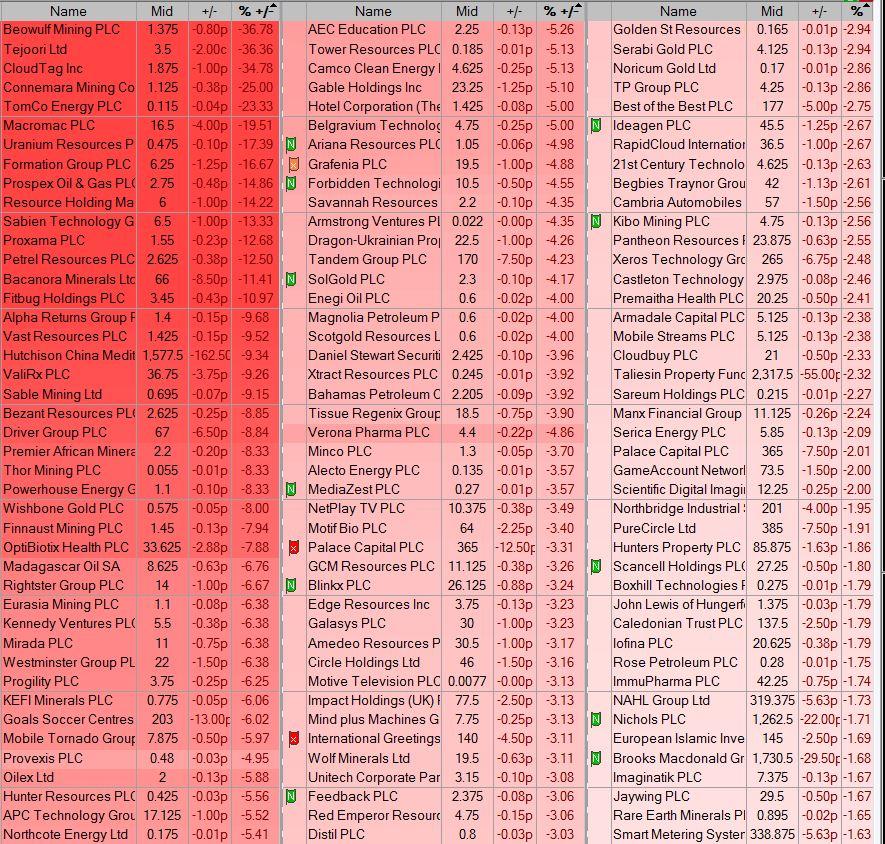
AIM movers: Power Resources proposed uranium joint venture and CRISM Therapeutics shares continue to decline

1

Eleco (LON: ELCO) shares have risen 13% to 121.5p ahead of the construction and asset management software provider’s AGM on Tuesday. This is the highest level since 2021. The switch from software sales to a SaaS model is beginning to show through in improving profit momentum.

Power Metal Resources (LON: POW) has secured a £2m loan note investment from ACAM, which is also negotiating a uranium-focused joint venture, which would include all of Power Metal’s uranium licences. This would mean that the flotation of Uranium Energy Exploration will not happen – that has already cost £500,000 – and neither will previously proposed disposals. There would be a £10m investment in Power Metal Resources Canada so that ACAM would have a 70% stake. The loan notes bear interest of 10%/year and there will be 13.3 million warrants issued that are exercisable at 15p each. The share price increased 11.8% to 19p.

Deltic Energy (LON: DELT) has been granted an extension to 12 June to seek ways of funding its share of the costs of the North Sea Pensacola well, where it has a 30% working interest. This cost could be £15m. Deltic Energy would have to withdraw from the licence if not funding partner can be secured and discussions are ongoing. Canaccord Genuity has a NPV10 based target price of 110p, which includes 90p for the 25% working interest in the Selene target, where Deltic is fully funded for the well. The share price recovered 10.6% to 13p.

Mosman Oil & Gas (LON: MSMN) is paying $500,000 for a 10% interest in a US helium project in Las Animas County, Colorado. This is an area with known helium deposits. There are five helium prospects and a well will be drilled for each of them. The sale of oil and gas asset will help finance the move into helium. The share price improved 9.3% to 0.0235p.

FALLERS

Beacon Energy (LON: BCE) has not been able to produce a stabilised flow rate from the SCHB-2 sidetrack in the Erfelden field in Germany. Based on bottom hole pressures and flow rates obtained the initial response from the reservoir was poor. The well will be temporarily shut-in and data analysed. This well was expected to produce 9,000 barrel of oil equivalent/day. This cash would have funded further exploration and development. The share price slumped by four-fifths to 0.0115p.

CRISM Therapeutics Corporation (LON: CRTX) was formed when brain tumour treatment developer Extruded Pharmaceuticals reversed into Amur Minerals Corporation on Friday. The opening share price was 24p, but it ended the day at 11.5p and it has declined a further 21.7% to 9p. Some shareholders in the original mining company are probably not interested in healthcare and want to get out. This may hamper the share price in the short-term. CRISM has developed ChemoSeed, which is a treatment for glioblastoma and high-grade glioma, which are brain tumours where there is no current cure. It is an implantable, bioresorbable drug delivery platform.

Cameroon-focused oil and gas company Tower Resources (LON: TRP) reported a $450,000 loss for 2023. The rig to drill the NJOM-3 appraisal well on the Thali licence will not be delivered until the fourth quarter. This hole will cost $13.4m and the company is seeking a farm-in partner to cover some of that cost. The share price fell 19.4% to 0.0125p.

Bushveld Minerals (LON: BMN) has gained South African government approval for its sale of 64% of Mokopane, but it is still subject to due diligence and change of control for the mining and prospecting licence. Mokopane is a vanadium project. The share price slipped 14.2% to 0.7p.

Shein set for £51bn London IPO

Shein is reportedly preparing to fire the starting gun on its London IPO this week in what will be the highest profile flotation for months.

The fast fashion retail company is thought to be seeking a valuation of over £51bn as London triumphs over New York in attracting Singapore-based Shein.

“It’s rumoured that it could file paperwork for an IPO as soon as this week, which may value the company at more than £51 billion,” said Susannah Streeter, head of money and markets, Hargreaves Lansdown.

Streeter continued to explain that while Shein’s listing will be very welcomed with open arms by London’s struggling capital markets, there are ESG considerations which may prevent some investors taking a stake in the company.

“While New York still holds immense pulling power, and was the company’s first choice, plans for a listing there look unlikely given the lack of a welcome by regulators,” Streeter said.

“This is over its ties to China, where it was founded, and questions raised over its supply chain and working conditions. London looks set to be the second-choice destination and, while this would be a boost for the city, is likely to present deep ESG issues for investors to navigate.”

“Shein has come under significant criticism for the huge volumes of cheap clothes it produces, the lack of transparency in its supply chain and its appropriation of other designers’ work. Given these concerns, investors could be wary if ESG is on their priority list. Nonetheless confirmation of listing may be fresh election campaign fodder for the Conservatives, who are likely to say it demonstrates that government efforts in wooing firms to launch IPOs in London are paying off.”

S&P 500 weekly technical outlook 3rd June

Last week we felt that the index looked vulnerable to a pullback, some selling has materialised in the past few days largely as expected, however the selling was not enough yet to feel that the sentiment is over.

The Dow Jones in comparison has moved back to its recent lows, for the S&P 500 to post a comparable move it would need to slide down towards the 5,100 area highlighted by us in recent weeks.

The index has been in a broad bull run for the past year, wide blue channel. Within this broad channel price action had found some resistance from the parallel black line, which then became support on the minor weakness in April.

This support area continues to be the natural area for significant buying interest. So we are still concerned that the index could slip towards the 5100 area in the coming days before the buyers are confident enough to move back into the market in enough scale to turn the market. Also there are some signs that the “AI bubble” which had been powering the market is starting to cool

Leaving a cautious outlook again for the week ahead. On any move down towards the 5,100 area we would need a clear break lower to turn more outright negative, as for the moment it is more that the AI led buying of recent months has cooled and that some of the fizzle has left the market, rather than there being any serious signs yet that the powerful 12 month bull trend is under threat.

Beacon Energy shares crater after disappointing Schwarzbach update

Beacon Energy shares sank on Monday after the oil and gas exploration and production company with onshore assets in Germany released an update on its Schwarzbach 2(3.) sidetrack well in the Erfelden field.

The company has been unable to establish a stabilised flow rate from the reservoir, and the drill rig is being demobilised. Such was the extent of investor disdain for the update, Beacon Energy shares were down 78% at the time of writing.

The sidetrack well extended 85 meters from the original wellbore at a depth of 2,145 meters, placing it approximately 9 meters away from the original well in the Lower PBS formation.

After installing a production liner and electric submersible pump (ESP), the well began producing intermittently with frequent stalling issues preventing a stabilised flow rate.

Initial data suggests a poor reservoir response, with bottom-hole pressures and flow rates lower than expected. As a result, Beacon has temporarily shut-in the well to allow the drilling rig to demobilise. During this time, the company will obtain pressure build-up data to better analyse the reservoir performance.

“Having safely drilled the SCHB-2 sidetrack and installed the ESP, it is disappointing a sustained flow rate has not yet been achieved. Whilst pressure build up data, to be obtained in the coming days, will provide clarity, the initial response from the reservoir appears disappointing,” said Stewart MacDonald, Incoming CEO of the Beacon Energy.

“Following reconnection to the production facility, a long-term stabilised flow rate should be established. We remain convinced that Erfelden is a material and potentially highly valuable onshore oil discovery with Best Estimated recoverable reserves of 7.2mmbbl.  The Company will now consider its options to maximise the value of the resource we have discovered.”

AIM reversal: CRISM Therapeutics brain cancer treatment potential

Brain tumour treatment developer Extruded Pharmaceuticals reversed into Amur Minerals Corporation, which had sold its mining asset and become a shell, to form CRISM Therapeutics Corporation on 31 May. There was a one-for-160 share consolidation prior to the readmission.
The shell had cash in it, but it will not last long. Management believes that there is enough to start a phase II clinical trial for the ChemoSeed implantable, bioresorbable drug delivery platform.
The opening share price was 24p, but it ended the day at 11.5p after more than 145,000 shares were traded – mainly sells. The share...