

Foresight Sustainable Forestry Company provides investors the opportunity for real returns and capital appreciation driven by the prevailing global imbalance between supply and demand for timber; the inflation-protection qualities of UK land freeholds; and biological tree growth of 3% to 4% not correlated to financial markets. The Company targets a net total return of more than CPI +5%.
Aquis weekly movers: Apollon Formularies disposal progress

Apollon Formularies (LON: APOL) has executed a binding letter of intent with Sproutly Canada Inc, who will acquire the assets of the cannabis-based drug discovery company. After completion of due diligence, the assets will be acquired in return for shares equivalent to 49% of Sproutly. The effective valuation is C$7m (£4.2m). Sproutly has to go through audits and other regulatory requirements to become active and trading on the Canadian Stock Exchange. The share price soared 117% to 0.1625p.
Fuel additives SulNOx Group (LON: SNOX) says it requires new equity investment from existing and new investors in order to achieve faster and sustainable revenue growth. There would additional industry hires for the board and sales personnel. There will also be increases in stock levels and new products will be developed. The board is seeking shareholder authority to issue new shares. Mohanned Nawaz Haq does not agree with the new strategy and the board recommends voting against his appointment at the AGM on 26 September. The share price jumped 24.6% to 21.5p.
Wishbone Gold (LON: WSBN) says drilling has started at the Red Setter project in Western Australia. Initial targets are at a shallow depth and the company is seeking broad spreads of mineralisation. Drilling at the Cottesloe prospect reinforces previous findings. Additional drilling will be 50% funded by the Western Australian government’s EIS scheme up to a total of A$220,000. The share price is 23.1% higher at 2.4p.
Invinity Energy Systems (LON: IES) says that Canadian company Elemental Energy has commenced operation of the company’s 8.4MWh Invinity VS3 vanadium flow battery. This is the largest operation so far. The share price rose 11.4% to 44p.
EPE Special Opportunities (LON: EO.P) directors and the managing partner of EPIC Investment Partners bought a total of 16,837 shares at 160p each. The share price was up 9.68% to 170p. NAV was 308p/share at the end of July 2023.
Aquis Stock Exchange owner Aquis Exchange (LON: AQX) reported interims showing growth in all four divisions of the group and the Aquis Stock Exchange remains profitable. Group revenues improved from £7.85m to £9.34m, while pre-tax profit rose from £699,000 to £1.15m. Net cash is £13.9m. The share price improved 3.49% to 385p.
FALLERS
Shares in Silverwood Brands (LON: SLWD) have halved to 30p (25p/35p) on the back of the extension of the time to deliver its defence to the legal action by Lush and VSA resigning as corporate adviser and being replaced by Peterhouse. Lush is refusing to recognise the transfer of a 20% stake to Silverwood Brands. VSA owns 0.88% of Silverwood Brands and the value of the investment has slumped.
Medical device developer TruSpine Technologies (LON: TSP) has appointed Victoria Sena and Samuel Ogunsalu to the board. The company is not appealing the disciplinary notice from the Aquis Stock Exchange and the new appointments will improve corporate governance. The share price declined 15.8% to 1.6p.
Cadence Minerals (LON: KDNC) investee company Evergreen Lithium has completed the final analysis of its EXOSPHERE BY FLEET Ambient Noise Tomography geophysics survey at Bynoe. Nine pegmatite targets have been identified. Approvals are required for drilling. The share price fell 9.09% to 7.5p.
Watchstone Group (LON: WTG) had net assets of £7.6m at the end of June 2023, including cash of £8.3m. By 19 September, cash had fallen to £7.6m. The claim against PwC was dismissed by the High Court and Watchstone had to settle legal costs. Canadian legal action continues. The share price fell 8% to 5.75p.
Africa-focused battery metals company Marula Mining (LON: MARU) is considering moving to the standard list as an alternative to AIM. Management believes that this would not add any additional time to the process, and it believes that the proposed investment by Q Global Commodities will make Marula Mining large enough to be eligible for the standard list. It is also planning listings on the Nairobi Securities Exchange and the Johannesburg Stock Exchange. Warrants exercised at 4p/share raised £50,000. A shipment of 27.5 tonne high-grade material processed from stockpiles at the Blesberg lithium and tantalum mine in South Africa has been delayed. The offtake agreement with Southern Jade Resources has been terminated and an alternative agreement is being finalised. Additional drilling at Blesberg is progressing and initial assay results should be published in late October. The share price slipped 7.78% to 10.375p.
Brewer Adnams (LON: ADB) says trading improved in the second quarter and cost savings started to kick in. This partly offset the decline in revenues in the first quarter, but the interim revenues were still slightly lower at £30m. Operating costs and interest charges increased, and the loss trebled to £3.13m. Adnams is taking on new customers, but the average order size has reduced. Trading conditions are uncertain, but the new customer sand listings will help to boost the second half. The share price is 5.98% lower at 5500p.
Newbury Racecourse (LON: NYR) improved interim turnover by 3% to £8.03m, but the company fell into loss because gross margins slumped. The nursery increased its contribution, but there were lower attendances at races. An event in July had the highest attendance for four years. Next year will get the full benefits of the media rights deal. The share price is 3.77% lower at 765p.
Broker and wealth management company Oberon Investments (LON: OBE) has raised £2.5m via a placing at 3.6p/share and a retail offer could raise a further £500,000. The share price dipped 2.78% to 3.5p. The cash will fund expansion, including the recruitment of revenue generating teams. The Winterflood Retail Access Platform offer has a minimum subscription of £50. Investors can apply for shares via their broker or intermediary and the closing date is 4.30pm on 25 September.
AIM weekly movers: Orcadian Energy farm out
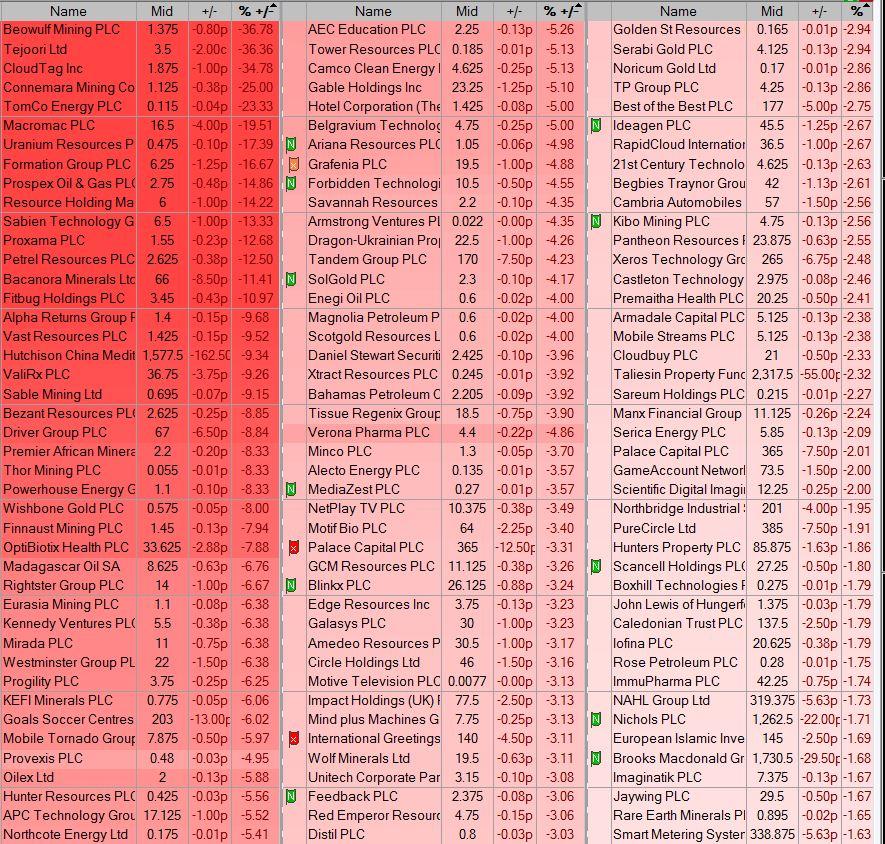
Shares in Orcadian Energy (LON: ORCA) were the best performer on the week and the price quadrupled to 14.25p following the announcement that it has entered non-binding heads of agreement with a North Sea operator to farm out the Pilot project for a full carry until first oil. Orcadian Energy would retain a 18.75% working interest. The agreement includes the drilling of five subsea wells. Orcadian Energy will receive $100,000 when the agreement is completed, plus $100,000 if it is awarded an additional licence. Field development plan approval would trigger a payment of $3m. The company joined AIM in July 2021 at a placing price of 40p.
Scancell (LON: SCLP) reports that early data from the phase II SCOPE study of SCIB1 in combination with checkpoint inhibitors as a treatment for advanced melanoma are positive. Tumour reduction at 13 weeks is 31-94%. This is for a relatively small number of patients, but it does indicate that there is strong potential for the treatment. The second stage of the study has a strong probability of success. This data will be available in the first half of 2024. Potential partners are likely to be interested. The share price improved 60.4% to 16.2p. This is the highest the share price has been since April.
Clean water technology developer MYCELX Technologies Corp (LON: MYX) increased interim revenues by 51% to $5.6m and reduced its loss. The momentum is continuing in the second half and this should continue as environmental regulations are tightened. Canaccord Genuity forecasts a full year loss of $1.6m and it expects at least breakeven in 2024. The share price jumped 49.5% to 72.5p.
Vela Technologies (LON: VELA) shares jumped 44.7% to 0.0275p on the news that Conduit Pharmaceuticals was completing its IPO and started trading on Nasdaq on Friday. This will trigger the option to sell the interest in AZD1656, which relates to a Covid application, to Conduit Pharmaceuticals for £4m.
FALLERS
Eqtec (LON: EQT) announced that the Billingham waste-to-energy project is not going ahead. Potential customers have closed facilities and the project is behind schedule. So far, £4m has been invested. There is a possibility of getting some of this cash back. Eqtec is also taking legal action against its partner in the Deeside project, seeking repayment of £4m of loans. The focus is other European markets. Forecast 2023 revenues have been slashed by more than three-quarters to €2-3m. Net debt is expected to be €5.7m and double that at the end of 2024. More cash will need to be raised. The share price dived 51.6% to 0.075p.
Trading has deteriorated since August at replacement windows supplier Safestyle (LON: SFE) and it is expected to lose £10m in 2023. Order levels are falling short of budget. Net debt could reach £6m at the end of 2023 – the credit facility is £7.5m. Management wants to strengthen the balance sheet. The share price slipped 39.9% to 4.81p.
Harvest Minerals (LON: HMI) reported interims showing a near-doubled loss as demand for fertiliser fell and pricing was lower in the period. The second half sales are normally much greater than in the first half, but they continue to be disappointing. Low crop prices mean that farmers are not investing to boost production. Cash has declined and the company has moved into net debt of £1.4m, partly due to a jump in inventories. The share price fell 39.5% to 1.3p.
Shares in Strix (LON: KETL) slumped on the decision to cut the interim dividend from 2.75p/share to 0.9p/share because of high borrowings. Acquisitions have pushed up net debt to £93.1m. There was a strong contribution from recent acquisition Billi, but the economic recovery has been slower than expected hitting kettle controls revenues. Revenues are recovering, but higher interest rates meant that interim pre-tax profit has dived from £11.6m to £5.7m. Chief executive Mark Bartlett bought 51,732 shares at 57.7p each, which helped the share price to recover at the end of the week, but it was still down 34.4% to 59.9p.

FTSE 100 supported by domestic-facing stocks, weaker pound
The FTSE 100 was supported by domestic-facing UK shares and weaker sterling on Friday after the Bank of England paused its hiking cycle on Thursday.
A rally in UK banks and housebuilders reflected relief from the pressure of constantly rising interest rates as Lloyds rose 3% and Barratt Developments added 1.3%.
Stocks reliant on the UK consumer also enjoyed marginal improvements in UK retail sales data and consumer confidence released on Friday.
“UK retail sales have edged up 0.4% following a sharp drop in July caused by wet weather. This coincides with news that UK consumer confidence has reached a 20-month high, with GfK’s consumer confidence index showing a four point rise to a net minus 21,” said Sophie Lund-Yates, lead equity analyst at Hargreaves Lansdown.
Frasers Group and Auotrader were among the gainers in Friday afternoon trade.
However, improving UK economic data was not enough to provide support for the pound which hit multi-month lows against the dollar on Friday.
The Bank of England’s decision to keep rates on hold has been bearish for the pound while the Federal Reserve’s suggestion they will keep rates higher for longer has helped lift the dollar.
Weaker GBP/USD provided additional support for the FTSE 100 with many overseas earners in positive territory. Miners were higher as commodity prices rallied.
Ocado was the top riser after recovering some of their 20% decline yesterday.
Although neither company is listed in London, the big news on Friday was the UK CMA’s approval of the Microsoft takeover of Activision.
Microsoft’s Activision takeover is set to be approved in the UK

The UK’s Competition and Markets Authority (CMA) announced that it has revised its view on Microsoft’s acquisition of Activision Blizzard and paved the way for the takeover to proceed.
At the end of 2022, the tech giant announced its intentions to buy Activision Blizzard for $95 per share, valuing the deal at $68.7 billion.
The deal faced some obstacles related to the CMA’s concern about Microsoft monopolising the online gaming industry. That changed after Microsoft’s decision to sell Activision Blizzard´s cloud streaming rights to Ubisoft, which prevents the tech giant from having complete control over Activision’s cloud gaming content.
But, according to the Market Authority´s report, “The CMA considers that the restructured deal makes important changes that substantially address the concerns it set out in relation to the original transaction earlier this year”.
“In particular, the sale of Activision’s cloud streaming rights to Ubisoft will prevent this important content—including games such as Call of Duty, Overwatch, and World of Warcraft—from coming under the control of Microsoft in relation to cloud gaming.”
According to Sophie Lund-Yates, lead equity analyst at Hargreaves Lansdown, Microsoft’s decision to sell Activision’s cloud streaming rights to Ubisoft “eradicates concerns that Microsoft would be able to gatekeep Activision’s content and withhold it from rivals. The loss of the cloud gaming rights is not an ideal concession for Microsoft to have to make, but it is necessary collateral if the deal is to be waved through. This looks to be the final bump in the road, and approval should be just around the corner in what is ultimately a win for Microsoft.”
The merger is still likely to pave the way for Microsoft to become a major stakeholder in esports and to consolidate its leading position within the cloud gaming industry.
The merger is still pending in the US but has already been approved in the EU, Japan, Brazil, Chile, China, Ukraine, Saudi Arabia, South Africa, Serbia, South Korea, and New Zealand.
AIM movers: OPG Power Generation prospects improve and Comptoir moves into loss
OPG Power Ventures (LON: OPG) is the highest riser today even though it will not publish its 2022-23 accounts by the end of September and trading in the shares will be suspended on 2 October. The figures should be in line with expectations. The Indian coal-based power generator says demand for electricity has grown 9% and renewables capacity is not expanding as quickly as expected. Coal prices are falling, and plant load factors should improve. Net cash was £18.6m at the end of August 2023. The share price increased 30.3% to 10.75p.
OptiBiotix Health (LON: OPTI) has secured the launch of its SlimBiome, GoFigure and Snacksmart products on Boots online store. They will go on sale in the first quarter of 2024, and they could be in stores by May. The share price continued its recovery and is 18.9% higher at 26.75p.
Insurance company R&Q Insurance Holdings (LON: RQIH) confirms that it is in talks to sell its programme management business, Accredited to Onex Corporation. The company is also considering legally separating R&Q Legacy. The share price is 13.6% ahead at 55.6p.
Invinity Energy Systems (LON: IES) says that Canadian company Elemental Energy has commenced operation of the company’s 8.4MWh Invinity VS3 vanadium flow battery. This is the largest operation so far. The share price rose 4.76% to 44p.
FALLERS
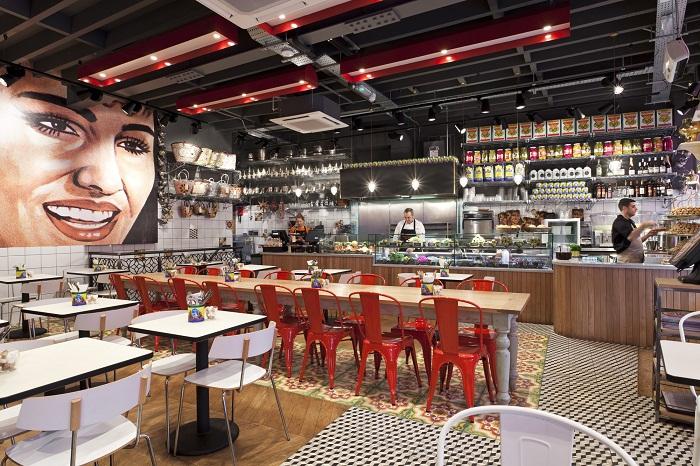
Restaurants operator Comptoir (LON: COM) grew like for like interim revenues by 6%, but it fell into loss because of increasing costs and the removal of government assistance. Net cash was £5.7m. There are plans for two new sites. The share price declined 15.8% to 6p.
Katoro Gold (LON: KAT) reported a cash outflow of £376,000 in the first half before cash generated from a share issue. There was £25,000 in the bank at the end of June 2023. The share price slid 11.8% to 0.075p.
Vast Resources (LON: VAST) says a small number of workers at the Baita Plai polymetallic mine have gone on strike. Salary payments were delayed because the company was waiting for a cash from a concentrate shipment. The cash has been received. The share price fell 9.52% to 0.19p. Gemfields (LON: GEM) is not paying an interim dividend as revenues declined from $193m to $153.6m, while EBITDA dipped from $105m to $73m. The cash balance fell from $82m to $62m. Production is declining at the Kagem emerald mine and gemstone prices are lower. The Montepuez ruby mine is expected to come into production in the first half of 2025. The share price is 5.36% to 13.25p.
Google is being sued after a man was led to death by maps

Late at night in September 2022, Philip Paxson died after following Google Maps’ directions to a collapsed bridge. Now his family is suing Google for negligence.
According to the lawsuit, the bridge in North Carolina, US, collapsed in 2013. Over the years, the company has received multiple complaints about the bridge´s malfunction but has done nothing.
Google´s spokesperson, José Castañeda, said that:
“We have the deepest sympathies for the Paxson family. Our goal is to provide accurate routing information in maps, and we are reviewing this lawsuit.”
The route through the Snow Creek Bridge, known as the “Bridge to Nowhere” by locals, remains active.
The lawsuit also targets Google`s parent company, Alphabet Inc., the owner of a piece of land where the bridge is located, and the individuals responsible for its maintenance.
The bridge is usually surrounded by warning signs and barricades, but those were “removed after being vandalised and were missing at the time of Paxson’s wreck”, reported the Charlotte Observer.
Philip Paxson`s widow, Alicia, said:
“Our girls ask how and why their daddy died, and I’m at a loss for words they can understand because, as an adult, I still can’t understand how those responsible for the GPS directions and the bridge could have acted with so little regard for human life.”
Premier African Minerals shares edge higher as lithium production set to resume

Premier African Minerals shares edged higher on Friday as investors positioned for the recommencement of lithium production at the flagship Zulu project.
The company has completed the installation of much-needed processing machinery and is set to resume open-pit mining from next week.
Premier African Minerals shares were 1% higher at 0.52p at the time of writing.
Premier is required to ramp lithium production up to 1,000 tonnes per month by 1st November 2023 or face penalty payments contracted with offtake partner Canmax.
The next month will be crucial for meeting these targets and investors will be on the edge of their seats waiting for further updates.
“Subsequent to our update of 23 August 2023, I am pleased to confirm the completion of the installation of the Mill including all necessary feeds and discharge components, pumps, control circuitry and grinding media requirements that is expected to support planned production of up to 1,000 tons per month of spodumene from November 2023 at Zulu,” said George Roach, CEO, in a statement issued yesterday.
“The commissioning phase is now planned to commence from today with first material expected to be fed through the Mill on Monday, 25 September 2023.
“Open pit mining operations at Zulu are expected to resume next week and while there is already substantial material on the run-of-mine pad, it remains critical that the plant has sufficient ore for current processing.
“Further updates will follow in Premier’s unaudited interim results for the six months ended 30 June 2023 which will be published on 29 September 2023.”
Bank of England’s surprise rate hike pause fails to take FTSE 100 higher
The Bank of England made the surprise decision to keep rates on hold on Thursday, with the nine voting members split five to four on whether to keep interest rates at 5.25%.
The FTSE 100 did pop higher in the immediate reaction, but the rally faded shortly afterwards, and London’s leading index was trading down 0.25% at 7,712 at the time of writing.
The FTSE 100 touched lows of 7,674 earlier in the session.
The skittish nature of UK stocks in the aftermath of the decision to keep rates on hold after 14 consecutive hikes reflects division in the Bank of England and the mixed picture of the UK economy.
“There were a lot of moving parts for the Bank of England (BoE) to contend with going into today’s decision. But, with yesterday’s core print still three times higher than the BoE’s target and wage growth remaining strong, the BoE clearly want to stamp inflation into the ground for good,” said Giles Coghlan, Chief Market Analyst consulting for HYCM.
“However, there is a risk that the ‘lag effect’ on interest rate hikes means that today’s decision may not be felt for another 9 to 12 months. As such, with economic growth already faltering and core inflation remaining high, today’s hike runs the risk of overtightening the economy and inducing a period of stagflation further down the line.”
As an ultra interest rate sensitive sector, Housebuilders were among the top risers on Thursday and built on yesterday’s gains. Taylor Wimpey was 1.6% higher, and Barratt Developments had gained 1.8% at the time of writing. Both were well off session highs.
While keeping rates steady at 5.25% is good for housebuilders and the UK property market, there is the question of what the Bank of England knows about the health of the UK economy that we don’t.
For the BoE to hold off hiking rates while inflation rates are still at 6.7% suggests they see a weakening in the UK economy, which would warrant keeping rates on hold.
With the Bank of England and Federal Reserve both keeping rates on hold in the last 24 hours, attention will very quickly shift to growth rates and what they mean for company earnings.
JD Sports & Next
Insight into the health of UK consumers was provided by Next and JD Sports on Thursday, who both reported positive first-half trading. The two were the FTSE 100’s top risers, with Next gaining 3.2% and JD Sports surging 6%.
Next increased their profit guidance for the year while JD Sports reported strong organic growth.