FTSE 100 hit by stronger pound

A stronger pound sent the FTSE 100 lower on Tuesday as the Brexit deal on Northern Ireland helped lift sterling against the dollar.

The breakthrough agreement saw GBP/USD rise 0.5% to 1.2131 and FTSE 100 slip back beneath 7,900.

While the agreement is good news for the UK economy and UK companies, it is not favourable for London’s leading index packed full of companies earning their revenue overseas. The FTSE 100’s overseas earners suffer in periods of sterling strength, and are supported by a weaker pound.

The FTSE 100’s inverse relationship with the pound has become prevalent in periods of market volatility related to Brexit negotiations ever since the vote to leave in 2016. Today’s deal between the UK and EU was no exception.

FTSE 100 sectors exposed to the UK including financials, banks and housebuilders rallied on the agreement, but their support was not enough to offset losses in overseas earners. Kingfisher was a notable riser, gaining 4%.

Heavyweights including AstraZeneca, Diageo, Unilever and British American Tobacco were all weaker on the day and dragged on the index.

Ocado

A disappointing update from Ocado meant the premium online retailer was the FTSE 100’s worst performer, falling as much as 10%.

Ocado’s 2022 revenue edged fractionally higher but the cost of living crisis was blamed for lower average basket sizes and there was little improvement in their solutions business EBITDA.

“Ocado: so much promise and so little joy. Three years ago, it was on the cusp on a significant shift in consumer behaviour. The pandemic forced people to buy their groceries online, meaning any company that didn’t have a robust set-up to pack and deliver food and drink to households had to think fast to gain this capability,” said Russ Mould, investment director at AJ Bell.

“Ocado had the best moment in its existence to sell its technology platform to grocers around the world. Sadly, the deals have been few and far between, leaving investors wondering when it will ever make a sustainable profit.”

abrdn

Investors were pleased with abrdn’s robust 2022 full report and confirmation their strategic plan was beginning to bear fruit. A focus on their Adviser and Personal business, which includes the acquisition of Interactive Investor, helped offset weaker revenue from their Investments unit due to poor market conditions.

“We are building a stronger abrdn. As we exit year two of our three-year strategic plan, the structure of our group is now broadly set. We are increasingly well positioned for growth,” said Stephen Bird, Chief Executive Officer of abrdn.

“In one of the toughest investing years in living memory, the resilience we have created in our business model helped us to deliver adjusted operating profit of £263m.”

abrdn shares were 4% higher at the time of writing.

Videndum – record results point to an even better 2023

FTSE 250 company Videndum (LON:VID) is certainly growing at a very good pace.

The international provider of premium branded hardware products and software solutions to the growing content creation market, has reported excellent results for its 2022 Trading Year.

With 90% of its revenue coming from professional content creators, the group showed an impressive 14% growth in sales to £451m (£394m), with a 27% advance in pre-tax profits to £54.0m (£42.4m), taking earnings up 29% to 90.1p (69.9p), enabling an increase of 14% in its dividend to 40p (35p) per share.

CEO Stephen Bird stated that:

“Videndum delivered another record performance, despite a challenging H2 2022 macroeconomic environment. This is testament to the quality of our people, operational excellence and our leading, premium brands which allow us to manage pricing to more than offset inflationary headwinds. We executed well on our strategy, delivering organic growth, margin improvement, good cash generation and growth through M&A.”

The Business

Uniquely positioned at the heart of the content creation market, the group which used to be called The Vitec Group, has been transformed over the last decade.

Videndum’s customers include broadcasters, film studios, production and rental companies, photographers, independent content creators, vloggers, influencers, gamers, professional sound crews and enterprises.

The group’s product portfolio includes camera supports, video transmission systems and monitors, live streaming solutions, smartphone accessories, robotic camera systems, prompters, LED lighting, mobile power, carrying solutions, backgrounds and motion control, audio capture and noise reduction equipment.

Employing some 2,000 people across the world in 11 different countries, the business is organised into three Divisions: Media Solutions, Production Solutions and Creative Solutions.

The fundamental growth drivers of the business have remained very positive, underpinned by technology change driving shorter product replacement cycles.

The group’s market-leading, premium brands allow it to manage inflationary headwinds with pricing actions and to manage its supply chain challenges.

Conclusion – market price estimates of 1500p for the shares

The £423m capitalised group has shown a very impressive trading year in 2022, hopefully it will continue to do so in 2023.

The company’s shares fell 20p to 910p on the results, but there are currently market estimates suggesting a Target Price of over 1500p in the due course.

Travis Perkins, Cadence Minerals, and Kavango Resources with Alan Green

Alan Green joins the UK Investor Magazine Podcast for our regular instalment of companies and markets.

This week, we discuss:

  • Travis Perkins (LON:TPK)
  • Cadence Minerals (LON:KDNC)
  • Kavango Resources (LON:KAV)

We start with exploring the current FTSE 100 trading range and whether a break to the upside, or downside, is more likely.

The first company we discuss is Travis Perkins and their full year results. Cost inflation has dogged numerous companies and Travis Perkins is not immune. Travis Perkins revenue rose 8.9% but operating profit margin was eroded by higher input prices.

Cadence Minerals has a broad portfolio which is broken down and attention paid to their current valuation.

Download Kemeny Capital Cadence Minerals report.

We conclude with a look at Kavango Resources.

AIM movers: Safestay occupancy recovers and Baron Oil disappoints

1

Hostels operator Safestay (LON: SSTY) generated higher than expected revenues in 2022 as occupancy levels continue to rebuild reaching 63%. There are Safestay hostels across Europe in cities, such as Barcelona and Pisa. Revenues were £19m, compared with a forecast of £17.9m. A small pre-tax loss is forecast with a move back to profit expected this year. The share price jumped 27.5% to 25.5p, which is the highest it has been for nearly three years.

Diagnostics tests developer Abingdon Health (LON: ABDX) says interim revenues fell from £1.7m to £1.1m but second half revenues will be significantly higher. Abingdon Health has broadened its customer base. There is £4.4m in the bank. Breakeven could be achieved during 2024. The share price recovered 15% to 5.75p.

Online brand protection services provider Brandshield Systems (LON: BRSD) increased annual recurring revenues by three-fifths to $8.42m, with client numbers almost trebling to 183. More than two-thirds of customers are in North America. The trading statement says that reported 2022 revenues are 55% ahead at $6.39m, but there will be a significant loss. Shore expects 2023 revenues of $9.4m and a reduced loss. The share price moved up by 13.7% to 5.8p, but it is still near to its low since Brandshield reversed into Two Shields Investments.

WH Ireland has upgraded its 2023 forecasts for LifeSafe Holdings (LON: LIFS) after the fire safety products supplier published a full year trading statement. The 2022 revenues were £3.9m, having been £1.3m at the interim stage. US sales are accelerating. The 2023 forecast revenues have been raised from £5.5m to £6.5m with a slight reduction in the loss to £400,000. The share price reached a new low on Monday but is 12.1% ahead at 37.5p.

Baron Oil (LON: BOIL) has published the competent person report on the 75%-owned Chuditch gas project, which shows lower than expected prospective resources. Even so, Allenby believes that the 1.1tcf contingent resource for the Chuditch-1 discovery underpins the potential and it has increased its risked valuation of Chuditch to 1.027pa share. Baron Oil has until 18 June to make a drill or drop commitment. The share price fell 15.1% to 0.175p.

Super capacitors developer CAP-XX Ltd (LON: CPX) has been hit by supply problems and destocking. Interim revenues fell by one-third and the second half recovery will not be as strong as previously thought. Cenkos has cut its 2022-23 forecast revenues from A$8.33m to A$4.18m and slashed its estimate for next year. CAP-XX is expected to move to a net debt position by June 2023. The share price is 10.2% down at 2.65p – a new low for the year.

Beowulf Mining (LON: BEM) says there was a 73.5% take up of its rights issue, which raised £5m. This is on top of the £1.4m raised in a placing and PrimaryBid offer at 2.06p a share. The share price fell 9.89% to 2.05p. There was £1.78m in the bank at the end of December 2022, but also £1.85m of borrowings. The cash outflow from operations and investing in 2022 was just over £3m.

Block Energy (LON: BLOE) has started testing on the WR-B01Za well in the West Rustavi / Krtsansi field in Georgia. Data indicates a good reservoir containing oil and significant gas. Even so, the share price declined 9.52% to 0.95p.

McBride – a much cleaner profits recovery is in sight

We all know this group’s household and personal care products and it sells over 1bn of them a year.

It is the leading European manufacturer and supplier of private label and contract manufactured products for the domestic and professional cleaning/hygiene markets,

However, over the last couple of years its trading has been tough.

The pace of cost inflation and price increase negotiation time lags helped to push the group into significant losses.

But it is now becoming apparent that measures taken by the group’s Management have been effective and will take it back into profitability in its next year to end June 2024.

For the six months to end December from its continuing operations the group had a turnover of £426.3m (£323.4m).

The half-year adjusted operating loss of £7.9m (£16.9m) was due primarily to exceptional raw material, packaging, logistics, energy and labour cost rises, which were unable to be fully recovered by price increases in the first half. 

 CEO Chris Smith stated that:

“The first half year required continued high levels of attention to margin recovery in light of ongoing inflationary pressures. Whilst there are some early signs of stabilisation in certain input costs, many raw material costs remain historically high. Energy and employment costs continue to apply further inflationary pressure, and accordingly, we continue to action mitigations including price increases, product engineering and cost control.

It is pleasing to have returned to positive adjusted operating profit in the last two months of the period, with momentum improving into the second half as a result of higher volumes from new business wins, better customer service levels and pricing actions fully annualising. All of this is supported by consumer behaviour creating a more favourable environment for private label products.

Group Operations

Established way back in 1927, the Manchester-based McBride (LON:MCB), manufactures and sells private label household and personal care products to retailers and brand owners in the UK, Germany, France, Australia, the rest of Europe, the rest of Asia-Pacific, and otherwise internationally.

The company operates through five segments: Liquids, Powders, Unit dosing, Aerosols, and Asia Pacific.

It employs 3,400 people across 18 locations in 12 countries.

The group develops, manufactures and distributes products for both Private Label clients in the retail segment and Contract Manufacturing for established brands. 

In addition, it also has a growing portfolio of its own successful brands within the household category.

Analyst Opinion – estimates of profits in the next year

The consensus view is that the group will this year, to end June, see sales up £200m to £874m, while the massive £35.3m loss of 2022 will be sliced back by £10.0m to £25.3m.

For the coming 2024 June figures some £911m sales are estimated, with a bounce back to £3.55m of pre-tax profits.

Conclusion – shares could move forward again

Five years ago this group’s shares were trading at around 160p, a year ago they were down to 50p.

They are now 24p, at which level the whole group is only valued at £42.5m.

With the hopes of a recovery into profits over the next year or so the shares could well start to move forward again.

Ocado shares sink as higher costs lead to EBITDA loss

Ocado shares were falling on Tuesday after the premium online food retailer said that although revenue had marginally increased, higher costs caused a swing to an EBITDA loss.

Ocado’s 2022 revenue rose 0.6% to £2,513.8m but increasing costs saw EBITDA swing to a £74.1m loss. The cost of living crisis meant customer average basket value fell while active customer numbers grew 13% to 940,000.

“Ocado Retail has seen losses mushroom. Despite a 13% increase in active customers, volumes haven’t followed suit, meaning the cost to serve all those online orders has become a burden,” said Sophie Lund-Yates, Lead Equity Analyst at Hargreaves Lansdown

“Ocado is in the eye of the cost-of-living storm because its offering isn’t synonymous with being the best value, it’s a higher-end option, without the same benefits of enticing people in with tangible, physical goods like M&S or Waitrose can.”

“One quarter of British shoppers are struggling as grocery price inflation goes above 17% for the first time, according to new data from Kantar. It was a year ago that food inflation climbed above 4%, meaning consumers now feel like there’s a hole in their wallet every time they reach the checkout.”

Ocado’s retail business revenue was £2,203m in 2022, a 3.8% reduction from 2021’s £2,289m.

Ocado Costs

Growth in Ocado’s solutions business propped up revenue as their international solution business revenue 122% grew to £148m, but the revenue increase failed to add any meaningful impact to EBITDA. This accentuated the increase in administration and distribution costs that was responsible for the swing to a group EBITDA loss.

The group continue to win new Customer Fulfilment Centre (CFC) contracts and now has 23 sites live with a further 6 expected to come online in 2023.

Ocado signed two new Ocado Smart Platform contracts in 2022 to bring the total to 12 partners.

Despite the progress in the solution business, Ocado said they expect it will take 4-6 years for the group to become cashflow positive.

Ocado shares were trading down 9% to 567p at the time of writing on Tuesday.

FTSE 100 jumps as UK nears agreement with EU

The FTSE 100 enjoyed improving sentiment on Monday as the UK neared a deal with the EU over the Irish border and the pound avoided capping the FTSE’s gains with only a minor move against the dollar.

“The FTSE 100 made a strong start to the week as investors shrugged off the inflation and interest rate concerns which bedevilled markets last week,” said AJ Bell investment director Russ Mould.

“This went against the prevailing mood in Asia which followed in the footsteps of the US in seeing material declines after a key inflation reading closely watched by the US Federal Reserve came in ahead of expectations.”

While interest rates and the dynamics of overseas economies dictated trade last week, the focus was firmly back on the UK economy and relations with the EU on Monday.

The prospect of a greater cooperation with the EU helped lifted sentiment, but it was the move – or the lack of a move – in the pound that helped the FTSE 100 index rally.

Good news for the UK economy and a rising pound tends to curtail upside in the FTSE 100 and the absence of a strong sterling rally against the dollar provided support for London’s overseas earners.

“With no big fire lit under sterling and recent weakness persisting,  it has given support to the internationally focused FTSE 100, which benefits from a weaker pound given that it boosts earnings made overseas in dollars,” said Susannah Streeter, head of money and markets, Hargreaves Lansdown.

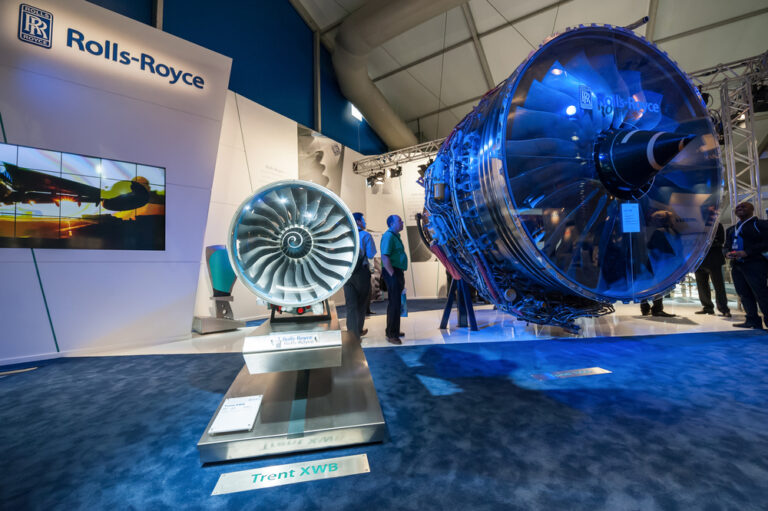
Rolls Royce

Rolls Royce was the FTSE 100 top gainer as it continued the rally sparked by last week’s upbeat results. Rolls Royce is now up 52% in 2023 – no other FTSE 100 stock has performed better.

AB Foods was among the gainers after the Primark-owner said sales had increased 20% in their first half. AB Foods warned input cost inflation would mean operating profit are likely to be flat in 2023, although their outlook had slightly improved.

“Primark owner Associated British Foods painted a positive picture with its latest trading update. There’s good news on both demand and costs which has helped the company lift its guidance,” said Russ Mould.

“Resilient spending at Primark could well reflect the company’s budget credentials, people trading down from more expensive chains and brands. Particularly in areas like kids’ clothes where growth spurts mean clothes have a relatively short shelf life and therefore price rather than quality is a big driver of purchases.

AIM movers: i-nexus Global gains customers and discounted Hercules placing

0

Cloud based software supplier i-nexus Global (LON: INX) shares have jumped 29.3% to 3.75p after a positive AGM statement. This is a recovery from the all-time share price low. Double-digit growth is anticipated. Four new clients have been gained and existing clients are increasing usage.

Management consultancy Elixirr (LON: ELIX) generated better margins than expected in 2022 and guidance for 2023 has been upgraded. The dividend has been increased from 4.1p a share to 10.8p a share. finnCap expects operating profit to grow by an average of 20% a year for the next three years. The share price increased 23.8% to 520p.

Graphene technology developer Directa Plus (LON: DCTA) says 2022 revenues were more than €10.8m, which is higher than the December update figure. This year’s order book is worth €8.8m. There is increasing interest in graphene and a better pipeline of opportunities. The share price is 8.86% higher at 86p.

Mineral sands producer Base Resources (LON: BSE) generated better than expected interim revenues of $127m, although operational cash flow was similar to forecast at $56m. Net cash is around $60m. A dividend of A$0.02 a share has been declared. This will be converted into pounds at the exchange rate on 13 March. Negotiations are progressing for terms for the Toliara project. The share price rose 5.88% to 13.5p.

Hercules Site Services (LON: HERC) reached a share price peak last week, but a heavily discounted placing has knocked the share price by 37.8% to 44.8p. The construction labour provider has raised £1.7m at 45p a share. Last February’s flotation price was 50.5p. The cash will be used to fund growth in the labour supply division. The company has started to supply security and white-collar staff.

Shares in immunology testing business Oncimmune Holdings (LON: ONC) have fallen even though it says it will be operating cash flow positive by the end of the year. Management warns that there are short-term operating and financing challenges. Figures for the 15 months to August 2022 show revenues of £3.79m and this level has already been surpassed in the current financial year. The share price fell 28% to 39p.

Synergia Energy (LON: SYN) says that several companies are finalising due diligence for the farm-out of the onshore India Cambay PSC and an agreement could be secured this year. The Cambay carbon capture and storage scheme has also garnered considerable interest. The share price has fallen 21.5% to 0.1275p because of uncertainty about remediation plans for the Cambay PSC.  

Oil and gas producer San Leon Energy (LON: SLE) denies speculation that the Nigerian National Petroleum Company has taken over the operatorship of OML 18, where San Leon has a 10.58% interest. Eroton remains the operator of OML 18 and any change needs to be agreed formally. Armed men have forced Eroton staff to leave the Alkari gas plant, though. Eroton denies claims of fraud. The San Leon Energy share price has slipped by 15.8% to 22.45p.

Are Lloyds shares the pick of the UK banks?

Lloyds shares have more than recovered the minor losses incurred after they announced full year results last week and are shaping up for a run at the 52-week high of 53.97p.

Lloyds was the last FTSE 100 UK bank to report and wrapped an earnings season for the sector which was largely disappointing for those banks with a focus on the UK economy. 

However, when Lloyds is compared to to NatWest and Barclays, there are many positives to take away.

Lloyds share market reaction

First and foremost is the market reaction. Notwithstanding the variations in each respective companies’ metrics, Lloyds shares had the most favourable immediate market reaction to their results.

Both NatWest and Barclays suffered dearly in the aftermath of their full results with NatWest falling nearly 10%. In contrast, the Lloyds share price slipped only 2% and has since more than recovered their initial losses. While this has little bearing on the future performance of the Lloyds share price, it does highlight the market’s favourable perception of Lloyds shares based purely on 2022 results.

UK bank comparisons

UK banking results for 2022 on an underlying basis were very similar. Lloyds, Barclays and NatWest all reported higher net interest margins and an expansion to the top line.

What set the banks apart were impairments charges, one-off litigation costs, and 2023’s outlook.

2022 Net Interest Margin2023 Net Interest Margin Forecast
Lloyds2.94%> 3.05%
Barclays3.54%> 3.20%
NatWest2.85%around 3.20%

Lloyds Net Interest Margin, a key profitability metric, was by no means the highest of the three UK-focused banking giants. However, Lloyds earns the entirety of their income from the UK through retail and business banking.

Barclays has previously enjoyed the benefits of a strong international and markets business, but in 2022 they suffered a litigation costs of £1,597m due to the over issuance of bonds. This hit their earnings and reduced their 2022 profit before tax compared to 2021.

2022 Impairment Charges (£m)Litigation/Remediation
Lloyds1,510255
Barclays1,2201,597
NatWest337385

Lloyds managed to marginally increase profit before tax to £6,928m, despite a £1,510m impairment charge. This would suggest Lloyds has largely priced in the impact of any up coming economic deterioration, and could even reverse the impairments next year.

NatWest recorded an impairment of just £337m and created the uncertainty of additional impairments next year.

2023 Outlook

In terms of the outlook for 2023, all three of the banks suggest Q4 2022 saw a peak in their net interest margins.

The impact of higher interest rates was evident in 2022 banking results. However, a stabilising inflation rate and the threat of an economic downturn means rates are unlikely to increase much further. Certainly not to the extent we saw in 2022.

This will cap banking net interest incomes and make the bank’s increasingly reliant on increased demand for banking products to generate earnings growth.

As the UK’s largest mortgage provider, Lloyds is well placed to benefit from an upside surprise in UK economic conditions. Lloyds does, however, lack the exposure to international financial markets and investment banking that Barclays does. This could mean Barclays outperforms Lloyds in 2023 if capital markets activities enjoy a revival.

Lloyds Dividend Comparison

Lloyds increased their ordinary dividend for the 2022 full year to 2.4p, an increase of 20%. As a result, Lloyds shares have a historical yield of 4.6%, largely in line with their peers.

However, Lloyds willingness to announce an additional £2bn share buyback sets them apart from peers and is likely a core reason for their recent outperformance.

Ordinary 2022 Dividend (p)Historic YieldAdditional Share Buyback (£m)
Lloyds2.4p4.6%2,000
Barclays7.5p4.3%500
NatWest13.5p4.7%800

It must be noted NatWest paid a rewarding 16.8p special dividend in August.

Lloyds Valuation

From a valuation perspective, Lloyds offers very little value compared to their peers. They trade at a premium to the average earnings and NAV multiples. This would imply Lloyds offers little value but also suggests the market feels Lloyds is a higher quality business and deserves a premium valuation.

Forward Price-to-EarningsPrice-to-EarningsPrice-to-NAV
Lloyds6.96.50.7
Barclays5.54.50.4
NatWest6.270.7

Conclusion

Lloyds higher valuation reflects solid underlying earners and a willingness to front-load bad debts, at a time they are prepared to reward investors with higher distributions.

This makes Lloyds a more stable income option.

However, should we see upside surprises to the global economy and a recovery in capital markets, the Lloyds share price may lag their peers.

Tekcapital’s MicroSalt secures additional distribution before IPO

Tekcapital’s MicroSalt is gearing up for their proposed AIM IPO this year with a raft of new agreements for the low-sodium salt shakers.

MicroSalt’s salt technology has reduced overall sodium content in their salt shakers by 50% while still providing the same taste as normal table salt.

Millions of people suffer from cardiovascular disease and the disease has strong links with high sodium intake. Today’s announcement confirms MicroSalt have ensured their products can no help more people improve their diets through a number of new distribution agreements. 

MicroSalt has said their low sodium salt shakers are now available through UNFI and KeHE Foods. UNFI and KeHE are two of the U.S.’s largest retail food distributors and significantly increases the availability of MicroSalt products across the US and Canada.

“Excess sodium intake is one of the world’s greatest health concerns, and partnerships like these are the best way to make a difference in our efforts to address the sodium challenge. We are proud to have our shakers available at both UNFI and KeHe and truly believe that working together we can make a difference.” Said Rick Guiney, CEO of MicroSalt.

The announcement comes as markets prepare for highly anticipated news on MicroSalt’s AIM IPO. MicroSalt said they had appointed Zeus Capital as their AIM Nomad in December and expectations are they will push on with a listing in 2023.