Superdry – strong Christmas period retail sales but remaining cautious for this year

Boss Julian Dunkerton believes that his iconic Superdry (LON:SDRY) brand now has real momentum and he was delighted by how the group’s retail trading had continued to strengthen.

However, in the first half year, covering the 26 weeks to 29th October, the group was let down by the poor performance of its wholesale operations.

The interim results reported a 3.6% increase in group revenue to £287.2m (£277.2m) with the adjusted pre-tax loss coming out at £13.6m (£2.8m loss).

Including the nine weeks to end December the group saw stores revenues rising 14.3% to £117.7m as its customers returned to the high streets, with the group seeing strong demand for its womenswear, denim and jackets.

The wholesale side suffered from the lagged recovery after Covid combined with shipment timing.

The group is known globally for its distinct collections of affordable, premium quality clothing, accessories and footwear. There are 219 physical stores, around 450 franchisees and licensees, with the group selling in over countries across the world.

Boss Julian Dunkerton stated that:

“The Superdry brand has real momentum and I’m delighted by how our retail trading continues to strengthen. We’ve done this against a difficult macroeconomic backdrop by delivering well-designed, affordable, and responsibly sourced products which have resonated well with customers. 

Our coats performed really well in the run up to Christmas, and womenswear continues to be a highlight for us. Stores continued to recover strongly and online had its biggest ever week over Black Friday, helped by our new ecommerce platform which is delivering real benefits.

Despite the underlying brand recovery, our profits in the first half fell short of expectations mainly due to the underperformance of Wholesale.

Whilst we did trade well through November and December, the outlook for the remainder of the year is uncertain and as a result, we are moderating our profit outlook to broadly breakeven. We don’t expect market conditions to become easier any time soon, but with a new financing package in place and the brand in great health, we approach the year ahead with optimism.”

Analyst Wayne Brown at Liberum Capital has reiterated his view that Superdry shares are cheap and offer significant long-term value. 

For the year to end April 2023 he is estimating £604m (£610m) group revenues, with a £5.8m pre-tax loss (£21.9m profit), but with net debt falling by £20m to £198m.

The coming year sees Brown looking for £645m sales, £8.8m profits and earnings of 8.2p per share.

He has a Buy rating on its shares looking for 500p in due course.

FTSE 100 extends gains after the US grows more than expected

The FTSE 100 extended gains on Thursday afternoon after the United States grew more than expected in the 4th quarter and US tech stocks continued to rally. US GDP grew 2.9% on an annualised basis, compared to estimates of 2.6% growth.

US GDP figures released on Thursday provided the cue for investors to buy risk assets on hopes the damaging recession predicted last year may not come to pass.

After the release of US GDP today, attention will quickly shift to tomorrow’s instalment of US personal spending and housing data. These data points will influence the Federal Reserve’s next decision on interest rates due next month. 

The FTSE 100 was gaining 0.3% at the time of writing.

Despite a raft of updates from UK companies, the focus has largely been on the United States this week and UK equities have broadly been ebbing and flowing in line with markets over the pond.

In addition to key economic data, the US tech sector has been a major factor driving sentiment as giants such as Microsoft and Tesla update investors.

Tesla beat earnings expectations overnight and jumped over 10% on Thursday as US trade began.

Diageo

FTSE 100 stalwart Diageo disappointed markets on Thursday and dragged on the index after the alcoholic drinks company said they saw weaker organic growth. Nonetheless, reported net sales in the six months ended 31st December grew 18.4% in a challenging environment.

“It’s glass half empty time for Diageo, which poured out some resilient results showing a surge in super-premium brand drinks, but disappointed in its outlook for the all-important American market,” said Susannah Streeter, senior investment and markets analyst, Hargreaves Lansdown.

“Shares fell as investors eyed up the lack of cheer ahead as Americans tighten their belts amid the downturn. Diageo has been benefiting from ongoing pandemic habits, when people turned to favourite pricier tipples, including the likes of Johnnie Walker and Tanqueray, for lockdown distraction.”

A sharp increase in net asset value (NAV) helped 3i Group shares rally 9% on Thursday. The private equity and infrastructure group enjoyed a 26.8% increase in NAV for the nine months to 31 December 2022.

Inspecs sees improvement and ex-dividends

0

Slightly higher than expected 2022 revenues and profit were enough to push spectacles supplier Inspecs (LON: SPEC) was enough to push the share price 36.8% higher at 85.5p. The figures are still much worse than expected six months ago due to destocking and poorly performing businesses. Sales were flat at $246m, although there was growth before currency movements. Pre-tax profit is set to more than halve from $17.9m to $7.7m. Trading is improving.

Healthcare data analysis provider Diaceutics (LON: DXRX) beat expectations with revenues 44% higher at £20m, helped by currency movements, and margins are being maintained despite inflationary pressures. Diaceutics has secured two agreements with top ten global pharma companies. The order book is worth £15.6m. Investment in data and technology is being increased. The share price jumped 20.9% to 95.5p.

Competitions organiser Best of the Best (LON: BOTB) reported interim revenues in line with expectations. Two midweek competitions have been consolidated, which will reduce revenues, but profit forecasts are maintained at £5.5m. New shareholder Globe Invest is in discussions with the company concerning potential international expansion. The share price is 15.9% higher at 475p – the highest it has been since July.

Bus operator Rotala (LON: ROL) is returning £10m to shareholders via a tender offer at 55p a share. The share price rose 17.1% to 48p. Eligible shareholder can tender 35.7% of their shares. Cash will be generated by the sale of the Bolton depot and bus fleet.

Battery technology developer Ilika (LON: IKA) will receive a UK grant of £2.8m for development of its Goliath battery and taking a leading role on a 24-month Faraday Battery Challenge collaboration with BMW and Williams. This is designed to develop cost-effective, recyclable batteries. The share price continued its improvement rising a further 15.3% to 56.5p.

Supercapacitors manufacturer CAP-XX (LON: CPX) is the worst performing company with a 29.1% decline to 3.175p after it reported that interim revenues were one-third lower at A$1.6m.  A full year loss of A$1m is expected.

Window fittings manufacturer Titon (LON: TON) slipped into loss last year and it is set to continue to lose money this year. Software problems appear to have been sorted out and supply chain problems are easing. Revenues should start to grow again. The share price slipped 6.67% to 70p. Net cash is £1.7m and Titon is trading at discount to book value of well over two-fifths.

Animalcare (LON: ANCR) says 2022 revenues fell from £74m to £71.6m. Spending on pets has fallen from high levels during Covid lockdowns and distribution agreements ended. Net debt is £5.4m. The share price dipped 6.25% to 187.5p.

Mixer drinks supplier Fevertree Drinks (LON: FEVR) surprised the market with full year revenues 3% below expectations. This led to EBITDA guidance being cut to £36m- £42m. Taking the mid-point of the range that is a reduction of more than one-fifth on the previous consensus forecasts. Costs are continuing to rise, and profit could be flat in 2023. The share price fell 4.43% to 1067.5p, although it had been below 1000p at one point.

Ex-dividends

BP Marsh (LON: BPM) is paying an interim dividend of 1.39p a share and the share price is unchanged at 338p.

Brickability (LON: BRCK) is paying an interim dividend of 1.01p a share and the share price is down 1p to 64.5p.

Panther Securities (LON: PNS) is paying a dividend of 10p a share and the share price is unchanged at 315p.

RWS Holdings (LON: RWS) is paying a final dividend of 9.5p a share and the share price is 8.1p lower at 378.7p.

Solid State (LON: SOLI) is paying an interim dividend of 6.5p a share and the share price is unchanged at 1325p.

Tracsis (LON: TRCS) is paying a final dividend of 1.1p a share and the share price is unchanged at 981p.

CLIQ Digital set for further revenue growth to support shareholder value creation

CLIQ Digital (ETR:CLIQ) sell subscription-based streaming services that bundle movies & series, music, audiobooks, sports and games to consumers globally and are now creating shareholder value through increased revenue.

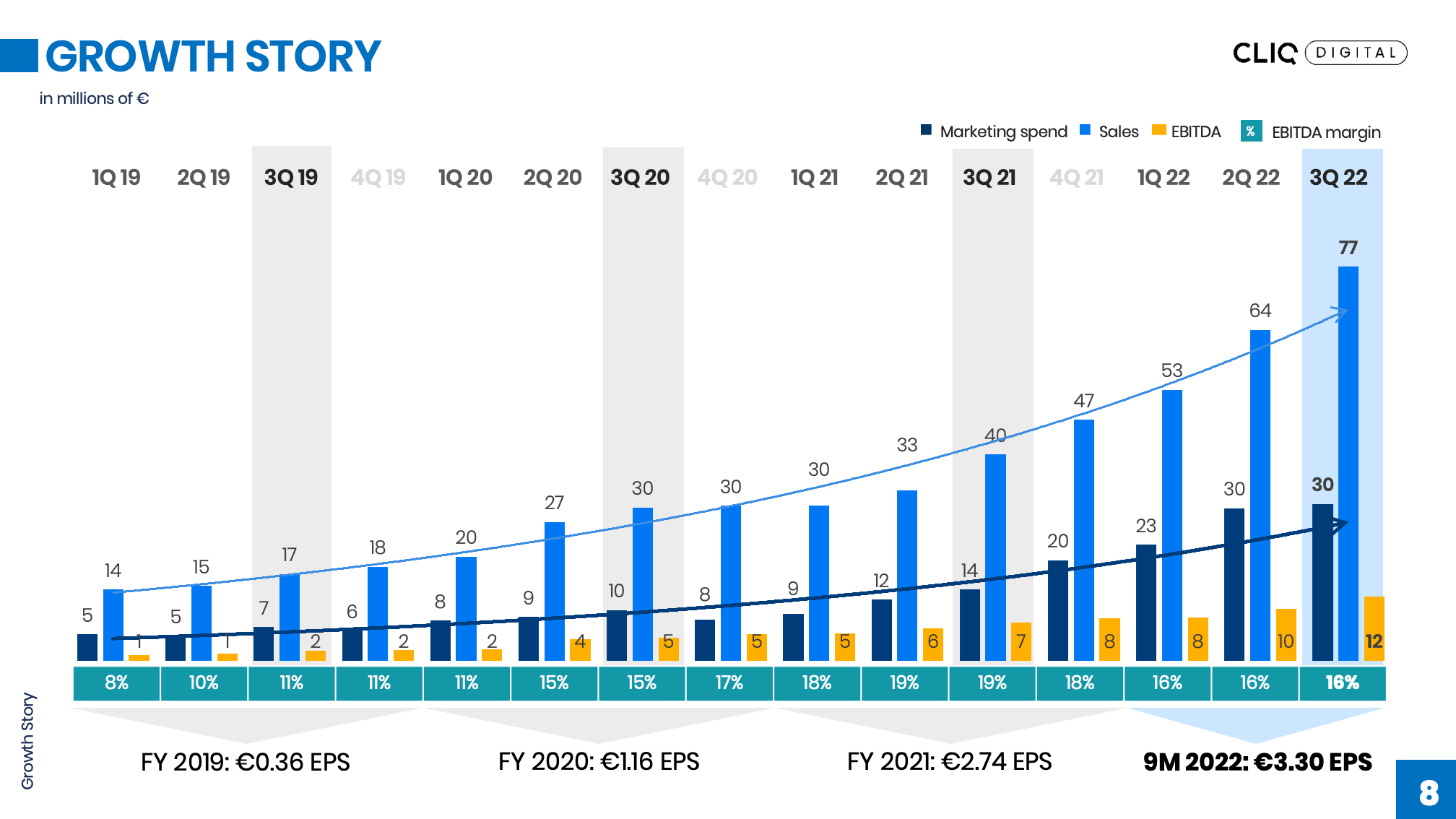
CLIQ Digital have produced consistent revenue growth since the beginning of 2019 and in the most recent quarter recorded a bumper 91% increase in sales. 

CLIQ shares are up 54% over the past year to €28.50 and analysts see additional upside to their median fair value price target of €70.

The company is due to report next week and results will be closely watched for further progress in their key profitability metrics to support their already attractive valuation.

Established market position 

CLIQ’s success lies in their approach to marketing by sparking the interest of the online consumer in numerous streaming services via a well-designed banner, followed by a membership offer which includes a free trial period. To gain traction in a market with a number of incumbent streaming competitors, CLIQ have taken a more personalised approach to securing memberships.

The strategy has been a two-pronged approach in the targeting of individuals with direct personalised marketing and the creation of services appealing to different groups of media consumers. 

Their approach has gained them 1.8 million paid memberships and €8.3m operating free cash flow.

CLIQ Digital have carved out a niche in the streaming market

CLIQ licences its streaming content from partners across those multiple categories. The company stores, bundles and curates digital content in its digital content warehouse. Within the CLIQ Tech Hub data-driven marketing and business knowledge is combined with the company’s digital content warehouse. This enables CLIQ to create attractive streaming services.

Over the years, CLIQ have become experts in online advertising and currently have 1.8 million paid memberships on numerous streaming services across 30+ countries.

CLIQ’s strong track record in building streaming services has brought it closer to achieving its dream: cliq.de – the company’s most advanced all-in-one streaming service for the mass market, which makes streaming content accessible to everyone in Germany.

CLIQ Digital recognises the power of targeted advertising 

The mass marketing approach is not appropriate for specialised streaming service. This is one of the reasons CLIQ is selling a bundled streaming service which includes movies & series, music, audiobooks, sports and games. The all-in-one streaming service enables CLIQ to target a wide variety of consumers with the streaming content they like. Direct marketing focuses on effective cost per acquisition as opposed to expensive brand building. 

To facilitate their long-term growth ambitions, CLIQ have developed an intricate marketing strategy that focuses on converting customers in a cost-effective manner from online advertising campaigns.

Consistently increasing revenue

CLIQ is debt free and have supported their growth through significant increases in revenue. Sales grew 91% in Q3 2022 compared to the same period a year ago. EBITDA grew 68% over the same period.

The company will report 2022 preliminary results 31st January. 

Profit upgrade for Time Finance

0

Small business finance provider Time Finance (LON: TIME) is trading well ahead of previous expectations for this year and this has sparked a profit upgrade. The momentum suggests that there could be further upgrades to come for next year. Time Finance continues to be valued at a large discount to its net tangible assets.

In the six months to November 2022, revenues were 12% ahead at £13.2m, while pre-tax profit was two-thirds higher at £2m. This shows the operational gearing of the business, with admin expenses reducing year on year. Most of the increase in interest rates is being passed onto clients.

Non-core businesses have been sold and the unsecured loan book is being run down. This enables management to focus on the invoice discounting, asset finance and secured loans businesses, while adding selected products to expand the range offered to small businesses.

Lending

In the past six months, the gross lending book has risen from £136.8m to £152.7m. The average deal size has risen to £27,000 and management would like it to be higher. Year-on-year net deals in arrears have fallen from £10.5m to £8.7m, despite that increase in the lending book.

A good spread of sectors means that the company is not dependent on any area. In tough economic times there is likely to be increasing demand from small businesses for the types of finance provided by the company.

There is £40m of headroom in Time Finance’s loan facilities with potential for £15m to be added. This should provide adequate funding well into 2024.

Net tangible assets are £32.1m. At 23.2p, the market capitalisation is £21.5m.

Forecasts

Time Finance has guided pre-tax profit estimates upwards from £2.8m to £3.2m on a 3% upgrade in revenues. Management is still cautious and will know more about the market after February. That is why the second half growth expectation is currently modest in relation to the interim outcome.

The shares are trading on eight times prospective 2022-23 earnings. Cenkos has not changed 2023-24 forecasts, but they already indicate significant growth with a pre-tax profit estimate of £4.6m on a 13% improvement in revenues.

Time Finance share price has been on a downward trajectory for years. There have been short-term upticks, but the latest improvement since September last year appears to be gaining momentum suggesting that there should be further to go.

Tate & Lyle shares jump as food price inflation drives revenue higher

Tate & Lyle have combatted rising input prices by increasing their food prices driving which drove group revenue higher by 16% in the three months ended 31st December.

Their Food & Beverage Solutions unit was the standout performer with revenue increasing 19%. Due to the timing of orders earlier this year, the Sucralose unit saw revenue fall 8%, as expected.

Tate & Lyle says they see revenue increasing in the coming year and are confident in maintaining cost discipline. The group says profit will be broadly in line with expectations.

Tate & Lyle shares were 4% higher at 755p at the time of writing.

“Third quarter trading was robust at Tate & Lyle, with double digit revenue growth showing resilient demand in the face of a round of price hikes and broader economic uncertainty. It’s pleasing to see no material growth slowdown in North America, despite ongoing supple chain troubles, and volumes across the Food & Beverage Solutions business look to be holding up despite the higher prices,” said Matt Britzman, Equity Analyst at Hargreaves Lansdown.

We expected a slowdown in sales from the Sucralose division, as Tate pushed orders through the first half of the year – effectively front-loading performance there. The Primient joint venture looks to be benefiting from planned price hikes and we’d expected to see performance continue to improve as we move through the second half and margins recover – it’s good to hear that’s progressing as expected.”

Proptech company lettingaproperty.com launches Seedrs crowdfunding campaign

Don’t invest unless you’re prepared to lose all the money you invest. This is a high risk investment and you are unlikely to be protected if something goes wrong. Take 2 mins to learn more.

Following a successful capital raise of £750,000 with Mercia Asset Management, rental platform lettingaproperty.com has launched a crowdfunding campaign on Seedrs, extending this opportunity to its own community and a wider investment audience.

Founded by brothers Jonathan and Matthew Daines in 2008, lettingaproperty.com provides a cost-effective alternative to traditional high street letting agents. Landlords can get their rent paid on time, plus legal protection and home emergency cover, giving them complete financial peace of mind – all backed by excellent lettings support.

A recently launched SaaS rental platform enables landlords to simply manage the end-to-end letting process online, while providing a marketplace for landlords and tenants to securely connect, with instant messaging, digital wallets, and OpenBanking.

lettingaproperty.com has grown consistently over the years, proving its business model, refining its offering, and delivering excellent service. Today, lettingaproperty.com has over 20,000 registered landlords and manages more than 1,500 rental properties across the UK.

Over the last two years, lettingaproperty.com has seen 80% subscriber growth, generating £800,000 in annual recurring revenue, and £1.1 million turnover in 2022. This represents just over 0.1% of the available market, so the potential is huge.

With 4.4 million homes in the UK private rented sector, and 20% seeing new tenancies over the last year, this creates a Serviceable Available Market of £1.4 billion in lettings fees* with 890,000 annual home moves that could be serviced by lettingaproperty.com.

The aim is to service 1.2% of this market over the next three years – that’s 10,500 recurring revenue subscribers, and a strong growth story as lettingaproperty.com journeys through future funding rounds.

To support this growth, the company has assembled a strong leadership team, with proven experience of rapidly scaling businesses. This includes Kevin Neary, Founder of GameStop Group, and Matthew Farrow, former Financial Director of Purplebricks.

Founder and CEO, Jonathan Daines, comments: “With our proven business model, strong leadership team and innovative rental platform, we’re ready to scale at pace. On the back of our Mercia capital raise, we are excited to open this opportunity to the wider investment community, prove our potential to grow, and progress to the next investment round.”

Funds raised in this round will support marketing activity and product development – designed to nurture, retain and grow the subscriber base, boost recurring revenue, and capture greater market share.

lettingaproperty.com is on a mission to become the go-to destination for renting. Offering simple rental property management from any device, anywhere, at any time.

Learn more about lettingaproperty.com and invest on the Seedrs crowdfunding page: https://www.seedrs.com/lettingaproperty/ 

*based on average rent figures for SW&SE England

Investing involves risks, including loss of capital, illiquidity, lack of dividends and dilution, and should be done only as part of a diversified portfolio. Please read the Risk Warnings before investing. Investments should only be made by investors who understand these risks. Tax treatment depends on individual circumstances and is subject to change in future. Seedrs or the fundraising business do not make investment recommendations to you and any investment decision should be made on the basis of the full campaign. No communications about any campaigns on Seedrs you receive from Seedrs or the fundraising business, through email or any other medium, should be construed as an investment recommendation.

This article has been approved as a financial promotion by Seedrs Limited on 23/01/23

Seedrs Limited is authorised and regulated by the Financial Conduct Authority. Seedrs Limited is a limited company, registered in England and Wales (No. 06848016), with registered office at Churchill House, 142-146 Old Street, London EC1V 9BW.

AIM movers: RUA Life Sciences global partnership and Inland Homes sells land

0

RUA Life Sciences (LON: RUA) has announced an exclusive global commercialisation partnership with medical device company Corcym for its large-diameter vascular grafts. The share price jumped 35.9% to 62.5p – the highest it has been for one year. RUA’s products are for straight and aortic root grafts and fit with the current portfolio of heart valves supplied by Corcym, which has operations in more than one hundred countries. Gross margin will be shared equally.

The CPP Group (LON: CPP) share price continues to rise even though yesterday afternoon it put out a statement saying it did not know why it had increased. A further 15.3% rise takes it to 219p, up from 110p at the start of the week.

Velocys (LON: VLS) shares rose 13.9% to 4.72p, after it announced a relationship agreement with Bechtel for developing sustainable aviation fuel projects. Bechtel will provide engineering and processing expertise.

Clinical studies operator hVIVO (LON: HVO) did better than expected in 2022. Revenues were 31% ahead at £50.6m and margins were higher than forecast. Pre-tax profit of £5.4m is anticipated. Net cash was £28.4m at the end of the year, when the order book was worth £76m – more orders have been added since then. The share price has picked up this year and it rose a further 12.1% to 167p.

Builders merchant Lords Group Trading (LON: LORD) is growing faster than expected even though markets remain tough. The 2022 pre-tax profit forecast has been maintained at £16m, even though revenues were 3% higher than forecast. Broadening the product range has helped. The share price increased 9.74% to 84.5p. The July 2021 placing price was 95p.

Tracking systems developer t42 IoT Tracking Solutions (LON: TRAC) has secured an order for 1,000 Tetis cargo tracking units from a US-based client. The share price rose 6.5% to 5.75p.

Following the departure of the recently appointed chief executive last week Inland Homes (LON: INL) has sold its greenfield strategic land portfolio. There was a £3.5m profit on the sale that raised £9.5m. There will also be fees for assisting the purchaser. Despite the disposal, net debt has risen to £100m and trading conditions have deteriorated. The 2021-22 loss is expected to be £91m and NAV has fallen to 40p a share. The share price slumped 32.9% to 11.75p.

Beowulf Mining (LON: BEM) is raising up to £9.1m to finance the development of the Kallak iron mine. This includes a £2.1m PrimaryBid offer at 2.06p a share, compared with a market price of 3p, down by one-quarter on the day. The cash will fund a pre-feasibility study and resource drilling, as well as reducing debt.

South America-focused electricity generator Rurelec (LON: RUR) says it is running short of cash and there is little prospect of a dividend from its Argentinian subsidiary. The majority shareholder is against issuing more shares. Management hopes to sell the investment in the Argentinian business and become a shell. The current cash should last into the second quarter of 2023. The share price dipped 13.6% to 0.475p.

Jangada Mines (LON: JAN) says that commodity price volatility is holding up its development plans. Management is waiting for the right time to start the Pitombeiras iron, vanadium and titanium project in Brazil. The completion of the Brazilian election should make it easier to progress discussions with local customers. The share price has fallen 18.7% to 3.7p.

FTSE 100 flat as US tech implications considered

The FTSE 100 outperformed US indices significantly in 2022 as US tech stocks cratered while the FTSE 100’s defensive sectors provided support during economic uncertainty.

However, a recent tech rally has started to lift global equity sentiment and provided support for the FTSE 100. Layoffs by major tech companies combined with relatively upbeat earnings has helped spur investment into a tech sector which is responsible for large proportion of the returns in broad global equity indices.

News last night Microsoft – 3.2% of the MSCI World Index – were concerned about the outlook for 2023 has raised questions about the ability for US tech to ignite a global equity rally.

“Microsoft has proved one of the more durable names in the tech sell-off over the last year so its gloomy outlook will do nothing to improve weak sentiment towards the sector. It also sets an uncomfortable tone ahead of updates from its tech rivals,” said AJ Bell investment director Russ Mould.

Wait and see mode

US futures were falling while the FTSE 100 was broadly flat at the time of writing, as investors digested the implications of Microsoft’s comments, and whether a recent global equity rally can be sustained.

Investors will be in wait and see mode and looking forward to US GDP figures tomorrow to judge how far the Federal Reserve will go with additional rates hike in early 2023.

“Thursday’s fourth quarter GDP figures for the US could either reinforce or blow-up expectations for a soft landing for the American economy, with core inflation numbers on Friday helping to provide some insight into the Federal Reserve’s decision making ahead of its crunch meeting next week,” Mould said.

Wetherspoons sales continue recovery but still below pre-pandemic levels

Wetherspoons fared better than most of their competitors during the second half of 2022 as sales grew 13.1% in the period 25 weeks to 22 January 2023, compared to a year ago.

Despite sales rising 13.1%, trading for the period was still 0.7% lower than before the pandemic.

During the 12 week Christmas trading period, Wetherspoons like-for-like sales were 17.8% higher than the same period a year ago, but were 2% lower than the pre-pandemic trade.

The jump in sales reflects the absence of fears around coronavirus, as well as drinkers choosing the more cost effective Wetherspoons offering.

However, Wetherspoon feel the cost-of-living crisis capped sales gains as consumers chose to purchase alcohol from supermarkets and stay at home to save money.

“Supermarkets pay zero VAT in respect of food sales, whereas pubs and restaurants pay 20%. This tax benefit allows supermarkets to subsidise the selling price of beer,” said Wetherspoon chairman Tim Martin.

Wetherspoons estimate supermarket have taken around half of pub beer sales since 1979.

“Naturally, pub chain Wetherspoons did better in the Christmas just gone than the Omicron-marred festive period in 2021 – that’s not really news. It would have been difficult to do worse given restrictions are no longer in place and the fear factor associated with going about normal life has receded,” said AJ Bell investment director Russ Mould.

Mould went on to explain why investors could be disappointed with today’s update and reasons for today’s 2.7% drop in Wetherspoons shares.

“What is damaging for Wetherspoons is that trading is still behind where it was pre-pandemic. Wetherspoons has always had a model of prizing volume over margins, so when you consider how fast costs are rising it is not surprising profitability is under pressure.

“Outspoken chair Tim Martin points to the threat posed by supermarkets, with people buying booze in stores and drinking at home – a situation he notes is exacerbated by the disparity in tax treatment.