Omega Diagnostics shares jump on positive VISITECT® data

Omega Diagnostics shares had a storming start to Wednesday’s session after the company announced positive data from VISITECT® CD4 Advanced Disease Rapid Test evaluations.

Omega Diagnostics agreed the sale of VISITECT® CD4 to Accubio Limited in August and are set to receive an additional £4m should there be a successful outcome of a clinical study in Kenya.

The study analysed 300 specimens and concluded that the VISITECT® CD4 Advanced test showed high sensitivity of 96.0%. This will likely satisfy WHO pre-qualification status and can be included in the VISITECT® Performance Evaluation.

 Omega Diagnostics shares were 18% higher at 2.7p at the time of writing.

“We are extremely pleased to receive this draft report, detailing that the test has shown high diagnostic accuracy. Whilst we have no visibility of the WHO pre-qualification requirements, it is encouraging to formally receive these positive results,” said Jag Grewal, CEO of Omega Diagnostics.

“If the VISITECT® CD4 Advanced Disease test successfully meets all WHO pre-qualification requirements, it will continue to be made available for sale by Accubio and the Company will receive the full £4.0m of deferred consideration. We look forward to updating shareholders on the outcome in due course.”

Gyllenhammar acquires stake in Pressure Technologies

0

Peter Gyllenhammar has taken a stake in Pressure Technologies (LON: PRES) following the share price slump after last week’s trading statement.

Premier Miton more than halved its stake in Pressure Technologies from 9.99% to 4.59% – Miton UK MicroCap Trust has cut its stake in to 2.29% and this was being reduced before the trading statement. Rockwood Strategic, which moved from AIM to the Main Market last week, holds 13.8%.

Pressure Technologies had a disappointing second half. There will be a full year loss and the engineering company will also breach covenants on its bank facility. More cash is required.

Net debt was £5.4m at the interim stage and it could be £3.9m at year-end. The finance could come from a share issue or a convertible issue or another form of funding. Management is talking to Lloyds about the bank facility.

Supply chain and manufacturing problems hampered progress with defence contracts, while oil and gas companies delayed orders. On top of this costs have been rising.

Demand for the Chesterfield Special Cylinders remains strong with potential from the hydrogen sector. Precision Machined Components should benefit from a recovery in oil and gas demand.

Management believes that Pressure Technologies can return to profit in 2022-23 on the back of improving order levels. VSA forecasts a 2022-23 pre-tax profit of £200,000, recovering to £1.7m the following year.

Forecast net assets are £15.4m, including the company’s main factory. The share price has fallen from 63p to 27p since the trading statement. That values Pressure Technologies at £8.5m, which is low considering the asset backing. However, the concerns about cash are likely to hold back the share price in the short-term.

FTSE 100 surges in broad rally, Legal & General reassures investors

The FTSE 100 surged on Tuesday as bargain hunters stepped in to pick up beaten down stocks after a strong session in the US overnight.

The FTSE 100 flew back through 7,000 to trade as high as 7,040 around midday on Tuesday.

“US markets finally got something to cheer about in the first session of the fourth quarter. Both the S&P 500 and NASDAQ posted their biggest daily increases since August as US Treasury yields pulled back 0.18 percentage points,” said Matt Britzman, Equity Analyst at Hargreaves Lansdown.

However, Britzman warned while optimism is returning to markets, it may be short-lived.

“Whilst rallies in most global indices is certainly a welcome reprieve, underlying issues very much remain,” Britzman said.

Nonetheless, FTSE 100 blue chips that had been heavily hit since the mini-budget became the target of investors seeking out bargains.

Hargreaves Landsown was the top riser gaining 6%, while Entain, Melrose and Legal & General were all up over 5% higher.

Legal & General issued a trading statement on Tuesday and focused on the strength of their cash position and solvency. Legal & General shares had fallen sharply last week as investors fretted about their exposure to UK government bonds during high periods of volatility.

“It’s not often that Legal & General has to calm investors’ nerves, given it is meant to be a steady as she goes type of business. Its shares enjoyed a relief rally after reassuring the market that it hasn’t been a forced seller of gilts or bonds, and that it continues to have a good solvency coverage ratio,” said Danni Hewson, financial analyst at AJ Bell.

Slow interest rate hikes?

With a backdrop of rising prices and the threat of a recession, the large jumps in interest rates have been unnerving markets.

The Australian central bank hiked rates by 25bps overnight – a lower increase than expected – and raised the question of a near term peak in the global hiking cycle.

“The cash rate has been increased substantially in a short period of time,” said RBA Governor Philip Lowe in a statement.

If the Australian central bank’s decision and subsequent comments prove to be the beginning of a trend of central banks slowing the pace of hiking, it may begin to improve sentiment around the depth of any recession and bring investors back into equities.

However, inflation is still soaring in many countries and Australia is a somewhat insular economy compared those of Western Europe and the US.

AIM movers: Watkin Jones slumps and no bid for GB Group

0

Two deals were not completed by student accommodation and build to rent developer Watkin Jones (LON: WJG) before the end of September and they have knocked at least 10% off 2021-22 profit to around £49m. The dividend could be trimmed to 7.8p a share, so that it is twice covered by earnings. There are also cost pressures and interest rate rises will hamper future profitability. This led to a one-third cut in 2022-23 pre-tax profit forecast to £50m. Demand for student accommodation and build to rent remains strong but margins will come under pressure. Net cash is £75m. The share price has slumped by one-third to 100.3p.

Interim results from medical devices supplier Inspiration Healthcare (LON: IHC) show a small dip in revenues from £20.9m to £20.5m, although higher full year revenues are still anticipated. This is backed up by the order book. Sales mix and higher costs have hit margins. Stock levels have increased to offset rising prices. Along with capital investment, this led to a fall in cash to £3.3m. Cenkos has trimmed its revenues forecast but maintained profit expectations. The share price has fallen 16% to 73.5p.

GTCR is no longer considering a bid for GB Group (LON: GBG) and the shares have fallen 14.2% to 527.5p.

Allergy Therapeutics (LON: AGY) has paused production at its Worthing manufacturing site in order to make operational improvements. This should improve quality and increase production capacity. Clinical trials will not be affected, but there will be an impact on revenues. That knocked 10.5% off the share price to 17p.

A trading statement from Character Group (LON: CCT) indicates that figures for the year to August 2022 will be in line with expectations, but the new financial year will be tougher due to the weakness of sterling and consumer spending concerns. There has been a large increase in inventories, which has reduced cash to £15.1m. Allenby expects a 2021-22 pre-tax profit of £11.25m, but it has halved the forecast for next year to £5.5m. A total dividend of 17p a share is forecast for 2021-22. The shares fell 9% to 445p.

ECR Minerals (LON: ECR) has completed nearly three-quarters of the sampling programme at the Lolworth Range gold prospect in north Queensland. The share price fell 3.57% to 0.675p.

N4 Pharma (LON: N4P) has completed initial in vitro testing of its Nuvec delivery system loaded with two generic siRNA probes at the same time and both were able to significantly silence their respective targets. This will help discussions with potential partners. Work continues on a treatment for lung cancer. The N4 Pharma share price rose 10% to 2.2p.

Share buybacks are helping to maintain a strong share price at Shoe Zone (LON: SHOE) even though they have generally been in modest numbers.  The shares are 10.6% higher at 177.5p.

Align Research has published a report on tantalum project developer Kazera Global Investments (LON: KZG) and set a price target of 4.55p. The share price is 9.1% ahead at 0.9p.

The Catenae Innovations (LON: CTEA) share price has more than recovered the loss after it returned from suspension on 30 September. The suspension price of the digital media company was 0.275p and it returned from suspension at 0.175p but had got back to 0.275p by Monday. The price has risen a further 9.1% to 0.3p.

Commercial property: resilience at a turbulent time

  • Commercial property is one of the few asset classes to have delivered positive returns for the year to date
  • However, headwinds are building in the form of higher inflation, rising interest rates and weakening economic growth
  • Targeting structural growth sectors, careful asset selection and a focus on ESG will be vital in this environment 

Commercial property has been relatively resilient amid a turbulent start to 2022. It remains one of the few sectors to have delivered positive returns for the year to date, at a time when equities and bonds have sold off concurrently. However, it is not immune to an increasingly challenging economic environment and there will be implications for investors in the sector. 

There are a number of headwinds building in the second half of 2022. Inflation has proved stubborn, leaving central banks little choice but to pursue aggressive interest rate rises. The energy crisis is curtailing the ability of consumers and corporates to spend. Economic growth is weakening with no immediate prospect of a resolution. Against this unforgiving backdrop, commercial property fund managers need to focus on areas of structural growth, where tenant demand is secure and cash flows are inflation-protected. 

For the property fund managers at abrdn, portfolio construction is viewed through a lens of environmental and social criteria. Across all property sectors, it is becoming a factor in tenant decision-making and there are real risks to property that doesn’t meet certain standards. It has become a swing factor in the office market as well, where companies are often trying to work out their post-pandemic working arrangements. 

Mark Blyth, deputy fund manager on the abrdn Property Income Trust, says: “Every decision we make has environmental, social and governance (ESG) factors at its heart. This includes appraising potential investment opportunities or with our existing holdings, where we are constantly assessing the potential to improve a property’s appeal to occupiers. Our conviction is that strong ESG credentials will be a driver of future performance.”

“Within the office market, for example, sentiment among occupiers has quickly shifted to become far more focused on space that ticks the boxes on ESG.  Employers recognise that, post-pandemic, they need to offer their staff an attractive place to work to encourage them back into the office. So to cater for this, seeking not only improve the environmental footprint of the property as much as possible, but also install the right occupier amenities.  In doing so, we aim to ensure that the property is ‘future fit’. This is starting to drive divergence in performance between offices.” 

Sector selection

It is also vitally important to be hunting in the right areas. Our view is that all property assets could see some repricing over the next year, with higher borrowing costs impacting valuations. However, there will be a real difference between sectors. For example, while there have been opportunities in selected retail assets, the sector is subject to some powerful structural changes, such as ecommerce and needs to be approached with caution. In contrast, the industrial sector has, over recent years, proved a far more fertile hunting ground for investors, even if performance has weakened in the short-term.

Mark says: “Although there has been a recent price correction in logistics assets we remain supportive of the sector as tenant demand remains robust. Wage costs and the rising cost of materials is limiting opportunities for development, with very low levels of supply leading to rental growth. We have two units that have seen a change in tenants during 2022. Both have already been let to new parties – significantly ahead of the previous rental levels.” 

The logistics sector in Europe also has strong fundamentals. Evert Castelein, manager of abrdn European Logistics Income plc, says: “We need 300 million square feet to meet demand for logistics across Europe, equivalent to 4000 football fields. There is demand from near-shoring – companies moving back to Europe, holding higher inventory or supply chain diversification – and ecommerce. This is driving significant demand and leading to an undersupply situation.” 

Tenant selectivity

However, even within these high growth areas, selectivity is needed. Within logistics, for example, Evert is focusing on those parts of the market that are most liquid and that have a second life if tenants leave. He adds: “That way, we’re not nervous if a tenant is leaving because they can be replaced.” This has seen him focus on medium-sized units, rather than the very largest options, which are harder to fill. 

A close focus on tenants will also be important. The pandemic tested resilience for many commercial property tenants and this new environment will also present real challenges for certain segments. There is a wide divergence between retail opportunities, for example. Mark says: “Food will be robust, but there are challenges in high street and shopping centres. Where we have retail holdings, we are focusing on food and discount-led retail.”

There are significant benefits to finding the right options within commercial property. With secure tenants, it is possible to create a resilient, inflation-adjusted income stream alongside long-term capital growth. This is valuable in an environment of weaker growth. The cash flows from commercial property are often directly linked to the Consumer Prices Index, so their income grows in line with inflation. This should help defend commercial property against rising interest rates and a higher cost of debt.  

Maintaining diversification is also important in this environment. It is febrile economic situation and it is important to sustain a spread of sectors and opportunities. Mark says: “We currently have 49 holdings in the portfolio, drawing the best opportunities from a spread of sectors.”

This is unquestionably a difficult economic climate and commercial property cannot escape these pressures entirely, but many commercial property opportunities don’t need rapid growth to thrive. There are structural factors that will drive income and capital growth over the longer-term. Commercial property should offer resilience at a tough moment for investors. 

Important information

Risk factors you should consider prior to investing: 

  • The value of investments and the income from them can go down as well as up and you may get back less than the amount invested. 
  • Past performance is not a guide to future results. 
  • Investment companies can borrow money in order to enhance investment returns. This is known as ‘gearing’ or ‘leverage’. 
  • However, the use of gearing can result in share prices being more volatile and subject to sudden or large falls in value. Where permitted an investment company may invest in other investment companies that utilise gearing which will exaggerate market movements, both up and down.
  • There is no guarantee that the market price of the Company’s shares will fully reflect its underlying Net Asset Value. 
  • As with all stock exchange investments the value of the Company’s shares purchased will immediately fall by the difference between the buying and selling prices, the bid-offer spread. If trading volumes fall, the bid-offer spread can widen. 
  • Investing globally can bring additional returns and diversify risk. However, currency exchange rate fluctuations may have a positive or negative impact on the value of your investment. 
  • The Company may hold a limited number of investments. If one of these investments declines in value this can have a greater impact on the fund’s value than if it held a larger number of investments. 
  • Property values are a matter of the valuers’ opinions and can go up and down. There is no guarantee that property values, or rental income from them, will increase so you may not get back the full amount invested. 
  • Property investments are relatively illiquid compared to bonds and equities and can take a significant length of time to sell and buy. 
  • The Company invests in a specialist sector and it will not perform in line with funds that have a broader investment policy. 
  • Derivatives may be used, subject to restrictions set out for the Company, for efficient portfolio management in order to manage risk. The market in derivatives can be volatile and there is a higher than average risk of loss.
  • The value of property and property-related assets is inherently subjective due to the individual nature of each property. As a result, valuations are subject to substantial uncertainty. There is no assurance that the valuations of Properties will correspond exactly with the actual sale price even where such sales occur shortly after the relevant valuation date. 
  • Prospective investors should be aware that, whilst the use of borrowings should enhance the net asset value of the Ordinary Shares where the value of the Company’s underlying assets is rising, it will have the opposite effect where the underlying asset value is falling. In addition, in the event that the rental income of the falls for whatever reason, including tenant defaults, the use of borrowings will increase the impact of such fall on the net revenue of the Company and, accordingly, will have an adverse effect on the Company’s ability to pay dividends to Shareholders. 
  • The performance of the Company would be adversely affected by a downturn in the property market in terms of market value or a weakening of rental yields. In the event of default by a tenant, or during any other void period, the Company will suffer a rental shortfall and incur additional expenses until the property is re-let. These expenses could include legal and surveying costs in re-letting, maintenance costs, insurance costs, rates and marketing costs. 
  • Returns from an investment in property depend largely upon the amount of rental income generated from the property and the expenses incurred in the development or redevelopment and management of the property, as well as upon changes in its market value. 
  • Any change to the laws and regulations relating to the UK commercial property market may have an adverse effect on the market value of the Property Portfolio and/or the rental income of the Property Portfolio. 
  • Where there are lease expiries within the Property Portfolio, there is a risk that a significant proportion of leases may be re-let at rental values lower than those prevailing under the current leases, or that void periods may be experienced on a significant proportion of the Property Portfolio. 
  • The Company may undertake development (including redevelopment) of property or invest in property that requires refurbishment prior to renting the property. The risks of development or refurbishment include, but are not limited to, delays in timely completion of the project, cost overruns, poor quality workmanship, and inability to rent or inability to rent at a rental level sufficient to generate profits. 
  • The Company may face significant competition from UK or other foreign property companies or funds. Competition in the property market may lead to prices for existing properties or land for development being driven up through competing bids by potential purchasers. 
  • Accordingly, the existence of such competition may have a material adverse impact on the Company’s ability to acquire properties or development land at satisfactory prices. 
  • As the owner of UK commercial property, the Company is subject to environmental regulations that can impose liability for cleaning up contaminated land, watercourses or groundwater on the person causing or knowingly permitting the contamination. If the Company owns or acquires contaminated land, it could also be liable to third parties for harm caused to them or their property as a result of the contamination. If the Company is found to be in violation of environmental regulations, it could face reputational damage, regulatory compliance penalties, reduced letting income and reduced asset valuation, which could have a material adverse effect on the Company’s business, financial condition, results of operations, future prospects and/or the price of the Shares.

Other important information:

Issued by Aberdeen Asset Managers Limited which is authorised and regulated by the Financial Conduct Authority in the United Kingdom. Registered Office: 10 Queen’s Terrace, Aberdeen AB10 1XL. Registered in Scotland No. 108419. 

Find out more at eurologisticsincome.co.uk and abrndpit.co.uk. You can also register for updates or follow us on social media: Twitter and LinkedIn.

Innovative Eyewear shares surge after Lucyd announce Nautica partnership

NASDAQ-listed Innovative Eyewear shares jumped 13% yesterday after their smart eyewear brand Lucyd announced a strategic licensing agreement with lifestyle brand Nautica.

Innovative Eyewear shares rose 13% to $1.58 by the close on Monday.

Innovative Eyewear has licensed their Lucyd smart eyewear technology to Nautica which has a substantial activewear range. Lucyd’s bluetooth-enabled smart eyewear allows wearers to avoid the distractions associated with mobile phone use.

“The Nautica smart eyewear line will stay true to the brand essence of bringing the inspiration of the sea into smart eyewear that is modern and innovative,” says Harrison Gross, CEO of Innovative Eyewear, Inc.

“Our Nautica® smart eyewear collection, powered by Lucyd®will align perfectly with today’s lifestyle, as we believe consumers are looking for designer eyewear that allows them to reman connected to their digital lives.” 

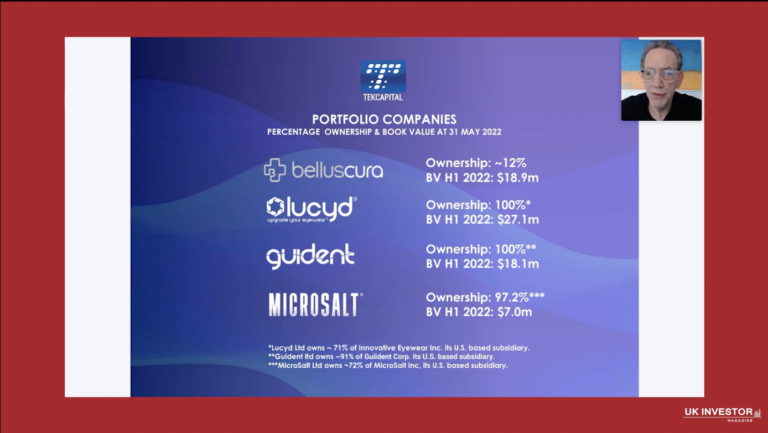
Innovative Eyewear is a portfolio company of Tekcapital and recently completed their NASDAQ IPO, raising $7.4m.

Tortilla Mexican Grill – costs hitting profits but the advance continues apace

The dishes are hotting up all around the country as Tortilla Mexican Grill (LON:MEX) continues its expansion.

Sales in the first half-year to 3 July were up 30% to £26.9m (£20.8m) but a rise in protein and energy costs hit the bottom line, leaving the interim pre-tax profit substantially lower at just £0.3m (£2.6m).

However, against this backdrop the UK’s largest and most successful fast-casual Mexican restaurant group has carried on with its expansion plans to cover the country.

Following the now bedded-in Chilango acquisition, the group opened five new sites in this period and has plans to open another five in the second half.

Further to that its strategic plans are to open between 12 to 15 new sites in the next year. The group is looking to carry on taking advantage of the depressed commercial property market, where landlords are almost desperate to tenant-up their vacant sites.

The company has opened more of its sites in partnership with the Compass Group, while its tie-up with SSP saw the opening of a site in Bristol Airport, while the Gatwick Airport site achieved record sales over the summer.

Analyst Opinion

At the group’s brokers Liberum Capital, their analyst Anna Barnfather has retained her Buy recommendation on the group’s shares, which were knocked for six upon the interim news.

The shares fell heavily yesterday, while Barnfather has lowered her Target Price from 235p to 170p, as she noted that Tortilla’s outperformance had continued, while having net cash in its balance sheet and remaining the leader in an attractive space which “will bear fruit when the cost environment normalises.”

Her estimates for the current year to end December are for sales to rise to £58.4m (£48.1m) while pre-tax profits ease considerably to £0.7m (£5.7m), dropping earnings to 0.8p (12.3p) per share.

Her forecast is for a gradual recovery next year to £69.8m sales, £1.1m profits and 1.2p in earnings.

By 2024 Barnfather expects much better times to ensue with sales of £85.2m for the enlarged estate, £2.7m profits and 4.3p in earnings per share.

Conclusion

Obviously cost pressures have hit the restaurant and fast-food sector everywhere, so perhaps we should not have been too surprised at these interim figures. 

However, the slowing down in financial expectations as the group expands could be too cautious to entice fresh investors into the shares, which might well make them appear overpriced for a while.

James Halstead proves adaptability

0

Floorcoverings supplier James Halstead (LON: JHD) reported annual figures slightly ahead of expectations. Even so, there was only a small increase in profit, and it will be difficult for the AIM-quoted company to maintain that profit this year.

In the year to June 2022, revenues grew from £266.4m to £291.9m, while underlying pre-tax profit improved from £51.3m to £52.1m. Net cash was £52.1m at the end of June 2022. Total dividends were 7.75p a share, up from 7.63p the previous year.

The international markets generally grew strongly. A major competitor has gone into receivership.

Forecasts

So far in the financial year demand continues to be strong and prices have been increased. Forecast revenues have been increased. The weak pound means that materials costs will rise on top of energy cost increases, although the exchange rate could help exports.

Although revenues are forecast to grow to £321m, much of that reflects inflation and admin costs are expected to grow at a faster rate. The forecast 2022-23 pre-tax profit is £51.1m. The dividend should be maintained, and it should still be more than 1.2 times covered by earnings.

The shares fell 2.5p to 204p. They are trading on nearly 22 times prospective earnings, while the yield is 3.8%.

The prospective multiple is relatively high, but it is much lower than in the past. James Halstead has shown that it can cope with economic uncertainty and has a good track record in good and bad times.

Essentra plans to distribute £150m

0

Essentra (LON: ESNT) has sold its filters business and intends to distribute £150m to shareholders. That could be around 49p a share. The share price rose 27.9p to 210.5p.

The filters business is being bought by a business controlled by the Markus family. The total enterprise value of the deal is £262.1m, which includes £42.1m to consolidate existing joint ventures. The business had an operating profit of £28.2m in the 12-months to June 2022.

There will initially be £200m paid in cash with a further £20m deferred. Some of that cash will be paid into the pension scheme and to pay off US debt. The deal depends on shareholder approval.

The sale of the packaging division to Mayr-Meinhof has completed and that brought in £312m. The Indian packaging business was sold separately.

Scott Fawcett is taking over from Paul Forman as chief executive. Essentra will be debt free after the disposals and distributing the cash to shareholders.

Esentra was previously known as Filtrona and it was demerged from Bunzl in June 2005. The company will focus on the components business, which has clients in industrial, retail displays, transport and automotive sectors.

Public Policy Holding Company’s maiden purchase as AIM company

0

Public Policy Holding Company Inc (LON: PPHC) is acquiring California-based KP Public Affairs in an earnings enhancing deal, which is the first since the December 2021 flotation on AIM. The acquisition could cost up to $35m and enhances earnings by 2% in 2022 and 9% in 2023.

Washington DC-based Public Policy Holding Company provides public affairs, crisis management and lobbying services in the US. Founded in 1996, KP Public Affairs provides a foothold in the largest individual US economy. Clients are involved in technology, renewable energy and resources sectors.

KP Public Affairs generated pre-tax profit of $3.2m on revenues of $10.9m in 2021. The initial cost is $11.4m – 90% cash and 10% shares. The additional payments will depend on profit levels in the years to 2026.

Stifel forecasts a dip in full year pre-tax profit from $31.9m to $31.1m before rising to $35.8m in 2023. The acquisition enhances earnings by 2% in 2022 and 9% in 2023. A full year dividend of 13.5 cents a share is forecast.

Public Policy Holding Company raised £11.1m at 135p a share when it joined AIM. There should still be net cash of $15m at the end of the year, so there is plenty of scope for further deals. Free cash flow could be $26m in 2023.

At 143.5p, the shares are trading on eight times prospective 2022 earnings, falling to seven for 2023. The forecast yield is 9%.