Sterling returns to pre-budget level, 900 pips off weeks lows

The pound continued its recovery on Friday with GBP/USD returning to pre-pandemic levels as markets looked forward to dramatic rate hikes from the Bank of England.

There has been a general improvement in UK assets on Friday with the FTSE 100 gaining and bond yields falling.

However, analysts warned the respite from this week’s volatility may only be short lived.

“The pound may have returned to the levels it was at when Chancellor Kwasi Kwarteng stood to address MPs a week ago but that doesn’t mean we’ve miraculously returned to a pre-mini-Budget world,” said AJ Bell investment director, Russ Mould.

“The currency’s recovery is predicated on more rapid and aggressive rate hiking from the Bank of England with all the implications that has for borrowers and, in particular, anyone with a mortgage.”

Despite the backdrop of worsening economic conditions, traders were positioning for a possible U-turn by the government on some of their measures which would be a welcome boost sentiment.

There is growing pressure on the PM from her backbenchers to remove the Chancellor and pedal back on his mini-budget package.

GBP/USD was 1% higher at 1.2223 at the time of writing, around 900 pips above the lows of the week.

UK housebuilders lead FTSE 100 rally

The FTSE 100 staged a rally on Friday morning with the house builders leading the way after suffering sharp declines earlier in the week.

Barrett Developments was the top riser gaining some 5% and Persimmon was 4% stronger while the FTSE 100 was 0.95% higher at the time of writing.

Banks were also gaining as the same sentiments driving housebuilders higher also saw support for Lloyds, Natwest and Barclays. Lloyds shares were 3.4% higher while Natwest gained 2.9%.

In a sign of improving sentiment – albeit from a very low base – defensive names such as Unilever, Reckitt Benckiser, and BAE Systems were all negative on the day.

In what has been an extremely volatile week, there was a general recovery in UK assets on Friday with GBP/USD gaining 0.3% to 1.1148 and UK 10-year yield dropping to 4.07%. A better than expected read on UK Q2 GDP will also help improve the mood after the original 0.1% contraction was revised to 0.2% growth.

This will ease any concerns of an imminent technical recession but the coming quarters could well see the UK slip in contraction and recession.

“The Office of National Statistics has released its revised view of recent GDP data this morning. Growth in Q2 of this year has been revised up from -0.1% to growth of 0.2%. Hardly a blistering pace, but enough to mean that the UK has not already entered recession, contrary to some forecasters,” said Steve Clayton, Fund Manager at HL Select.

Any further pick up in UK assets will hinge on the market’s perceptions of the government’s ability to provide some balance to their radical spending plans and tax cuts. The Tory will hold their conference this weekend and markets will be watching closely for any signals about their intentions to push forward with their proposals.

As we noted yesterday, we will receive updates from consumer facing companies such as Tesco and Greggs next week and investors will be keen to gauge the health of the UK consumer following a raft of retail profit warnings this week.

UK house price growth eases for the first time in 2022 but remains resilient

After consistently seeing a fast pace of growth through 2022, UK house price growth slowed for the first time in September.

The Nationwide House Price Index showed house prices grew 9.5% in the year to September, down from 10% in August.

Although the pace house price growth slowed, house prices were still flat month on month highlighting there was yet to be any major disruption to the housing market.

The Nationwide Chief economist highlighted a lack of supply as supporting house prices even though new buyer enquiries dipped.

“There have been further signs of a slowdown in the market over the past month, with the number of mortgages approved for house purchase remaining below pre-pandemic levels and surveyors reporting a decline in new buyer enquiries.  Nevertheless, the slowdown to date has been modest and, combined with a shortage of stock on the market, this has meant that price growth has remained firm,” said Robert Gardner, Nationwide’s Chief Economist.

The recent volatility in fixed income markets and indications of higher mortgage rates will lump further pressure on house prices and some experts are predicting house prices could fall by 10%-20% in the next year.

The removal of mortgage products by banks and building societies will also send waves through the housing market as buyer find themselves limited in options to secure new loans.

“There were already gathering clouds in the property market, with surveyors saying fewer people were househunting and buyers were losing confidence. In fact consumer confidence hit record lows. There was no real rush to buy, and mortgage approvals for purchases stuck below pre-pandemic levels,” said Sarah Coles, senior personal finance analyst, Hargreaves Lansdown.

“However, the storm broke this week, with around 40% of mortgages being pulled from shelves, because the pace and scale of the collapse in the bond market meant it was impossible to sensibly price them. When the dust settles, and lenders come back to the market, we can expect eye-watering rises in interest rates.”

“This needs to be seen in the context of how dramatic house price rises have been in recent years, and the fact that our bills have raced away too. Even if people are still keen to buy, they may no longer qualify for a mortgage on affordability terms.”

UK GDP expands 0.2% as growth revised higher

The UK economy actually grew in the second quarter as initial estimates of a 0.1% contraction were revised higher.

With the economy growing the second quarter, the prospect of a technical recession will be pushed back.

“The Final UK GDP rate for second quarter 2022 came in at 0.2%, beating the -0.1% initial expectations. The figure is surprising given the growth outlook for the UK has been deteriorating since the start of the year. There were increases in services and construction output, while production fell,” said Tom Hopkins, Portfolio Manager at BRI Wealth Management.

GBP/USD continued a move the upside on the news and was 0.2% higher at 1.1144 at the time of writing.

Despite the revisions higher in second quarter GDP, the outlook for the Uk economy still remain uncertain with rising rates and a cost of living crisis likely to push the economy into contraction in the third quarter.

Salinity Solutions: On a mission to treat water better

As the global demand for water continues to grow, how do we reduce the vast amount of energy used in water treatment? A Coventry-based company claims to have the answer.

While we think of ourselves as residents of a blue planet, only 0.5% of the earth’s water is in the form of available fresh water. That’s the kind we need to survive. The supply of fresh water has been steadily decreasing, while demand has been rising. In the 20th Century, the world’s population quadrupled – but water use increased six-fold.

To access this finite resource, a huge unseen global industry pumps, treats and redistributes water to homes, farms and factories. But only if you’re lucky enough to live in a country with adequate water supply. According to Unicef, half of the world’s population could be living in areas facing water scarcity by as early as 2025.

The water industry consumes vast amounts of electricity – 978 trillion Watt-hours (tWh) in 2020, which is 4% of the world’s total energy, or enough to power almost 500 million electric cars for a year (roughly half the number of cars on the planet). 

And this energy requirement is predicted to rise to almost 1500 tWh by 2040. 

Meanwhile 80% of wastewater is released into the environment untreated. To improve the water quality of lakes, rivers and oceans more water treatment solutions are needed, which will in turn increase our energy consumption. 

And where does all this energy come from? Currently 80% of the world’s electricity is generated from fossil fuels. 

In order to get even close to the net zero goals of 2050, we need to improve the way we treat water, while reducing the energy it uses.

Part of the solution lies in better water treatment technologies, specifically ones that provide greater energy efficiency and versatility.  

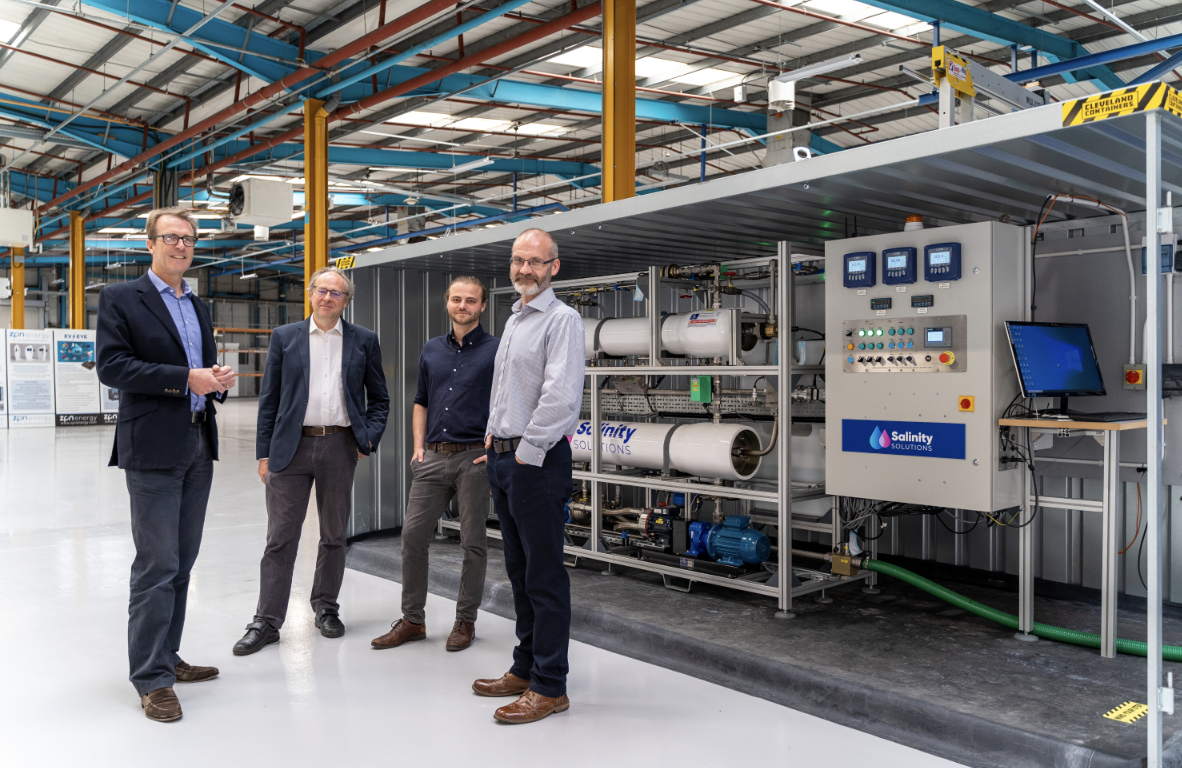
Salinity Solutions is on a mission to treat water better. After 10 years of development at the University of Birmingham and Aston University, their high recovery batch reverse osmosis (RO) system operates in a way that is over 50% more energy efficient than traditional RO systems (for an explanation of RO and how Salinity’s technology works visit salinitysolutions.co.uk/product/), offering significant savings in water treatment cost and carbon footprint. Plus, their compact, mobile units are scalable for a wide range of applications, for example solar powered units operating in remote areas. 

Founder and CTO Tim Naughton added: “We are making the biggest step forward in water treatment in over 50 years. Our vision is to drastically cut the energy consumed by water treatment and deliver a sustainable solution to water scarcity.

“We’ve recently completed successful field trials with Cornish Lithium and we’re now looking at a wide range of other water treatment applications, including industrial, medical and agricultural. Our tests show that our system delivers 95% water recovery, or 20x brine concentration, for just 0.5kWh per tonne of feedwater, which is an industry game changer. Traditional RO systems operate at around 2-3 kWh/m3. We’re hoping to make a significant impact in a market projected to reach a value of 490 billion US dollars by 2029.

“Increasingly we’re hearing from major industry players that our combination of ultra-high energy efficiency and ultra-high recovery is ‘the holy grail’ for the next generation of water treatment systems.

“We’ve just had our first European patent approved and there are four more in the pipeline. This marks a significant milestone for us and a step up in value of the business.”

Salinity Solution is closing its Crowdcube funding round on Tuesday October 4th. To invest, visit their campaign page. If you are interested in investing more than £20,000, you should contact the company direct on info@salinitysolutions.co.uk .

Investments of this nature carry risks to your capital. Please Invest Aware.

Sources:
Wastewater market global sizeWastewater release; Energy consumption by water sectorWorld energy outlook;Volume of global car productionEV energy consumptionFresh water; Fossil fuelsWater scarcity

AIM movers: Bid for Attraqt and ex-dividends

0

Crownpeak Holdings is making an agreed 30p a share cash bid for omnichannel retail merchandising software provider Attraqt Group (LON: ATQT) in order to combine the technology with its Digital Experience Platform. The share price has not been at that level since May, and it reached its all-time low of 17.5p yesterday. The share price rose by 65.7% to 29p.

Pathfinder Minerals (LON: PFP) has agreed an option with claim enforcement group Acumen Advisory Group (AAG) for the acquisition of Mozambique-based IM Minerals Ltd. AAG will complete due diligence before deciding whether to pay £2m to acquire the business and the n commence proceedings against the government of Mozambique due to the unlawful transfer of a mining licence. A successful claim would spark a contingent payment to Pathfinder Minerals of either $24m or 20% of net recoveries if that is higher. The claim could be worth between $110m and $1.5bn and AAG has the cash to pursue it. Pathfinder Minerals shares jumped 61.9% to 0.85p.

Kodal Minerals (LON: KOD) estimates that capital costs for dense media separation processing plant for the Bougouni lithium project in Southern Mali will cost $65m. The NPV (7%) is estimated at $420m post-tax. This is based on an initial four-year mine life and based on a lithium price of $2,080 per tonne. The shares rose 15.1% to 0.305p.

Cyber security services provider Falanx Group (LON: FLX) reported 14% growth in underlying 2021-22 revenues to £3.5m and a slightly lower loss. So far in this financial year the order intake has increased by 18%. Operating costs will peak in the first half. There was a 14.3% rise in the share price to 0.6p.

Rosslyn Data Technologies (LON: RDT) has won a three-year, £500,000 contract with a multinational medtech company for the digital transformation of procurement operations. The share price rose 13.9% to 1.85p.

Shares in online performance marketing firm XLMedia (LON: XLM) slumped by 27.5% to 25p after forecast downgrades. More-third party business and a levelling off of activity in the sports sector have led Cenkos to reduce its profit after tax estimate from $14.6m to $6.2m.

US-focused minerals explorer Phoenix Copper (LON: PXC) says that the current economic conditions and volatile commodity prices have made it difficult to estimate operating and capital cost for the Empire open pit copper mine. The shares price slipped 22% to 23p.

Cloud-based conferencing services provider LoopUp (LON: LOOP) raised £3.5m at 5p a share to plug delays in cash generation and R&D tax credit receipts. This follows the deal to take on a book of business and the transfer happens on 1 October. The share price fell 21.1% to 5.05p. Last year £8.85m was raised at 25p a share, some of which went to finance the acquisition of SyncRTC.

Trading in Ukrproduct Group (LON: UKR) shares recommenced after it published its 2021 results and there was a 12.7% fall to 1.75p. A £329,000 profit was reported.

Ex-dividends

Advanced Medical Solutions (LON: AMS) is paying an interim dividend of 0.64p a share and the share price fell 5p to 241p.

Alumasc (LON: ALU) is paying a final dividend of 6.65p a share and the share price fell 1.5p to 143p.

Anglo Asian Mining (LON: AAZ) is paying an interim dividend of 3.69p a share and the share price fell 2.5p to 71.5p.

Arcontech (LON: ARC) is paying a dividend of 3.25p a share and the share price fell 2p to 78p.

TF & JH Braime (BMT) is paying a dividend of 4.75p a ordinary share and the share price is unchanged at 2050p.

TF & JH Braime (BMT) is paying a dividend of 4.75p per A non-voting share and the share price is unchanged at 1750p.

Central Asia Metals (LON: CAML) is paying an interim dividend of 10p a share and the share price declined by 3.75p to 219.25p.

Duke Royalty (LON: DUKE) is paying a dividend of 0.7p a share and the share price slipped 0.5p to 31.25p.

Fevertree Drinks (LON: FEVR) is paying a dividend of 5.63p a share and the share price fell 44.25p to 825.25p.

Fintel (LON: FNTL) is paying an interim dividend of 1p a share and the share price declined by 3.75p to 176.75p.

Fletcher King (LON: FLK) is paying a final dividend of 0.5p a share and the share price is unchanged at 37.5p.

Good Energy (LON: GOOD) is paying an interim dividend of 0.75p a share and the share price slipped 0.5p to 222.5p.

Jadestone Energy (LON: JSE) is paying an interim dividend of 0.6p a share and the share price lipped by 0.1p to 70.5p.

Life Science REIT (LON: LABS) is paying a maiden dividend of 1p a share and the share price fell 2.2p to 73p.

PHSC (LON: PHSC) is paying a final dividend of 0.5p a share and the share price is unchanged at 20p.

Public Policy Holding Company (LON: PPHC) is paying a maiden dividend of 4.5 cents a share and the share price is unchanged at 143.5p.

Safestyle UK (LON: SFE) is paying an interim dividend of 0.4p a share and the share price rose 0.5p to 26.75p.

Wynnstay Group (LON: WYN) is paying a final dividend of 5.4p a share and the share price slipped by 5p to 615p.


FTSE 100 falls in volatile session as pressure on government grows, profit warnings rise

The FTSE 100 experienced another volatile session on Thursday as the Uk government faced growing pressure to provide fiscal forecasts and U-turn on a number of measures unveiled in their mini-budget.

The FTSE 100 hits lows of 6,842, before bouncing back to trade at 6,933 at the time of writing.

Technical analysts will be conscious the index has now put in a short term double bottom in the 6,836-6,842 region which will form a level of technical support. A break of this level could open up the way to 6,800 and then a key Fibonacci retracement level at 6,685.

Bond purchases by the Bank of England have appear to built a floor in markets for now, but in such a highly fluid situation further volatility can’t be ruled out.

“After a highly volatile week, the febrile mood in the markets has been pacified a little by the Bank of England’s intervention to buy large chunks of UK government debt but signs are that investors have taken on a wait and see strategy,” said Susannah Streeter, senior investment and markets analyst, Hargreaves Lansdown.

Government pressure

The UK government’s actions are almost entirely responsible for volatility in markets and the pressure continued on Thursday. Investors had been hoping for a direct response from the government to improve sentiment. Instead Liz Truss choose to appear on local radio stations instead of making direct statements.

The move by the PM further unnerved markets and sterling fell against the dollar while UK-facing FTSE 100 stocks plunged.

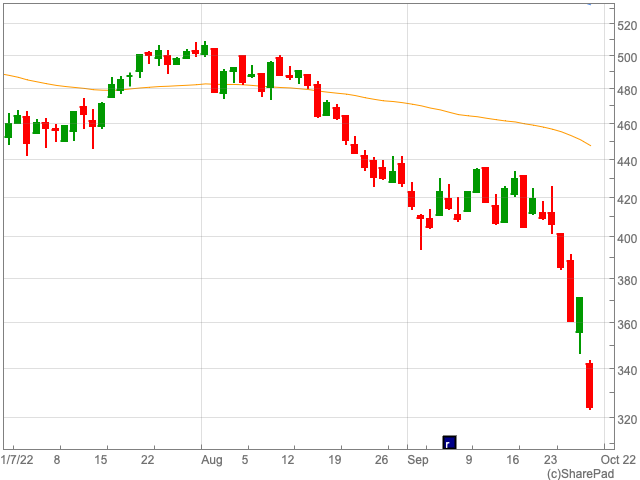
The UK housebuilders were heavily hit as more mortgage provider withdrew products from the markets. Barrett Developments crashed 12% to 324p, the lowest level since 2013.

Profit warnings

Next was also heavily hit after the retailer was the latest consumer facing company to warn on profits.

“If Next is struggling, you can be sure the retail sector is in a real fix. Among the most consistent of retailers, the company has an excellent track record and is a highly transparent communicator with the market,” said Russ Mould, investment director at AJ Bell.

“The message it has to deliver is a worrying one. True, Next does have a habit of managing expectations downward, to give it a lower bar to clear.”

“First-half results were strong and while the start to the current financial year was weak in August there was a notable pick-up in September. But there’s no disguising that behind the cuts to guidance lies deep uncertainty about the consumer backdrop.”

Mould went on to highlight next week’s earning and the threat of further profit warnings from companies exposed to the UK economy.

“Profit warnings are becoming a regular occurrence and there are several big names today telling investors to expect lower earnings than previously anticipated, including retailer Next. This raises the prospect of other consumer-facing companies disappointing the market and next week we have three big names reporting: Tesco, Greggs and Wetherspoons,” Mould said.

Porsche completes Europe’s biggest ever IPO

Porsche have completed the largest ever IPO in Europe today and shares immediately gained, despite wider market turmoil.

It is not uncommon for IPOs to be put back during times of volatility by Porsche took the decision to press on with their Frankfurt listing and raised €9.4 billion in at a €75 billion valuation.

Shares priced at the top end of the €76.50 to €82.50 range in an over subscribed offer.

“Investors were keen to get into the driver’s seat at Luxury carmaker Porsche with shares issued at the top end of the proposed range,” said Laura Hoy, Equity Analyst at Hargreaves Lansdown.

Porsche recorded €33.1bn revenue in 2021 and 24.5% EBITDA margin. In their 2022 half year report Porsche enjoyed €17.9bn, up from €16.5bn in the year prior.

CAP-XX – increased sale prospects will help to take it into profits

This little £21m company is a world leader in the designs and manufacture of thin, prismatic supercapacitors and energy management systems.

With very high-power density and high energy storage capacity, these systems are used in portable and small-scale electronic devices, as well as in larger uses in automotive and renewable energy.

Improved sales pipeline

The group’s results for the year to end June saw product sales revenues up by 44%, while overall its revenues advanced 36%, while margins were up 43% on last year.

Very encouragingly the company has reported that its sales pipeline was up some $10m, to over $60m per annum.

Its EBITDA loss was A$0.5m, which was broadly in line with last year’s A$0.4m.

Driving into profits

CEO Anthony Kongats, stated that:

“The major focus for CAP-XX continues to be to become profitable and cashflow positive as soon as possible by increasing product sales from the newly installed former Murata production equipment, other new product families the Company recently launched and new products and intellectual property the Company is currently developing. We look forward to the future with increasing confidence.”

Analyst opinion

John-Marc Bunce at Cenkos Securities rates the group’s shares as a Buy, with a valuation of 14p a share.

For the current year to end June he estimates A$8.3m (A$5.6m) and an adjusted pre-tax loss of just A$0.1m (A$1.4m).

But for the next year he sees A$14.3m of sales and A$3.6m of profits, worth A$0.7c per share in earnings.

He calls the shares as significantly undervalued.

Insider dealings look interesting

A number of the group’s directors have recently taken new shares in place of their salaries, which is an interesting pointer of their faith in its prospects, the swap price was pegged at 5.54p per share.

Conclusion

Having recently fallen back with the general market the group’s shares have risen to 4.15p on the back of the confident talk of early profits.

At that level they look to be a very appealing ‘penny stock’ investment taking a one-year view.

XLMedia – strong expansion of its US Sports business will create profits in 2023

Operating across the sports, gaming and personal finance sectors this global digital publisher connects advertisers and targeted, engaged audiences in helping to build up the brands.

The interim results for the half-year to end June from this XLMedia (LON:XLM) showed revenues of $44.5m ($32.2m) and an adjusted EBITDA of $10.6m ($6.6m).

The group ended the period with $17.7m in cash and short-term investments.

Rationalisation having its benefits

The recent rationalisation of the group’s activities and its online portfolio saw a massive reduction from over 3,000 sites to just around 45 currently. It has also set about cost saving to the tune of $4m a year.

The company saw a very strong performance from its Sports vertical which generated first half revenues of $14m, some 76% of group revenues.

It has a very strong focus upon the US sports sector, especially with an easing of regulations permitting sports betting across various of the US states. After opening its legal online sports betting in New York in January this year and is now operating in 16 US states. 

Strong US Sports advance

The group expects its full year adjusted EBITDA results to be in line with last year, while expecting to return to profits in 2023.

CEO David King stated that:

“Refocusing the business towards the rapidly growing US online sports betting market, managing the reduction in Personal Finance, while stabilising the Gaming vertical, alongside rightsizing the Group’s cost base, remains a key priority to ensuring new XLMedia is well placed for further growth.”

Broker’s opinion

Analysts Andrew Renton and Simon Strong at Cenkos Securities have rated the group’s shares as a Buy. 

They are estimating $69.8m ($66.5m) of revenues for this year to end December and an EBITDA of $16.5m ($17.9m).

The 2023 year could see $72.4m of sales and $17.3m of EBITDA.

The brokers consider that the group will have a healthy cash balance to fund both organic growth and future acquisitions to build its market share in US Sports.

They conclude that XLM’s valuation remains compelling trading on an EV/EBITDA multiple of 5.1x against its peers on 6.0x.

The group, which is a dollar dominated business, has its shares currently trading at 34.5p.