Pure Gym looking to capitalise on post-lockdown trading
Pure Gym, the largest gym chain in the UK, is expecting a valuation of £1.5bn as it looks set to be the first of a number of IPOs in the coming weeks.
The gym operator is looking to capitalise on a post-lockdown surge in trading, as the value of public firms goes up.
Having been taken over in 2016 for £600m by Leonard Green, the US private equity firm, Pure Gym has grown both organically and via acquisition.
PureGym has all but regained all of its membership levels from before the pandemic, while the total number of people who visited in June were at 91% of the level seen during the same month two years ago.
Pure Gym is receiving advice from Morgan Stanley and Barclays, according to The Times, with RBC, Jefferies and Berenberg as bookrunners.
In an update given in July, Pure Gym said that it was “in the early stages of considering options for potentially raising equity, including in the public markets”.
Pure Gym’s equity value of £1.5bn is expected to put the firm in the FTSE 250.
A kg of tomatoes wholesale now costs £1.47, up from 75p a year ago
Labour shortages affecting a range of industries in the UK could last for up to two years, according to the Confederation of British Industry (CBI).
The CBI’s members, some of the biggest employers in the UK, have said the government’s job retention scheme would do little to help in September, and that with the need to train staff, the issue is likely to remain unresolved in the short-term.
Officials in the UK have told companies that they should employ British workers, including those who are coming off furlough, and not to expect a temporary rule change to allow EU workers who have previously taken up these roles.
CBI boss Tony Danker says the UK needs to deal with its short-term economic needs as well as making reforms for the longer-term.
The CBI put the shortages down to both Brexit and Covid-19, which had limited the numbers of EU workers.
More specifically, the food industry has warned against the possibility of price rises as they need to raise the wages of workers, in addition to surging transportation costs.
The price of tomatoes has doubled in the past year, while the cost of vegetable oil is at its highest point in 30 years.
Darren Labbett, the managing director of Woods Foodservice, a wholesaler that supplies the pub and restaurant trade, said the industry is facing a “perfect storm” of negative effects.
“We are trying our utmost to absorb as much of the increases as possible but we, as well as the rest of the supply chain, can’t absorb those price increases forever,” Labbett told BBC Radio 4’s Today programme.
“We are also taking other actions, and that’s by ordering in more stock in advance and carrying more stock than we would normally carry. We have doubled the lead time to ensure if there are any delays due to a shortage of lorry drivers that it doesn’t impact on the availability to our customers.”
However, stocking up on fresh produce is easier said than done due to its short shelf life.
On Wednesday 8 September furnishings and homewares retailer Dunelm (LON: DNLM) is publishing its full year figures. They have been flagged in a trading statement and the level of dividend and current trading will be the main interest.
In the year to 26 June 2021, revenues were 26% ahead at £1.3bn. They were even 21% higher than in 2018-19. Pre-tax profit rose from £109.1m to more than £158m. That is a figure that has been upgraded more than once over the year. Net cash was £129m at the end of June, up from £45.4m one year earlier.
Dividend
There was a 12p a share interim dividend. In the previ...
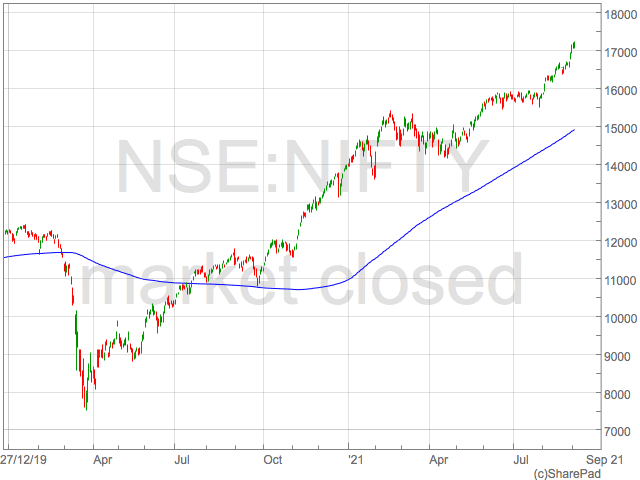
Nifty-50 hit 17,000 for the first time on 31st August 2021 as it made it’s fastest ever 1,000 points gain from the 16,000 level. On 3rd August, Nifty traded at 16,000, its all-time high and over the following 28 days investors saw continuous rallies in the Nifty and Sensex to reach 17,000 and 57,800 respectively.
The hopes for economic recovery from the pandemic is creating optimism in Indian markets. India’s economy grew 20.1% in the second quarter, despite a second wave of coronavirus.
In addition, Demat (Dematerialised) accounts are being opened at a record rate in India which is a factor fuelling the drive higher in stocks.
Several stockbrokers and investor platform’s have made the stock market more accessible to Indian retail investors. This led to the opening of a huge number of accounts and these new investors are thought to be igniting the start of a new era in the Indian stock markets.
Indian markets have been rising during the pandemic, bringing a sense of confidence among Indian investors building momentum across India’s major indices.
The journey of Nifty 50: From 8000 to 17000
As covid-19 hit the Indian markets, Nifty crashed to 8,083 on 3rd April 2020. On this day, IndusInd Bank and Kotak Bank were the top losers dragging down the market to lower levels. The following are the highs and lows of the NIFTY 50 during the crash.
11,433.00- High
7,511.10- Low
April FY20
Market sentiment have remained week for a long time since the pandemic started. It has been observed that 50% of Nifty 50’s stocks were traded in red. Nifty 50 rebounded back to green during mid-April of FY20. It started trading at the levels of 9000-9500 from April- June FY-20. Nifty formed a bearish candle on daily charts which made investors re-think their positioning in the Nifty 50 stocks.
On 5th June FY20, Nifty hit the levels of 10,000 and created a ray of hope for the investors to make a re-entry in the market. On this day, metal stocks shined their way through the market to take it back into the normal trading levels. As the market settled with minimum positivity, the highs and lows also increased for a better view towards the market:
10,553.15- High
9,544.35- Low
June FY20
On 24th July 2020, Nifty hit the levels of 11,000 and was ready to create a new leg up. Earlier before the pandemic started, the NIFTY 50 traded at the levels of 11000-12000.
Nifty 50 took 5 months to reach the levels of 12000 in November 2021. The rally began when Nifty hit the 13,000 level in December. The dream run of the domestic companies resulted in improved earnings and macro-data settlement which also generated a high GST collection. As the year ended by Nifty hitting 14,000 levels for the first time ever, December 2020 was considered as the decisive month for the investors.
13,145.85 High
11,557.40 Low
November FY20
The levels of 14,000 traded at par for a while in the market and were broke by a new record of 15,000 during February 2021. Over the months in 2021, Nifty 50 performed well and remained stable till July 2021. During this period, IndusInd bank, Kotak Bank, IT sectors (Infosys, Wipro, TCS), Bajaj FinServ were some of heaviest traded shares.
15,431.75 High
13,661.75 Low
February FY21
On 3rd August 2021 Nifty hits 16,000 and achieved the status of lifetime high gains. The past month remained positive for the Nifty stocks and involved high volume trading. The gains in the Index were added by consumer and IT stocks.
17,153.50 High
15,834.65 Low
August FY21
As soon as Investors digested the breach of 16000, Nifty added 1000 points in a record-breaking manner by the month-end. On 31st August FY21, Nifty hits 17,000 and sustained its levels on the next day too.
Top gainers with the win included Nifty PSU Bank, Nifty Metal and Nifty Healthcare index. The gain points were added by Adani Port, Bajaj FinServ, and Bharti Airtelin the Index.
Non-farm figures well below expectations of 733,000 new jobs
The US economy added 235,000 jobs in August, falling well below economists’ forecasts, as it appears the impact of the Delta variant may be disrupting hiring plans amid labour shortages.
Non-farm payroll figures released by the Bureau of Labor Statistics showed a sharp fall-back from the 1.1m jobs created in July, which was an upwardly revised figure.
August’s figures also came in well below expectations of 733,000 new jobs.
The unemployment rate, which was around 5.4% in July, fell to 5.2% last month.
US nonfarm payroll rose by 235k in August, lowest since Jan amidst Delta variant. Unemployed rate fell to 5.2%, 8.4 million; down considerably from highs in Feb-April 2020 but above their levels prior to the coronavirus pandemic (3.5 percent, 5.7 million). https://t.co/vAeSr8qWNB
The disappointing figures come days before enhanced federal unemployment benefits are set to expire. They were initially in place to support people who were struggling through economic damage caused by the pandemic.
Members of the Republican Party have previously suggested that the measures remove the incentive for people to go back to work, which has caused some conservative states to end the benefits.
Robert Alster, CIO at Close Brothers Asset Management, comments: “In the eyes of the market, the US labour data is a double edged sword. The staggering weakening we’ve seen in August’s labour activity is a sign that the delta variant is having a hugely damaging impact, which will in turn hit growth and confidence. But conversely, strong labour data – as seen in June and July’s nonfarm payrolls – would push the Fed towards a more Hawkish approach to monetary policy, with a tapering of asset purchases as soon as November and a rate rise in 2022.”
“This runs the risk of stifling US growth before it has had a chance to bed in – which could be the push the Democrats need to remove Powell from office. After eighteen months of uncertainty, stability is the order of the day – we must hope for a steady pace of recovery, rather than volatile booms and busts which will spook consumers, investors, and policy-makers alike.”
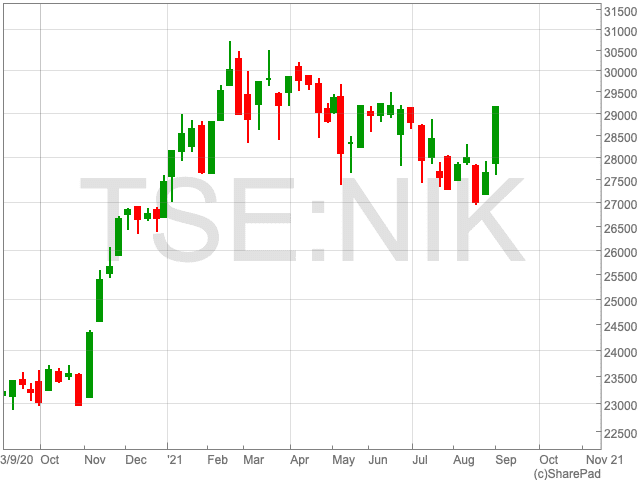
Japanese Prime Minister Yoshihide Suga confirmed on Friday his intention to not to run in the ruling Liberal Democratic Party’s leadership race, allowing room for his replacement after just one year in office.
The story caused the Nikkei, a stock market index for the Tokyo Stock Exchange, to surge by 2%.
“He has been an unpopular leader and the country has struggled with the Covid vaccine rollout, leading to low levels of confidence among people in Japan,” said Yoshihide Suga.
“The market’s reaction to his announcement would suggest investors are optimistic that the country will find a stronger leader. Mining, healthcare, real estate and technology stocks all pushed forward on the main Japanese index.
Today’s jump has put the Nikkei back on a stronger path, with the index up nearly 7% since the beginning of the year. However, it remains well behind the US Nasdaq’s 21% during the same period of time, although it is a stronger performance than China’s SSE index.
Later today investors will have their eyes the US non-farm payroll data in the US which is expected to show employers hired 725,000 people in August.
“There is a fine line to walk for the result in terms of the potential market reaction. Significantly beating the figure could trouble investors as it would strengthen the argument for the Federal Reserve to start tapering its bond buying, thereby going down the path to withdraw support following the pandemic,” said Mould.
“But missing that forecast number could also trouble investors as it would suggest a slowdown in economic growth, which is something that’s been troubling other parts of the world including China.”
SOHO’s portfolio of properties was independently valued at £596.3m on an IFRS basis, reflecting a valuation uplift of 7.7% against the total invested fund of £553.6m.
The REIT’s operating profit over the first six months of the year rose to £13.3m, up from £11.8m the year before. SOHO’s total annualised rental income stands at £33.4m, while it received 100% of rent due and paid all target dividends since IPO.
In addition to its ‘resilient’ performance during the pandemic, SOHO announced other developments.
In August 2021, SOHO received an Investment Grade rating of ‘A-‘ (Stable Outlook) from Fitch with a rating of ‘A’ for its recently issued debt. “This reflects the strength of SOHO’s business model and highlights the resilient fundamentals of the sector,” SOHO said.
At the same time, SOHO announced that it had secured long-term, fixed-rate loan notes worth £195m. The loan notes have enabled SOHO to re-finance its short-term, floating-rate revolving credit facility, while providing SOHO with another £65 million to deploy into further high-quality social housing investments.This is SOHO’s first debt facility directly linked to SOHO’s sustainability targets.
Max Shenkman, Head of Investment at Triple Point Social Housing REIT plc, commented: “We are delighted that Triple Point Social Housing REIT Plc’s strong ongoing performance has been reflected in its Investment Grade Rating and that we have secured a long-term, fixed-rate loan which is being used to re-finance an existing facility and support our growth to meet much-needed new housing.”
“We are also delighted to be leading the market with our retrofit programme to combat climate change, improve living comfort, reduce fuel poverty, and stay ahead of regulations, all of which we expect in time to be reflected in property valuations.”
Triple Point Social Housing REIT was one of three organisations that presented investment opportunities at February’s UK Investor Magazine Virtual Investor Conference.
The trust’s aim is to allow investors to get a solid long-term return while having a positive impact on society. Their mission is geared towards addressing the ongoing housing crisis by investing in the UK social housing sector. The REIT supplies homes adapted to the needs of vulnerable adults who require long-term care and support. Triple Point Social Housing generates a long-term investment stream for investors from tenants whose rent is ultimately paid by the government.
UK house prices are expected to rise by 30% over the next ten years
UK house prices are expected to rise by 30% over the next ten years, pushing the age of first-time buyers back by nearly two years.
New research by comparethemarket.com reveals the average age of first-time buyers is expected to reach 37 in London, and almost 35 for the rest of England by 2031 as house prices increase.
Over the next decade, the average price of a home will reach £323,718, a jump of 30%, and increase by 33% in Greater London to £619,568.
Analysis of ONS data from 1992 to 2020, alongside a forecasting model, predicts house prices will increase as follows:
Greater London
UK
2021
£465,549
2021
£248,496
2022
£480,951
2022
£256,018
2023
£496,353
2023
£263,540
2024
£511,755
2024
£271,062
2025
£527,157
2025
£278,584
2026
£542,559
2026
£286,107
2027
£557,961
2027
£293,629
2028
£573,363
2028
£301,151
2029
£588,765
2029
£308,673
2030
£604,167
2030
£316,195
2031
£619,568
2031
£323,718
By 2031 it is anticipated that house prices across Greater London will rise by a third, while the rest of the UK is expected to see a slightly lower increase of 30%.
Going beyond 2030, the UK property market is set to see incremental increases in the price of homes until 2040.
comparethemarket.com also analysed the age of first-time buyers in England going back to 2006, to reveal how this will increase over the next ten years:
Region
2021
2022
2023
2024
2025
2026
2027
2028
2029
2030
2031
London
35.0
35.2
35.4
35.6
35.8
36.0
36.2
36.4
36.6
36.8
37.0
Rest of England
33.1
33.2
33.4
33.6
33.7
33.9
34.1
34.2
34.4
34.6
34.7
The average age of a first-time buyer currently stands at 35 years-old, while in ten years, buyers will on average have to wait an extra two years to make the purchase.
Commenting on the findings, Chris King, head of home insurance at comparethemarket.com, says: “Despite house prices seeing an all-time high and the average age of first-time buyers set to increase over the next ten years, it’s interesting to see that buying habits have remained similar.”
For those who are yet to buy but are planning on doing so in the future, it’s important that you take out the correct insurance policies, ensuring that both your home and contents are covered ready for when you move in, should the worst happen.”
Reddit could IPO next year when its value is around $15bn
Reddit is hiring lawyers and investment bankers of an initial public offering in New York, as reported by Reuters.
In a private fundraising round last month Reddit was valued at $10bn.
Reporters reported via a source that the company’s hierarchy is hoping by the time of the IPO early next year that Reddit will be valued in excess of $15bn.
Reuters reported that the specific timing of the IPO would be subject to market conditions.
While it is the first time a report of this nature has been conducted, rumours over Reddit’s desire to go public as been circulating for months.
Steve Huffman, CEO of Reddit, has previously said the company intends to go public although he had not yet decided on the timing.
As of October 2020, Reddit has around 52m daily users and over 100,000 communities, also known as “subreddits”. However, the company said it gained millions of new users during the Reddit-induced trading frenzy, although recent figures have not been released.
Argo Blockchain holds 1,659 bitcoins on its balance sheet
Argo Blockchain (LON:ARB) made £6.83m in mining revenue last month, an increase of £2.23m, as the price of bitcoin rose.
The bitcoin mining company mined a total of 206 bitcoins in August, down from 225 in July, bringing the overall amount mined for the year-to-date to 1,314.
Argo sold 61 bitcoins last month, and kept a total of 1,659 bitcoins on its balance sheet, priced at a market value of $82m as of Friday morning.
Peter Wall, Chief Executive of Argo and interim Chairman said: “I am pleased that we have been able to deliver these results at an improved margin this month and continue to deliver value to our shareholders. We are also delighted to have released our Climate Strategy and remain committed in our efforts to enact positive change within the crypto mining sector.”
Argo Blockhain, listed on the London Stock Exchange (LSE) at present, is weighing up a secondary listing on Nasdaq.
The London-based miner revealed the plan last month, adding that no decision has been made whether to go ahead. The company said that “there is no guarantee that the listing will be finalized,” while, “any proposed listing is subject to market and other conditions, and there can be no assurance as to whether or when the proposed listing may be completed.”