Berkeley notes improvement in UK housing market

0

Berkeley is now expecting forward sales of properties to reach £1.7bn by 31 October

Berkeley (LON:BKG), the London-listed homebuilder, released a trading statement on Friday morning ahead of its anticipated AGM.

The FTSE 100 firm reported that reservations have recovered to levels from before the pandemic, while the group feels confident about its ability to earn profits of at least £518m for the year ending in April 2022.

Berkeley is now expecting forward sales of properties to reach £1.7bn by 31 October, when the group reaches its half-year end.

The homebuilder will pay £451m to shareholders from a pending return of capital and it intends to allocate a further £228m of surplus capital to increasing its land buying, allowing it to capitalise on favourable market conditions.

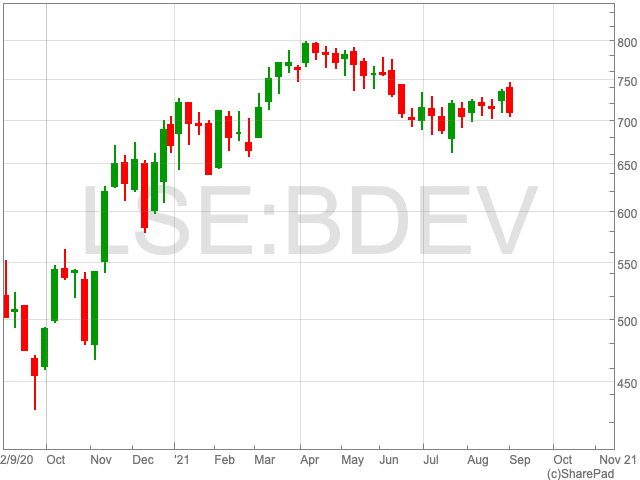
The Berkeley Group share price is up by 0.44% to 4,788p early on Friday morning.

Commenting on the results, Steve Clayton, HL Select fund manager said: “We hold Berkeley in our HL Select UK Growth Shares fund because of its strong cash generation. Berkeley takes on the big, complex projects that rivals find daunting. That means it can buy land cheaply, because it can be the only one that turns up to the auction. Their development expertise allows them to turn cheap, brownfield sites into premium developments, making fat margins in the process. Right now, conditions are good.”

“Yes, there are cost pressures out there, especially for building materials. But selling prices are rising, leaving profitability strong. Reservations are back to pre-pandemic levels, suggesting an increase of around 25% over 2020 levels as the London market comes roaring back to life. The group’s confidence is shown in their comment that the next shareholder return of £141m could be made via share buy-backs.”

BNY Mellon Blockchain Innovation Fund: a diversified approach to investing in blockchain

BNY Mellon Blockchain Innovation Fund

The BNY Mellon Blockchain Innovation Fund aims to capitalise on growth in the blockchain space by targeting firms that are leveraging blockchain technology to either generate new revenue streams or reduce their cost structures by increasing their operational efficiency.

Blockchain Technology

It has been suggested that blockchain is one of the most disruptive technologies to evolve since the mainstream adoption of the internet. Blockchain is a digitally-distributed, tamperproof, ledger system. It is most famously associated with cryptocurrencies, however, applications of the technology extend across industries and sectors, potentially revolutionising the way firms conduct business.

The technology is increasingly being accepted by regulators across the world, furthering adoption across a range of industries and regions.

Current common use cases for blockchain technology are financial services, healthcare and supply chain management. However, it still remains in a relatively early stage, therefore investors could gain a competitive advantage by allocating funds to the industry.

Holdings

The top three holdings in the trust are: Grayscale Bitcoin Trust (5%), a vehicle that allows investors to invest in trusts that hold large amounts of Bitcoin; Square (4.6%), an American financial services and digital payments company, and; Silvergate Capital (4.1%), a provider of financial infrastructure solutions and services to participants in the digital currency industry.

In terms of the sector breakdown, the BNY Mellon Blockchain Innovation Fund’s top three holdings are: capital markets (19.1%); IT Services (14.3%); and Software (9.7%).

While 73.8% of the companies in the fund are from the US, it does have a range of geographies represented, including South Korea (4%) and Germany (3.6%).

Performance

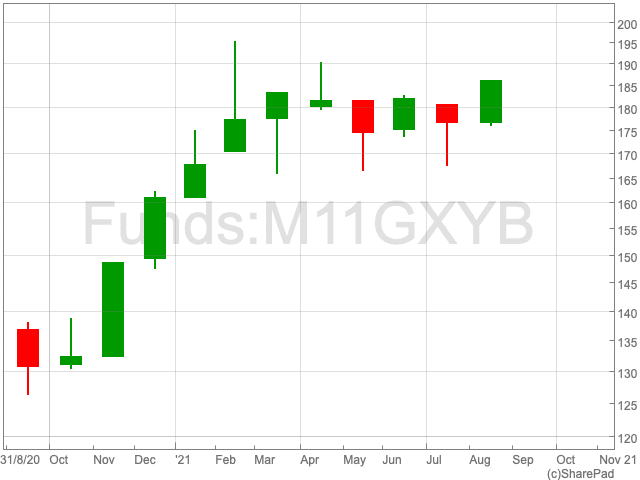
The fund has outperformed the the MSCI AC World NR Index benchmark over the past year. Between June 2020 and June 2021, the BNY Mellon Blockchain Innovation Fund added 59.44%

Barratt share price dips despite robust annual results

0

Barratt Share Price

The Barratt share price is down by 4.71% on Thursday despite strong demand for homes boosting annual profits by nearly two-thirds in its latest financial year.

“Perhaps it is down to concerns over the expiry of the stamp duty tax break in October, or worries over an increasing reliance on Help-to-Buy, or the potential impact of the proposed April 2022 launch of the Residential Property Developer Tax, but investors do not seem unduly moved by Barratt Developments’ strong full-year results,” says AJ Bell Investment Director Russ Mould.

Year-to-date the Barratt share price has added 8.89%. Although 2021 has seen healthy profits, a net cash balance sheet and a dividend that equates to a historic yield of 4%, the Barratt share price, at 707.60p, remains some way off its pre-pandemic level of 870.6p.

Outlook

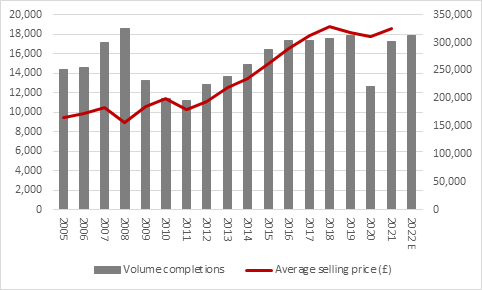
The FTSE 100 homebuilder expects to drive volume completions back to 2019’s pre-pandemic levels in the year to June 2022 and is set to benefit from further house price increases.

“That said, some investors may be fretting that the current surge in prices in unsustainable and the result of the stamp duty tax break, especially considering the fall in net private reservations through July and August, even if the UK housing market does still seem to be suffering from a shortage of supply,” says Mould.

Additionally, the pandemic could yet bolster the population’s desire for larger, suburban dwellings with gardens and underpin demand for some time to come.

Source: Company accounts, management guidance for completions for 2022. Financial year to June.

Further price rises could allow the FTSE 100 firm to balance out an increase in ‘input’ costs which Barratt says are persistent. Barratt’s results presentation flags its expectation that input costs will rise by 4% to 5% in the year to June 2022. This raises the question of affordability, as people have, until now, been helped by the stamp duty holiday and the help-to-buy scheme.

“The percentage of buyers who used one version or another of the Help-to-Buy scheme reached 38% in the year just ended, up from 33% the year before, a record high since the introduction of the support programme by Chancellor George Osborne in April 2013,” says Mould.

“The latest version of Help-to-Buy, the equity loan scheme, runs until March 2023 and shareholders can be forgiven nervous for wondering what will happen after then if so, many people need this financial assistance to get on the housing ladder – even if the chances of yet another extension are probably quite high, given the political fall-out for any minister or Government which pulls the rug from under the housing market, accidentally or otherwise.”

Shareholders will also be paying attention to the costs associated with cladding remediation of previously-constructed sites, notably Citiscape in Croydon.

“The bill went up by a further £81.9 million in the year to June 2021, taking the total to £184 million since 2017, and management has flagged that the year to June 2022 could see further costs of £40 to £50 million, if its guidance for ‘adjusted items’ in the results presentation is any guide,” Mould said.

For all of these concerns, Barratt remains in a healthy position. It is serving an undersupplied market, is looking to drive completions toward its annual target of 20,000 and generates healthy profit margins.

Historic low rates and cash savings boost £4.8bn investment fund inflows

Not every fund manager is enjoying a surge in investments

UK investors allocated money in their in droves in July, as £4.8bn flowed into funds last month.

The number is three times higher than the figure seen in the same month last year.

So far in 2021, investors have put £28.9bn into funds, while recent data shows there is no sign of this trend slowing down.

With interest rates at historic lows, and many people building up a nest of savings during lockdowns, more money is being directed towards investment opportunities this year.

Many expected a slow-down in the rate of investing as summer came, and more people had the opportunity to spend their money.

“Global funds have been the big winner, netting another £862m of inflows in July, taking the sector to £7.7bn of inflows so far this year. Investors have been rewarded with a near 11% return so far this year from the sector, compared to a 13% return from the MSCI World index,” said Laura Suter, head of personal finance at AJ Bell.

However, not every fund manager is enjoying a surge in investments. “The UK Equity Income sector clocked up its 14th straight month of outflows in July, with another £46m leaving funds in the sector. During those 14 months investors have pulled almost £5bn from UK Equity Income funds. It would appear the scars of the dividend drought in UK equity markets last year are still fresh for investors, as they’ve failed to return to the market despite dividends recovering,” said Suter.

Additionally, property investment funds have had an even worse time, and the sector is now just two months shy of having three years of straight monthly outflows.

“While the residential property market has been going gangbusters during the pandemic, that hasn’t translated into people’s investment portfolios. The lock-ups in the funds, concerns about liquidity and subsequent closing of some funds means it will be a long time before we see inflows to the sector. On top of that, FCA plans to potentially bring in a notice period for the sector could well be the final nail in the coffin, with the majority of investors saying it would put them off investing**.”

Workers continued to pay into pensions despite COVID uncertainty

0

‘Despite the uncertainty facing millions of savers in 2020/21 the majority have stuck with their workplace pension,’ says analyst

The number of people saving in a workplace pension scheme remained steady during lockdowns, new data has revealed.

There was only a small drop-off in the proportion of workers opting out of their workplace scheme every month.

The figure fell from 0.75% in 2019/20 to 0.63% the following year.

The rates of contribution also held steady, as the majority of employees contributed at least 4.5% of their earnings to their retirement.

On the other hand, many of those most affected by the pandemic, for example the self-employed, are not eligible for automatic enrolment.

Automatic enrolment was introduced in 2012 to help address the decline in private pension saving and to make long-term saving the norm.

There were concerns that the economic downturn caused by the coronavirus pandemic would be harmful to people’s retirement plans.

“Despite the uncertainty facing millions of savers in 2020/21 the majority have stuck with their workplace pension, benefitting from both upfront tax relief and matched employer contributions in the process,” said Tom Selby, head of retirement policy at AJ Bell.

“Although overall many are still saving too little to enjoy a comfortable retirement, the fact automatic enrolment held firm during the most turbulent 12-month period in living memory is hugely encouraging.”

However, there could be further challenges to come according to Selby.

“The UK economy has been held together by hundreds of billions of pounds of state support, primarily provided through the furlough scheme. As this support is withdrawn, policymakers will need to keep an eagle eye on both the unemployment rate and any knock-on impacts on retirement saving.”

Additionally, millions of people, including the low paid and self-employed, who are not part of auto-enrolment, with many saving little or nothing for their financial future.

“Ensuring as many people as possible understand the importance of saving both for the short and long-term – and the potential consequences of failing to do so – must be an absolute priority for Government, regulators and the wider pensions industry.”

FTSE 100 reshuffle, Morrisons and the Aquis Exchange with Alan Green

Alan Green joins the UK Investor Magazine Podcast for discussion of UK equities and global markets.

We begin with looking at the companies subject to the most recent FTSE 100 reshuffle in Morrisons, Weir Group, Meggitt and Just Eat.

The two companies promoted in Morrisons and Meggitt have been the recipients of take over offers that sent shares soaring, but it also means they may not be be hanging around in the FTSE 100 long before they are taken private.

The Aquis Exchange has been the venue of choice for an increasing number of UK growth companies seeking a listing and the growth in the number of companies using the Aquis to IPO along with increasing activity in Europe has been reflected in the share price which has doubled over the past year.

We finish by covering the latest updates from ECR Minerals.

Sign up to the UK Investor Magazine Virtual Technology Summit here

Markets take a breather on Thursday as Melrose supports FTSE 100

0

Markets seem to have paused for a breather on Thursday, as there is minimal movement in Europe and Asia. “Investors may well be waiting for the latest US jobs data before deciding on their next trades,” says Russ Mould, investment director at AJ Bell.

“Strong job numbers could strengthen the argument for the Federal Reserve to start tapering its bond buying.

Another key factor which could influence the US central bank to ease its support measures are employment levels. Fed chair Jerome Powell made this clear at last week’s Jackson Hole summit.

“US unemployment claims will be published later today, and tomorrow will see the latest unemployment rate and non-farm employment change,” said Mould.

Back in the UK, the FTSE 100 is trading sideways on Thursday morning at 7,144. BHP, which is now trading without the right to its next dividend, is the biggest faller, down 6.36% at the time of writing.

FTSE 100 Top Movers

Melrose Industries (4.51%), Prudential (1.94%) and Evraz (1.43%) are leading the way on the FTSE 100 during the morning session on Thursday.

The bottom three are BHP (-6.36%), Admiral Group (-4.2%) and BT (-2.46%).

Melrose

Melrose, the cars to planes giant, released a robust set of results this morning highlighting a swing back into the black on the back of a challenging year.

CEO Simon Peckham expressed his frustration about a chip shortage and supply chain problems.

“We have great demand for cars, we just can’t make them,” he told the Evening Standard. “There will be a solution to the chip shortage, but the consensus view is it won’t be cured until next year.”

China’s factory output drops leading to concerns over recovery

0

The Caixin/Markit China manufacturing purchasing managers’ index is down from 50.3 in July to 49.2 in August

China‘s manufacturing levels saw a fall in output for the first time since early during the pandemic in what could be a concerning signal for the worldwide recovery.

The country made a resurgence last year thanks to rising output in factories, however, thanks to the spiralling cost of raw materials and supply bottlenecks, the industry is coming under some pressure.

Additionally the Delta variant is causing a slowdown which is holding back the output of China factories.

The Caixin/Markit China manufacturing purchasing managers’ index is down from 50.3 in July to 49.2 in August, failing to meet economists’ forecasts of 50.2. A reading below 50 shows that the sector is contracting.

In an effort to deal with the Delta variant China imposed strict measures on its people, but this caused transport delays and resulted in additional costs.

Employers stopped hiring at the same rate as backlogs of work increased in May.

Freya Beamish, chief Asia economist at Pantheon Macroeconomics, said: “Domestic and foreign Covid resurgence was fingered by panellists as the culprit. Suppliers’ performance also deteriorated, putting upward pressure on prices and reinforcing our call that producer prices inflation hasn’t quite peaked yet. The authorities will be biting their nails, with the employment index signalling a fall in employment in August, though small, after little change in July.”

Beamish added: “The index should rebound this month, but we remain more broadly worried about the prospects going forward.”

Ryanair expecting to reach 90% of capacity in September

0

Ryanair CEO says 14 new routes would be added during the winter

Ryanair announced on Thursday that it flew 11m passengers in August, three quarters of the level the airline transported in August 2019 before the pandemic ravaged the industry.

The company’s CEO Michael O’Leary told Reuters that Ryanair was set to comfortably exceed its expectations of 10.5m travellers for August 2021.

O’Leary said that Ryanair expects to get close to 90% of capacity in September, and to return to pre-pandemic levels during October.

The boss said 14 routes would be added during the winter, which would help to created more than 500 new jobs for staff at its London airports.

“We think we are leading the recovery, not just here in the UK but in Europe … We’re seeing huge growth opportunities, and only we have the new aircraft deliveries coming to take up this growth,” O’Leary said.

“We might get close to 11 million in October, then you’re up to 90% of pre-Covid. As long as there’s no adverse Covid development, like a variant emerges that is vaccine resistant … we think we’ll be back to pre-Covid levels through November-February, and by next summer we’ll be growing significantly ahead of pre-Covid volumes.”

The Ryanair share price is up by 0.34% during the morning session on Thursday.

Gym Group losses narrow on recovery in membership levels

0

As of the end of June Gym Group has around 730,000 members

The Gym Group has seen a strong recovery in its membership levels as its reopened its locations having closed them for much of this year.

The firm, which operated 190 gyms across the UK, confirmed an operating loss for the six months to June of £19.4m.

Its revenue decreased by 21.4% to £29.3m compared to the same period a year before, causing Gym Group’s losses to grow.

The Gym Group is hoping for a “period of sustained recovery and accelerated growth” after it spent over 50% of its trading days closed. It added that there was strong demand for membership as restrictions have been progressively eased since July when gyms were allowed to reopen.

The company, as of the end of June, has around 730,000 members. This compared to the 547,000 recorded at the end of February.

The budget gym sector is emerging as one of the UK leisure sector’s post-covid winners.

“City centre gyms may still be relatively empty but regardless the Gym Group is averaging 1.4 visits per member per week since re-opening. Its young customer base, who may not have the budget or space for at-home equipment, is working out again and the company plans to open 40 new sites by the end of 2022,” said Harry Barnick, senior analyst at Third Bridge.

“Covid has strengthened the idea that health is wealth and The Gym Group is seeing the benefit of new members entering the sector for the first time. However, The Gym Group’s membership base still lags 2019 levels, reaching 721,000 at the end of August 2021. The company will likely pin its hopes on the upcoming crucial period of customer acquisition in September and October, as students return from their summer break. As one of the cheapest operators on the market it is in a good position to drive membership growth beyond today’s figures.”

The Gym Group share price is up by 3.89% during the morning session on Thursday.