Velocys secures grant of up to £2.4M for Altalto project

0

Velocys (LON:VLS), the sustainable fuels technology company, has confirmed that it has secured a grant from the UK Department for Transport (DfT) via the Green Fuels, Green Skies competition.

The grant award is up to a maximum of £2.4M, of which £1.2M is subject to progress by the DfT in developing policy support for Sustainable Aviation Fuels (SAF).

The Altalto project is a collaboration between Velocys and British Airways; the proposed plant will convert hundreds of thousands of tonnes per year of residual waste into sustainable fuels, mainly aviation fuel.

Planning consent was granted in 2020; the project is ready to proceed to the final stages of engineering prior to construction, subject to the policy progress mentioned above and to third party project funding.

Velocys has previously received grants totalling £934,000 from the Future Fuels for Flight and Freight (F4C) competition, the predecessor to Green Fuels, Green Skies.

Henrik Wareborn, Velocys CEO, said: “We are very pleased to have this enhanced level of support from the Department for Transport for the Altalto project.”

“The momentum for Sustainable Aviation Fuel (SAF) in the UK and around the world is growing, demonstrated here by the recent consultations on the path to net zero aviation and on a SAF mandate. This grant demonstrates that the Altalto project is a key part of the strategy to accelerate a SAF industry in the UK.”

Velocys is an international UK-based sustainable fuels technology company. Velocys designed, developed and now licenses proprietary Fischer-Tropsch technology for the generation of clean, low carbon, synthetic drop-in aviation and road transport fuel from residual woody biomass and municipal solid waste.

The Velocys technology can also enable the production of zero carbon fuels for the airline industry from renewable power and CO2.

The Velocys share price is up by 4.66% during the morning session on Wednesday.

Rising eurozone inflation puts pressure on ECB

0

Economists are predicting a peak of 3.5% in the coming months

Inflation across the eurozone has reached its highest point in nearly ten years, ramping up pressure on the European Central Bank to decrease the rate of its bond buying programme.

On the back of its recovery, August saw the consumer price index in the eurozone rise by 3% compared to a year ago, up from 2.2% in July. The increase surpassed the expectations of the majority of economists.

The last time the index of consumer prices rose so quickly was November 2011, shortly after the central bank had raised interest rates for the bloc.

Prices have shot up since the eurozone emerged from lockdowns.

Increased energy prices and supply bottlenecks are causing upward pressure, in addition to weak figures from the year before making the rise more stark.

There is likely to be a continuation of price rises in the coming months, as economists are predicting a peak of 3.5%.

“The effects of re-opening and supply problems could intensify in the next few months. But we suspect that they will begin to fade next year as global consumption and trade patterns return to something like their pre-pandemic norms,” Capital Economics said in a note.

“We think the headline rate will drop to about 2% in January and trend down throughout 2022 to end next year at around 1%,” it added.

Greatland Gold announces preliminary drill results at Juri Joint Venture

First gold identified at Goliath

Greatland Gold (LON:GGP) announced on Wednesday its first set of preliminary drill results from the initial 2021 drill programme at its Juri Joint Venture with partner Newcrest Mining in the Paterson Province of Western Australia.

Highlights

First phase of Juri JV drilling programme completed on the Paterson Range East and Black Hills tenements, forming the Juri JV with Newcrest.

  • Gold assays from first four assayed holes of Juri JV drill programme
  • At the Saddle Reefs target within the Black Hills licence an intersection of 3.5m @ 1.88g/t Au from 226.5m
  • First gold identified at the Goliath Prospect including a significant assay of 1.0m @ 1.49g/t Au from 651m
  • Assays for the remaining holes from Los Diablos, Parlay and Saddle Reef and sections of the Outamind hole expected for October 2021

The first phase of drilling comprised nine holes for 4,958m testing five targets including five holes at the Goliath, Outamind and Los Diablos targets on the Paterson Range East licence and four holes at the Parlay and Saddle Reefs targets on the Black Hills licence.

Shaun Day, Chief Executive Officer of Greatland Gold, commented: “We are delighted to receive the first set of results from the maiden drilling campaign under our Juri JV with Newcrest. Intercepting gold mineralisation from our initial assays is an excellent result. Greatland will now recalibrate our Juri JV targets based on this initial information as well as the assays pending from the five remaining drill holes and combined with the new proposed Ground EM survey.

“These initial results build confidence regarding the prospectivity of the assets under the Juri JV. With Newcrest funding the exploration programme, our Juri JV programme presents an opportunity to deploy our proven expertise and potentially deliver further exploration upside for our shareholders.”

Fledgling index outperforms its UK peers

AIM has risen by one-third over the past 12 months and the FTSE 100 index is one fifth higher. However, the FTSE Fledgling index has increased by 53.3% over the same period.
The Fledgling index has much smaller companies than AIM. It certainly does not have the likes of ASOS and Boohoo, which dominate the performance of AIM because of their large weightings in each of the main indexes.  
There are fewer than 100 companies in the Fledgling index, which includes small investment trusts. These are the companies that are eligible to be included in a Main Market index, but they are too small f...

EVs, Black Cabs and the Electric Revolution with Dynamo Motors

The UK Investor Magazine hosts the Founder and CEO of the Dynamo Motor Company Brendan O’Toole for a discussion around EVs and the production of Electric Black Cabs.

Dynamo Motor Company manufactures The Dynamo Taxi, the world’s first 100% electric zero emissions London black cabs, according to GOV.UK.

Dynamo is initially targeting the £4bn London Black Cab market comprising of 70,000 vehicles and has plans of diversifying into different types of vehicles such as those that carry wheel chairs.

We discuss Electric Vehicles Alternatives such as Hydrogen and where we are in the adoption of vehicles to meet the governments zero emissions policies.

Dynamo are currently crowdfunding on Seedrs. Find out more here:

https://www.seedrs.com/dynamotaxi

Nearly half of private landlords reduced tenant’s rent in 2020

0

Common reasons why reductions and payment holidays were brought up included concerns around furlough, redundancy and job security.

Nearly half (46%) of landlords surveyed Shawbrook Bank reduced monthly rent payments for their tenants as a result of the pandemic.

As many as 28% of landlords allowed their occupants a full rent payment holiday, a period of up to three months where tenants are not required to pay any rent.

In addition, 18% offered a rent reduction, a period where tenants paid a lower level of rent as agreed with their landlord.

Landlords who gave their tenants a payment holiday say they lost £7,500 on average, compared to rent holidays which cost landlords £6,500.

More than 33% of landlords said they proactively offered a rent reduction to their tenant, while an additional 45% said the agreement was reached mutually.

Common reasons why reductions and payment holidays were brought up included concerns around furlough, redundancy and job security.

John Eastgate, Managing Director of Property Finance at Shawbrook Bank, comments: “No amount of foresight could have prepared landlords, or tenants, for the impact of the pandemic.”

“During this incredibly difficult period, landlords acted pragmatically, recognising the additional strain their tenants were under. In fact, in many cases landlords were initiating the conversation around cutting rents to ease their financial burden,” Eastgate added.

“This period has clearly underlined the critically important role that the private rental sector is playing, and will continue to play, in the UK housing market. Responsible landlords have shown their reliability during a crisis, understanding the changing needs of their tenants and acting quickly.”

“Solid fundamentals will underpin the market going forward, landlords and investors should look to a positive future. There is a strong argument to suggest that landlords in regional locations have never been in a better position to profit, while city centres will continue to represent good value as workers head back to the office, even if it is on a part-time basis.”

Savings levels fall as people come out of lockdowns

0

Credit card spending did not see a rise

The levels of savings seen in the UK fell in July to £7.1bn, down from £9.8bn the month before, while credit card spending did not increase.

£1.4bn in mortgage debt was repaid by individuals, only the second time this has happened in the last ten years.

Children going on their summer holidays was a key factor in causing savings to rise and spending to fall, according to Laura Suter, head of personal finance at AJ Bell.

“People saved less in July than in June, with £7.1bn of money put away in the month, a nearly £3bn drop on the previous month. But it’s clear to see why people might decide to get out and spend their money instead of save it, as interest rates on deposits fell yet again to another historic low,” said Suter.

Although there was an increase in spending, this was not being driven by increased use of credit cards.

“Since the start of the pandemic last year households have paid off large sums of their credit card debt but this started to turn around earlier this year as lockdown eased and everyone got out and spent more. In July net borrowing was zero, compared to an average borrowing figure of £1.2bn a month in pre-pandemic times, showing we’ve not entirely returned to our old spending ways,” said Suter.

Suter believes that many are waiting to see what happens to the housing market upon the conclusion of the stamp duty holiday.

“July’s data suggests the market may be slowing, with £1.4bn of net repayments of mortgage debt in the month. This is something that has happened only one other time in the past decade: in April last year during the thick of the pandemic when the housing market was effectively closed. The amount we were all repaying on our mortgages stayed roughly the same as the past year, but the amount we borrowed dropped to £16.5bn – the lowest since June last year.”

50 years on from the end of Bretton Woods gold bugs stand by precious metal

Ever since Richard Nixon ended the Bretton Woods monetary system in August 1971, the US dollar has been on a downward spiral. Under the Bretton Woods system, gold was the basis for the US dollar and other currencies were pegged to its value. According to Russ Mould, AJ Bell investment director, “there are more than a few parallels between the economic backdrop then and now and these trends may have gold bugs thinking they could yet have cause to celebrate the fiftieth anniversary of Nixon’s monetary policy revolution”.

“In August 1971, President Nixon took the US dollar off the gold standard, ‘closing the window’ through which overseas governments could exchange paper greenbacks for the precious metal at a fixed rate of $35 an ounce,” Mould added.

The move by Nixon allowed the US government to pay for welfare programmes and oversees wars. “Although economists and politicians hailed the policy as a liberation from a monetary straitjacket, investors may choose to draw their own conclusions as to what markets ultimately think of the launch of unfettered money creation.”

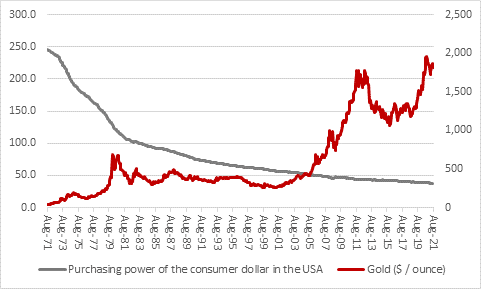
What has ensued ever since is clear as day. Over the past 50 years, gold has gained 4,160% against the greenback. “Put another way, the dollar has lost 98% of its value relative to the precious metal while 85% of its purchasing power has gone for good measure, thanks to an inexorable rise in the consumer price index (or inflation, in other words),” says Mould.

Source: Refinitiv data, FRED – St. Louis Federal Reserve database

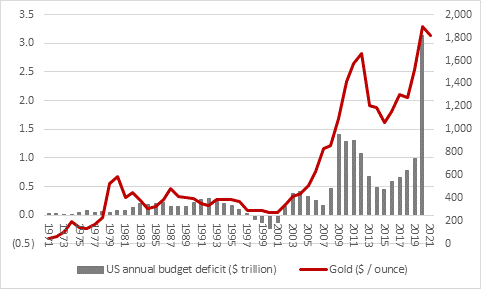
It could be argued by gold bugs that we are again seeing a replay of the events that caused Nixon to act. America is implementing unaffordable welfare programs, in addition to the Afghanistan war, as the price gold closely follows the current Federal ceiling.


However, even though most loyal of gold bugs would pause before celebrating too much. The precious metal has seen some substantial recent sell-offs for “reasons which have yet to become entirely clear”, according to Mould.

“Talk of a possible peak in the inflation rate in the USA could be one explanation. Others pointed to what they felt was a co-ordinated hit by hedge funds in the futures markets while a gathering consensus among economists that the US Federal Reserve may be about to start tapering its Quantitative Easing programme could have also had an influence.”

“Whatever the reason, though, the plunge did not last long, and gold has again held firm at around $1,800 an ounce.”

China’s services sector activity contracts in August

0

Consumption held back by Covid-19

China‘s services sector contracted in August, official figures revealed on Tuesday, as Covid-19 held back consumption.

The official non-manufacturing Purchasing Managers’ Index (PMI) was recorded at 47.5 in August against 53.3 the month before.

Anything above the 50-point mark represents growth while anything below is a contraction.

A steady upturn in consumption boosted the service sector over recent months, although it was slower to recover from thee pandemic than manufacturing.

However, an outbreak of the coronavirus resulted in strict lockdown measures, which negatively impacted business activity.

Kyle Rodda of IG told the Guardian that the PMI figures are ‘highly disappointing’, and suggest that the China economy is facing a slowdown.

“The manufacturing survey only missed estimates marginally, printing at 50.1 versus the 50.2 consensus forecast. But the non-manufacturing survey was a true stinker, with the headline number plunging to a contractionary 47.5, down from 53.3 last month and well below the expected 52.1 figure.”

“Though obviously it doesn’t tell the whole story for China’s economy, the PMIs were the weakest since the COVID-19 collapse of February 2020, and reveal the impact of last month’s Delta outbreak on the country, amidst what’s a clear trend of weakening growth.”

GSK to start phase 3 trial of Covid-19 vaccine

0

88% of over-16s in the UK have received one dose of vaccine

GSK (LON:GSK), along with a South Korean pharmaceutical company, have begun a third phase trial of their Covid-19 vaccine combination.

The FTSE 100 company made the announcement on Tuesday that the news came on the back of “positive” interim results during the Phase 1 and 2 studies.

The two firms are now aiming for global supply through the Covax facility in the first six months of 2022, subject to data and regulatory reviews.

Levels of antibodies that neutralise the virus were between five and eight times higher in vaccinated candidates than in people who had previously been infected with Covid-19.

Thomas Breuer, Chief Global Health Officer, GSK said that “while many countries have made good progress with vaccination, there remains a need for accessible and affordable COVID-19 vaccines to ensure equitable access and to protect people across the world”.

Recent figures show that around 88% of over-16s in the UK have received at least one vaccine dose.

“We are pleased to contribute with GSK’s pandemic adjuvant and to be working with SK to deliver the vaccine at scale via COVAX if it is approved,” he added.

The late-stage trial will involve around 4,000 participants from a variety of countries to assess the vaccine candidate’s safety and immunogenicity compared with the Oxford AstraZeneca vaccine.

The GSK share price is down by 1.18% during the morning session on Tuesday.