BT has announced plans to pump £30m into Distributed, the tech freelancing startup that helps businesses transform digital systems.
BT has taken a stake in the startup and technology executive at BT, Mark Murphy, will be on the board.
It is a “huge milestone” for the company, said Callum Adamson the head of the group.
BT is undergoing a modernisation effort after Harmeen Mehta became the group’s chief digital and innovation officer last year.
Mehta said that investing £30m in the startup Distributed would “accelerate the digital revolution within BT and help to make it and the UK a key hub for the digital innovation economy.”
Antimicrobial and textile odour control materials developer HeiQ (LON:HEIQ) has secured a development partnership with Hugo Boss for HeiQ AeoniQ, a high performance yarn. Hugo Boss is investing $5m in a subsidiary that holds the technology, which values that company at $200m, which is more than HeiQ’s market capitalisation.
The cash will be used fund a pilot commercialisation plant. Hugo Boss will inject up to $4m more depending on the achievement of project milestones. It also has an option to take a bigger stake.
AeoniQ is designed as a sustainable alternative to oil-based nylon and polyeste...
Circle Property (LON: CRC) is selling one of its main properties and intends to sell more and return to cash to shareholders. The property investor has achieved total shareholder return of 114% since joining AIM in 2016, but the shares have continually traded at a large discount to NAV, so management has decided to make further disposals over the next few years.
The revised strategy has helped to narrow the discount to NAV - 277p a share after the disposal - with the share price rising 21p to 226p. The discount is still more than 18%. That is the lowest it has been since 2018.
Circle Property ...
Domain name and online marketing services provider CentralNic (LON: CNIC) is already beating expectations for 2022. The online marketing operations are behind this growth.
Trading in the first few weeks of 2022 is well ahead of previous expectations. This follows the accelerating growth performance in 2021.
The 2021 figures will be published on 28 February and a pre-tax profit of $33m, up from $19.8m in 2020. Acquisitions are behind much of this growth, but earnings are expected to increase from 10.2 cents a share to 11.5 cents a share. Organic revenue growth was 37%.
Online marketing has been...
FTSE 100 sank on Monday as Russia-Ukraine tensions following comments from US officials over the weekend and reports Russia had increased the number of troops on the Ukrainian border.
The FTSE 100 was down 1.9% and the French CAC plummeted 3.4%. The German Dax crashed over 3.1%.
“The prospect of war is rarely good for stock markets, and so the new trading week has begun on a bad note across Europe and Asia as investors fear the alarm clock is about to sound on a physical battle between Russia and Ukraine,” said Danni Hewson, financial analyst at AJ Bell.
“Should Russia go to war with Ukraine, there is no telling how long the battle will last, and the damage wrought on the stock market.”
Evraz was the FTSE 100’s biggest faller slumping over 30% to 302p on Monday morning. Evraz has substantial operations in Russia and any sanctions imposed by the West as a result of Russia invading Ukraine could cripple their business.
IAG gave up 6% as investors departed travel shares on fears a war in Ukraine will lead to people cancelling holidays.
Asset managers were also heavily hit as they tracked global equity markets lower. Abrdn fell 4.8% while Schroders and St James’s Place were both 3.6% weaker.
The injection of uncertainty in markets saw gold rise which was enough to send Fresnillo higher by 4% which was the best performance of any stock listed in London.
If there is no invasion in the short term we could see a rebound in markets. Analyst Danni Hewson highlights the benefits of patience through periods of volatility and panic in markets.
“Uncertainty is terrible for investors, and it will take real nerve to stay invested through war, particularly as news headlines are likely to cause panic on the markets. Yet patience has historically been rewarded as time in the markets is better than timing the markets.”
Audioboom shares rose on Monday after reports by Sky News that Amazon and Spotify were preparing rival bids for the podcasting company chichis listed on London’s AIM.
Audioboom shares traded briefly above 2,150p before the rally faded to trade 11% higher on the day at 1,960p.
Exclusive: The technology giants Amazon and Spotify are considering rival takeover bids for Audioboom, the London-listed podcasting group which has seen revenues and its public market valuation surge amid a boom in audience figures during the pandemic. https://t.co/YL72xLlU1H
Audioboom have experienced a significant increase in the number of people listening to podcasts and recorded their maiden annual net profit of approximately $1.4m.
“2021 was a phenomenal year for Audioboom. In my second year leading the business we have delivered an incredible set of results, the culmination of our focus on content expansion and platform development,” said Stuart Last, CEO of Audioboom.
Audioboom posted a 39% increase in average global monthly downloads to 113 million in Q4 2021, up from 81.7 million in Q4 2020.
The pandemic has dramatically increased the popularity of podcasts and Audioboom would be a deft acquisition for the tech giants and they seek to grow their audience.
Spotify launched podcasts in 2020 and made big investments in growing their presence in the market by securing a $100m deal with Joe Rogan for exclusive distribution of his Podcast which has featured guests such as Elon Musk. Spotify has splashed out $1bn on Podcast rights and securing shows so AudiBoom’s platform and audience would be the perfect addition to further monetise their investment.
Audioboom has previously received a bid from All Active Asset Capital but appeared dead in the water as All Active shares were delisted.
Shares in Russia-focused mining company Evraz sank on Monday as fears grew Russia was on the verge of invading Ukraine.
Evraz shares were down over 30% in early trade on Monday as investors fled the stock to avoid the impact of any economic consequences from sanctions imposed by the west if Russia invaded Ukraine.
Evraz has operations across Europe and North America but earns the majority of its revenue in Russia from the production of steel.
The company produced 2.9m tonnes of steel in Russia in Q4 2021 and 480,000 tonnes in North America.
“We continue to see signs of Russian escalation, including new forces arriving at the Ukrainian border,” said Jake Sullivan, the US president’s national security adviser.
Russia have denied they are preparing an attack but after the weeks of growing tensions, Monday finally saw sharp moves in markets as investors repositioned portfolios.
“Just as the storm of Covid appeared to be receding, the growing expectation of an invasion of Ukraine is the fresh threat now unnerving investors, with confidence plunging in many parts of the world,” said Susannah Streeter, senior investment and markets analyst, Hargreaves Lansdown.
Orchard Bond Finance has launched a bond offer via PrimaryBid. The bond offers an annual interest rate of 6.25% and it is partially guaranteed by AIM-quoted Orchard Funding Group (ORCH) that is limited to 10% of face value of outstanding bonds. Interest is payable twice a year and the repayment date is 2027. The offer is open until 23 February.
The offer is also available through other intermediaries, including Interactive Investor and AJ Bell. The minimum subscription is £2,000. The expenses of the offer are expected to be 4%-5% of the total cash raised.
This could be the first of many bond i...
Investors can gain exposure to significant sustainable services and technology companies via new AIM admission i(x) Net Zero. The company has an international perspective.
The £9m raised after expenses will enable further investments and provide working capital for the group.
There was little interest on the first day of trading, but the number of shares traded built up over the remaining week. The share price ended the week at 77p. That represents a premium to pro forma net assets.
There is no rush to get involved. Anyone buying the shares needs to take a long-term view.
==========
i(x) Net Z...
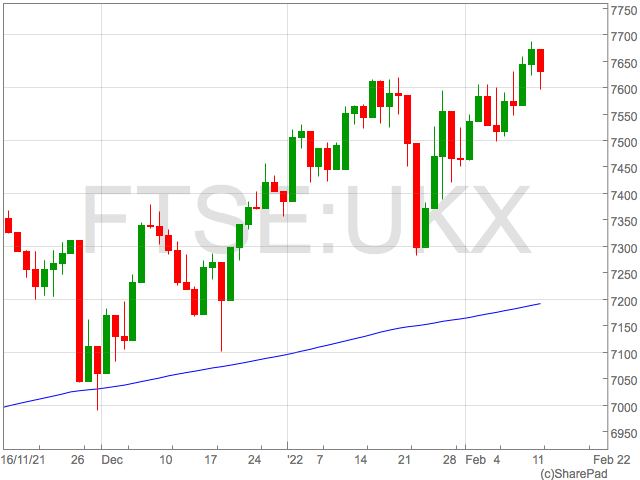
The FTSE 100 eased on Friday after a strong week of gains that saw the index trade at the highest levels since the beginning of the pandemic.
The FTSE 100 was trading 7,627, down 0.4% going into the close on Friday. Although the index was down on Friday, the FTSE 100 rebounded from sharper selling earlier in the session to trade marginally above key support levels around 7,620.
Trade was led by US equities which sank overnight on fears around inflation and interest rates. This meant the FTSE 100 opened lower, but later tracked the recovery in US futures higher during the session.
UK GDP
Markets learnt of the UK’s strong economic performance in 2021 on Friday but the bumper reading did little to inspire confidence.
Investors seemed unimpressed with the UK’s 7.5% growth in 2021 with domestic facing sectors such as housebuilders barely moving.
GDP is backward looking economic indicator and despite grinding out 1% growth during the ‘lockdown by stealth’ in Q4, both households and investors will be looking forward to conditions in 2022 with soaring inflation and the prospect of multiple rate hikes.
“Will 2022 see the UK quickly shake itself off after December’s blip or will supply constraints and those rising prices keep the lid on things? One percent growth in Q4 is pretty good going when you think about those empty high streets dressed up for a Christmas party that never took place. Household consumption has been a key factor in the UK’s growth story, the question is will households still have the fire power as additional budget pressures exert a choke hold,” said Danni Hewson, AJ Bell financial analyst.
Overseas earners
With the majority of shares in the FTSE 100 down on Friday, those that showed some signs of positivity were predominately companies that earn a large proportion of their revenue overseas.
Unilever rebounded from selling yesterdays as investors contemplated the company’s strategy and decision to proceed with share buybacks and hold off on any major acquisitions. Unilever shares were 3.3% higher at the time of writing.
Energy companies continued their rally on Friday as BP and Shell gained. Miners were mixed as copper miner Antofagasta pushed 2% higher but Rio Tinto, Glencore and Anglo American fell.
Betting companies Entain and Flutter also gained as investors positioned for the relaxation of betting laws in the US.