UK house prices drop for the first time since January

0

The average price of a home is now £260,358

House prices in the UK fell by 0.5% in June compared to the month before, according to Halifax, the mortgage lender.

It is the first time since January that house prices dropped.

The yearly rate of growth is down to 8.8% from 9.6% in May, which was a 14-year high. This comes stamp duty will gradually be phased out until September.

The average price of a home is now £260,358, down by £1,284 from the month before.

Russell Galley, managing director at Halifax, commented on the phasing out off the stamp duty holiday:

“With the stamp duty holiday now being phased out, it’s was predicted the market might start to lose some steam entering the latter half of the year, and it’s unlikely that those with mortgages approved in the early months of summer expected to benefit from the maximum tax break, given the time needed to complete transactions.”

“That said, with the tapered approach, those purchasing at the current average price of £260,358 would still only pay about £500 in stamp duty at today’s rates, increasing to around £3,000 when things return to normal from the start of October.”

Chris Hutchinson, CFO & Co-Founder of Canopy, says the stamp duty holiday was never going to be a permanent solution:

“House prices couldn’t keep on rising forever, and it seems that some of the heat is finally coming out of the market as the stamp duty holiday comes to an end. But while the temporary tax freeze got some buyers on the front-foot, it was never a long-term solution and barriers to homeownership remain. What’s more, we’re now at a point where the disparity between average salary and average asking price has led Generation Rent down an incredibly difficult path to future homeownership.”

“Nobody should feel that they are compelled to face a lifetime of renting. But with renters plugging thousands into the rental system each year, this money can feel like a waste. We should be making rent payments count towards people’s credit rating, to make it easier and quicker to secure an affordable mortgage when the time comes to buy. Instead of propping up first-time buyers with temporary support measures, it could make far more difference if we get Generation Rent equipped to buy from the very beginning of their rental journey.”
FTSE 100 has a spring in its step on Wednesday

0

The FTSE 100 made ground during the morning session today, up by 0.43%, or 30.77 points, to 7,131.65.

“Resources stocks helped lift the FTSE 100 on Wednesday morning despite a mixed showing from Asia and last night in the US,” says AJ Bell investment director Russ Mould.

“A positive update from Royal Dutch Shell and oil prices touching six-year highs contributed to gains for these index heavyweights and helped outweigh any fears over the inflationary pressures the recent spike in commodity prices may create.”

“This might change if meeting minutes from the US Federal Reserve, published this evening, sound the alarm on inflation,” Mould added.

FTSE 100 Top Movers

Shell (2.5%), along with miners BHP (2.47%) and Antofagasta (2.39%), are heading up the FTSE 100 on Wednesday.

Trailing the pack at the other end is Entain (-2.3%), Flutter Entertainment (-1.91%) and Rolls-Royce (-1.65%).

Shell

Shell today announced its intention to increase shareholder payouts as the world economy continues on its path to recovery. The FTSE 100 company confirmed that, as of its Q2 announcement at the end of July, its will raise its dividend to within the range of 20% to 30% of cash flow from its operations.

Shell put its decision down to a “strong operational and financial delivery” on the back of what it considers to be an improving outlook of the global economy. The oil giant said that “in the second quarter, Shell expects to have further reduced its net debt, although the extent of the reduction will be moderated by working capital movements”.

Shell to raise dividend on the improving outlook of the global economy

0

Shell confirmed that higher oil prices have reduced debt burden

Shell (LON:RDSA) announced on Wednesday its intention to increase shareholder payouts as the world economy continues on its path to recovery.

The FTSE 100 company confirmed that, as of its Q2 announcement at the end of July, its will raise its dividend to within the range of 20% to 30% of cash flow from its operations.

Shell put its decision down to a “strong operational and financial delivery” on the back of what it considers to be an improving outlook of the global economy.

The oil giant said that “in the second quarter, Shell expects to have further reduced its net debt, although the extent of the reduction will be moderated by working capital movements”.

“In conjunction with the increased distributions, Shell will retire its net debt milestone of $65 billion and will continue to target further strengthening of its balance sheet and AA credit metrics. 2021 cash capex will remain below $22 billion,” the statement added.

During the Wednesday morning session the Shell share price is up by 2.44%.

Oil prices were hovering around their highest price since October 2018 as attention turned to the OPEC+ ministerial meeting last week.

Upon the conclusion of the meeting Opec+ postponed a decision on whether or not to ramp up oil production as major players within the cartel have failed to reach an agreement on supply levels.

“Today’s teaser from Royal Dutch Shell ahead of second quarter results will be getting its investors as excited as James Bond fans are by the trailer for the latest film in the series,” said Russ Mould, investment director at AJ Bell.

“The company has unveiled plans to return more cash to shareholders in the second half as the recent surge in the oil price benefits cash flow and helps with debt reduction.

“This news is an interesting coda to the recent court decision in the Hague which effectively forced Shell to reduce its emissions more quickly than planned. This is likely to require significant investment and for this reason Shell is likely to be wary of overstretching itself in terms of dividend commitments.

Octopus Renewables Infrastructure Trust outlines results of share issue

0

ORIT confirmed that demand for the issue exceeded both the target issue size and the maximum issue size

Octopus Renewables Infrastructure Trust (LON:ORIT) announced on Wednesday the result of its issue, raising £150m, thereby achieving another oversubscribed fundraise.

Having considered ORIT’s investment pipeline and investor demand, the company’s board was ‘determined’ to increase the size of the issue by £50m to around £100m, issuing a total of 144,927,536 of ordinary shares at the price of 103.5p per share.

ORIT confirmed that demand for the issue exceeded both the target issue size and the maximum issue size.

“All valid applications received in respect of Qualifying Shareholders’ Open Offer Entitlements under the Open Offer will be met in full, and applications under the Placing, Excess Application Facility, Offer for Subscription and Intermediaries Offer have been scaled back,” the company said in a statement.

The Issue of Ordinary Shares will be split as follows:

  • 64,130,932 Ordinary Shares under the Placing
  • 67,979,280 Ordinary Shares under the Open Offer (including the Excess Application Facility)
  • 6,278,618 Ordinary Shares under the Offer for Subscription
  • 6,538,706 Ordinary Shares under the Intermediaries Offer

Phil Austin, Chairman of Octopus Renewables Infrastructure Trust plc, commented:

“I am delighted to announce the results of the Issue, achieving another oversubscribed fundraise. On behalf of the Board I would like to thank existing shareholders for supporting us through the first 18 months as a listed entity and allowing us to demonstrate our Investment Manager’s exceptional track record and expertise within the sector. I would also like to welcome new shareholders and to thank them for their support as ORIT enters into its next phase and continues to execute on its pipeline of investment opportunities,” said Austin.

The ORIT share price is up by 0.38% during the morning session on Wednesday and is down by 0.01% since it first listed.

Wetherspoons sales remain down amid reopening

0

Wetherspoons warns against increase in food prices

JD Wetherspoons (LON:JDW) confirmed on Wednesday that sales at its pubs haven’t risen as they would have hoped even though it has been able to reopen the majority of its locations.

Wetherspoons said that out of its 860 pubs, 850 were open, with the closed pubs being located by airports.

Between April 12 and May 16 bar and food sales dropped by 49% as guests were free to dine outside.

The pub company said its sales were down by 14.6% between May 17 and July 4, the period when the government said pubs could reopen for indoor dining.

Wetherspoons also warned that food prices would naturally rise towards the end of the year as the reduction in VAT rates will finish.

In an effort to stimulate the industry, hospitality firms were given a 5% rate cut to help them along during the pandemic-induced crisis.

As of September, the rate will rise to 12.5%, ahead of its return to 20% in April 2022.

Tim Martin, the chairman of Wetherspoon, said: “The company continues to expect to make a loss for the year ending 25 July 2021.”

“While pub operators across the UK have cheered on the Euro football championship as it has boosted sales, Wetherspoon is paying the price for not having televisions in its boozers,” said Russ Mould, investment director at AJ Bell.

“This disadvantage is a complete turnaround from last summer when its pubs had a strong advantage in that they were often bigger than rival outlets in the same area and were better placed to accommodate social distancing measures.”

“Wetherspoon also had an established app which meant it could instantly switch to mobile-based ordering from the table, unlike some rivals who had to ship in the technology.”

“As it stands, Wetherspoon is on track to make a loss for the year to 25 July. Apart from having some TVs in its pubs for the football, there was nothing else it could have really done to boost trade beyond what’s already in place, given how disruptive the year has been.”

Tip update: Lok’nStore

Self-storage sites operator Lok’nStore (LON: LOK) continues to grow at an impressive pace and add new sites that will enhance growth in the future. Declining yields on self-storage assets will help to boost NAV.
The site acquisitions and development spending will be financed through the existing bank facilities. The development pipeline will add 38% to capacity and take the number of sites to 51. It takes time for new sites to build up and the benefit to show through to profit, so sites opened in the coming year will not mature for years.
Contracts have been exchanged on two new freeholds in B...

Three days left for Forward Partners PrimaryBid offer

There are three days left to subscribe for the Forward Partners Group offer via PrimaryBid. The venture capital firm has already secured commitments from BlackRock and AIM-quoted Draper Esprit (LON: GROW) ahead of it joining AIM in mid-July. The offer price is 100p a share and the offer closes on 9 July.
BlackRock is investing £15m and Draper Esprit is subscribing £2m. BlackRock is already a major shareholder, and the other main shareholder is Neil Hutchinson. Forward Partners chief executive Nic Brisbourne was formerly a partner at Draper Esprit.
As part of the flotation, Forward Partners wil...

Research suggests the UK’s average pension pot stands at just £42,700

2

18% of people have adequate pension pot to retire ‘comfortably’

The average pension pot amounts to £42,651, according to a survey conducted by finder.com, the personal finance comparison site.

When only accounting for non-retirees, the figure is lower, as they have £33,809 saved on average.

Experts have recommended that someone retiring at 67 should have a minimum of £237,000 saved in order to retire comfortably, meaning that the average person in Britain has a mere 18% of this amount.

20% of the population have no form of private or workplace pension, while 18% have a workplace pension but no private pension.

Zoe Stabler, Investment Writer at the personal finance comparison site, finder.com, said: “The pandemic has been extremely tough for Brits in many ways, with a lot of people having to take unprecedented steps in order to stay afloat financially. It is understandable that some Brits have reduced, or paused, payments in order to direct money to more immediate priorities.”

Stabler also drew attention of the benefits of compound interest when accruing money over an extended period of time.

“However, if you are someone who has had to do this, it is vital that you look at replacing this money or at least starting to pay into your pension again. The power of compound interest means that what you pay in now could be a life changing amount if you’re able to leave it for decades. As an example, £10,000 paid in now, earning an interest rate of 5% per year, would be worth £25,330 in 20 years, £41,259 in 30 years and £67,207 in 40 years**,” said Stabler.

“Also, if you opted out of your workplace pension in order to save money during the pandemic, you should look to rejoin it as soon as you can. If you contribute 5% of your salary each month towards it, your employer is obliged to pay a minimum of 3% on top of this, which is effectively free money topping up your pension!”

The state pension could rise by up to 8% next year, according to forecasters.

The Argo Blockchain share price dipped again in June as company provides monthly update

Argo Blockchain Share Price

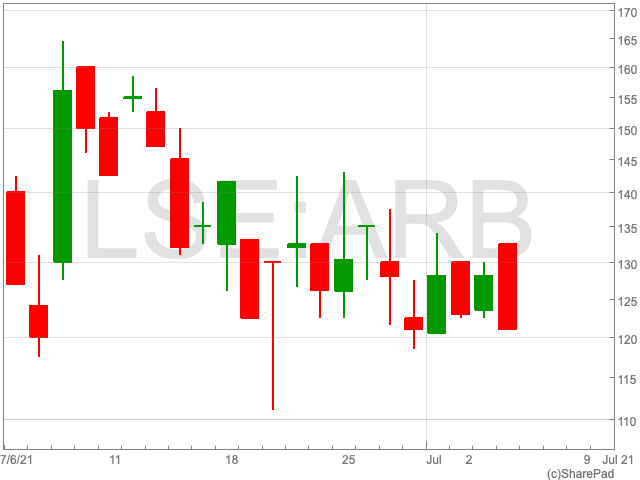
The Argo Blockchain share price (LON:ARB) continued its steady decline throughout June, falling by 3.15% over the past month. From its high-point of 284p in the middle of February, the Argo Blockchain share price is down by well over 50%, sitting at 121.55p at the time of writing.

While Bitcoin keeps threatening to go up or down, the mining company made an announcement today, which could impact the outlook of the Argo Blockchain share price.

Argo Blockchain Considers Secondary Listing

Argo Blockchain confirmed on Tuesday that it is considering a secondary listing in America on the Nasdaq, although it hasn’t yet decided when.

The Bitcoin miner said its proposed listing depends on market and other conditions, and cannot guarantee that the proposed listing will be completed.

Operational Update

In June, Argo Blockchain mined 167 Bitcoin, up by one compared to May, bringing the total number of Bitcoin mined in 2021 to 883.

Based on daily foreign exchange rates and cryptocurrency prices in June, mining revenue for the month came to £4.36m, down from £5.51m in May.

Argo Blockchain now owns 1268 Bitcoin.

Bitcoin

Bitcoin traded below $30,000 in June, the first time since January as China strengthened its regulations giving rise to fears of a crackdown across the world as well as a reluctance of institutions to invest.

Peter Wall, Chief Executive of Argo said: “June has seen big changes in the cryptocurrency sector, with the reduction in total global hash rate and mining difficulty as mining machines have come offline in China. We’ve seen the global hash rate drop from over 150m TH/s to just 90m TH/s in the space of a month and mining difficulty adjusted to reflect this reduction.”

Ukraine and London come together for eagerly anticipated Fintech Summit

0

Ukraine and London will be joining forces on 15 July for the first ever UK-Ukraine Fintech Summit.

The event brings London, the financial centre of the world, together with Ukraine, which is emerging as a major world player in technology.

Despite previous negative perceptions surrounding Ukraine, the country is steadfastly forging a new image of innovation and technological capability.

There is increasing optimism around new business opportunities in a post-Brexit world, exemplified by the trade deal between the UK and Ukraine, making now an ideal moment to connect fintech’s brightest minds from both regions.

The main organisers of the event will be the Embassy of Ukraine in the United Kingdom of Great Britain and Northern Ireland and Sigma Software Group, a software company of Ukrainian origin.

The summit, aimed at discovering emerging economic opportunities and exploring technologies that are disrupting their industries will be co-organised by TheCityUK, the UK-based financial and related professional services industry, and the London Stock Exchange Group.

UK Investor Magazine is proud to be a media partner of the event which will include the following talking points:

  • Learn about the vast post-Brexit opportunities in technology, development, and innovation between the two countries.
  • Discover partnership opportunities with the top executives of the National Bank of Ukraine, TheCityUK, Open Banking Europe, the government of Ukraine, and the most prominent FinTech startups.
  • Unveil how “The Offshoring Destination of the Year” has helped global blue-chip companies develop the most innovative products and attract millions of users, and how it can help your company today.

The event, which takes place on Thursday 15 July at 15:00 BST, can be registered for by using this link, and features a host of esteemed speakers from the worlds of fintech and politics.

The UK-Ukraine FinTech Summit is a part of FinTech Week London, which is taking place between 12 and 16 July.