


The Delta variant is holding back the Rolls-Royce share price
Rolls-Royce Share Price
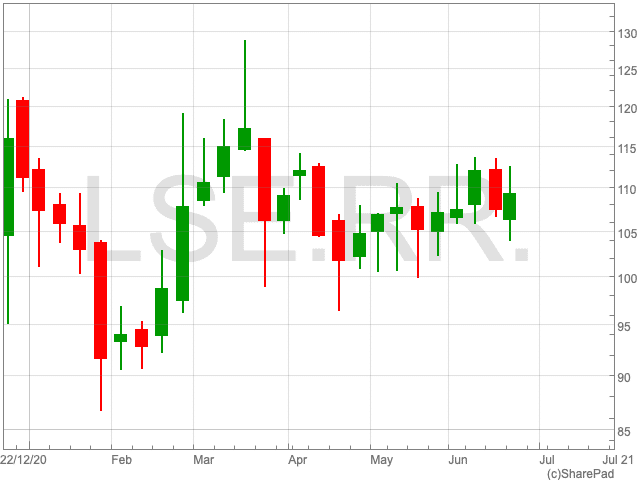
Despite some peaks and troughs along the way, the Rolls-Royce share price has remained pretty much at the same level over the past 12 months. This trend has continued throughout 2021, as the FTSE 100 company sits at 109.14p per share. However, there has been some pretty sharp dips and rises along the way, as investors appear interested, while uncertainty remains over the extent of the recovery. With current lockdown measures at home standing still, investors seem to have given up on the likelihood of foreign travel opening up in the short-term, knocking back the Rolls-Royce share price today.
Outlook
As one of the largest aircraft manufacturers in the world, the Rolls-Royce share price has been significantly impacted by the ongoing pandemic. Not only did many airlines rescind their orders but fewer planes are currently being serviced due to a lack of flights. The company does not expect orders to recover to pre-Covid levels until 2025. In the meantime, much will depend on the success of the continued vaccine roll-outs, and the resumption of international flights. The Rolls-Royce share price continues to react to updates, or lack thereof, regarding travel restrictions.
The news on this front is not great. The Delta variant of Covid-19 is spreading across the continent and threatening to derail plans of a summer reopening. In Portugal, which was initially opened to UK travellers, the variant has seen cases rise to their highest level in 12 weeks.
“If measures are relaxed too soon also for non-vaccinated people, then we may see a rapid rise in cases again,” the European Centre for Disease Prevention and Control director Andrea Ammon said a week ago.
There, its seems plausible that the Delta variant will result in further lockdowns, which will have a damaging impact in the airline industry.
Return to Positive Cash Flow
In better news, following its AGM last month, Rolls-Royce said it is expecting its cash flow to turn positive during H2 of 2021 “as engine activity recovers and cost savings are delivered”.
This announcement is especially important as Rolls-Royce ended last year with debt at £3.6bn as the group took measures to refinance. This came about partly because Rolls-Royce made 1,400 people redundant, saving the company up to £1.3bn a year.
This could give hope to investors who are willing to be patient. Ultimately, the Delta variant may only be a delay, providing further value for those who believe in the Rolls-Royce share price over the long-term. The FTSE 100 company has managed to restructure during the pandemic which could be enticing for investors.
FCA outlines new proposals on climate-related disclosure rules
Banks and asset managers emitted more carbon in 2019 than the whole of the UK
The FCA is seeking to implement financial disclosure rules for asset managers, pension providers and insurance companies, as it seeks to make forward progress in the area of carbon emissions.
On Tuesday the UK regulator revealed two of its consultations looking at introducing new rules, which are in-keeping with the recommendations from the Taskforce on Climate-related Financial Disclosures (TCFD).
This applies to listed companies and FCA-regulated pension providers.
“The climate change challenge affects the whole of society. It is vital that the financial services sector plays a leading role in addressing this challenge,” FCA executive director of consumer and competition, Sheldon Mills, said.
“Managing the risks of climate change and transitioning to a cleaner and less carbon-intensive economy will require high quality information on how climate-related risks and opportunities are being managed throughout the investment chain.
According to research by Greenpeace UK and WFF, the UK financial services industry is one of the largest contributors of carbon emissions in the country.
Banks and asset managers emitted more carbon in 2019 than the whole of the UK.
The proposed rules aim to ensure that the correct information on climate risks is available along the investment chain.
Rosanna Bryant, co-head of financial services, Addleshaw Goddard, commented: “Going green is fast becoming business critical, and when it comes to tackling climate change the whole is most certainly greater than the sum of its parts.
“Our latest research* shows that the majority of asset managers are already prioritising green investments. But this announcement from the FCA makes clear that firms will be held to account on how the investments they make today will impact all of our tomorrow.
“While this proposal by the FCA is an vital step forward, it’s important that the regulator makes clear how this will interact or align with existing EU regulation for asset managers, such as the EU Sustainable Finance Disclosure Regulation.”
Research conducted by Addleshaw Goddard of 500 business leaders and 500 financial services leaders across the UK and Europe found that 92% of business leaders say that banks have been significant in influencing their business to act more sustainably.
While 84% of finance providers say they won’t offer services to companies that lack a clear net-zero strategy.
UK property transactions cool down in May as stamp duty holiday comes to an end

There were 114,940 residential property transactions in total in May
UK property transactions are down in May, as the end of the stamp duty holiday appears likely to bring about a cooling of the housing market.
Last month there were 114,940 residential property transactions in total, as confirmed by the Office for National Statistics (ONS), 3.9% down compared to April 2021, a month before.
House prices have soared over the past 12 months as the stamp duty holiday was introduced by Rishi Sunak.
However, as the end of the policy draws near, the evidence is suggesting that sales are beginning to slow down.
Sam Mitchell, CEO of online estate agent Strike commented: “Despite property transactions easing in May for the second month in a row, numbers remain well above pre-pandemic levels with buyers and sellers scrambling to complete before the stamp duty holiday deadline at the end of this month,” said Mitchell.
“Now with only days left until the stamp duty holiday deadline, we expect property transactions to skyrocket, similar to the frenzy we witnessed in March before the original deadline. Some may be expecting a drop after the stamp duty holiday has come to an end, but with the tapering off period until October and the Government’s lending scheme combined with low interest rates, there are still plenty of factors to keep the market bubbling into the Autumn.”
“Plus, with the extension of lockdown restrictions announced last week, buyers will no doubt still be considering a home that matches their new lifestyle, whether that’s somewhere with more green space or perhaps closer to family.”
John Eastgate, managing director of Property Finance at Shawbrook Bank, added that “re-mortgaging levels are therefore also likely to receive a boost as homeowners and investors choose to fix and secure another few years of low rates.”
Brent crude oil price goes past $74 as US/Iran talks stall
Ebrahim Raisi elected as leader of Iran
The price of Brent crude oil is creeping higher again on Tuesday, as demand keeps picking up, while talks between the US and Iran over the lifting of sanctions appear to be stalling.
Early this morning Brent crude oil went past the $74 mark, before retreating somewhat heading into the afternoon in the UK.
Further to the US talks, Ebrahim Raisi has been elected as leader of Iran, which could add further complications, thereby delaying a final outcome.
“We support the negotiations that guarantee our national interests. … America should immediately return to the deal and fulfill its obligations under the deal,” Raisi said according to a Reuters translation.
As the US and Europe continue their recoveries from the pandemic, energy demand appears to making a strong recovery.
“Oil prices are on the march once more on supply concerns, helping to lift index heavyweights BP and Royal Dutch Shell and fuelling the FTSE 100’s rise,” said Russ Mould, investment director at AJ Bell.
Bitcoin falls as Chinese government ramps up crackdown

China accounted for 65% of worldwide bitcoin production last year
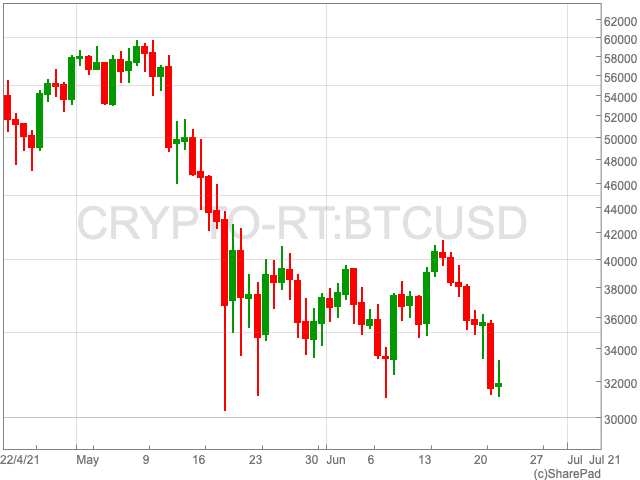
After staging a mini-recovery at the beginning of June, bitcoin has crashed again, as the Chinese Communist Party ramps up its crackdown on mining and trading.
Bitcoin is down to $31,522 at the time of writing, from just under $41,000 two weeks ago, as Beijing called on major banks to reinforce the ban.
In May China’s cabinet, the State Council, pledged to come down on mining and trading in an effort to mitigate financial risks.
“People still react strongly to actions from China that create uncertainty so this is likely to reflect negatively on the bitcoin price,” said Ruud Feltkamp, chief executive officer at at crypto trading bot Cryptohopper.
“China is rolling its own cryptocurrency and has every incentive to have as little competition as possible … I think we will see miners leaving China and relocate where there is spare or cheap energy.”
According to data from the University of Cambridge, bitcoin mining in China makes up around 65% of worldwide production last year.
Since China makes such a high proportion of the world’s bitcoin, a change in regulations is capable of creating a massive swing in the price of the cryptocurrency.
Payment platform Alipay, owned by fintech company Ant Group, confirmed that its intention to implement a system to monitor major websites to track illegal crypto transactions.
Some analysts are saying that recent price movements mean the cryptocurrency may have officially seen the end of its bull market.
Bitcoin’s 50-day moving average recently crossed its 200-day moving average, a phenomenon known as the “death cross”, which has been known to precede heavy crashes.
Having said that, when it comes to bitcoin, a death cross can signal the the worst is over, as seen in 2017 and 2019.
Sotheby’s recently confirmed it will accept cryptocurrency as payment for a rare diamond which is expected to fetch more than £10m.
Government borrowing eases in May but scars remain
Government debt is now at £2.2trn
Government borrowing dropped in May compared to 12 months ago, as lockdowns are easing and the UK continues its recovery.
Borrowing stood at £24.3bn, £19.4bn lower than May last year, as government spending continued to surpass tax income.
With measures such as the furlough scheme, borrowing has been reaching record levels.
Government debt is now at £2.2trn with all the borrowing that has occurred over the past year. This amounts to a rate of 99.2% of GDP, a rate last seen in the 60s.
The Office for National Statistics (ONS) reckons that the government borrowed £299.2bn during the financial year ending in March.
Danni Hewson, AJ Bell financial analyst, comments on today’s government borrowing figures:
“How you look at today’s public sector finances depends if you are a glass half-full or empty person. On the one hand borrowing in May was down by more than £19 billion compared to the previous year, on the other it was the second highest figure for May since records began and almost £19 billion more than May 2019,” said Hewson.
“Income was up by £7.5 billion compared to the same time last year, helped along by a 133% increase in fuel duty and an almost 90% leap in stamp duty income but there’s still a huge gap between what’s coming in and what’s going out and interest payments on all that debt has risen substantially, up 26% year on year, though much of that rise is down to changes in RPI.”
“But the gap is narrowing as the economy heals. Furlough costs were down a whopping 75% as the country went back to work and, though it doesn’t help with tax receipts, the fact that income from alcohol duty was down 20% reflects changing fortunes as people are able to reengage with friends and family.”
“The pandemic has left big scars on the nation’s finances and reopening is a salve but one that needs careful application. Too much, too soon and those inflation worries that have caused so much concern will come to bear. Not enough, too slow, or if variants demand another reverse then there will be difficult conversations about spend vs taxation. But today feel like a glass half full day, more income, less spend and a gentle foot on the accelerator.”
Markets shake off Fed fears as FTSE 100 consolidates above 7,000
The FTSE 100 consolidated its position above 7,000 once again on Tuesday, up by 0.31% during the morning session, or 21.67 points. US stocks rallied hard on Monday, while Japan’s Nikkei 225 produced a notable comeback on Tuesday.
“Well that didn’t last too long. After getting into a lather about the accelerated timetable for potential interest rate hikes announced by the US Federal Reserve last week, markets seem to have regained their poise,” says AJ Bell investment director Russ Mould.
“The catalyst seemed to be messaging from Fed officials which softened the hawkish tone of last Wednesday’s meeting, plus also a realisation that any rate increases are still two years away.”
“Meanwhile the dollar fell overnight and yields on long-term bonds were rising once again, leaving the past few days’ volatility looking like a brief hiccup rather than a major speed bump for markets. Oil prices are on the march once more on supply concerns, helping to lift index heavyweights BP and Royal Dutch Shell and fuelling the FTSE 100’s rise.”
Commercial property landlords British Land and Land Securities were also up strongly on recovery hopes as the former confirmed plans to commence construction on a new tower block in east London.
FTSE 100 Top Movers
Heading up the FTSE 100 during the Tuesday morning session is Land Securities (4.44%), British Land (4.28%) and Royal Dutch Shell (2.68%).
At the other end of the index is Just Eat (-2.24%), DS Smith (-2.27%) and Hargreaves and Lansdown (-2.07%).
DS Smith facing a number of challenges following end of year results

DS Smith confirmed its H2 adjusted operating profit stood at £272m
DS Smith (LON:SMDS), the UK cardboard manufacturer, announced on Tuesday that it saw record H2 growth as it benefitted from a boom in online shopping during the pandemic.
The surge offset an initial downturn due to Covid-19 lockdowns, the company added.
Throughout 2020, the coronavirus pandemic hastened the growth of its e-commerce business, in addition to demand for more sustainable products.
DS Smith, supplier of cardboard to some of the world’s most prominent brands, including Amazon and Unilever, confirmed its H2 adjusted operating profit stood at £272m, up from £230m in H1.
“It is our highest growth rate ever achieved. We are pleased with that growth in the COVID era,” Chief Executive Officer Miles Roberts said.
DS Smith also confirmed its statutory profit dropped by 38% to £231m for the 12 months ending in April, down from £368m a year earlier as the pandemic affected its operating at the beginning of the year.
Full-year revenue is down to £5.976bn from £6,043bn a year before.
Ben Nuttall, industrials sector Senior Analyst at Third Bridge commented on DS Smith’s results announcement this morning:
“DS Smith has a number of major challenges. First, DS Smith operates primarily in secondary packaging markets, packaging that is used in supply chains, rather than primary packaging that the customer sees. E-commerce growth is growing rapidly but from a small base, and environmental concerns are taken into consideration in the supply chain but not nearly in the same way that end consumers are. Second, DS Smith is short paper, this means that they buy more paper to make boxes with than they sell, compared to Mondi which is long paper. For DS Smith they hoped that this would flatten peaks and troughs in sales, however, in times when the market for paper is tight, such as the current situation, the danger is not being able to secure enough paper to make boxes with for customers,” said Nuttall.
“Corrugated box volumes have started to accelerate with 8.2% growth in the second half of 2021, but DS Smith had a relatively lacklustre start to 2020, the year of online shopping, despite supplying cardboard boxes to Amazon and having a product that is very environmentally friendly compared to plastic. New box volume growth in H2 was promising and have been driven by FMCG customer gains.”
“DS Smiths revenue growth came in at negative 1%, roughly in line with expectations, but with adjusted operating profit down 24% around 6% under expectations. Over the year it shows the challenges of dealing with rising input costs during times of high volatility.”
Oakley Capital acquires PRIMAVERA

Oakley Capital will combine PRIMAVERA with Ekon, one of its current portfolio companies
Oakley Capital Investments (LON:OCI), the listed trust that provides access to Oakley Capital’s private equity funds, has announced that Oakley Capital has reached an agreement to acquire PRIMAVERA Business Software Solutions, a Portuguese company.
Oakley will combines PRIMAVERA with Ekon, one of its current portfolio companies, a Spanish provider of Enterprise Resource Planning (ERP) software to create a new group by the name of Grupo Primavera.
Subject to regulatory approval, the group will be the largest independent provider of business software in Iberia.
Having been founded in 1993, PRIMAVERA offers ERP and cloud solutions to more than 32,000 SMEs across Portugal and Portuguese-speaking African countries.
“The newly established group will be the largest independent software platform serving SMEs in Iberia, with over 55,000 customers, c.€60 million of revenues and double-digit annual growth, driven by the rapid adoption of Software as a Service (“SaaS”) solutions. Grupo Primavera will be led by Santiago Solanas, an industry veteran with over 30 years’ experience in global roles in the software industry, including leadership positions at Cisco in France and Southern Europe, Sage Iberia, as well as in Microsoft and Oracle,” Oakley Capital said in a statement on Tuesday.
Grupo Primavera’s plan is to accelerate its deployment of cloud solutions organically through investment in product development and go-to-market initiatives, as well as through further acquisitions.
Peter Dubens, Managing Partner of Oakley Capital, commented on the deal:
“This is another example of Oakley’s ability to invest in founder-owned technology businesses and execute buy-and-build strategies. With the adoption of cloud technology in Iberia being behind the rest of Europe, we see significant value and further potential in growing the largest independent business software platform to service SMEs within the region.”
José Dionísio and Jorge Batista, CEOs and Co-Founders of PRIMAVERA, added:
“We are very excited about the new path that we are taking by creating an independent Iberian business software champion. This is a project with great potential, bringing together companies with a wide range of experience and leadership within the sector. We have been approached by many potential partners over the years, but it is with Oakley Capital and Santiago Solanas that we decided to take this step due to the exciting project they presented to us.”