Boohoo share price: outlook is positive despite challenges from all angles

0

Boohoo shares (LON:BOO) are stirring interest among investors again as the fast fashion brand emerges from the pandemic in tact. However, the next few weeks could be telling for investors interested in the online retail giant as the company faces up to the prospect of a tax hike from the UK government and an outright ban from the US authorities.

Boohoo share price

Boohoo’s share price tumbled in July by over 20% to 210p per share as news emerged of poor factory conditions and low pay at some of the company’s suppliers. However, the fast fashion brand showed resilience and recovered well in the following weeks by convincing investors that they planned to turn the situation around. At the end of January, when Boohoo announced its acquisition of Debenhams, the company’s shares jumped up but have since retreated.
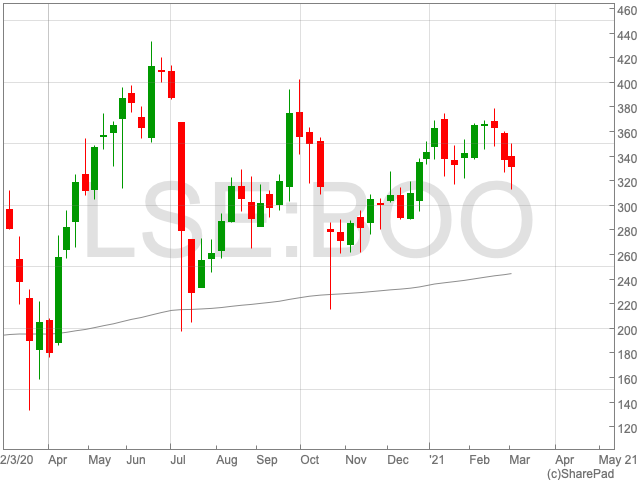
Over the past 12 months, taking into account the pandemic and the factory scandal, Boohoo’s share price has risen by over 10% to 333.42p per share. Asos, one of the online retailer’s main competitors, saw a dramatic rise in its share price during 2020, from 2,945p per share to 5,646, an increase of over 90%. However, over a period of five years, Boohoo’s share price, up 669%, has far outperformed Asos, which is up 84%.

Boohoo’s outlook

Boohoo’s revenue growth over the past year has been strong across all regions. In January the retailer released a trading update. Four the final four months of 2020, Boohoo saw its revenue grow by 40%, up to £660.8m. More specifically, in the UK, the US, the rest of Europe and the rest of the world, revenues were up by 40%, 51%, 32% and 34% respectively. The fashion brand anticipates revenue growth between 36% and 38% for the financial year to 28 February 2021. Boohoo also expects to deliver an adjusted EBITDA margin for 2021 at around 2021.

Risks

Boohoo’s price-to-earnings (PE) ratio is at 58.4. This is a high PE ratio, which appears expensive, however it could also reflect the company’s potential for high earnings growth.

While Boohoo recovered well from the factory controversy in 2020, the issue may not have been put to rest. The company could be facing a ban on importing into the US as an investigation has been launched into the its handling of claims of “modern-day slavery”.

Online retailers, including Boohoo, could also face the prospect of a tax policy aimed at the companies that have profited from the unique nature of lockdowns.


BlackRock Circular Economy Fund highlights key sectors for 2021

The BlackRock Circular Economy Fund report has outlined how the coronavirus pandemic threatened to stall the world’s transition towards ‘circular’ solutions to economic issues. However, as consumer preferences have changed, corporations have increased awareness, and governments have implemented regulations, the sector looks set to get back on track in 2021. The fund’s managers have identified four key sectors where they are expecting growth over the coming months.

The fund invests at least 80% of its total assets in companies that contribute to the advancement of the Circular Economy. The Circular Economy involves unravelling business activity from the consumption of finite resources. Its core principles include: designing out waste and pollution, keeping products and materials in use, and regenerating natural systems.

The BlackRock Circular Economy fund was established in partnership with the Ellen MacArthur Foundation, which is providing the investment firm with expert insights and guidance on circular economic principles and practices.

There is a great deal of overlap between the principles of the Circular Economy and Environmental Sustainability and Governance (ESG) investing.

Plastic

The widespread use of masks during the pandemic saw a reverse in the decline of single use plastic, although more sustainable options have made an impact.

Plastic usage is often touted as being problematic when discussing sustainability. However, within the circular economy, plastics could very much be a part of the future, according to BlackRock. This can be done, as an example, by replacing recyclable plastic with compostable plastic, which would avoid the prospect of recyclable plastic ending up in a landfill or the sea.

Evy Hambro, co-manager of the BlackRock Circular Economy Fund, argues that getting rid of plastic use is not the solution to the take-make-waste model of consumption.

“We believe that the pandemic will shift the focus to building the right infrastructure to deal with plastic disposal — waste management, collection, sorting and chemical recycling. That makes us more bullish on the supply chain opportunities compared to the pre-COVID era when the debate mostly focused on demonising plastic.”

Technology

BlackRock sees tech companies as embodying the principles of the circular economy. The investment management company expects the theme of sustainability to grow specifically within electronics.

Olivia Markham, co-manager of the BlackRock Circular Economy Fund, believes there needs to be a sustainable solution to manage the economics of decommissioning equipment, and says the company will allocate its holdings accordingly.

“For our portfolio, we seek companies that are aiding lower waste by reducing, reusing, or recycling materials. This applies to the components going into tech hardware produced by technology companies, as well as enabling consumers to do the same with disposable goods. As such, we see growth in the sharing economy, online flea market apps, second hand and rental platforms, e-waste solutions, device leasing and take back schemes.”

Healthcare

BlackRock has drawn attention to the pressing need for a more reliable healthcare infrastructure. While it is clear the sector needs the best equipment possible, product cycles are short-lived.

Olivia Markham outlined the sector’s various schemes to improve reuse and recycle rates.

“Healthcare is an important part of the circular economy with increasing relevance to circularity, especially considering medical devices and single-use health solutions. COVID-19 has been instrumental in shining the spotlight on this area, as hygiene and disposability – for example PPE and testing material – have taken precedence in almost every household in the world. We believe this accelerates the need to better understand medical waste and develop more permanent solutions for recycling and re-usability.”

Fast fashion

Fast fashion has boomed over the last two to three decades as barriers to trade have broken down across the world. While this has allowed for the democratisation of fashion, more affordable clothing has come at a cost to the planet.

BlackRock has argued that the industry will increasingly come under pressure, which will accelerate its transition towards circular practices. The investment management company will seek supply chain innovators which innovate along these lines.

FTSE 100 edges past 6,600 as ‘strong rebound’ anticipated

0

The FTSE 100 edged past 6,600 as strong gains by Pershing Holdings, CRH and Taylor Wimpey were offset by fears of slowing demand in China. In better news for the FTSE 100 companies, the UK economy avoided a recession at the end of 2020, and optimism is building around the future.

“The UK economy dodged a double dip recession as the economy grew by 1% in the final quarter of 2020, which was a pleasant surprise as economists were predicting 0.5% growth,” said David Madden, market analyst at CMC Markets.

Madden also highlighted that the BoE predicted there will be a “strong economic rebound this year as restrictions will be eased as the UK’s vaccination distribution process builds on its already solid success”.

FTSE 100 movers

At mid-morning trade, Pershing Square Holdings (3.88%), CRH (2.38%) and Taylor Wimpey (2.09%) led up the FTSE 100 as the day’s top movers.

Ashtead Group (-2.78%), BP (-2.34%) and International Consolidated Airlines (-2%) were at the bottom of the pile before lunchtime on Tuesday.

Taylor Wimpey

Taylor Wimpey confirmed on Tuesday that it would resume its dividend payment after seeing a fall in pre-tax profit of 68%. The housebuilder’s profit fell from £673.9m in 2019 to £217m. Taylor Wimpey has now reinstated its dividend at 4.14p per share. If approved then the total payout will come to £151m.

There was also a 38.9% decrease in completion, down to 9,799 in 2020 from 16,042 the year before.

Intertek

Intertek, the FTSE 100 assurance, inspection, product testing and certification company, confirmed a drop in its profit during 2020 but the company is expecting a strong year ahead. Adjusted operating profit fell by 18.4% to £427.7m, while pre-tax profit dipped by 19% to £392.8m.

Looking ahead, the company vowed to continue its focus on on sustainability, targeting net zero emissions by 2050. Intertek also stated that it is strongly positioned for growth during the pandemic recovery, as it will focus on risk and M&A growth opportunities.

Intertek ‘ahead of expectations’ despite fall in profit

0

Intertek pre-tax profit down by 19%

Intertek (LON:ITRK), the FTSE 100 assurance, inspection, product testing and certification company, confirmed a drop in its profit during 2020 but the company is expecting a strong year ahead.

Adjusted operating profit fell by 18.4% to £427.7m, while pre-tax profit dipped by 19% to £392.8m.

Intertek’s revenue fell from £2.98bn in 2019 to £2.7bn.

Intertek confirmed its full year dividend payment for 2020 at 105.8p, “in-line” with its 2019 payout.

On Tuesday’s early morning trading, Intertek’s share price is up 2.59% to 5,622p. Year-to-date the company’s share price is well down from 5,870.

Looking ahead, the company vowed to continue its focus on on sustainability, targeting net zero emissions by 2050. Intertek also stated that it is strongly positioned for growth during the pandemic recovery, as it will focus on risk and M&A growth opportunities.

André Lacroix, chief executive of Intertek, commented on the results:

“I am very proud of the energy, agility and innovation of our colleagues around the world that has enabled us to navigate a difficult 2020 with a laser focuson health and safety, customer service, cost control, cash management and employee engagement. My sincere thanks to all my colleagues.”

“In 2020, we delivered resilient revenue of £2,742m, down 6.7% at constant rates, with our earnings and cash performance well ahead of expectations. This has enabled us to deliver sustained returns to our shareholders with a full year dividend of 105.8p, in-line with 2019, reflecting our strong financial position and confidence in the future.”

Lacroix expects Intertek to continue to benefit from the pandemic into 2021.

“In 2021, we will continue to benefit from the COVID -19 recovery and the attractive growth opportunities in our industry. We are confident that the Group will continue to drive sustained value for our shareholders with year-on-year progress in revenue, margin and cash.”

Taylor Wimpey reinstates dividend as 2020 profit falls by 68%

0

Taylor Wimpey sees 38.9% decrease in completions

Taylor Wimpey (LON:TW) confirmed on Tuesday that it would resume its dividend payment after seeing a fall in pre-tax profit of 68%.

The housebuilder’s profit fell from £673.9m in 2019 to £217m.

There was also a 38.9% decrease in completion, down to 9,799 in 2020 from 16,042 the year before.

Taylor Wimpey stated that the results were expected, while the company saw a return towards normal levels of building during the second half of the year.

In March the housebuilder cancelled its dividend payment to protect its balance sheet during the pandemic. However, Taylor Wimpey has now reinstated its dividend at 4.14p per share. If approved then the total payout will come to £151m.

At early morning trade, the company’s share price is up by over 3% to 171.7p. It follows on from a strong performance yesterday as rumours circulated of an extension of the stamp duty holiday and a new help to buy scheme in Rishi Sunak’s upcoming budget circulated.

Pete Redfern, chief executive at Taylor Wimpey, commented on the results:

“2020 was a very challenging year, during which our priority has continued to be the health and safety of our colleagues, customers, suppliers and subcontractors. Operating performance has bounced back strongly in the second half of 2020, with build capacity returning to near normal levels and strong sales,” Redfern said.

“We are confident in the medium term performance of the housing market and therefore accelerated our land purchases from May 2020 as high-quality land became available at attractive rates. We are now focusing on driving efficiencies across the business, the roll out of our new house type range and implementing our ambitious new environmental strategy.”

“The UK housing market has been resilient and continues to reinforce our confidence in our outlook. We are a cash generative business with a strong balance sheet, and we are pleased to announce today that we will reinstate our ordinary dividend in line with our aim of providing a reliable income stream to our shareholders.”

UK manufacturing stalls due to Brexit and lockdowns

4

Business expectations have improved

UK manufacturers paid the price of supply chain disruptions in February as lockdowns and Brexit caused a dip in production levels.

The latest figures from the IHS Markit/Chartered Institute of Procurement Supply index for manufacturing output revealed a fall to 50.5 this month, the lowest point since May.

Britain’s departure from the single market and customs union led to the erection of barriers between the UK and the bloc. PMI (Purchasing Manager’s Index) data has previously highlighted the short-term impact of the new agreements.

The data showed that UK manufacturing sales fell, while respondents to the survey divulged “difficulties fulfilling orders to existing clients in the EU due to higher costs and transportation delays”.

James Brougham, a senior economist at Make UK, the manufacturing industry trade body, outlined the combined impact of Brexit and the pandemic on the sector.

“The compound effects of continued Covid-19 related disruption now exacerbated by manufacturers’ cautious navigation of the new UK-EU trading arrangement has created a scenario in which logistical and supply-side challenges are limiting the rate of economic recovery for the sector,” he said.

On the other hand, the PMI figures showed business expectations for the year ahead improved in February, as the roll-out of vaccines is expected to generate a rebound effect on the economy.

Despite the slowdown in manufacturing made solid gains on Monday amid expectations that Rishi Sunak will upgrade forecasts on the UK’s economic recovery from Covid-19.

Oil shrugs off poor China manufacturing data to continue rally

Oil at highest point since 2019

Oil has continued its recent resurgence despite a recent weak performance of the Chinese manufacturing sector.

West Texas Intermediate (WTI) began February at $53.55 per barrel and finished the month $61.50, up early 15%. Brent crude oil started February at $56.35 per barrel and was valued $66.13 heading into March, an increase of over 17%.

It was oil’s highest point since 2019, well before worldwide lockdowns came into effect.

This is despite a slowdown in manufacturing growth in China.

The headline seasonally adjusted Purchasing Managers’ Index (PMI), an indicator of manufacturing conditions in the Chinese economy, fell from 51.5 in January to 50.9, a nine-month low.

If the PMI figure is above 50 then output has increased for that month. Therefore, while output is still rising, it is going up minimally. PMI has also risen at a slower rate for the third month in a row.

Many companies commented on the ongoing negative impact of the pandemic on demand and business operations during the last survey period.

Analysing the China General Manufacturing PMI data, Dr. Wang Zhe, senior economist at Caixin Insight Group said:

“The Caixin China General Manufacturing PMI fell to 50.9 in February and stayed in positive territory for 10 straight months, indicating that the economic recovery in the manufacturing sector continued. But the effect of the recovery further weakened as the reading declined for a third straight month, falling to the lowest since May,” Zhe said.

Russ Mould, investment director at AJ Bell, is looking forward to Thursday as he predicts the commodity’s recent bullish run could be tested.

“Its price faces a big test on Thursday when oil producers’ cartel OPEC+ holds its next meeting. The market will be watching closely to see if an increase in supply is agreed at the meeting as a large hike could cap any further gains with Brent Crude in the near-term,” said Mould.

Oil’s price has benefitted from a number of favourable macroeconomic factors in recent weeks in addition to China’s recovery, including the Texas freeze, Joe Biden’s pending stimulus package and the retreat of Covid-19.

Lloyds share price: are Lloyds shares now the pick of UK banks?

0

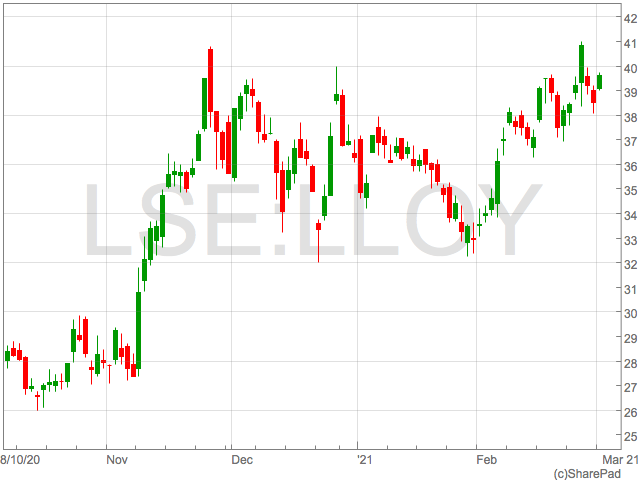
Lloyds share price (LON:LLOY) has been relatively stable so far this year after a tumultuous 2020.

Despite facing huge pressure throughout the pandemic, Lloyds and other UK banks posted robust results in February given the circumstances.

Investors are now looking to the FTSE 100’s staple institutions to explore their relative value as share prices continue to recover from sharp falls when lockdowns began. Lloyds surpassed expectations by making a respectable profit, while Natwest and Barclays both produced profits in 2020. This article will look at the recent performance of the banks and some useful valuation metrics to compare and contrast each one’s credentials as an investment proposition as the UK economy continues its recovery.

Dividends

In March 2020 the Bank of England (BoE) told the UK’s major banks to suspend dividend payments until the end of the year as a protection against loss of revenue due the pandemic. Towards the end of 2020, the BoE informed the banks that they could resume dividend payments as they were well capitalised and equipped to deal with any further disruptions caused by the pandemic. Lloyds, Natwest and Barclays resumed their dividends accordingly, with payouts of 0.5p, 3p and 1p respectively.

The newly resumed dividend payouts means Lloyds is now yielding 1.5%, whilst Natwest is yielding 1.6% and Barclays 0.6%.

These dividends are a long way off the yields investors had become accustomed to prior to the pandemic. Due to ongoing guidance from regulators, payments to investors may remain tepid in the short-term, but Lloyds has said it is committed to resuming a progressive dividend policy.

Earnings

Lloyds’ pre-tax profit dropped from £4.4bn to £1.2bn as the bank paid a £4.2bn impairment charge. Natwest, formerly the Royal Bank of Scotland, slumped to a £351m loss from a profit of £4.2bn a year earlier. Barclays was the most profitable bank out of the three during 2020, making a pre-tax profit of £3.1bn, down from £4.3bn in 2019. Barclays’ balance sheet was supported by its investment banking department which recorded robust revenues from its equities and fixed income businesses as customers rushed to the markets in 2020.

Price-to-earnings

Lloyds has the highest price-to-earnings (PE) ratio out of the three banks at 24.4, while Natwest and Barclays are at 13.2 and 16.8 respectively. Lloyds shares are the highest values based on earnings, while this may make the Lloyds share price seem expensive, it could also signal the market’s expectations of higher earnings going forward.

However, with the banks’ earnings remaining volatile due to the impact of the pandemic, investors will be paying particular attention to the valuation of banks based on their assets.

Price-to-NAV

There is little discrepancy between the banks when it comes to their price to NAV (net asset values). Lloyds, Natwest and Barclays all have Price-to-NAV measures below 1 – 0.6, 0.5 and 0.4 respectively – meaning the total value of their assets minus their liabilities is lower than the value of their share price.

This could represent excellent value for investors looking at the UK’s major banks.

However, it also reflects the current uncertainty around banks, and the future value of their assets. With all three banks trading below a Price-to-NAV of one, it suggests the market doesn’t have a high degree of confidence in the current health of banking assets such as loans and mortgages.

Lloyds share price

With Lloyds share price trading at 39.2p, it has performed worse year-to-date than peers Barclays and Natwest, who have seen their share prices increase by 10%.

Lloyds share price year-to-date is up 7%. With such little deviation in share price performance, it suggests the market views all three banks in much the same light.

Halfords to repay furlough grant as profits expected to soar

0

Halfords’ profit forecasted between £90m and £100m

Halfords (LON:HFD) announced on Monday that it expects to post a profit for the year between £90m and £100m as cycling’s boom during the pandemic continues.

Shares in Halfords rose by 19.86% to 347p upon the company’s announcement.

Following its better than expected performance, the company offered to repay the £10.7m received as a part of the government’s furlough scheme.

The company said: “The board has taken the decision to repay in full £10.7m of furlough income received, and the profit range is after this repayment.”

For the first seven weeks of Q4 2021, between 2 January and 19 February, like-for-like growth was up 6.2%, with retail and Autocentres at 13.3% respectively.

Halfords’ results indicates the sustained impact of the pandemic on cycling, according to investment director at AJ Bell, Russ Mould.

“The bullish trading statement from Halfords shows the love for cycling picked up by Britons during lockdown still has momentum,” Mould said.

“While previous cycling booms, including the one linked to the 2012 Olympics, have lost traction rapidly, it may be that the more dramatic impact of Covid on our lives will make the cycling habit stick this time.”

Halfords could also benefit from a return to normality, said Mould, as people will increasingly use their cars for longer journeys.

“On the auto side Halfords could be a beneficiary of a reopening of the economy as people get their cars on the road or at least consider longer journeys for the first time in months and want to get their vehicles checked over to ensure they are road-safe and ready.

More than £907m has been spent on cycling-related infrastructure and 1,400 miles of new bike lanes have been rolled across Europe since the pandemic began.

However, the company warned over further uncertainty in the weeks ahead. “Trading patterns continue to be volatile, with sales before Easter particularly difficult to predict while the UK remains in lockdown. As the country starts to open up once more, our overriding priority remains the health and safety of our colleagues and customers,” Halfords said.

1Spatial revenue set to surpass expectations

0

1Spatial revenue to exceed £24m for the year

1Spatial (AIM:SPA) announced on Monday that it expects to post better than forecasted financial results for the second half of the company’s trading year.

The Location Master Data Management (LMDM) software and solutions company expects its yearly revenue will exceed £24m, up from £23.4m the previous year. Recurring revenue is also forecasted to have increased on the year, along with committed revenue and longer-term contracts.

Adjusted EBITDA is expected to be in excess of £3.2m.

The AIM-listed company has improved its cash performance, with net cash increasing to £4.3m, up from £3.9m the previous year. The increase in net cash is after payment of deferred consideration of €0.7m (£0.6m), and the result of a strongly positive operating cash flow and a positive free cash flow for the full year. 

1Spaitial’s share price is up by 1.79% to 34.1p on Monday’s mid-morning trading.

1Spatial expects to continue its progress in the coming year, while remaining cautious over how the pandemic continues to unfold.

Commenting on the update, 1Spatial CEO, Claire Milverton, said:

“I am delighted to report such a solid set of numbers and significantly improved cash performance against the challenging backdrop of the global pandemic. Our expertise in the cleansing and management of location data means we sit right at the heart of changes across multiple sectors.”

“Whether that be in helping governments and energy providers prepare to meet the green agenda, supporting the investment in infrastructure upgrades as the world’s economies prepare for post-COVID recovery, or implementing digital transformation strategies. We closed the year strongly and look to the future with increasing confidence,” Milverton continued.