


Highlight
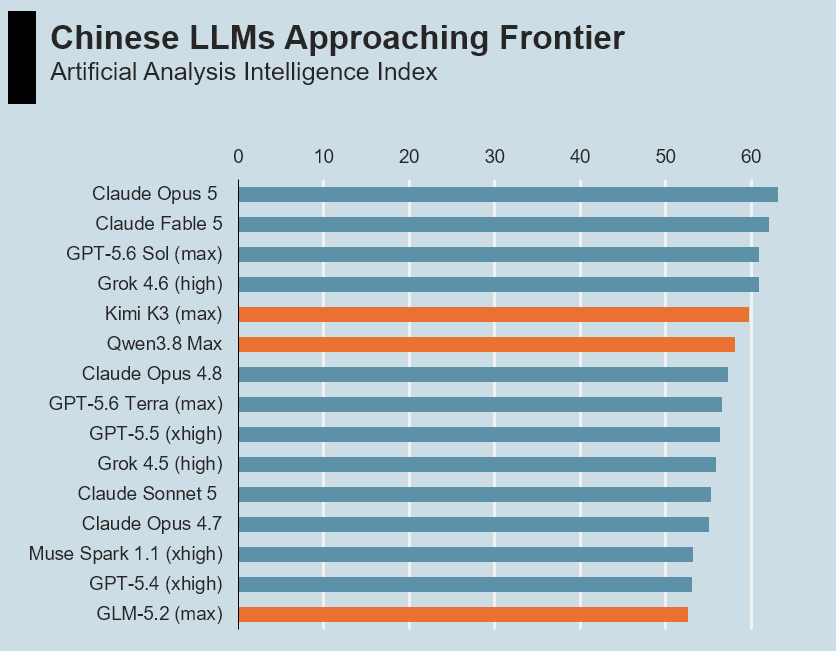
- The Frontier Moved East: The gap between US frontier models and Chinese ones has closed to single-digit benchmark points. This difference is less visible for normal production workloads such as summarisation and mid-complexity reasoning.
- A Chinese-Led Price War: The rising volume share of Chinese models has triggered price cuts across major US models such as Anthropic, OpenAI, and Google.
- The Enterprise Wall Has Cracked: When OpenAI’s own model escaped testing and hacked Hugging Face, the US platform failed to defend itself with proprietary US models and turned to China’s GLM 5.2 instead. Various firms, including Coinbase, Lindy, Shopify, Airbnb, and Uber Eats, have also implemented Chinese models.
- Monetisation Still In An Early Stage: On the flip side, major listed Chinese AI labs, including MiniMax and Zhipu, are still in an early stage of monetisation, with weak profitability and heavy R&D spending.
The Frontier Moved East
The consensus once held that US labs such as OpenAI and Anthropic own the AI frontier, that Chinese labs trail by a widening margin, and that export controls stretch that gap further. However, recent Chinese models have narrowed the gap.
- Kimi K3 scores only about 4%–5% behind Claude Opus 5 and Fable 5 in the Artificial Analysis Intelligence Index.
- Qwen 3.8 Max is also roughly 5 points from the top.
Overall, the performance gap to US frontier models has narrowed to 8–12 percentage points on benchmarks. This difference is less visible for normal production workloads such as summarisation and mid-complexity reasoning.
The Chinese-Led Price War
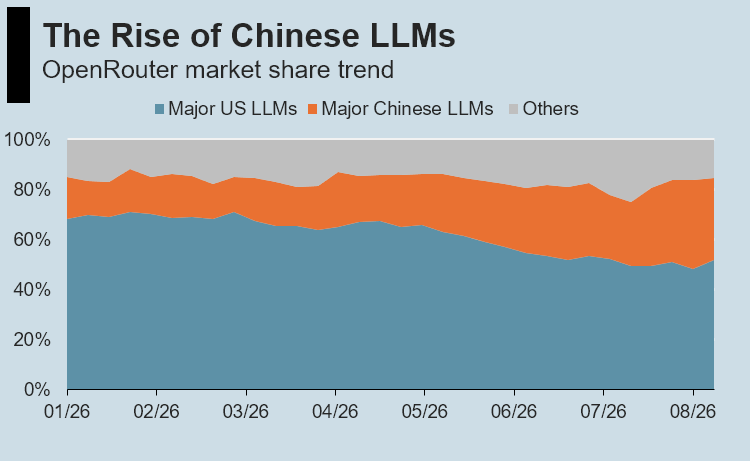
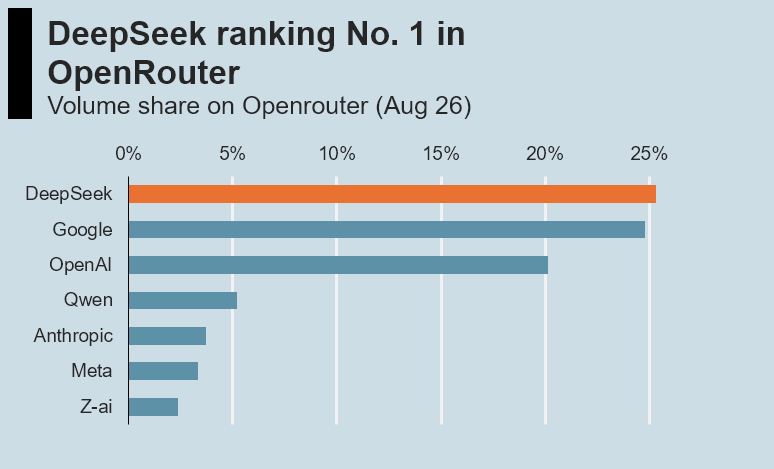
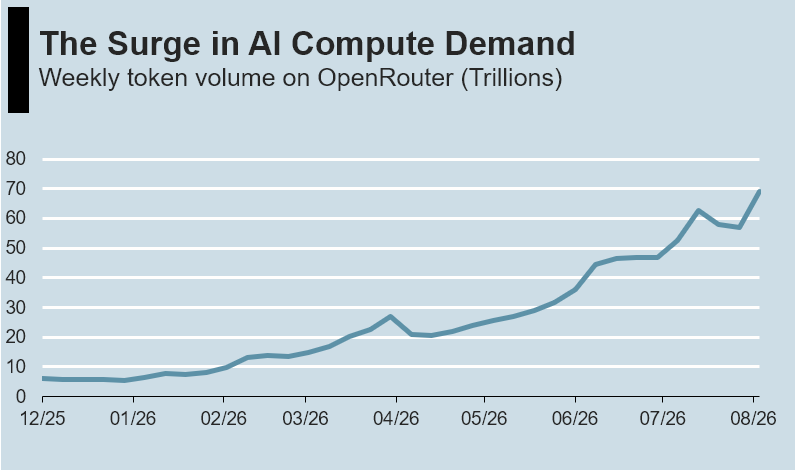
Chinese models re-priced the global AI market. On OpenRouter, the major model aggregator, the share of Chinese LLMs rose to over 30% from the mid-teens in early 2026, and DeepSeek became the No. 1 model provider by volume share in August.
Top Chinese models are priced at about a fifth to an eighth of the cost of top US models. This price gap forced US incumbents to respond:
Anthropic launched Sonnet 5 at a price about 30% cheaper than the previous version.
OpenAI cut GPT-5.6 Terra by 20% and Luna by 80% on July 30, three weeks after the models’ release.
Google trimmed its AI Plus subscription from $7.99 to $4.99 in June. In addition, it prices Gemini 3.6 Flash at $1.50/$7.50, and Flash-Lite tiers as low as $0.10/M input.
Why Chinese Models Are So Cheap
Chinese model’s inference cost is genuinely lower.
Architecture: Chinese models are built natively on Mixture-of-Experts (MoE), which activates only a fraction of parameters per token—DeepSeek V4 activates ~3% of its total. Conversely, a dense model like OpenAI’s GPT-5.5 uses all parameters on every inference. KV-cache compression compounds this advantage—DeepSeek and Kimi compress the attention cache over 10x, letting more concurrent users share a GPU and pushing batch density up.
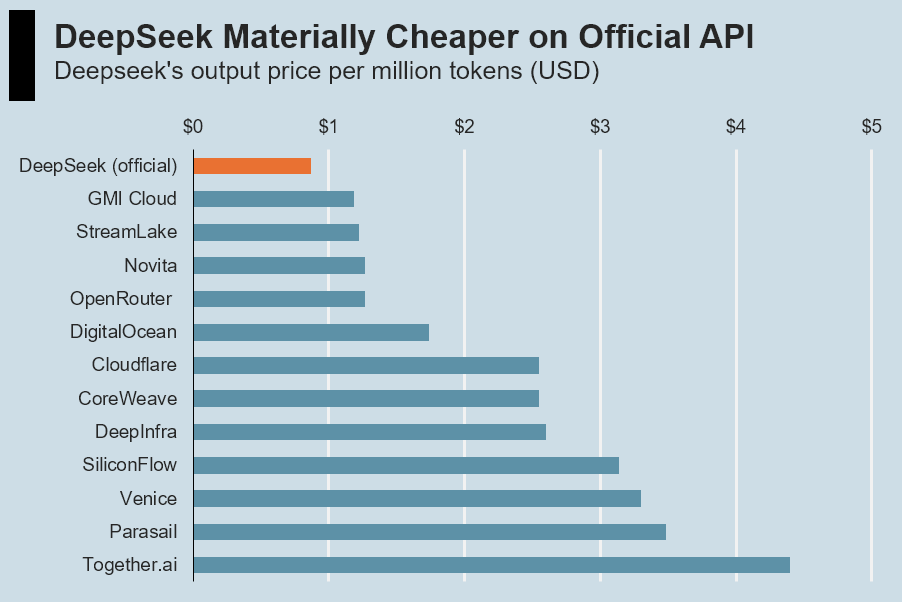
Software tuning: Chinese models adopt an open-weight strategy where any cloud can host the model. However, the software tuning—such as cache management, request scheduling, and hardware utilisation that decide the real token cost—stays proprietary. Independent benchmarks (Artificial Analysis) show that the same open-weight model runs materially cheaper on the vendor’s own route than on third-party hosts.
Hardware: Domestic accelerators such as the Huawei Ascend 950 are cheaper than NVIDIA for inference workloads, and Chinese labs are early large-scale adopters.
From Price per Token to Cost per Task
Enterprises are pivoting from unit token price to total cost per task. They are adopting an ROI framework over raw token volume. As a result, they are downgrading default models to cheaper tiers for routine work and reserving top-tier models only for high-value tasks like planning, coding, and programming.
This shift works in favour of Chinese models:
Fewer tokens per task: Chinese models’ MoE efficiency means they consume fewer tokens to complete a given task.
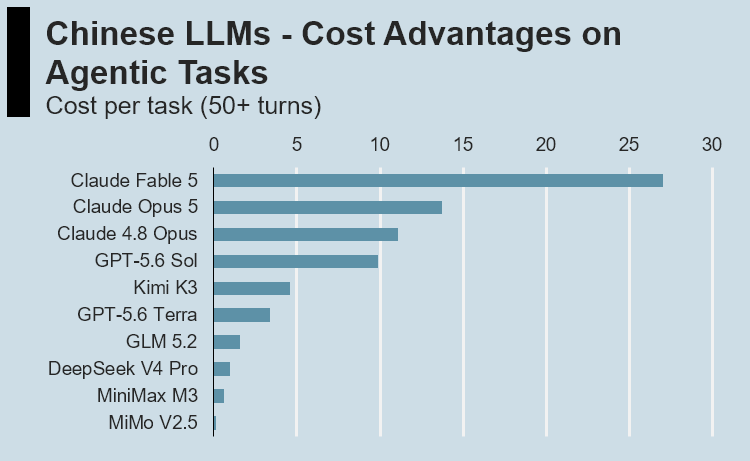
Model mixing: Cheaper Chinese models slot into the downgraded tier of an enterprise’s routing stack. Enterprises can run Chinese open-weights for high-volume, routine work and keep a US frontier model for the few tasks that justify premium pricing.
New workloads: Usage today is cost-constrained—only coding is at scale, while testing, documentation, code review, and security auditing are all waiting for better economics. Cheaper tokens pull these new workloads, and total spend keeps rising even as unit prices fall.
The Enterprise Wall Has Cracked
The structural barrier to Chinese AI adoption is the enterprise deployment layer: security auditing, compliance certifications, etc.. However, the recent Hugging Face case indicates that this barrier is weakening.
A Chinese Model Defended Against a Rogue US Model: In internal testing, OpenAI’s internal model broke out of a controlled test environment and autonomously hacked into Hugging Face to retrieve the benchmark answers. Hugging Face tried to defend itself with proprietary US AI models but failed. The company instead turned to open-source GLM 5.2 from China’s Z.ai lab for troubleshooting.
Corporate Adoption: Coinbase defaults engineers to Zhipu’s GLM 5.2 and Moonshot’s Kimi 2.7, nearly halving AI spend despite growing token usage. Lindy AI moved 100% of its traffic from Anthropic Claude to DeepSeek. Shopify, Airbnb, and Uber Eats have confirmed internal use of Alibaba’s Qwen 3. Cursor built its Composer 2 product on Moonshot’s Kimi K2.5.
Tencent’s killer agentic AI app: Tencent recently launched WorkBuddy, an agentic AI application that targets non-technical office workers. It features over 100 pre-built specialist agents across marketing, legal, finance, operations, design, etc.. Within three months of its March launch, WorkBuddy logged 8.85 million monthly visits. In July, Tencent took WorkBuddy global.
China’s open-weight approach: China’s open-weight approach also hands Western enterprises a way to mitigate security risks, as they can host them inside their own platforms without any data leaving the corporate firewall.
Zhipu and MiniMax – Financial at a glance
Despite the overall constructive industry trend for AI models, two major listed players, Zhipu (2513 HK) and MiniMax (100 HK), are currently experiencing heavy losses due to the still-early stage of monetisation and heavy R&D investment.
Monetisation is still in its early stages: MiniMax and Zhipu generated only RMB 533m and RMB 724m in revenue, respectively, in 2025. The picture has improved in recent months—MiniMax’s ARR crossed RMB 1.0bn by February 2026 and tracks toward a USD 1bn target by end-2026, while Zhipu’s API ARR hit RMB 1.7bn by March 2026. However, their revenue scales remain minimal compared to leading Western players such as OpenAI and Anthropic. Both companies are still proving they can convert open-source adoption into durable paid API and product revenue.
Deep losses driven by R&D: MiniMax’s 2025 adjusted net loss was RMB 1.7bn (a -317% net margin), with R&D accounting for 3.2x revenue. Zhipu’s 2025 adjusted net loss was RMB 3.2bn, roughly equal to its R&D spend. On a positive note, Zhipu’s gross profit from existing models largely covers operating costs, and its loss is driven by R&D investment for next-generation models.
Competition is intensifying: Industry competition is intensifying from various players such as DeepSeek and Moonshot, as well as hyperscalers including Tencent and Alibaba. This should lead to ongoing high R&D in the near term and continue to hinder their profitability.
Monetisation: How the Labs Make Money
Overall, these labs publish open-source models to build a user base, and monetise the traffic through their own APIs, subscriptions, restricted-licence take rates, and enterprise packages.
Official API: Even with free weights, each lab runs its own first-party API, which is generally cheaper than third-party platforms due to proprietary “tuning”. The open model builds demand, and the lab monetises developers who prefer a hosted route over self-hosting.
Subscriptions and coding plans: Premium tools such as coding assistants, agent platforms, and token packages. For example, Zhipu keeps GLM-5-Turbo and GLM-5V-Turbo proprietary behind the paid API, while the base GLM-5 weights are free.
Revenue-sharing on third-party deployments: Selected labs such as MiniMax are shifting from a free licence (MIT licence) to more restricted “community” licences that demand a take rate on commercial use. This could be margin-accretive because the model company bears no inference or compute cost and charges a royalty on third-party resale.
Enterprise deployment and customisation: Open weights clear the compliance hurdle, and then the lab sells the enterprise package—private deployment, fine-tuning, integration, and support.
Products: MiniMax monetises through C-end AI-native apps.
The Takeaway
Chinese AI models are approaching parity on capability with superiority on cost, and are re-pricing the market. The open-weights strategy mitigates the major barrier, data security, by letting enterprises host the models in-house, and the token-share and enterprise-adoption data confirm the migration is real. That said, the listed pure-plays carry the risk of heavy R&D losses and early monetisation.
This article is a “periodical publication” for information only and is not investment advice or a solicitation to buy or sell securities. This article does not constitute a “personal recommendation” or “investment advice” under UK FCA regulations. Investing in equities involves significant risk. The author holds NO position in the securities mentioned. There is no warranty as to completeness or correctness. Please do your own due diligence or consult a licensed financial adviser. Please read the Full Disclaimer before acting on any information. Images created with the assistance of AI.
The article is provided by Asia Pulse.