
ECB will continue bond buying to aid eurozone economy

0

Rates remain on hold as ECB chiefs anticipate easing of lockdowns

The European Central Bank (ECB) has restated its desire to minimise borrowing costs across the eurozone, suggesting it will continue its increased rate of bond buying until the EU is well on the road to recovery.

The bank confirmed on Thursday via a press conference that it has “decided to reconfirm its very accommodative monetary policy stance”. The ECB’s to policymakers said in a statement after the conference that “incoming information confirmed the joint assessment of financing conditions and the inflation outlook carried out at the March monetary policy meeting”.

Therefore, “the governing council expects purchases under the [pandemic emergency purchase programme] over the current quarter to continue to be conducted at a significantly higher pace than during the first months of the year”, the statement said.

The deposit rate held steady at -0.5% as the ECB reaffirmed its position that €1.85tn emergency bond-buying programme could be expanded or not fully utilised. Its decision would depend on the progress of its efforts to support a recovery in output and inflation.

Containment Measures

The bloc is hurting as EU countries deploy measures to stifle the high rate of infections. However, the rate of vaccinations is moving more quickly in a number of countries. So much so that economists are anticipating the possibility of a strong recovery if restrictions are eased next month.

Speaking at a press conference after the announcement, ECB president Christine Lagarde said: “While the recovery in global demand and sizeable fiscal stimulus are supporting global and euro area activity, the near-term economic outlook remains clouded by uncertainty about the pandemic.”

“The progress with vaccination campaigns, which should allow for a gradual relaxation of containment measures, should pave the way for a firm rebound in economic activity in the course of 2021,” Lagarde said.

Downside Risk

While the risks surrounding the euro area growth outlook over the near term continue to be on the downside, according to Lagarde, medium-term risks remain more balanced. The president of the ECB also said that the prospects for global demand were better – bolstered by the sizeable fiscal stimulus – and that the progress with the vaccination roll-outs are encouraging.

“On the other hand, the ongoing pandemic, including the spread of virus mutations, and its implications for economic and financial conditions continue to be sources of downside risk,” Lagarde added.

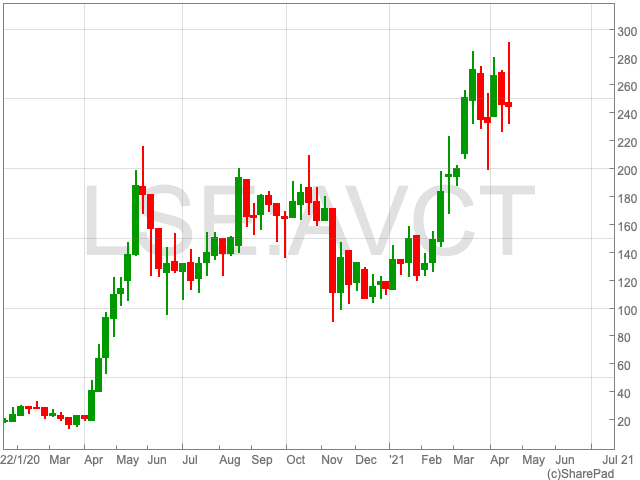
Avacta Group Share Price: further to go after impressive gains?

0

Avacta Group Share Price

Having made outstanding gains since the beginning of April, the Avacta Group share price (LON:AVCT) continued to push on into 2021. Since the turn of the year the company is up by 115%, while in the last 12 months it is up by 360%. Avacta recorded £3.9m during 2020, while its sales for the full year of 2021 are expected to reach £6.25m. The question now is whether, after its impressive resurgence in the face of the pandemic, it is a viable stock for the long-term.

Rapid Antigen Lateral Flow Test

Avacta’s share price shot up in March and the key factor was positive results from its rapid antigen lateral flow test. The therapy and diagnostics developer said that it is now able to detect dominant new variants of the coronavirus, such as the B117 and D614G, in addition the original strain of Covid-19.

The SARS-CoV-2 antigen lateral flow test was clinically evaluated in Europe and identified 96 out of 98 positive patients correctly with a 20 minute read time and 101 out of 102 negative samples.

Chief executive Dr Alastair Smith said: “I am delighted with the clinical data from this larger clinical study, which has robustly evaluated the AffiDX antigen test … The results are very impressive and mark a major step in obtaining a CE mark for professional use.

“We are completing the necessary assessment of the product from our manufacturing partner Global Access Diagnostics, including stability testing that will complete the technical file for CE marking, which we expect will happen in early May.

Avacta said it is looking to provide a commercial update as soon as possible on the commercial roll-out of the AffiDX test in the coming months.

Long-term

Moving forward there is always the possibility that Avacta’s trials will be unsuccessful. This is a risk any investor takes when it comes to biotechnology, which could negatively impact the company’s share price. Alternatively, as seen over the course of the past 12 months, it can be the cause of sharp rises.

Another hazard of the industry is research and development costs, which as well as being substantial, are ongoing. This means Avacta has to pump money in which has at times come from a dilution of the company’s share price. Avacta is also an AIM-listed stock, and so there is less liquidity than in, for example, the FTSE 100. This means there can be a great deal of volatility, which presents a risk for investors who want quick access to their money.

Who are the young affluents? Why ikigai is redefining wealth management and banking for millennials

By Maurizio Kaiser, co-founder of ikigai, raising on Crowdcube

For many years, the word “millennial” has been synonymous with “the young” – and yet, millennials today (defined as those born between 1981 and 1996) are now in their late twenties and thirties. The oldest are hitting their forties. 

They’re not just coming of age, they areof age: working harder, acting smarter, facing vastly different challenges than other generations. What’s more, they are increasingly of stature in politics, culture and across professions – they’re CEOs and rising artists, leading teams and driving change across business and society. 

For banks and wealth management firms alike, the rise of the millennial represents a crucial opportunity. 

Not only digitally native and forming the majority of today’s workforce, there is a growing cohort within the millennial generation who are not only affluent in their own right, but are about to become the beneficiaries of one of the greatest wealth transfer in history. According to Simon Kucher & Partners, by 2046 baby boomers (those born between 1946 and 1964) will have transferred USD30 trillion of their wealth to the next generation. 

There are already over 2.4 millionyoung but affluent millennials in the UK – but that number is increasing. As they enter their prime earning, inheriting, and spending years, these millennials – the young affluents – are the future clients that banks and wealth managers must work hard to not just attract, but retain. And that means addressing a swathe of currently unmet expectations. 

Underserviced and overlooked 

Despite the size and potential of the young affluent audience, the financial sector in its current guise is not meeting their expectations. 

When it comes to wealth, incumbents and challengers alike favour a one-size-fits-all approach, meaning that there are a growing number of young and affluent people who are currently overlooked by banks. 

Research backs this up, with data showing that 56% of high-net-work millennials in the UK are dissatisfied with the wealth management tools on offer to them. They seek a financial solution which is personal, accessible, high-tech and high-touch – but they’re not finding a service that meets these needs amongst the current market offering. 

Unsurprisingly, this dissatisfaction shapes their behaviour; 60% of millennials say they’re not loyal to their current wealth management service. 

So where’s the disconnect?

Crucially, young affluents recognise how important their relationship with money is. Unlike previous generations, they approach their wealth as an act of self-care, rather than avarice, which makes them both more financially conscious and financially cautious. 

With this in mind, there are a number of consequences that shape young affluents’ requirements from a bank.

Firstly, they want to approach their personal finances and savings goals from a place of mindfulness and intention, with accumulation no longer the sole focus. Accenture’s ‘Millennials & Money’report found that 59% of millennials want to become savvier with cash flow management and budgeting, as well as planning for specific events.

Secondly, young affluents want their wealth to meet their sense of purpose. They believe – as I do – that your money should help you achieve your goals, not be the point of stress that it all-too-often becomes.

That’s where ikigai comes in

At ikigai, we’re on a mission to help this under-serviced but increasingly powerful audience, by building a financial platform for the future of wealth. 

We want to redefine the way young affluent people bank and invest by approaching personal finance from a personal place – an approach to money that, as explored here, we believe escapes incumbents and challengers alike. 

As for why we’re taking this challenge so seriously? 

With ikigai, we believe there is a clear opportunity to redesign banking and wealth management from the ground up. We’ve created a product where our clients’ wealth meets their sense of purpose. And we’re inviting you to join us on our mission. 

If what I’ve shared here resonates with you, and you’d like to join us on our journey to redefine the way young affluent people bank and invest, I’m pleased to offer you the chance to become part of our community. 

ikigai’s crowdfunding is now open with exclusive early access. 

To invest in us on Crowdcube, and to find out more, head here.

Investments of this nature carry risk to your capital and should be invested in as part of a diversified portfolio. Please Invest aware.

Aggreko’s largest shareholder moves to block £2.3bn takeover

0

Aggreko will now turn focus to second largest shareholder

The takeover of Aggreko (LON:AGK), the temporary power supplier, seems more unlikely now as the FTSE 250 company’s largest shareholder hinted its intention to thwart the deal worth billions of pounds.

Sky News has reported that Liontrust Asset Management, whose stake in Aggreko amounts to 12%, will vote against the £2.3m deal.

If they do then the company’s 880p-a-share acquisition by a consortium comprising TDR Capital, the private equity firm, and Squared Capital, an infrastructure investor, could come in to doubt.

Aggreko supplies its equipment across industrial sectors, notably to large-scale events, including the World Cup, the Super Bowl and Glastonbury.

The Scottish-based company recently reported a yearly profit before tax of £102m on its revenue of £1.4bn. Eyes will now turn to the plans of Sprucegrove, whose stake amounts to 8%, meaning it is the second-largest shareholder. As of yesterday, its voting intention is unclear.

Aggreko confirmed last month that it would recommend the deal to shareholders, with Ken Hanna, chairman, insisting that the price reflected its future growth prospects.

Nestlé sales boosted by coffee surge

0

Consumers buying Starbucks-branded products, Nescafe instant coffee and Nespresso pods

A rise in the number of people drinking coffee at home saw Nestlé (SWX:NESN) increase its sales quicker than anticipated during the quarter ending in March.

This happened as consumers were buying up coffee products such Starbucks-branded products, Nescafe instant coffee and Nespresso pods.

The Swiss food and drinks conglomerate revealed sales growth of 7.7% in the past three months, surpassing the 7.3% from the year before and well higher than analysts’ expectations of 3.3%.

The rise was down to a 17.1% increase in the sales of its Nespresso products, in addition to its Starbucks-branded coffee sold in shops as part of a deal agreed three years ago by chief executive Mark Schneider.

Other drivers of Nestlé’s growth was the sale of its dairy products, as well as pet food.

Schneider said the company was gaining market share. “We are pleased with Nestlé’s strong organic sales growth in the first quarter, building on broad-based contributions from most geographies and product categories,” he added. “Retail sales saw solid growth and out-of-home channels saw signs of improvement.”

Vietnam Holding (LSE: VNH) celebrates Earth Day

Earth Day (April 22nd) is the largest civic event in the world and an important opportunity to raise awareness about climate change, global warming, biodiversity loss and the need to conserve the environment. Even leaders from the USA and China are setting aside their differences to discuss initiatives to lower carbon dioxide emissions at a climate summit.

When Earth Day was established in 1970, much of Asia was in a real or perceived conflict, with regime changes and the war in Vietnam being the biggest threats to South East Asia. In fact, the student antiwar movement across US university campuses was one of the key catalysts for the creation of Earth Day. Five decades later, much of South East Asia has seen dramatic economic growth, with Vietnam leading this momentum over the last few years.

Now the threats are more from rising sea levels, increased plastic waste and global warming caused by increased levels of greenhouse gases (GHG) in the environment.

As a sign of its more prominent role in global trade, and on the back of its recent chairmanship of ASEAN, the Vietnamese government has revised the Law on Environmental Protection (LEP) with more detailed provisions on climate change and waste management, including promoting climate change mitigation and regulating the roadmap for Vietnam’s pledge to reduce GHG and setting out legislation towards the development of the ‘circular economy’ including establishing extended producer responsibility towards the use of plastic bottles and containers.

This comes after a year in which Vietnam has been hailed as a Pandemic Winner, having controlled the outbreaks of COVID-19 in a super-effective way and managed to keep its economy roaring ahead despite the woes in other parts of the world.

The pandemic has accelerated many global trends, and the increasing importance of investing for a sustainable future is picking up pace in Vietnam as much as it is anywhere in the world now. Although environmental, social and governance (ESG) criteria have been fully integrated into VNH’s investment process for over a decade now, we’re seeing a new wave of forces moving sustainability up the Board agenda in Vietnam as more investors and regulators wake up to the urgencies of climate change and its material impact on people and the planet. As a responsible investor and pioneer of ESG investing in Vietnam, we appreciate how integral our stewardship role for each of our investee companies is in helping them achieve their sustainability goals.

This is why we are pleased to reveal the findings of our latest independent carbon footprint assessment, which shows that our portfolio was 41% less carbon intensive than its benchmark, the VN All Share Index, for each US$100 invested in the year ending December 31st2019. The positive performance is a result of sector and stock picks – a feature of an actively managed portfolio.

Vietnam Holding was recently flagged as a ‘Strong Buy’ in Investors Chronicle and has seen its Net Asset Value rise more than 53% since the start of its financial year.

The assessment was conducted by Vietnam Energy and Environment (VNEEC), a climate change specialist firm in Hanoi, which established that the carbon footprint of the VNH portfolio is 18,003 tCO2e compared with an investment of the same size in VN All Share being 30,396 tCO2e.

It is essential that we track our progress in low-carbon investing and keep a pulse on how companies across sectors are dealing with upcoming regulations on reporting on GHG emissions and reductions.

VNEEC, which uses an internationally recognised methodology for the reports, will release the findings for 2020 in June.

With exports growing fast and a US$2 bn trade surplus continuing in March 2021, Vietnam is making more of a name for itself in global value chains. As such, companies will be under greater pressure by stakeholders to be more transparent about their ESG risks. One of Vietnam Holding’s more recent investments is HSC, the first broker in Vietnam to produce a research report on ESG in August 2020. It explored how companies that are more ESG aware have better supply chain resilience and corporate governance. “It stands to reason that companies which are focused on the long-term are better managers of investors’ capital, more able to minimise volatility and risk in their operations and therefore better positioned to generate longer-term returns,” the report stated. We share this view and believe that our ESG approach and analysis of financial and non-financial risks enables us to better understand how a company creates and delivers value for its stakeholders now and into the future. 

According to the International Monetary Fund, Vietnam’s GDP growth forecast is still set to reach 6.5% in 2021, and economic indicators show that manufacturing continues to recover strongly. Nevertheless, the IMF is one of many also saying that Vietnam needs to catch up on the sustainable infrastructure front and roll out more reforms aligned with the UN’s 17 Sustainable Development Goals (SDGs) if it is to continue attracting new foreign players. We are seeing more opportunities for SDG investment in Vietnam, in this respect, particularly in transport infrastructure, green real estate, and improved digital access.

In our view, ESG is already becoming less of a trend and more mainstream for companies everywhere in the world if they are to survive the fast-changing landscape this decade brings and allow us to celebrate Earth Day for generations to come. Collective action, SDG #17, is crucial if we are to build a sustainable future for us all.

Vietnam Holding (LSE: VNH) is listed on the main board of the London Stock Exchange and its shares can be bought through your broker. The shares currently trade at an attractive discount of 20% to its Net Asset Value. Sign-up for the monthly factsheet here.

Pernod Ricard forecasts strong profit growth for full year

0

Pernod Ricard up 19.1% for last quarter

Pernod Ricard (EPA:RI), the French alcoholic beverages company, said on Thursday that it expects 10% organic profit growth in the fiscal year 2020/21 as strong demand in key markets – the US and China – have helped the firm surpass its Q3 estimates.

The brand that owns Absolut vodka and Martell cognac is anticipating a surge in sales in Q4 as pubs and bars begin to reopen, although travel retail is expected to remain limited.

The Pernot Ricard share price is up by 1.96% to €176.50 midway through the morning session on Thursday.

“Management guidance for 10% organic EBIT growth in FY21E is significantly better than the market expected and compares to current consensus of 7.1%,” Citi analysts wrote in a note.

Pernot announced sales of €1.955bn in the next three months to March 31, up 19.1% compared to the year before, and outdoing expectations of 11.3%.

After two consecutive quarters of decline, the performance confirmed a return to growth for the CAC 40 company’s sales.

Sales for the first nine months reached €6.941bn, an organic growth of 1.7%, with sales in the United States continuing to grow at a mid-single digit pace, as stuck-at-home consumers splurged on Glenlivet scotch and American whiskeys while a cocktail craze boosted demand for Malibu rum and Kahlua liquors and tequila.

FTSE 100 lagging behind German and French markets

0

Ahead of the ECB’s latest monthly meeting the Eurozone indices made a strong start to Thursday morning trading.

Following on from a full recovery from the Dow Jones last night, the DAX and CAC both added more than 0.5% after the bell. That leaves the DAX knocking at the door of 15,300, and around 230 points away from its all-time highs, with the CAC 10 or so points short of 6,200.

The European Central Bank isn’t expected to ruffle any feathers this Thursday, with analysts predicting that it will be another steady session from Christine Lagarde and co.

“But with a while until the next meeting – the central bank skips May – the ECB could use this opportunity to sharpen its forward guidance. There are also hawks lurking among the doves, meaning the get-together may not go as smoothly as forecast,” according to Connor Campbell, financial analyst at Spreadex.

While the Eurozone markets were aggressive in their continued rebound, the FTSE 100 is struggling to get back to 7,000. Instead, a 0.2% increase leaves it just above 6,900, with little on the agenda until tomorrow’s flash manufacturing and services PMIs to help generate momentum.

FTSE 100 Top Movers

Experian (3.68%), Polymetal International (2.55%) and RELX (2.08%) have made the most ground on the FTSE 100 at early morning trading.

BAE Systems (-3.84%), Antofagasta (-2.10%) and Rentokil (-1.74%) are the biggest fallers on the UK index so far.

Taylor Wimpey

Taylor Wimpey confirmed via a trading statement on Thursday that its order book has grown, as house sales had made a positive start to the year. The FTSE 100 company said that up to 18 April 2021, outstanding orders were worth £2.81bn (2020: £2,67bn) or the equivalent of 10,995 homes.

Taylor Wimpey also reported that net private sales for the same period had risen to 1.00, up from 0.90 the year before. The FTSE 100 company will payout a final dividend of 4.14p for 2020 and a similar amount again at the half-way through the current year.

musicMagpie makes London debut

0

musicMagpie receives green accreditation as it begins trading

musicMagpie (LON:MMAG), a leading re-commerce business in the UK and US specialising in refurbished consumer technology, announced on Thursday the admission of the company’s ordinary shares of one pence each to trading on the AIM market of London Stock Exchange (LSE).

musicMagpie is a leader in the re-commerce of consumer technology (including smartphones, tablets, consoles and computers) with “sustainability running to the very heart of its operations”, the company said via a statement.

Founded in 2007, the company has an established presence in the UK, with operations in Stockport, Greater Manchester, and in the US in Atlanta, Georgia.

Operating through its two trusted brands – musicMagpie in the UK and Decluttr in the US – its core business model is to provide consumers with “a smart, trusted and sustainable way to buy, rent and sell refurbished consumer technology and physical media products”.

The company confirmed that it has received the LSE’s Green Economy Mark, which recognises companies that derive% or more of their total annual revenue from products and services that contribute to the global ‘Green Economy’.

Steve Oliver, Chief Executive Officer and co-founder of musicMagpie, expressed his delight at welcoming new shareholders, as well as the company receiving the LSE’s Green Economy Mark.

“This is an exciting new chapter in the musicMagpie story, and we are delighted to welcome our new shareholders to the business. The Company has been on a fantastic journey since Walter Gleeson and I founded it in 2007, and I am hugely proud of the hard work, innovation and dedication of our people in getting the business to where it is today. I am thrilled that our colleagues can now have a direct stake in musicMagpie’s future success,” Oliver said.

“I am also particularly pleased that musicMagpie has received the LSE’s Green Economy Mark. It is a clear recognition of our strong environmental, social and corporate governance credentials as we continue to provide a service that is both smart for the consumer and smart for the planet.”

AJ Bell says total assets under control up by 35%

0

Customers who use AJ Bell platform increased by a record 34,223 in Q2

AJ Bell (LON:AJB) announced on Thursday in a trading update that it had seen a record number of customers joining its trading platform.

The FTSE 250 company’s total number of customers rose by 32% over the last year, and 11% in the quarter, to 346,797. Total net inflows of £1.5bn were generated from the quarter, up from £1.3bn the year before.

AJ Bell’s total assets under administration rose by 35% to £65.2bn.

Customers who receive advice grew by 14% over the past year while customers who use the platform increased by a record 34,223 in Q2.

AJ Bell’s inflows were up by 13% over the past year to £1.8bn, while its assets finished up by 38% at £58bn.

Andy Bell, chief executive at AJ Bell, commented on one of the company’s busiest ever years:

“The run up to the recent tax year-end was our busiest ever, driving strong growth in customer numbers and assets under administration during our second quarter. Our easy-to-use, low-cost platform continues to perform well in both the financial adviser and direct-to-consumer markets,” Bell said.

“Our adviser platform saw its largest ever quarterly increase in new customers. This is testimony to our award-winning proposition and the price advantage our customers enjoy compared to other major adviser platforms.”

“Our direct-to-consumer platform saw record growth in customer numbers and inflows in the quarter. We continue to see growing numbers of younger people joining the platform as they look to take control of their long-term financial future via pensions and ISAs. Our new and existing customers continue to consolidate existing investments onto our platform, meaning we are growing quickly whilst maintaining a high average customer portfolio of £79,000.”

“”Our investment business also had another strong quarter, with both advisers and customers recognising the value and performance our low-cost investment solutions are delivering. Our managed portfolio service is growing increasingly popular with financial advisers and our range of multi-asset funds is seeing strong inflows, with our Responsible Growth fund proving particularly popular.”