India Capital Growth Fund presents at the UK Investor Magazine Virtual Conference April

Managers of Investment Trust India Capital Growth Fund (LON:IGC), David Cornell and Gaurav Narain, were welcomed to the UK Investor Magazine Virtual Conference to outline the investment case for India, and in particular the India Capital Growth Fund.

The India Capital Growth Fund is listed on the London Stock Exchange and is fairly liquid with £0.5m in daily traded volume. The Trust focuses on the Mid-Cap section of the Indian equity markets and is positioning for the upcoming revery in the Indian economy after the pandemic.

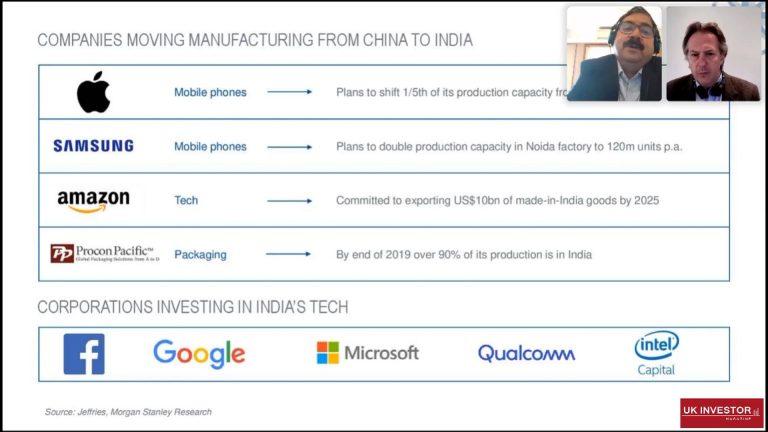
Managers of the India Capital Growth Fund detail their view on India becoming a manufacturing hub and provide background on the wider economy, highlighting the IMF’s prediction India will be the world’s fastest growing major economy in 2021.

Please download full presentation slides here.

Antofagasta production meets expectations despite new lockdown in Chile

0

Antofagasta copper production for Q1 at 183,000 tonnes

Antofagasta (LON:ANTO) confirmed on Wednesday that its production and costs were aligned with its expectations in Q1 although it remains wary of the consequences of another lockdown in Chile.

The major mining company announced its copper production was on schedule at 183,000 tonnes, 5.7% lower than the year before, and 5% down on Q4. The results were largely down to reduced grades at its Los Pelambres mine.

Production of gold is down to 59,100 ounces, while production of Molybdenum, a silvery-white ductile metal, was up by 600 tonnes from last year to 3,000 tonnes.

Net cash costs came in at $1.16 per pound, compared to $1.10 per pound in Q1 of 2020. This happened as a result of lower levels of production, a strengthening in the Chilean peso and a one-time bonus payment to employees as the company avoided a strike earlier this year.

The FTSE 100 company shared concerns that a new wave of coronavirus infections, and a subsequent national lockdown, means that scheduled maintenance works at Los Pelambres would be rescheduled to later this year.

Nonetheless, Antofagasta did not change its guidance which is between 730,000 and 760,000 tonnes of copper, at a net cash cost of $1.25 per pound and capital expenditure of $1.6bn.

Antofagasta chief executive Iván Arriagada, made further comment on the second wave of Covid-19 in the South American country:

“In March, Chile entered a second wave of COVID-19 infections as the number of cases in Chile accelerated, reaching record daily cases since the outbreak of the pandemic. As a result, countrywide lockdowns have been reinstated with the availability of critical hospital infrastructure under significant pressure,” Arriagada.

“In addition to the health measures we introduced last year we have further reduced our on-site workforce and these actions have allowed us to continue to operate our mines and projects under these challenging conditions. Additional testing has been introduced throughout the Group while the full benefit of the country’s successful vaccination programme is expected to be realised later in the year. We also remain committed to supporting our local communities and suppliers, and contributing to the social and economic recovery of Chile.”

Nova Financial present at the UK Investor Magazine Virtual Conference April

Property Advisory company, Nova Financial, joined the UK Investor Magazine Virtual Conference to deliver key strategies for investing in UK property.

Paul Mahoney, CEO of Nova Financial, looked past COVID-19 and Brexit and explored the drivers of the UK property market. Paul delved down into key issues such as the impact on UK city centres as home owners seek great space and sacrifice location.

Nova Financial also outline geographical considerations when investing in property picking out attractive cities for investment.

You can download the full presentation slides here.

BHP in a “postion to finish the year strongly”

0

BHP says production of iron ore up by 4% to 188 metric tonnes

BHP (LON:BHP) gave an update on production at its Western Australia iron ore business, which it said had reached record levels in the first nine months.

The mining giant said it was expecting to finish the year strongly as a result.

The FTSE 100 company said its annual production guidance for iron ore and petroleum was unchanged, while it reduced guidance for metallurgical coal and energy coal, on account of wet weather conditions.

Production of iron ore increased by 4% to 188 metric tonnes for the three quarters up to the end of March while BHP anticipates its yearly production to be between 245 and 255 metric tonnes.

Production of petroleum is down by 8% to 75.8 megatonnes.

BHP has cut its guidance for metallurgical coal to between 70 and 73 metric tonnes from 71 and 77 tonnes, while for energy coal the guidance is down from 21-23 metric tonnes to 18-20 metric tonnes.

Jamie Maddock, equity research analyst at Quilter Cheviot, added that copper output is up which could beneficial to investors:

“Moreover, and after a stronger than expected quarter for copper output, which represents the bulk of the outstanding earnings, full year copper production guidance has been nudged higher with the longer-term targets restated. Copper is becoming increasingly crucial to development of ‘green economies’ around the world and as such BHP is well positioned to take advantage of the demand. Indeed, we have already seen this year the price of copper surge on increased demand, and we expect this to be sustained as the economic reopening takes shape.”

“Overall, the operations remain still very much on track with only minor cost revisions and we wouldn’t expect significant changes to earnings estimates.”

BHP chief executive Mike Henry commented further on the company’s updates from its mines across the world:

“BHP’s strong safety and operational performance continued during the quarter, with record year-to-date production at Western Australia Iron Ore, the Goonyella Riverside metallurgical coal mine in Queensland and concentrator throughput at Escondida in Chile,” Henry said.

“We are reliably executing our major projects, bringing on new supply in copper, petroleum and iron ore. The Spence Growth Option and Samarco are ramping up and West Barracouta, in Petroleum, started production this month. First production from Petroleum’s Ruby project is expected in the coming weeks and South Flank, with its higher grade and lump proportion, is on track to begin production in the middle of the year.”

“With our focus on keeping our people safe, costs down and productivity up, we are well positioned to finish the year strongly and continue delivering the essential products the world needs.”

Emmerson presents at the UK Investor Magazine Virtual Conference April

Graham Clarke, CEO of Emmerson PLC, joined the UK Investor Magazine Virtual Conference to discuss recent progress at the Potash mining company.

Emmerson is specialist Potash miner focussed on the development of the low cost, high margin, Khemisset Potash Project in Northern Morocco.

Clarke outlined the latest updates in the companies negotiations and answered questions around possibilities for off take agreements and the reasoning behind a move to the AIM.

You can download the presentation slides here.

UK inflation up to 0.7% in March

0

Bank of England is estimating that inflation will reach 1.9% by the end of the year

The UK’s Consumer Price Index (CPI), a measure of inflation, increased by 0.7% during March, up from 0.4% the month before, according to ONS figures released on Wednesday.

CPI was raised by an increase in fuel costs and clothing even though the price of food went down.

The ONS also confirmed that the prices set by manufacturers jumped by 1.9% for the year up to March, the highest in just under two years.

The prices they paid for inputs rose sharply by 5.9%, the most since September 2018.

The Bank of England is estimating that inflation will reach 1.9% by the end of the year while experts are saying it could exceed that figure before then.

Yael Selfin, chief economist at KPMG, said: “The increase in Ofgem’s energy price cap in April, alongside rising oil prices and the reversal of the VAT rate for hospitality and tourism, will push inflation above the two per cent target later this year.”

While others have said the spike in inflation is nothing to worry about, including Laith Khalaf, financial analyst at AJ Bell:

“The spike in inflation is nothing to worry about – yet. We always knew inflation was going to rise once we started lapping the beginning of the pandemic, in particular the steep falls in energy prices witnessed in the spring of last year,” Khalaf said.

“Petrol prices were 4.3p higher in March than a year ago, when they stood at 119.4p. In May 2020, they dropped to 106.2p, so this upward pressure on inflation will continue to grow in the coming months, even if fuel prices are relatively stable now.”

Khalaf added that there are a number of factors to monitor that could influence spiralling inflation.

“The big question is whether the economic recovery, combined with fiscal and monetary stimulus, will start to foster a more sustained, inflationary trend that has the potential to get out of hand,” Khalaf said.

“This risk isn’t likely to come home to roost anytime soon, with unemployment expected to rise later this year, thereby acting as a drag on rising wages. But beyond that, the worry is that the powder keg of cheap money could ignite an inflationary spiral.”

UK set to go further on climate targets

0

UK government to make pledge to slash the its carbon emissions by 78% by 2035

The UK is set to commit to deeper cuts in its carbon emissions as it prepares to host the UN’s COP26 summit later in 2021, the Financial Times reported on Tuesday.

Over the next few days Boris Johnson will make a pledge to slash the UK’s carbon emissions by 78% by the year 2035, to a level last seen in 1990.

The new goal will be revealed ahead of a major US climate summit taking place on Thursday, where Joe Biden will put forward his own target for reducing America’s carbon emissions.

The UK’s latest target raises the bar from its previous goal of a 68% emissions reduction by 2030, already one of the most ambitious among the world’s major economies.

Achieving the ambitious target will come down to a number of factors. Firstly, the UK will need to implement an electricity system that operates without generating carbon emissions. Second, there will need to bee a reduction in meat and dairy consumption. Third, low-carbon heating systems will need to be introduced in homes, and finally, more woodland will need to be planted.

The Financial Times also reported that emissions from international aviation and shipping were likely to be featured in the targets.

The global movement received a boost when the US rejoined the Paris Climate accord in what John Kerry our last, “best hope” to get the world on track to limit global warming to 1.5C, as the Presidential Envoy for Climate underscored the security challenges posed by climate change.

The EU and China have pledged to reduce their emissions by 55% and 65% respectively by 2030, while India and Japan have announced goals of 33-35% and 26% by the same date.

The pandemic has so far been a barrier to efforts to organise a physical meeting of COP26, although organisers remain determined that it will go ahead.

“We are working very hard to ensure that we have an in-person physical COP, taking into account of course any Covid-related contingencies,” summit president Alok Sharma told parliament last week.

“I don’t sense any desire among parties for a further postponement,” he added.

French Connection earnings preview

Results Preview 
Finals are due Next week…..FCUK
French Connection (LSE: FCCN)
19.5p (19-19.75p)Market Cap: £19m
Next Results Finals 28th April 
FCUK is known for its woman’s, men’s and kids' clothes but over recent years the brand has been stretched to cover home furnishings, from glass to furniture to rugs. The Finals to January 2021 will be  reported on Wednesday 28th April. At the Interims the chairman stated that, ‘this has undoubtedly been the most difficult trading period that the Group has ever faced’…..but then it got worse with the second ...

Bank of England launches task force on digital currency

0

Rishi Sunak referred to the currency as ‘Britcoin’

UK households could be using digital pounds to pay for goods sooner rather than later as the Treasury and the Bank of England (BoE) revealed plans to set up a task force to look into the idea.

A central bank digital currency (CBDC), which would sit alongside cash and bank deposits, could offer an alternative method of receiving and making payments.

While CBDC could be underpinned by blockchain technology, according to The Times, it would also be pegged to the pound, and therefore much less volatile than cryptos such as bitcoin.

No decision has been made to introduce the currency, however, authorities have begun looking into the advantages.

Some of which included a more resilient payments system, faster payments and the provision of a government backed alternative to a future currency developed by the private sector.

The task force will be jointly chaired by Sir Jon Cunliffe, deputy governor at the BoE, and Katharine Braddick, the Treasury mandarin responsible for financial services, while the BoE will also establish a CBDC division.

The BoE confirmed that if a central bank digital currency were introduced, it would be denominated in pounds sterling, like banknotes, “so £10 of CBDC would always be worth the same as a £10 note . . . Any CBDC would be introduced alongside — rather than replacing — cash and bank deposits.”

In a report released last month, the BoE suggested that the new medium would provide stability as an alternative payment main plumbing for card payments was hit by an outage, The Times reported.

Jason Cozens, founder of Glint, which lets users make and receive electronic payments backed by physical gold, said: “This is the clearest indication yet that the Bank of England is looking to control or, better yet, crush the rise of alternative currencies.”

He warned that CBDCs were still tied to the performance of national currencies and “subject to the same external factors that erode our purchasing power and the value of our cash and savings”.


FTSE 100 surrenders 7,000 level after US tech sell-off

0

The FTSE 100 is down by over 1% at Tuesday lunchtime, falling well below 7,000 after mixed trading in Asia and a fall in the US as tech stocks slumped.

Russ Mould, investment director at AJ Bell, said the move spoke to uncertain sentiment around markets from investors.

“Investors seem to be struggling to make up their minds on where we are with the Covid-19 pandemic, unsurprisingly as this is a global picture with plenty of moving parts,” Mould said.

“The markets are bouncing from reopening optimism to concerns over mounting infections in parts of the world as the rollout of vaccines proves patchy.”

FTSE 100 Top Movers

Avast (4.25%), Weir Group (0.99%) and Fresnillo (1.03%) are the top movers on the FTSE 100 at midday.

At the bottom end, Imperial Brands (-7.05%), British American Tobacco (-6.89%) and IAG (-4.41%) are the top fallers on the UK index.

Primark

Primark confirmed on Tuesday that its operating profit fell by 90% to £43m in H2 as the budget fashion brand raised its estimate for the volume of sales that will be lost due to trading restrictions in the second half of the current year.

Associated British Foods (LON:ABF), Primark’s parent company, said in its trading statement that while many stores in the UK have set trading records since returning to business on April 12, trading across the continent has been mixed.

UK Unemployment

Britain’s unemployment rate dropped for the second consecutive month to 4.9% from December to February, a period in which most of the company remained locked down. This is according to figures revealed by the ONS on Tuesday. According to poll of economists by Reuters, the jobless rate was supposed to go up to 5.1% from 5% in the three months leading up to January.

“The drop in UK unemployment below 5% in the three months to February suggests the job retention scheme is doing its job, though beneath the surface more up to date indicators suggest a less happy picture with 56,000 fewer people on company payroll in March,” Mould said.