
Slingsby shares surge 72% on sales growth

Shares in industrial supplies company, Slingsby (LON: SLNG), surged 72% following the half-year results released on Tuesday.
Sales in June 2020 were 50% higher than a year earlier, leading to an operating profit of £0.5m for the six months to 30 June 2020 – £0.4m higher than the same period a year earlier.
Pre-tax profit was £0.4m compared to a prior year loss before tax of £52,000.
in a statement, Dominic Slingsby the group’s chairman, said: “In my trading update of 19 June 2020, I reported that Group sales in the five months to 31 May 2020 were 3% lower than prior year but that an improved level of gross margin and lower overheads meant that operating profit was higher than the comparable period in 2019. We were cautious regarding the outlook due to the significant uncertainty caused by the Coronavirus and that orders were concentrated on a limited product range.”
“Orders remain focussed on a limited number of products. The Group has managed to largely fulfil demand for these products to enable customers to continue or re-start their operations in accordance with Government Coronavirus guidance.”
“However, we remain cautious that this increase in demand is short term and economic conditions may deteriorate should our customers suffer from lower levels of activity than they experienced prior to the pandemic when Government stimulus measures are withdrawn.”
“We would like to thank our employees for their hard work and adaptability which has enabled the Group to maintain its operations and continue to help its customers through this difficult time,” he added.
Shares in Slingsby (LON: SLNG) are trading 36.8% higher at 171.00 (1123GMT).
Marks & Spencer to axe 7,000 jobs amid “uncertain outlook”
Marks & Spencer (LON: MKS) will cut 7,000 jobs in response to the pandemic.
After a steep drop in sales, the retailer said it plans a “multi-level consultation programme” due to the ‘uncertain outlook’.
In-stores sales at Marks & Spencer fell 47.9% on the same period a year ago whilst online sales were up 39% and food sales grew by 10%.
In a statement, chief executive Steve Rowe, said:
“In May we outlined our plans to learn from the crisis, accelerate our transformation and deliver a stronger, more agile business in a world in which some customer habits were changed forever. Three months on and our Never the Same Again programme is progressing; albeit the outlook is uncertain and we remain cautious. As part of our Never The Same Again programme to embed the positive changes in ways of working through the crisis, we are today announcing proposals to further streamline store operations and management structures.”
“These proposals are an important step in becoming a leaner, faster business set up to serve changing customer needs and we are committed to supporting colleagues through this time.”
The job cuts will be across UK stores central support centre and in regional management.
With a total fall of revenue over the last 8 weeks being 10%, the group said in a statement that the fall in smart clothing sales was dramatic due to the lack of weddings and smart events attended.
“The performance of store sales has varied widely across the estate with some of the newer out of town stores trading close to last year’s level of sales overall in recent weeks but legacy town centre stores and some shopping centres still heavily impacted by social distancing and reduced footfall.”
“Furthermore, with the closure of many workplaces and lack of social gatherings, the clothing sales mix has seen a substantial shift from office dressing and formal wear into casual clothing and leisurewear.”
Marks & Spencer has said they plan to create new jobs in online delivery warehouses.
This is the latest blow to the high street. Richard Lim, CEO of Retail Economics fears the job losses will continue once the government’s furlough period ends in October.
“Retailers were already battling with the pace of structural change facing the sector but the impact of the pandemic has been a step-change for the industry. Retailers remain in survival mode, preserving cash and hanging on for more sustainable levels of demand to return. But the way we shop has changed on a permanent basis for many parts of the sector almost overnight,” he said.
“The reality is that many more retailers will fail and the number of job losses will ramp up as government support is withdrawn. This is the calm before the storm.”
Shares in the retailer (LON: MKS) are trading at 114.94 (0926GMT).
Ryanair to cut flights following weak bookings
Ryanair has announced plans to cut flights throughout September and October after a drop in bookings over the past 10 days.
As new quarantine restrictions have come into play, bookings over the past weekend have dropped due to uncertainty around traveling.
The airline will cut the number of flights flying to France, Sweden, and Spain in particular.
“Over the past two weeks as a number of EU countries have raised travel restrictions, forward bookings, especially for business travel into September and October, have been negatively affected, and it makes sense to reduce frequencies so that we tailor our capacity to demand over the next two months,” said a spokesperson.
Airline and travel company stocks plunged on Monday after the government removed France, the Netherlands, and various other countries were removed from the UK government’s travel corridor list.
Shares in Easyjet (LON: EZJ), Ryanair (LON: RYA) and IAG (LON: IAG) were down following the news. Easyjet shares fell over 7% on the news, following the news that the budget airline had finished the sale and leaseback of 23 aircrafts to raise a total of £608m amid the pandemic.
Back to work: how Londoners feel about the new normal

With lockdown slowly but surely coming to an end, and the UK government’s furlough scheme set to wrap up in October, the vast majority of employees across the country now face the awkward reality of going back to work in the post-pandemic world. But after months of disruption, returning to normality is not going to be as simple as just showing up at the office again for the tried-and-tested 9-5.
The coronavirus pandemic has changed how we work for good. Millions of staff up and down the UK were placed on furlough as businesses either shut completely or operated under restrictive social distancing guidelines between March and June, and even those that were held on were encouraged to work remotely wherever possible to limit contact between employees. So was born an unprecedented work from home scheme, which has proven that UK businesses can – and often do – operate successfully without employees in the office.
Of course, the work from home luxury does not extend to all industries. Millions of staff across supermarkets, building and the manufacturing sector were never able to conduct their business through Zoom calls and emails in the comfort of their own home. But for those comparatively fortunate desk workers who were, the prospect of returning to the city in the coming weeks comes with a great deal of anxiety about how businesses can guarantee their staff will be safe – and if they can do that at all.
The new normal
British asset management firm Schroders (LON:SDR) made headlines last week by announcing that they were to become the first company to embrace working from home for good. The FTSE 100 listed institution told its 5,000 staff worldwide that they would not need to be in the office five days a week, declaring a “new approach to flexible working” which allows employees to decide when they want to be on site as long as they work the total days or hours required by their contract. Commenting on the move, Schroders’ chief executive Peter Harrison said that the coronavirus pandemic had “changed society irrevocably”: “The contract between society and business has changed forever. The office will become a convening place where you get teams together, but the work will be done in people’s homes”. Schroders’ is not the only firm recalibrating its post-pandemic office obligations; Aviva’s chief executive Amanda Blanc told journalists earlier this month that she expects a mere 10% of staff to return to the office in September, as the company explores how it can prioritise the “safety and wellbeing” of employees while ramping up productivity to pre-coronavirus levels. PwC also announced that it expects the majority of its 22,000-strong UK workforce to work from home for the foreseeable future, as chairman Kevin Ellis stated: “There’s no question that lockdown has done away with presenteeism. It’s shown many business leaders that their people can be productive, engaged and happy working from home”.How do Londoners feel about getting back to work?
The safety and comfort of working from home is not expected to last for everyone, and with thousands of businesses preparing to return to relative normality, anxiety is beginning to heighten about whether “normal” is actually achievable in the post-coronavirus world. Cramped office spaces will no doubt make social distancing difficult, and with the majority of London staff using public transport to travel to work, the risk of infection rises exponentially with each tap of their Oyster card. A new survey published by Theta Financial Reporting has condensed Londoners’ anxieties about returning to work in the “first nationally representative survey across over 2,000 UK adults looking into how the UK workforce and business leaders feel about returning to work post-lockdown, and what it is that they are returning to”. Among the survey’s findings was the claim that “57% of people in the Capital do not want to go back to a normal way of working in an office environment with normal office hours” and “35% of people in London say going back to work in a traditional office environment will have a negative impact on their mental health, which in turn will negatively affect their productivity”. The mood is clear: Londoners are anxious about returning to normality, and if there is even something “normal” to go back to any more. Even outside of the office, the use of public transport raises a number of concerns, with a whopping 70% of Londoners saying that they “do not feel comfortable commuting to work via public transport anymore and think it will be one of the most stressful parts of their day”. While Schroders’ and Aviva lead the pack of big names adjusting the way they do business to accommodate employee concerns, the vast majority have not yet been able to make any sweeping changes, and nearly “three in 10 Londoners – 28% – say their employer hasn’t explored any flexible working options to help them or their colleagues return to work”.How can companies keep staff safe?
It may yet be too early to tell how businesses handle the back to work transition process. The furlough scheme is set to wind up in October, at which point Chancellor Rishi Sunak has already warned of “tragic projections” for unemployment, but for the staff able to hold onto their positions, the post-pandemic office landscape may look very different. The BBC published a list of guidelines which employers are obliged to uphold to maintain the health and safety of staff in the workplace, including (but not limited to):- Observing the “1m plus” rule of social distancing
- Introducing one-way systems to minimise contact
- Frequent cleaning of objects and communal areas
An unprecedented opportunity
Nevertheless, when the summer holidays end and staff increasingly return to their desks in the autumn, employers are faced with a rare opportunity to reassess how they should conduct business in a world still battling coronavirus – with no universal vaccine on the table just yet.Chris Biggs, Managing Director and Founder of Theta Financial Reporting, commented on the survey’s findings:
“It is refreshing to see large firms take note of their employees’ concerns in regards to travelling into central London offices. From the commute to boosted productivity when working from home, there are numerous benefits to flexible working that this period has uncovered for millions of employers and employees alike. Business leaders would do well to realise this and adapt now to pivot their business, remove unnecessary overheads and plan for a post-COVID future.”
UK housing: August sees total sales of £37bn

The latest figures from Rightmove have revealed a “mini-boom” in the UK’s housing market.
This August saw the highest number of monthly sales in over 10 years as the usual summer rest was replaced by high levels of activity.
As pent-up demand from lockdown is released and more properties come onto the market, total monthly sales reached £37bn and were 37% higher than the same month in 2019.
During the UK lockdown, the housing market was put on pause and reopened in mid-May. Since, activity levels have been high – helped by a stamp duty holiday on homes costing up to £500,000 in England and £250,000 in Wales and Scotland.
“There have been many changes as a result of the unprecedented pandemic, and these include a rewriting of the previously predictable seasonal rulebook for housing market activity and prices,” said Miles Shipside, a Rightmove director.
“Rather than just a release of existing pent-up demand due to the suspension of the housing market during lockdown, there’s an added layer of additional demand due to people’s changed housing priorities after the experience of lockdown.”
“Patience will be required, especially with some lenders limiting their product ranges due to capacity constraints in their ability to process mortgages.”
Despite the flurry in activity seen in the housing market, Nationwide has warned that the increase in sales will be shortlived. As the furlough scheme ends in October and a new wave of people will be made redundant, the market will start to slow down.
“Most forecasters expect labour market conditions to weaken significantly in the quarters ahead as a result of the after-effects of the pandemic and as government support schemes wind down. If this comes to pass, it would likely dampen housing activity once again in the quarters ahead,” said Robert Gardner, Nationwide’s chief economist.
Will Amazon overtake Tesco in the UK grocery market?
In an attempt to keep Amazon at bay from taking more of the UK grocery market, Tesco has announced plans to scrap delivery fees to members of its Clubcard Plus loyalty scheme.
Although the supermarket normally charges customers a standard £4.50 for a delivery slot, the group hopes to introduce free delivery for premium members.
The news comes one month after it was revealed that Amazon plans to offer free delivery of its Amazon Fresh scheme to 15m Amazon Prime members.
The Amazon fresh service offers cheese and bakery, fruit, and vegetable items to customers.
To try and keep Amazon from stealing a huge portion of the grocery market, Tesco last month introduced Clubcard Plus. The scheme costs £7.99 a month and includes perks such as 10% off two shops per month.
Dave Lewis, Tesco’s chief executive, said in an interview with the Sunday Times: “I understand the move [from Amazon]. The idea of Prime is very similar to where we are in Clubcard Plus, in terms of bringing a whole bunch of benefits together. So an opportunity into the future for us is to think about how we put delivery into Clubcard Plus. That’s always been the direction of travel.”
Is Amazon likely to overtake Tesco?
Currently, no. According to data from market researcher Mintel, Tesco has 30% of the UK grocery market whilst Amazon has just 3%. Amazon’s share is likely to grow, however, as the retail-giant has boomed throughout lockdown. The online grocery market is also expanding, as lockdown saw shopping habits change. “It is interesting to see Tesco these days following Amazon on deliveries and Aldi on price,” said retail expert Richard Hyman. “I think Tesco needs to invest in its own strengths, set its own agenda, and not be seduced into following theirs,” he added.


FTSE 100 sinks on travel restrictions and US stimulus stalemate
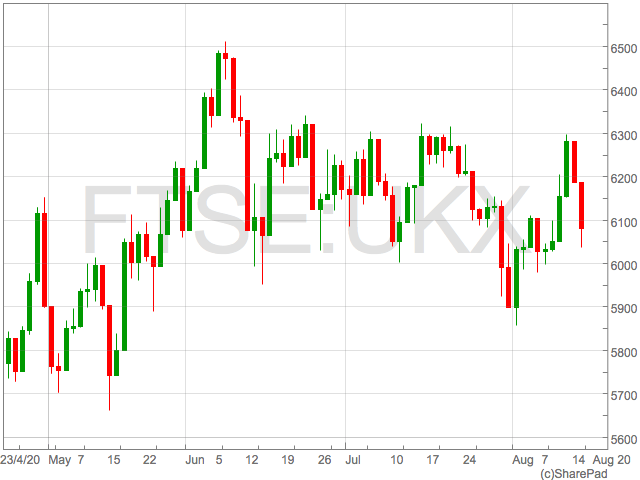
The FTSE 100 sank on Friday and in the process wiped nearly wiped the entire weeks gains as the latest round of UK travel restrictions, poor Chinese data, and a stalemate in the US stimulus debate sapped confidence from the market.
The FTSE 100 traded as low as 6,033 in morning trading on Friday, before recovering some of the losses as US markets opened.
The implementation of fourteen day quarantines for UK citizens returning from France, Holland and Malta sparked negativity in markets as airline International Consolidated Airlines crashed over 6% whilst aircraft engine maker Rolls Royce shed 4%.
 There was little in the way of positivity from FTSE 100 shares with only minor gains noticeable in packaging company Smurfit Kappa and a number house builders.
 There was little in the way of positivity from FTSE 100 shares with only minor gains noticeable in packaging company Smurfit Kappa and a number house builders.
Stimulus stalemate
In addition to concern around further restrictions on travel, the US Congress has taken leave without finalising a $1 trillion stimulus package to support the US economy through the coronavirus pandemic. There are currently no talks scheduled to break the stalemate between Democrats and Republicans. With Congressmen going on their vacation, a deal over potential stimulus will be postponed. This has left a vacuum in US politics and attention has shifted towards the upcoming US election in November and the possibility of Joe Biden taking the White House. The market has mixed feeling about Joe Biden who is seen to be a negative force through tax increases but its also likely to enact significant infrastructure spending which will provide support for the US economy.Chinese data
Chinese data was also a cause for concern as consumer activity remained soggy and industrial production missed estimates. “Once again Chinese retail sales became a sticking point for the markets. Though an improvement on June’s -1.8%, July’s -1.1% reading marked the 2nd month in a row that retail sales in the country had failed to climb back into positive territory as expected,” said Connor Campbell, analyst at Spreadex. “Combine that with an industrial production reading that remained unchanged at 4.8%, missing the forecast 5.1%, and there are signs of a stalling recovery in the superpower.”Travel shares tumble on new quarantine rules, dragging down FTSE 100
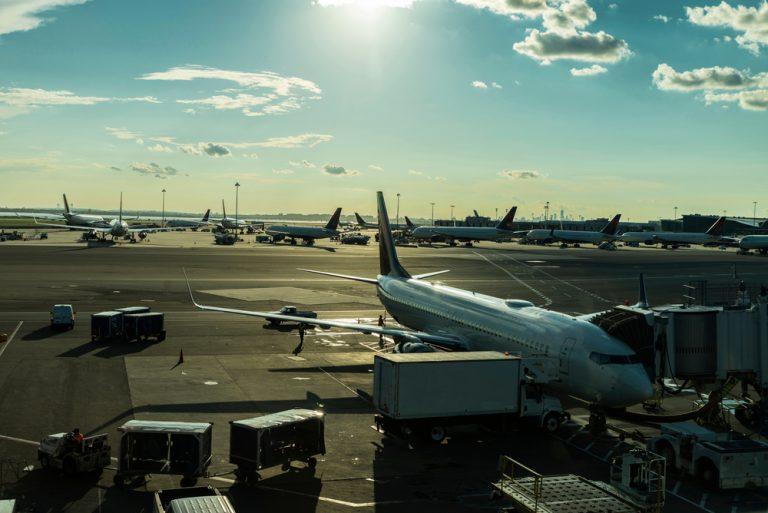
Shares in Easyjet (LON: EZJ), Ryanair (LON: RYA) and IAG (LON: IAG) are down on Friday morning as the UK government announced France to be removed from the UK’s travel corridor list.
From 4 am on Saturday, travellers will have to quarantine for 14 days or face a fine due to a spike in new Coronavirus cases. France and the Netherlands have joined Spain, Belgium and Luxembourg on the list of countries that are on the quarantine list.
Easyjet shares fell over 7% on the news, following the news that the budget airline had finished the sale and leaseback of 23 aircrafts to raise a total of £608m amid the pandemic.
Easyjet has already withdrawn £600m from the Bank of England’s Covid Corporate Financing Facility, as well as raise £419m through the issue of new equity.
On Friday morning shares fell 49.42 points to 6140.28. Neil Wilson, chief market analyst at Markets.com, said that adding new countries to the quarantine list would “force a large swathe of cancellations right at the peak of the summer holiday season for one of the largest markets for UK tourists”.
IAG (LON: IAG) shares were also down over 6%, whilst Ryanair shares are trading down over 4%.
Michael Hewson, chief market analyst at CMC Markets, remains positive despite the fall.
“It’s also important to remember that for all of the weakness of the last 24 hours that markets here in Europe remain on course for their second successive weekly gain, despite some anxiety about rising infection rates across various parts of Europe, as well as here in the UK,” he said.