


Vistry partners with government agency to boost home building

Vistry Group has forged a strategic partnership with Homes England to tackle England’s housing shortage through a new joint venture backed by £150 million in capital investment.
The collaboration, named Hestia, aims to deliver high-quality, mixed-tenure communities across England. Both organisations are pooling resources to accelerate development on large-scale residential sites, with each project spanning between 400 and 3,000 homes.
Homes England is the UK government’s housing and regeneration agency responsible for ensuring the supply of affordable housing.
In a move that demonstrates broader sector commitment, Hestia plans to sell parcels of land from larger developments to small and medium-sized enterprise (SME) developers.
This strategy serves multiple purposes: it enables smaller developers to participate in large-scale projects whilst maintaining the joint venture’s focus on strategic site delivery. The UK is desperate for new homes, and the plans recognise that to achieve the UK’s 1.5m housing building target, the entire sector needs to be behind the drive to build more homes.
“As one of the country’s largest providers of affordable homes, we are closely aligned with Homes England and share their ambitions for further affordable housing delivery,” said Greg Fitzgerald, Chief Executive of Vistry Group.
“Hestia represents a bold and collaborative step forward in unlocking the potential of large-scale sites and accelerating the creation of thriving, mixed-tenure communities across England.”
Pan African Resources to leave AIM for Main Market

Pan African Resources has revealed its intention to migrate from the AIM market to the London Stock Exchange’s main market, seeking admission by the end of 2025.
The gold mining company, which has operations across South Africa and Australia, believes the transition will enhance its corporate profile and provide access to a broader pool of UK and international investors.
This strategic shift comes as Pan African targets its next phase of growth, with gold production expected to increase by approximately 40% to between 275,000oz and 292,000oz for the financial year ending June 2026. The company believes it is well-positioned to benefit from record-high gold prices, with its production completely unhedged from July 2025.
Many companies have left AIM in recent years, yet Pan African Resources is one of very few that have moved from AIM to the Main Market. Most leave AIM and delist.
The shift to the Main Market will be executed through the introduction of existing ordinary shares rather than a fundraising exercise, meaning no new capital will be raised. The company will maintain its dual primary listing structure, continuing its presence on the JSE’s main board alongside the new London main market listing.
Admission remains subject to FCA approval of a prospectus and other regulatory conditions.
“Our proposed listing on the Main Market of the London Stock Exchange represents a natural continuation of Pan African’s growth,” said Cobus Loots, Pan African’s CEO.
“Over the last decade, we have consistently grown both organically and through acquisitions whilst returning capital to our loyal shareholders. We are currently benefitting from the strong gold price environment which we expect will enable us to be fully de-geared (from a net debt perspective) during the course of FY26. We believe the proposed move from AIM to the Main Market will enable us to access a deeper pool of capital and enhance liquidity for the group as we continue our ambitious growth strategy.”

AIM weekly movers: ImmuPharma applies for P140 patent
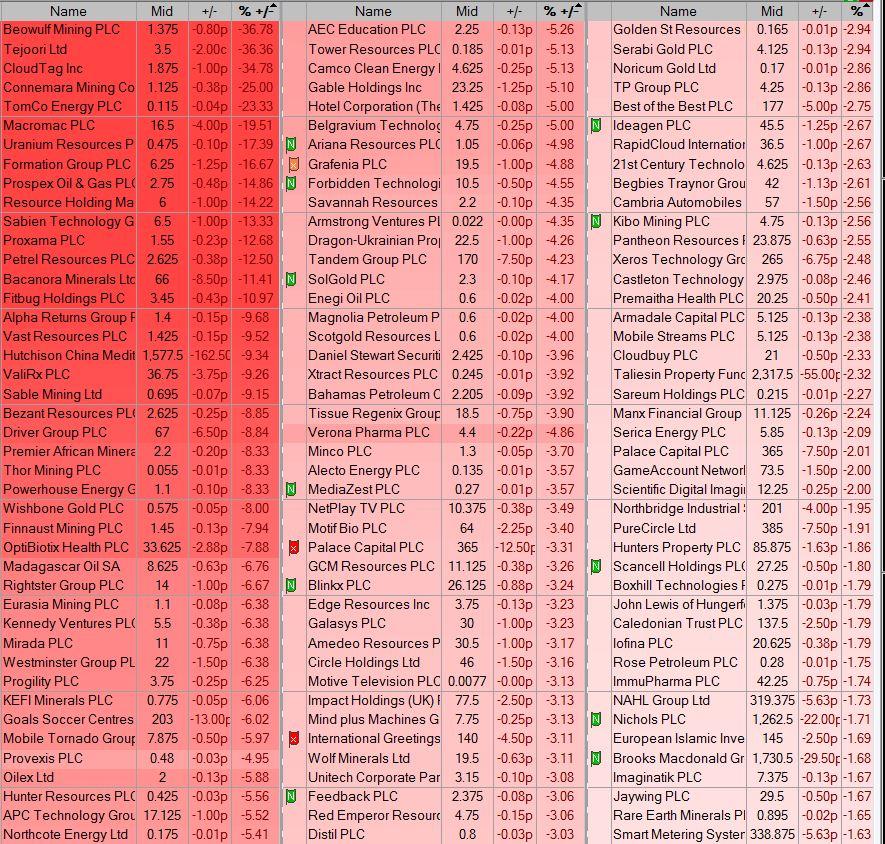
ImmuPharma (LON: IMM) has filed a new patent application for P140, which can help to identify and treat a subpopulation of patients with Type M immune disorder that ae P140 super-responders. This can be used to sped up diagnosis and treat up to 50 autoimmune diseases. The global market is worth more than $100bn. The share price jumped 134% to 5.21p.
Orosur Mining Inc (LON: OMI) has raised $174,711 from the exercise of warrants at 5.33 cents each. The share price improved 54.4% to 21p.
Surface Transforms (LON: SCE) shares ae continuing their recovery rising to 53% to 2.525p. Paul Marr has been appointed as a non-executive agreement. He has been working with a customer to help improve the operations of the ceramic brake manufacturer.
Geo Exploration (LON: GEO) has commenced the maiden drilling programme at the Juno project. JUD001 will be drilled to depths of up to 1,000 metres. The share price increased 37.3% to 0.46p.
FALLERS
Shares in pharmacogenetic testing company Genedrive (LON: GDR) continued to decline following the previous Friday’s announcement of a share capital reorganisation after the share price fell below par value of 1.5p. There was cash of £700,000 at the end of August and this will last until mid-October. Shares cannot be issued at below par value so it will be reduced to 0.015p. The share price fell 29.2% to 0.425p.
Fiinu (LON: BANK) took advantage of the share price rise since readmission last week to raise £1.41m at 15p/share. The initial payment of £8m for Poland-based foreign exchange brokerage Everfex was satisfied by the issue of 80 million shares at 10p each. A previous subscription generated £801,000 at 10p/share. Luxembourg fund QVP is the main investor in the placing. The share price dipped 21.1% to 15p.
Telecoms services provider Maintel (LON: MAI) is finding it tougher to close deals and one major expected deal was not won. This will hit revenues in 2025, and forecasts have been cut from £101m to £95m. The pre-tax profit estimate has been slashed from £3.8m to £700,000. The share price slipped 18.9% to 150p.
India-focused power generator OPG Power Ventures (LON: OPG) reported a 2.5% dip in revenues to £156.7m, while pre-tax profit was one-third lower at £5.2m. Management believe that demand for thermal power will continue. The share price declined 18.6% to 6.8p.
Aquis weekly movers: Oscillate sells hydrogen assets

Directors continue to buy shares in EDX Medical (LON: EDX). Sir Christopher Evans bought 51,225 shares at 10.88p each and Martin Walton acquired 20,000 shares at 10.8p each. The share price increased 11.3% to 11.875p.
Oscillate (LON: MUSH) has conditionally agreed to sell its hydrogen assets to AIM-quoted Pulsar Helium (LON: PLSR) for $800,000 in shares. The focus switches to base metals. Oscillate has entered a joint venture to develop the Duekoue copper gold molybdenum prospect in Côte d’Ivoire. Geochemical results and magnetic data has identified the historical anomalies. The share price improved 10% to 0.275p.
Oberon Investments (LON: OBE) is raising £1.85m at 4p/share and two institutional investors have agreed, subject to documentation, to subscribe for £3m of convertible loan notes. The cash will be used to finance further hires for the investment management division and acquisitions. There are discussions concerning the acquisition of the wealth management division of another Uk firm. That would add £850m to assets under administration. The share price rose 2.53% to 4.05p.
IntelliAM AI (LON: INT) has appointed Victoria Brown as a non-executive director. The share price firmed 2.38% to 107.5p.
The Smarter Web Company (LON: SWC) has appointed Strand Hanson to replace Peterhouse as corporate adviser. Albert Soleiman has joined the board as finance director. The company has signed a subscription agreement with Shard Merchant Capital, which will be issued 21 million shares at par value, and the company will receive 97% of net proceeds when they are sold. The share price edged up 2% to 127.5p.
FALLERS
VSA Capital (LON: VSA) chairman Mark Steeves will stand down after the AGM on 30 September. Mark Thompson will take over the role at the broker. VSA has entered into a five-year lease for new office premises in London and has been loaned £95,715 by 19.9% shareholder Drakewood Capital Management, which is represented on the board by Mark Thompson. The share price slumped 28.6% to 3.5p.
Vautz Capital (LON: V3TC) reported a loss of £361,000 in the year to April 2025, which was prior to the change in focus to crypto currency. The share price declined 13.6% to 6.375p.
NYCE International (LON: NYCE) has raised £150,000 at 0.2p/share. And the cash will fund the expansion in the crypto casinos channel. That includes gaining certifications for the company’s games platform and developing games and services. The share price slipped 11.8% to 0.075p.
In the year to March 2025, SulNOx Group (LON: SNOX) increased revenues from £54,000 to £1.21m, although the loss rose from £1.86m to £4.21m. Sales growth is accelerating and £564,000 has been generated in the two months to August 2025, taking the five month total to £1.09m. The share price slipped 7.95% to 40.5p.
Ventura Finance has increased its stake in Evrima (LON: EVA) from 5.14% to 6.15%. The share price fell 6.67% to 0.35p.
Valereum (LON: VLRM) has adopted the crypto and multi-currency payroll solution developed by investee company Fideum. There is potential for this as a white label service. The share price decreased 5.08% to 2.8p.
FTSE 100 gains as Non-Farm Payrolls signal US interest rate cut

The FTSE 100 gained on Friday as investors digested the August Non-Farm Payroll report, which signalled a potential US interest rate cut at the Federal Reserve’s next meeting.
London’s leading index was 0.3% higher at the time of writing, while S&P 500 futures were pointing to further gains for US stocks.
Following a record high for the S&P 500 overnight on hopes of an interest rate cut this month, the Non-Farm Payrolls had the potential to upset the equity rally.
Thankfully for equity bulls, US Non-Farm Payrolls missed already low expectations and effectively nailed on a rate cut by the Federal Reserve.
US job creation has virtually ground to a halt, with only 22,000 jobs created in August. Economists had predicted 75,000 jobs would be added. Worryingly for the US economy, the June figure was revised lower to 13,000 job losses from 14,000 added.
US markets were also buoyed by a tie-up between OpenAI and Broadcom that sent Broadcom’s shares to all-time highs. OpenAI plans to develop AI chips in a partnership with Broadcom, which could challenge Nvidia’s dominance in the market.
In the UK, Cyclical stocks led the FTSE 100 as investors bought into ‘riskier’ sectors including miners, financials and industrials.
HSBC added around 2% and Rio Tinto rose around 1.5%.
There was minor strength in UK housebuilders after Halifax released data revealing the average UK house price hit a record high in August.
“Housebuilders were in demand as signs of a robust property market raises hopes for stronger earnings in the sector. Halifax says average UK prices are now at a new record high of £299,331,” said Russ Mould, investment director at AJ Bell.
“It’s not a simple green light for the sector. Interest rates arguably need to come down a lot more to convince investors that the sector has legs as mortgage affordability is still an issue for many aspiring homeowners.”
Housebuilders have had another tough year in 2025 as interest rates remain stubbornly high and many in the sector were hit with legacy costs.
That said, Berkeley Group carved out a 1% gain as Halifax’s report coincided with a trading statement in which Berkeley maintained its guidance for the year.
“Berkeley Group’s trading update this morning reflects a company managing well against a difficult backdrop, but investors should remain realistic on near term growth,” explained Adam Vettese, market analyst for eToro.
“The reaffirmation of profit targets and update that 85% of next year’s profits are already secured underscores the strength of its order book and prudent management.”
AIM movers: Gear4Music recovery and Peel Hunt ahead of expectations

Altitude (LON: ALT) non-executive director Martin Varley bought 115,473 shares at 21.59p each. He owns 13.1% of the promotional products platform operator. The share price rose 10% to 22p
Gear4Music (LON: G4M) forecasts have been upgraded on the back of its trading statement. The musical instruments retailer is continuing its recovery, and first quarter sales are 27% higher and the growth is continuing into the second quarter. UK and international sales are growing. The 2025-26 pre-tax profit forecast has been raised from £2.7m to £3.6m. Peak trading is before Christmas, and this will be important for the outcome. There will be an interim trading statement on 21 October. The share price increased 8.68% to 288p.
Broker Peel Hunt (LON: PEEL) is trading ahead of expectations. It has handled significant mergers and acquisition transactions and there has been more fundraising activity. Execution services revenues are materially ahead of the prior year. Results for the year to March 2026 will be ahead of expectations. The current consensus was a pre-tax profit of £3.8m, up from £800,000 last year – which was before restructuring costs. There will be an interim trading statement published on 1 October. The share price recovered 8.37% to 110p.
Hutchmed China (LON: HCM) says new data from several studies of compounds discovered by Hutchmed will be presented at the 2025 World Conference on Lung Cancer in Barcelona. The share price improved 8.84% to 234p.
Metals One (LON: MET1) has acquired a stake in Evolution Energy Minerals and is partly underwriting a right issue. Metals One has bought 37.9 million shares at A$0.011/share – a total cost of £202,000. The mining investment company will underwrite up to £257,000 of a rights issue at A$0.01/share. Evolution owns the Chilalo Graphite project in Tanzania, which has a post-DFS NPV8 of A$518m. This diversifies the portfolio of Metals One interests into graphite. The share price is 6.01% higher at 4.198p.
FALLERS
Canaccord Genuity has reduced its stake in escape rooms and bars operator XP Factory (LON: XPF) from 18.9% to 17.8%. This follows Monday’s full year results announcement. In the year to March 2025, revenues increased 19% to £57.8m. Trading has been tough since the year end because of the weak economy and hot weather. So, Boom Battle Bars like-for-like sales were 5.6% lower sine the end of March, although Escape Hunt like-for-like sales are 0.4% higher. Trading has improved since June. The share price lost part of the gain earlier in the week and is down 3.85% to 10p.
Black Rock has cut its stake in vet practices operator CVS Group (LON: CVSG) to below 5%. The share price declined 1.48% to 1198p.
Anthropic raises $13bn at a whopping $183bn valuation

AI giant Anthropic announced a Series F $13bn capital raise this week, valuing the company at $183bn as the company sees an explosion in its run-rate revenue.
The funding round means Anthropic has a higher company valuation than all but three FTSE 100 companies.
Having entered 2025 with run-rate revenue of $1bn, the company enjoyed one of the fastest periods of growth of any tech company in history as the firm launched new features and improved models. Anthropic’s run-rate revenue surpassed $5bn in August.
Anthropic is one of the biggest challengers to OpenAI’s dominance of AI chat interfaces and large language models. The company has launched a string of AI innovations in recent months, including its coding functionality and financial analysis services.
“From Fortune 500 companies to AI-native startups, our customers rely on Anthropic’s frontier models and platform products for their most important, mission-critical work,” said Krishna Rao, Chief Financial Officer of Anthropic.
“We are seeing exponential growth in demand across our entire customer base. This financing demonstrates investors’ extraordinary confidence in our financial performance and the strength of their collaboration with us to continue fueling our unprecedented growth.”
The funding round was led by ICONIQ and co-led by Fidelity Management & Research Company and Lightspeed Venture Partners. Other investors include Altimeter, Baillie Gifford, and affiliated funds of BlackRock, Blackstone, Coatue, D1 Capital Partners, General Atlantic, and General Catalyst.
“Anthropic is on an exceptional trajectory, combining research excellence, technological leadership, and relentless focus on customers. We’re honored to partner with Dario and the team, and our lead investment in their Series F reflects our belief in their values and their ability to shape the future of responsible AI,” said Divesh Makan, Partner at ICONIQ.
“Enterprise leaders tell us what we’re seeing firsthand—Claude is reliable, built on a trustworthy foundation, and guided by leaders truly focused on the long term.”
Berkeley Group reiterates guidance and warns of falling London housing starts
Berkeley Group Holdings has called on the government to support investment in the London housing market with planning reform and lower taxes in a trading statement released on Friday.
The group is highly weighted to London and the South East – an area of slowing house price growth as highlighted by the latest Halifax House Price Index.
Nonetheless, Berkeley Group confirmed it remains on track to achieve £450 million pre-tax earnings for FY2026, with 85% already secured through exchanged contracts.
The group expects profits to be evenly split between both halves of the financial year and targets net cash of around £300 million by April 2026.
Although the UK housing market has slowed, Berkeley Group remains a highly cash-generative firm and is committed to returning cash to shareholders.
The housebuilder highlighted it had returned £121 million to shareholders in the first four months through share buybacks at an average of £37.20 per share.
The company completed its 2011 shareholder returns programme and the first £260 million of its £2 billion Berkeley 2035 strategy target. A further £640 million will be returned by September 2030 through buybacks and dividends.
Like all housebuilders, Berkeley referenced government planning reforms but highlighted concerning data showing London housing starts have fallen to levels not seen since the global financial crisis.
The company called for deregulation and warned against increased taxation beyond the Building Safety Levy, citing regulatory and viability challenges deterring investment.