
ECB Conference: Draghi on interest rates, Rome & bank independence
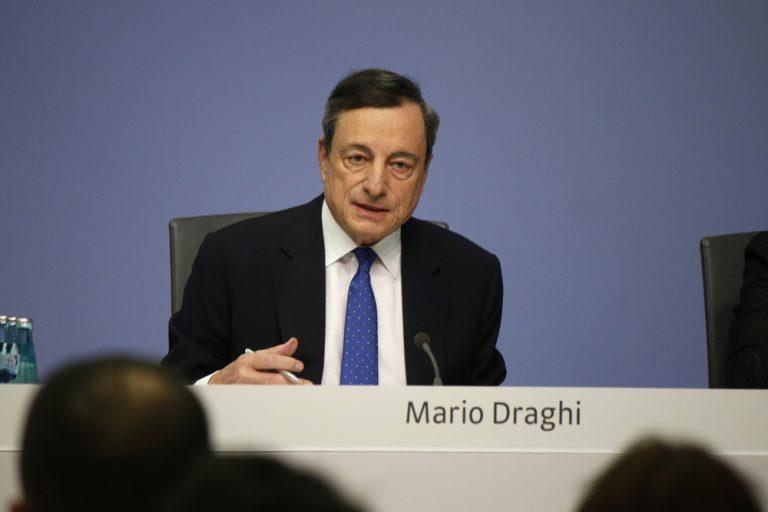
The European Central Bank announced today at the conference that they have left the eurozone interest rates at their current record lows.
Mario Draghi, president of the ECB, spoke from Frankfurt today and labelled protectionism, emerging market vulnerabilities and financial market volatility as the key risks to eurozone recovery.
Draghi went onto highlight the importance of protecting “precious” central bank independence.
Perhaps in a swipe to Donald Trump, who has put pressure on central banks to change policies, the ECB president said:
“Central bank independence is a precious thing. It’s precious because it’s essential for the credibility of the central banks, and credibility is essential for effectiveness.”
“Actually, the legislators themselves, who are often the very same people who are arguing for the central bank to do this or that, should be the first ones to care about monetary policy effectiveness and central banks achieving their goals.”
In regards to Rome, Draghi attempted to stay clear Italy’s 2019 budget, saying it was a fiscal discussion.
However, he did add that he was “confident” that a deal would be reached between Rome and Brussels over the budget.
Reacting to the ECB conference today, Silvia Dall’Angelo, who is the Senior Economist at Hermes Investment Management, said:
“The bottom line is that the ECB is on a gradual path of monetary policy normalisation for now, but risks from protectionism, a further slowdown in external demand, domestic political instability, Brexit and volatility in financial markets cast a dark shadow on the ECB’s plans.”
“Policy uncertainty has increased both externally and domestically: international trade tensions have remained high, there is no solution for the Brexit issue in sight, and the Italian government seems determined to defy the European fiscal rules. The recent turmoil in financial markets is a new addition to the list of downside risks,” she added.
Boeing opens first UK factory, showing commitment “to UK prosperity”

Boeing has opened its first European manufacturing site in Sheffield.
The world’s largest planemaker opened the £40 million plant with attempts to prove the firm’s commitment “to UK prosperity”.
The new manufacturing site will make components for 737 and 767 passenger jets, which will be shipped to the US.
Jenette Ramos, who is the Boeing senior vice president of manufacturing, supply chain and operations, said: “We appreciate all the community support for Boeing’s new advanced manufacturing factory in the UK. This is a fabulous example of how we are engaging global talent to provide greater value to our customers.”
“In Boeing Sheffield, we are building on longstanding relationships and the region’s manufacturing expertise to enhance our production system and continue to connect, protect, explore and inspire aerospace innovation.”
The opening of the new factory has created 52 new jobs.
James Needham, the operations manager at Boeing Sheffield, commented: “Today’s about celebrating the milestone we’ve achieved in opening our factory.”
“We have a tough challenge ahead to make the parts and hit the ferocious rate we need to achieve to keep these commercial airplanes flying us all on holiday next summer.”
Greg Clark, the secretary of state for business, energy and industrial strategy, said: “Boeing choosing the heart of South Yorkshire as its first European home is testament to our capabilities, talent pool and strong manufacturing supply chains which are vital to job creation and creating value for local economies.”
In 2015, the government committed to spending £3.9 billion in order to further transform aerospace research and manufacturing until 2026.
Mayor of the Sheffield City Region, Dan Jarvis, said that the opening of the factory was “excellent news”.
“Boeing’s choice of location is a strong sign of confidence in our advanced engineering excellence, confidence in our workforce and strong manufacturing heritage, and confidence in the cutting-edge collaborations between university and business that enable us to lead the world,” he added.
Shares in the group (NYSE: BA) are trading +1.92% (1614GMT).
Pay inequality: BBC comes under fire
A report by the digital, culture, media and sport committee (DCMS) has revealed the pay inequality of BBC employees. The report demands an end to the broadcaster’s culture of “invidious, opaque decision-making” regarding pay.
Evidence has been put forward by witnesses that illustrates that the broadcaster is still failing its female employees. This includes 40 BBC staff and the BBC Women campaign group. The group represents over 170 presenters and producers including the well-known Mishal Husain and Jane Gravey.
The report said:
“Our evidence suggests women within the BBC are working in comparable jobs to men but earning far less.”
“The corporation was unable to give us a good reason for why or how pay discrimination has been left unchallenged for so long.”
Moreover, it has been revealed that several female BBC employees were offered pay rises as a result to their equal pay complaints.
This contradicts the corporation’s claim that there were no equal pay issues in their case. The dealing of complaints left women “feeling worthless or diminished, ground down by an employer refusing to admit any equal pay liability”. The report revealed: “Where staff come forward with complaints, management must refrain from using unhelpful terminology and talk about these cases in terms of ‘equal pay’, rather than using euphemisms such as ‘fair pay’, ‘oversights’ and pay ‘revisions’, in an attempt to avoid the issues at hand.” “The BBC pay structure lacks central oversight and allows for too much managerial discretion over salaries. Pay decisions for senior positions appear to be made on an ad hoc basis.” “It is regrettable that it took the forced publication of this list and the resultant publicity to push the BBC into action on a longstanding problem.” “The BBC’s reluctance to tackle this issue has resulted in a loss of trust between staff and management. The BBC needs to commit to concrete targets to ensure that the pay of its high earners has absolutely no discriminatory element to it.” Earlier today, we reported that the gender pay gap was at a record breaking low. But large scale corporations are still failing to admit their incompetency when targeting gender pay inequality.BT announces Worldpay boss as new chief executive
BT has confirmed its new chief executive, Philip Jansen.
Gavin Patterson will be replaced by Jansen, the current boss of payment service Worldpay.
It is said that BT’s leadership needed a fresh pair of eyes to help assess the business’s future. Philip Jensen’s base salary will add up to £1.1 million. This figure is £100,000 more than what Gavin Patterson was earning. Likewise, awards of up to 400% of his salary are included in his deal. This follows a yearly bonus of 240% of salary subject to performance. Additionally, the company will offer him a compensation of £900,000 as a result of the shares he will lose leaving Worldpay.
Philip Jansen commented in a statement:
“In a competitive market we will need to be absolutely focused on our customers’ needs and pursue the right technology investments to help grow the business.”
“I’m excited to get to know all the people at BT and work together to take the business forward.”
Shortly before his leave, Gavin Patterson announced that BT will be implementing 13,000 job cuts.
This is one of the few challenges the company will face in the upcoming years. It is also battling with the UK government and Ofcom. This is over a multi-billion pound programme to upgrade Britain’s digital infrastructure. Moreover, the company has one of Britain’s largest corporate pension deficits. But, speculators have said that Jansen lacks the experience required to deal with fierce regulator Ofcom. However, chairman of the BT Group called him a “proven leader” because of his outstanding leadership experience with complex businesses. Jan du Plessis, chairman of BT Group, commented: “Philip’s strong leadership has inspired his teams, successfully transformed businesses across multiple industries and created significant value for shareholders.” Philip Jansen joins as shares in the business are down by over 8% since the beginning of the year. At 15:37 today, shares in BT Group (LON:BT.A) were trading at -4.2%. At 10:41 GMT -4 today, shares in Worldpay Inc (NYSE:WP) were trading by +1.53%.Facebook fined maximum amount over Cambridge Analytica data breach

Facebook has been fined £500,000 for the Cambridge Analytica scandal. Indeed, the social media network will receive the maximum fine penalty for collecting the data of tens of millions of users.
The Information Commissioner’s Office (ICO) revealed that the social media network permitted a “serious breach” to take place. As a result, the UK’s data protection watchdog has issued it a £500,000 fine.
The investigation identified that between 2007-2014, Facebook gave app developers access to the personal data of its users. This took place without the informed consent of the individuals. The Cambridge Analytica scandal saw the illegal data collection of 87 million Facebook users. As a result, the information collected was used to assist Donald Trump’s presidential election campaign.
Because the data breach took place prior to the new GDPR regulation, the maximum fine permitted is only £500,000. But, had the scandal taken place under the new EU data protection law, the fine would have been £17 million.
The £500,000 fine remains only 0.04% of Facebook UK’s annual revenue.
Under the £17 million fine, it would have been 4% of global turnover. Information Commissioner Elizabeth Denham commented: “Facebook failed to sufficiently protect the privacy of its users before, during and after the unlawful processing of this data. A company of its size and expertise should have known better and it should have done better. “We considered these contraventions to be so serious we imposed the maximum penalty under the previous legislation. “One of our main motivations for taking enforcement action is to drive meaningful change in how organisations handle people’s data.” Facebook is currently “reviewing” the ICO’s verdict. It commented in a statement: “While we respectfully disagree with some of their findings, we have said before that we should have done more to investigate claims about Cambridge Analytica and taken action in 2015.” At 10:09 GMT -4 today, shares in Facebook, Inc. (NASDAQ:FB) were trading at +2.31%.Twitter reveals Q3 profit, sales rise 17%

Twitter has revealed better-than-expected sales and profits in the three months to September 30.
The social network beat analyst expectations for the quarter, sending shares up 13% in pre-market trading.
Jack Dorsey, the group’s CEO, said in the earnings release: “We’re achieving meaningful progress in our efforts to make Twitter a healthier and valuable everyday service.”
“We’re doing a better job detecting and removing spammy and suspicious accounts at sign-up. We’re also continuing to introduce improvements that make it easier for people to follow events, topics and interests on Twitter, like adding support for U.S. TV shows in our new event infrastructure. This quarter’s strong results prove we can prioritize the long-term health of Twitter while growing the number of people who participate in public conversation.”
Revenue increased by 29% to $758 million.
The total number of users on Twitter fell due to the social media platform’s crackdown on “spammy and suspicious” accounts.
The group said earlier this year that it would look at “behavioural signals” to “improve the health” of discussions on the platform.
“People contributing to the healthy conversation will be more visible in conversations and search,” it said.
“These accounts have a disproportionately large – and negative – impact on people’s experience on Twitter.”
“The challenge for us has been: how can we proactively address these disruptive behaviours that do not violate our policies but negatively impact the health of the conversation.”
In the first three months of 2018, the media group deleted 29 million posts that broke rules on hate speech, graphic violence, terrorism and sex.
Shares in the group (NYSE: TWTR) are trading +17.32% at 32,31 (1454GMT).
Gender pay gap at 8.6% record low

The Office for National Statistics (ONS) has reported that the gender pay gap has fallen to a record-breaking low. In the year to April 2018, the gap was at 8.6%. This is down from 9.1% the previous year. These statistics are based on the median difference in full-time hourly pay.
Despite the record low, campaigners have deemed the rate of improvement too slow.
The gender pay gap was the first figure released since Britain’s top employers were made to reveal their data.
In September, the UK government revealed it would launch a review of the obstacles faced by women in business. The TUC union has insisted that ministers must truly pressure employers in order to see real change. General secretary, Frances O’Grady, commented: “Working women won’t be celebrating this negligible decrease in the gender pay gap.” “At this rate, another generation of women will spend their whole working lives waiting to be paid the same as men.” “Companies shouldn’t just be made to publish their gender pay gaps, they should be legally required to explain how they’ll close them, and bosses who flout the law should be fined.” Roger Smith, the Senior ONS earnings statistician, put together the wage statistics for the 2017-2018 year: “Average weekly pay for full-time employees is now increasing at its fastest since the financial crisis, in cash terms, with hourly pay rising fastest among lower-paid occupations.” “However, after taking account of inflation, earnings are still only where they were in 2011, and have not yet returned to pre-downturn levels.” “The gender pay gap fell to 8.6% on our headline measure, its lowest ever. But it isn’t the same for everyone – it’s close to zero for employees aged under 40, but widens for those who are older.” Earlier in October, we revealed that the reporting of the ethnicity pay gap may become mandatory. This was as a result of an audit demonstrating large differences in pay and promotion opportunities for ethnic minorities.Halfords pulls out of Evans Cycles rescue talks

Sky News has reported that Halfords (LON: HFD) has pulled out of rescue talks with Evans Cycles.
The UK’s biggest bikes retailer was previously in talks with Evans Cycles and made bids for the struggling retailers but has ended discussions.
A source told Sky News that Halfords plans to invest on its current brands, Cycle Republic and Tredz, rather than invest in Evans.
Halfords declined to comment on the report.
Sports Direct (LON: SPD) is rumoured to be the new saviour of Evans Cycles. Mike Ashley recently purchased House of Fraser in a £90 million deal after it fell into administration.
It is now yet known if a deal will be agreed between Sports Direct and Evans but a likely deal will be valued at between £10-20 million.
The cycle chain was founded almost a century ago and has been one of the many retailers struggling amid the difficult retail environment.
Group’s including House of Fraser, Mothercare (LON: MTC), New Look and Toys R Us UK have either been forced into administration or secured creditor approval for radical restructurings.
Evans is being advised by PricewaterhouseCoopers (PwC). It has over 60 stores across the UK and required an urgent capital injection following a slump in profits back in September.
Millennials shunning wealth management firms for alternative advice

Millennials are seeking investment advice in considerably different ways when compared to other generations. A survey conducted by Crealogix has revealed the different perceptions of traditional wealth management services across generations.
Provider of digital banking solutions, Crealogix conducted an independent survey of 1,200 UK consumers. Interestingly, the survey identified that over 41% of millennials seek investment advice from their family above any other option. Moreover, only 30% of respondents said they would seek investment advice from a bank. Additionally, only 19% identified wealth management services. This is striking given the range of apps and digital services that banks and wealth management firms offer, encouraging investment. Despite digital services rendering investment management more accessible than ever, a family is still the first port of call.
Furthermore, the survey identified that younger investors seek advice from a more varied group of sources.
Of the millennials surveyed, 50% turn to family for investment advice, whereas 25% seek advice from their bank.
It has become apparent that this trend inverts as investors get older. In fact, 22% of baby boomers ask family members for investment advice and 35% opt for their bank. Interestingly, the survey has revealed why there may be a general reluctance to turn to wealth management firms. Of the consumers surveyed, 19% branded wealth managers as “elitist”. Likewise, 18% have said the industry is “old-fashioned”. Commercial Director at Crealogix UK, Jo Howes, has commented: “There appears to be a misconception that bank savings accounts are the best safe choice for big investments, which is untrue. Wealth management services are falling behind in educating their clients about other low risk investment options which have a better chance of protecting savers from the effects of inflation.” “Risk-averse, long term savers are just one of several market segments where wealth managers have the opportunity to compete more proactively with banks to attract new consumers and their investments. By educating people about how to make smarter use of their money, the wealth management sector can regain trust and reputation.” “Digital wealth management technology offers wealth management firms a great new set of opportunities for engaging consumers and helping them manage their money better.”Millennials are twice as likely to invest via an app, according to the survey. In fact, today there is a wealth of apps designed to educate and encourage new investors.
Moreover, Anton Zdziebczok, Head of Product Strategy, added: “Providing digital wealth management services allows established firms to appeal to younger generations and gain much better scalability as they onboard new clients. Financial institutions don’t need to build everything in house.” “There’s plenty of expertise on hand in the UK, once wealth managers commit to a digital strategy. With the ecosystem of specialist software providers and fintechs expanding rapidly thanks to the open banking movement, there’s never been a better time for wealth management firms and financial advisors to reinvent themselves.” With the growing technological advancements, perhaps wealth managers should commit to offering more digital alternatives to attract younger investors. However, they would still be competing with family members as the top investment advisors for young people.WPP shares tumble 22% on fall in sales
Shares in WPP (LON: WPP) plummeted over 22% on Thursday after reporting a fall in sales.
The advertising group reported a 1.5% fall in net sales for the third quarter when it was expected to reach a 0.3% growth.
Almost £3 billion was wiped off the group’s market value.
Mark Read, WPP’s new chief executive, said: “Clearly we have underperformed our competition in the third quarter.”
“We are not going to sugarcoat the reality,” he added.
WPP is struggling to perform following the departure of founder and former chief executive Sir Martin Sorrell in April.
Sorrell said when stepping down: “As I look ahead, I see that the current disruption we are experiencing is simply putting too much unnecessary pressure on the business.“
“That is why I have decided that in your interest, in the interest of our clients, in the interest of all shareowners, both big and small, and in the interest of all our other stakeholders, it is best for me to step aside.”
“As a founder, I can say that WPP is not just a matter of life or death, it was, is and will be more important than that. Good fortune and Godspeed to all of you … now Back to the Future.”
WPP has been struggling amid the growing competition from Facebook (NASDAQ: FB) and Google (NASDAQ: GOOG), whilst other big clients including Unilever (LON: ULVR) are spending less on advertising.
George Salmon, who is an equity analyst at Hargreaves Lansdown, said: “We’re yet to get the full details, but it looks like the over-riding theme of [Mark Read’s] restructure will be a simplification of the business. It’s easy to see why.”
“Taking over at a group where success depends so much on having an in-depth knowledge of all the various agencies and divisions was always going to be a serious challenge.”
“This journey has already started, and the decision to sell a stake in Kantar is the next step,” he added.
Shares in WPP are currently trading -16.88% (1112GMT).