
Trump calls JP Morgan boss a “nervous mess”
Donald Trump has called JP Morgan (NYSE: JPM) boss Jamie Morgan a “nervous mess”.
After Morgan attacked Trump and claimed he was “smarter than he is”, Trump responded over Twitter.
“The problem with banker Jamie Dimon running for President is that he doesn’t have the aptitude or ‘smarts’ & is a poor public speaker & nervous mess – otherwise he is wonderful,” Trump tweeted. “I’ve made a lot of bankers, and others, look much smarter than they are with my great economic policy!”
Trump’s tweet came Dimon told reporters at JPMorgan headquarters: “I think I could beat Trump.”
“Because I’m as tough as he is, I’m smarter than he is. I would be fine,” Dimon said. “He could punch me all he wants, it wouldn’t work with me. I’d fight right back.”
The JP Morgan boss clarified he was not planning on running for President.
“I should not have said it. I’m not running for president,” Dimon, 62, said in a statement.
The pair have had a turbulent relationship. Last year, Dimon said it was “almost an embarrassment to be an American citizen travelling around the world and listening to the stupid shit we have to deal with in this country”.
In true Trump passion, the US President wrote on Twitter: “Sorry losers and haters, my I.Q. is one of the highest – and you all know it! Please don’t feel so stupid or insecure, it’s not your fault.”
Morgan has supported and criticized Trump’s actions since becoming President. The banking boss supported the President’s corporate tax cuts yet showed frustration over his positions on immigration and trade.
RBS boss McEwan accused withholding information from MPs
MPs have accused the Royal Bank of Scotland (LON: RBS) boss of withholding information about a police investigation.
Chief executive Ross McEwan was sent a letter by the Commons Treasury Committee in regards to the police investigation of the bank’s mistreatment of small businesses.
The scandal surrounding the Global Restructuring Group (GRG) was investigated for leading to widespread inappropriate treatment, which resulted in “material financial distress”.
McEwan wrote to the Treasury Committee and said why he had not mentioned the investigation, despite saying in January: “Not that we have seen or had reported, and certainly none that the police of Serious Fraud Office are looking at, to our knowledge.”
In the letter, McEwan said: “In relation to that article we would entirely reject the suggestion that the committee may have been in any way misled by the evidence that I gave during my appearance before you in January.”
Nicky Morgan, the chair of the Commons Treasury Committee, was not convinced.
The committee “expects clarity and openness from witnesses, and Mr McEwan’s evidence fell short of that standard,” she said.
“More generally, the committee is concerned by the pattern of defensiveness, and a failure to acknowledge mistakes, demonstrated by RBS throughout its handling of the GRG affair.”
“Mr McEwan’s letter to me is an example of this, and it casts doubt on his assurances that RBS’s culture has changed fundamentally since he took up his position five years ago.”
“If the committee decides to ask Mr McEwan to provide further oral evidence, it will expect him to tell the whole truth, not an edited version to suit him.”
FCA chief executive Andrew Bailey said: “Taking action was therefore always going to be difficult and challenging but after carefully considering all the evidence we have concluded that our powers to discipline for misconduct do not apply and that an action in relation to senior management for lack of fitness and propriety would not have reasonable prospects of success.”
Renewable energy: what is it and why the UK needs it

According to Ofgem, there are currently 71 active suppliers competing in the domestic energy market. A number of suppliers dominate the industry. But, how many of these focus on renewable energy? As we drown in a global environmental crisis, renewable energy is more important than ever.
What is it?
Renewable resources produce renewable energy. These resources do not deplete when they are used because they replenish naturally over time. For example, sources of renewable energy include sunlight, geothermal heat, wind, tides, water and other forms of biomass. More and more consumers are ditching traditional energy sources such as fossil fuels. The environmentally conscious consumer finds renewable energy appealing because of its lower environmental impact than traditional sources. Interestingly, Ovoenergy has predicted that the renewable energy market will be worth $777.6 billion by 2019.Why does the UK need it?
As the globe drowns in an environmental crisis, renewable energy is needed now more than ever. Climate change is the largest environmental challenge we have ever faced, and it is fundamentally driven by fossil fuel consumption. Fossil fuels remain the dominant source of energy in the UK accounting for 80.1%. That said, this is a record breaking low. But, the UK needs more of it. In order to help alleviate the disastrous effects of climate change. Fossil fuels accounting for 80.1% is still a huge majority.Renewable energy spotlight: solar energy
Until 2011, solar power accounted for a very small proportion of electricity production. However, in 2012 the government announced that by 2020, solar energy will power 4 million homes. Today, solar energy powers homes, cars, appliances, businesses and cities. One way homeowners can get on board with renewable energy is by switching to solar panels. In addition to the variety of environmental benefits this ‘green’ form of energy provides, it also helps economically. By switching to solar panels, homeowners can use their homes to produce energy. As a result, the energy generated powers the home. Moreover, a Feed-In Tariff allows people to sell any surplus. Feed-in Tariffs (FITs) is a UK government incentive aimed to drive small-scale renewable energy. Essentially, home owners are paid for extra electricity they generate through solar PV, a wind turbine, hydro or micro CHP technology.The Monetary Policy Committee maintains Bank Rate at 0.75%, Brexit uncertainty prevails
The Bank of England’s Monetary Policy Committee (MPC) has voted to maintain Bank Rate at 0.75%. This decision was unanimous. The majority of analysts now believe that the rate will not rise until after Brexit leaves the EU in March 2019.
The Committee also voted to maintain the stock of sterling non-financial investment-grade corporate bond purchases at £10 billion.
Additionally, the Committee voted to maintain the stock of UK government bond purchases at £435 billion.
In the August Inflation Report, the MPC predicted that GDP would grow by 1.75% per year on average. This is conditioned on the steady rising path of Bank Rate implied by market yields at the time. The predicted pace of GDP growth was slightly faster than the rate of supply growth. Moreover, CPI Inflation remained just above 2% through most of the forecast period.
Fundamentally, the MPC’s August predictions appear on track. UK GDP grew by 0.4% in 2018 Q2 and by 0.6% in the three months to July. Unemployment rate decreased to 4.0% and regular pay growth has risen to roughly 3% on a year earlier. In July, CPI inflation was 2.5%.
Britain’s economy has slowed since Britain’s vote to leave the EU in 2016. In fact, the BoE Governor predicted that in the event of a no-deal Brexit, household incomes could face economic difficulty.
In the minutes of the meeting, the MPC said:
“Economic outlook could be influenced significantly by the response of households, businesses and financial markets to developments related to [Brexit].”
According to the minutes, the sterling has continued to be influenced by the uncertainty of Britain’s EU withdrawal.
The MPC have found it challenging to assess the economic implications of Brexit. Moreover, since the last MPC meeting there has been greater financial uncertainty about future developments of Brexit.
Legal & General completes largest ever buy-in for British Airways’ pension scheme

Legal & General Group PLC (LON:LGEN) has announced the completion of a £4.4 billion buy-in for BA’s pension scheme. Currently, BA’s pension scheme covers almost 22,000 pensions. This is the largest ever bulk annuity buy-in arranged with a UK pension scheme.
The UK pension risk transfer (PRT) market continues to demonstrate a high level of activity. Legal & General actively quote on over £20 billion. Over £7 billion of this figure was in exclusive negotiations at the time.
“Since then, Legal & General has completed £4.8 billion of UK PRT transactions, including the APS buy-in”, the company said. Additionally, it is now actively quoting on £27 billion of UK PRT deals.
On an international scale, Legal & General has completed £191 million of transactions since the end of June.
CEO of Legal & General Retirement Institutional, Laura Mason, said:
“This transaction also included the conversion of existing longevity insurance to a bulk annuity, demonstrating Legal & General’s ability to deal with a complex situation”
Moreover, Chief Executive of the Legal & General Group, Nigel Wilson, commented:
“As we indicated at the half year results, the second half of 2018 is likely to be a record six months for our PRT business”
“we expect to announce further transactions in the next few months.”
At 11:35 BST, shares in Legal & General were trading at +0.66%.
Free-to-use ATMs closing at a record rate, Link reports

Cash machine operator, Link, has reported that free-to-use ATMs are closing at a rate of over 250 per month. Over the five months ending in July, 1,300 ATMs were shut down.
Link has reported that this is the first decline of free-to-use ATMs in over 20 years.
As a result, the Payment Systems Regulator (PSR) is demanding the protection of free cash machines in remote areas.
PSR has requested 2,365 ATMS be kept open. This is because they are over half a mile from the nearest alternative free ATM. But, 76 of those have already closed.
The Independent reports that David Clarke, head of Policy at Positive Money, finds the closure rate “deeply concerning”.
“These closures risk leaving whole communities without access to cash, harming the over two million people who are wholly reliant on cash for their day-to-day shopping.
“Banks have pressured Link to reduce the fees they pay towards the cash network,
“The result has been to make hundreds of machines unprofitable.
“The PSR must urgently step in to prevent any further cuts to the interchange fee, and ensure that a widespread network of free machines is preserved.”
JD Wetherspoon announces it will stop selling EU spirits ahead of Brexit

Pub company JD Wetherspoon (LON:JDW) has said it will increase its range of beverages from the UK and non-EU producers. Infact, European drinks are set to be removed from the 880 pubs as of September 26, ahead of Brexit.
Currently, Wetherspoon pubs will stop serving the German Jägermeister and French brandies Courvoisier VS and Hennessy Fine de Cognac.
The two brandies will be replaced with E&J Brandy, the second top selling US brandy, and Black Bottle, the top selling Australian label. Additionally, the herbal liqueur, Jägermeister, will be replaced by English Strika.
Moreover, the pub company has already replaced Champagne with British and Australian sparkling wine alternatives. Likewise, British labels have replaced German wheat beers.
Tim Martin, founder and chairman of the pub chain, commented: “The three new products will be offered at a lower price than those they are replacing.
“This is a significant move by us and highlights our commitment to offering an excellent range of UK and world products, with the emphasis on quality and value for the two million customers who visit our pubs each week.
“In blind tastings conducted by Wetherspoon, the new products were more popular than those they are replacing.
“We will continue to review all products over the next 24 months, with the object of making the business more competitive and offering the best choice and value for customers.
“Many commentators talk of a “cliff-edge” if the UK “crashes out” of the EU without a deal.
“In reality, there is no cliff-edge, only sunlit uplands beyond the EU’s protectionist system of quotas and tariffs.
“All EU products have UK or non-EU replacements, often at equal or better quality and price.
“It’s important to remember that 93 per cent of the world is outside the EU.”
London no longer world’s top financial centre, says survey

A new survey suggests that New York has overtaken London as the world’s most attractive financial centre.
The Z/Yen global financial centres index, which ranks 100 centres depending on factors including infrastructure, showed a knock in confidence for London amid an uncertain Brexit.
“Zurich, Frankfurt, Amsterdam, Vienna, and Milan moved up the rankings significantly,” the report said.
“These centres may be the main beneficiaries of the uncertainty caused by Brexit.”
“Surprisingly, despite some evident success in attracting new business, Dublin, Munich, Hamburg, Copenhagen, and Stockholm fell in the rankings, reflecting respondents’ views of their future prospects,” the study said.
The UK capital faced the biggest decline in the survey, falling by eight points.
Mark Yeandle, co-creator of the index, said: “We are getting closer and closer to exit day and we still don’t know whether London will be able to trade with all the other European financial centres.”
“The fear of losing business to other centres is driving the slight decline and people are concerned about London’s competitiveness.”
The results of the survey have highlighted the need for a Brexit deal to be agreed before the March deadline.
“London and New York have long vied for the top spot of this index and the uncertainty around the future shape of Brexit is likely to be factor in their latest switch in positions,” said Mikes Celic, the chief executive of industry group TheCityUK.
“Hong Kong is now just three points behind London for the first time. Singapore, Shanghai and Tokyo are close behind.
“Given the fall in a number of North American centres as well, it is Asia, not Europe, where the challenge to London and the UK will come from in the years ahead,” he added.
John Lewis reports 99pc fall in profits
The John Lewis Partnership (LON: JLH) has announced a 99 percent fall in profits.
The group reported that profits for the six months to 28 July have fallen to £1.2 million. This is compared to the £95 million in profits for the same period last year.
“These are challenging times in retail,” said Sir Charlie Mayfield, chairman of the group, who added that the department stores are being squeezed by the “most promotional market we have seen for almost a decade.”
The John Lewis Partnership warned that profits for the first half of the year would be almost wiped.
“With the level of uncertainty facing consumers and the economy, in part due to ongoing Brexit negotiations, forecasting is particularly difficult but we continue to expect full-year profits to be substantially lower than last year for the partnership as a whole,” the retailer said.
Mayfield said: “We’re continuing to improve our offer for customers while ensuring we have the financial strength to continue developing our business going forward.”
“This is reflected in both brands continuing to grow sales and customer numbers, and our total net debts reducing.”
“The pressure on gross margin has predominantly been from our commitment to maintain price competitiveness.”
“This reflects our decision not to pass on to our customers all cost price inflation from a weaker exchange rate and from our Never Knowingly Undersold promise, where we have seen an unprecedented level of price matching as other retailers have discounted heavily,” he added.
Due to a fall in profits over the past year, staff bonuses have been cut for the fifth year in a row.
“This was why we chose to reduce the proportion of profits paid as partnership bonus last year so as to absorb these impacts while continuing to invest in the future and in strengthening our balance sheet,” said Mayfield.
Watchdog intervenes on Bentley’s Debenhams comment
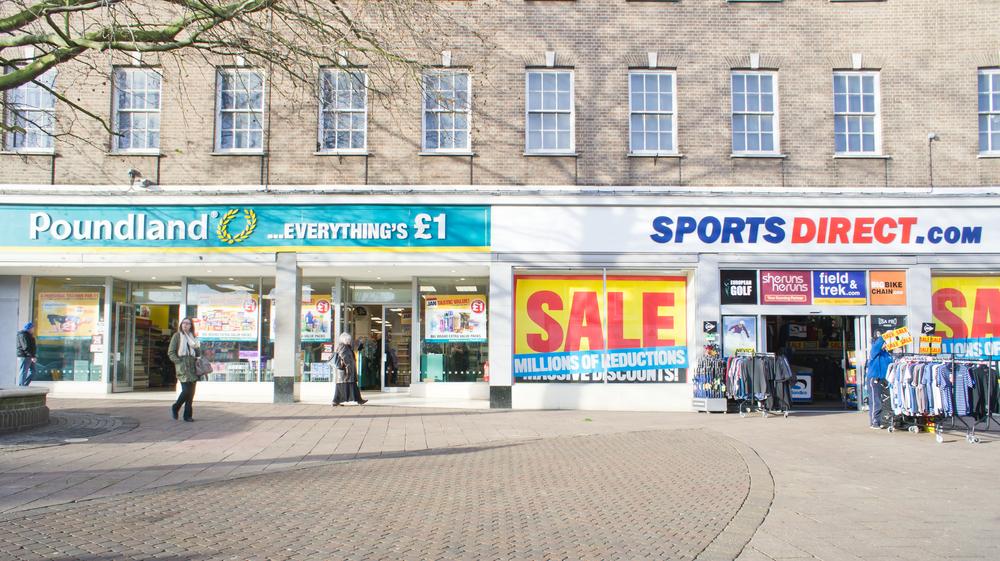
A Sports Direct (LON: SPD) director caused confusion on Wednesday after suggestions that the group would buy Debenhams – before insisting he did not intend to make the comment.
The Takeover Panel had no choice to intervene following the made by comments Simon Bentley and led Sports Direct to issue a formal statement confirming it had no plans to buy the department store.
“If there are opportunities in the future we would be in a position to take advantage,” Bentley said.
Following the comment, shares in Debenhams (LON: DEB) climbed nine percent.
Soon after, the Sports Direct director said in a statement that his comments referred to “a general question about whether or not we discuss our strategic investments, and in particular Debenhams, to which I replied in the positive.”
“I made no mention of any merger between House of Fraser and Debenhams, nor did I intend my answer to infer that,” he added.
Bentley has resigned from the retailer, along with chairman Keith Hellawell after they had not been listed for re-election.
Sports Direct said in a statement: “Dr Keith Hellawell has today informed the board of his decision to step down as chairman and as a director of the company, having served since November 2009.
“Dr Hellawell will retire with effect from the conclusion of today’s AGM, and will therefore not be seeking re-election.
“David Daly, non-executive director, will take up the role of chairman at the conclusion of the AGM.”
Hellawell said: “Having overseen significant improvements in the working practices and corporate governance of the company, which includes a refresh of the board, now is the right time for me to step aside.
“I have every confidence that the group will continue to go from strength to strength. I have enjoyed the challenges of Sports Direct and the support of Mike Ashley; many major investors; members of the board and senior staff, and wish them much success for the future,” he added.