Shares in Greatland Gold (LON:GGP) soared on Monday, after the company announced plans to commence exploration efforts at its Black Hills project.
The company confirmed it intends to start exploration at its Black Hills Project in Western Australia after identifying four distinct gold mineralisation zones.
Gervaise Heddle, Chief Executive Officer, commented:
“Our first exploration programme at Black Hills marks another important step for Greatland. Sitting near the 27 million ounce Telfer gold deposit and hosting an equivalent style of mineralisation, Black Hills represents a compelling and high priority exploration opportunity for the Company.
He continued:
“The Black Hills project epitomises our strategy of targeting under-explored areas with great potential. We believe it represents an excellent opportunity for Greatland and we are excited to get started with the exploration programme.”
Back in April, the company also announced plans to commence exploration at a new site in Tansmania at The Australian Firetower Project.
Greatland Gold was founded back in 2005, and has been listed on the junior AIM-market of the London Stock Exchange since 2006.
The company’s current projects include Paterson, Ernest Giles, Bromus, Warrentinna, Firetower and Panorama, focusing primarily upon regions in Australia.
Shares in Greatland Gold are trading up 7.27 percent as of 13.52PM (GMT), as the market reacts to the news.
House prices in the UK have hit record highs, despite a continued slump in London and the South East.
Annual house price inflation in parts of Wales has jumped by ten percent in the year to the end of March, according to the Your Move index.
Prices in the City of London dramatically slumped by 31.4 percent.
The overall decline across London and Wales was 0.1 percent in March.
Oliver Blake, managing director of Your Move said: “There’s a simple explanation for this stellar performance: forestalling.”
“Wales introduced a new land transaction tax in April, starting at a higher base, of £180,000, than stamp duty in England (£125,000) but at a higher rate, particularly for properties priced £400,000 to £925,000, with tax rates at 7.5 percent and 10 percent.
“Anticipating this, buyers have brought forward purchases of high value homes to avoid the new tax, just as they did ahead of the stamp duty hike in April 2016. Consequently, six of the eight most expensive local authority areas in Wales set a new peak price in March. Such high price growth in Wales is likely to prove short-lived.”
Prices in Swansea and Cardiff were up 9.7 percent.
Property expert and Emoov chief executive Russell Quirk believes the numbers for London represent the “fragmented” market in the capital.
“While there is still an appetite amongst London buyers evident by the number of visits to Rightmove, a lack of commitment is resulting in a reduction in the number of sales agreed in the capital.”
“This is hardly surprising when you consider the reality gap between the expectations of stubborn London sellers and the current market climate itself, coupled with a lack of diversity where stock reaching the market is concerned.”
The City of London was the biggest faller in London, followed by Southwark where prices fell 17.5 percent in the year to March.
Marks and Spencer (LON:MKS) will announce on Monday which of their stores will be closing, in an effort to restructure its business during a difficult time for the high street.
100 of its stores will be shutting, as disappointing sales and profits at the grocery and retail chain led CEO Steve Rowe to take action. 20 stores have already been closed, causing the loss of 900 jobs, with another 80 set to be announce before its results on Wednesday.
The plan is to cut the amount of floor space dedicated to clothing, one of the biggest drags on performance. Analysts are expecting M&S to report pretax profits of £573 million, down from £614 million in 2017, with clothing and home like-for-like sales are forecast to be down 1.1 percent.
Continued decline could put its position on the FTSE 100 in danger. It has been a blue-chip company since 1984, but may fall into the FTSE 250 in a reshuffle later this week.
Marks and Spencer (LON:MKS) shares are currently trading up 1.51 percent on the news, at 296.10 (0844GMT).
Fashion retailer Matchesfashion.com announced a 44 percent rise in sales in 2017, after strong growth in the online luxury market.
Operating profit for the full year grew 34 percent to £26 million, with sales hitting £293 million for the 2017 year.
The company are based online and their strategy revolves around reaching customers through the internet.
Chief executive Ulric Jerome, said: “The global online luxury market is seeing strong growth but penetration is still very low, so the opportunity is huge.
“We continue to accelerate profitable growth in our international markets and we see that momentum continuing throughout 2018.”
Last year the husband and wife team who started the business sold a majority stake in the company to Apax partners for £800 million. Tom and Ruth Chapman, its founders, continue to hold minority stakes and have retained advisory roles at the company.
Shares in AstraZeneca (LON:AZN) rose 2 percent in early trading on Monday, after US authorities approved a new drug for hyperkalaemia.
The drug, Lokelma, is designed for high potassium levels in the blood and was given marketing authorisation by the European Commission in March.
The group also submitted a new application to Japan’s Pharmaceuticals and Medical Devices Agency for Forxiga, which provided reduced blood pressure and causes weight loss in adult patients with type-2 diabetes. This comes after regulatory submission for the drug was accepted in Europe earlier this year.
Shares in AstraZeneca (LON:AZN) are currently up 2.02 percent at 5,347.00 (0818GMT).
Ryanair (LON:RYA) posted a 10 percent increase in annual profit on Monday, despite a rota blunder resulting in hundreds of cancelled flights.
Profits after tax came in at €1.45 billion in the 12 months to 31st March, boosted by a 9 percent rise in passenger numbers to 130.3 million. On average, its planes were 95 percent full over the period.
For the 2019 financial year, the company forecast pre-tax profit to fall to a range of €1.25 billion and €1.35 billion.
However, the group warned that it expected profit to fall in the 2019 financial year due to higher staff and fuel costs.
“Our outlook for the 2019 financial year is on the pessimistic side of cautious,” chief executive Michael O’Leary said.
“While still too early to accurately forecast close-in summer bookings or second half fares, we are cautiously guiding for broadly flat average fares for FY19,” he said.
Staff costs are set to rise at the airline, after it was forced to offer new contract terms to its pilots in the wake of its decision to cancel thousands of flights from the winter schedule. It is now working on union recognition and new pay deals with staff.
At market open shares begun by trading down, currently at 15.40 (0803GMT).
Carpetright has revealed new plans to raise £60 million to help restructure the group.
The struggling company will divide the £60 million to cover the costs of implementing the CVA, repay loans, fund spending under the firm’s new business plan, and ongoing working capital requirements.
Following the details of the fundraising, shares rose 11 percent.
Carpetright recently announced plans to close 92 stores in the UK, putting 300 jobs at risk.
“The £60 million proceeds from the placing and open offer will give us the resources we need to complete our restructuring and accelerate our recovery plan,” said Wilf Walsh, the group’s chief executive.
“As well as funding implementation of the CVA to create a right-sized estate of stores on sustainable rents, it will provide the necessary capital to refurbish and modernise the ongoing store estate and to upgrade our digital platform – both vital investments in our future.”
“We believe that a recapitalised market leader will ultimately be better for customers, suppliers, landlords and shareholders,” he added.
This week Mothercare revealed a restructuring agreement, where they plan to close 50 stores sending up shares 25 percent.
Sponsored by Reid Green & CoPlease read this entire article because you will find how even the most modest value retail investor can create his own competitive advantage in the market place from the simple understanding of these facts.
We would like to begin by saying that finding obviously mispriced stocks or undervalued companies, while very doable is by no means easy. Often the obvious bargains are not around for long as they are quickly competed away by the legions of funds, analysts, activists and insiders who understand and continuously hunt for value.
However it is possible to find and profit from those obvious but temporary bargains, as well as the ones not so visible to the naked eye, if one possesses, creates and maintains an investment advantage. Or better yet a confluence of advantages.
A good way to gain an advantage is to do opposite of the crowd. If they lower their standards, increase yours, if they become impatient, become more patient, if they seek more information, seek better conclusions.
Reid Green & Co seeks and advantage otherwise known as an edge in 3 different ways. Firstly, gaining unique insights derived from a better approach to analysis, secondly understanding how opportunities are created and knowing where to look and finally which brings us to one of the most powerful, and penetrating but overlooked advantages – having a longer time horizon than the competition.
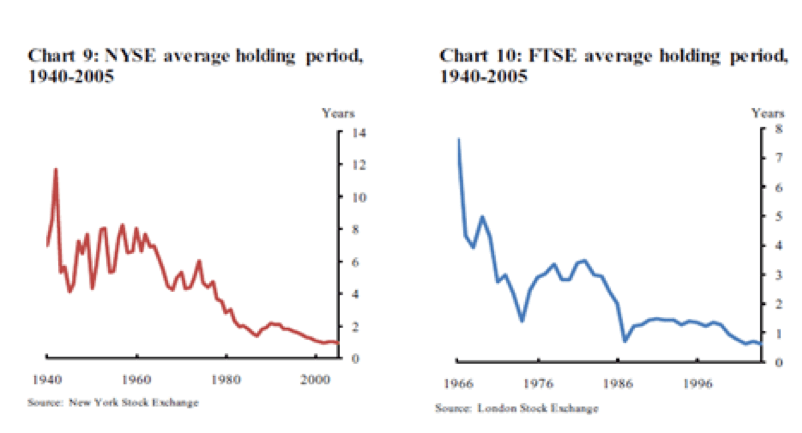
The best way to introduce this topic is demonstrate how much the average stock holding period has declined in the last 65 years.
According to the New York and London Stock Exchange the average holding period for a stock has declined from 8 years in 1940 down less than 1 year in 2005. The World Bank estimates it is now closer to 4 months.
So as the general investing population develops an ever-decreasing time horizon, Reid Green & Co maintains a long-term orientation focused on values, which are outside of the average investor’s time horizon.
Reid Green & Co typically thinks about a company’s value over a 1, 3 and 5 year period, and compares that value to today’s stock price, to look for substantial mis-pricings.
To demonstrate Reid Green & Co’s perspective on time horizon, we are going to use an example.
Glencore Plc
An investment idea we covered for our subscribers in 2016, when the stock was trading at a 50% discount to its book value.
Although Glencore announced it would slash its debt by 30%, monetise its non-core assets and reduce its operating costs over the next 12 – 18 months, the market was gripped by its fear by the short-term outlook concerning the record low oil prices.
The value investor does not necessarily have to wait for market crashes or corrections. Thinking about long-term values when others are obsessed with the short term should be sufficient to gain an advantage.
How can you start to ethically exploit this advantage for your own investment gain?
You can take the lessons from this article, read it, re-read it and then find a way to start looking for situations where you understand the long-term values of a company better than the market does. Or… you can find a source who sends you investment ideas which already meets this criteria, such as Reid Green & Co.
Founded in 2016, Reid Green & Co is a Value Investing research firm which publishes and distributes reports on deeply undervalued companies, which are listed in the UK and the US.
Experience our investment research, up-front, for free
We allow you to experience our investment research service up-front without paying for it via our no risk 30-day free trial
During the free trial on top of being able to examine the quality and nature of our reports you will receive at least 1 actionable investment idea you can take advantage of right now.
At any point in the free trial you can cancel your subscription. No questions asked. No payment required.
The Competition and Markets Authority has launched an investigation into the proposed deal between Sainsbury’s (LON: SBRY) and Asda.
The competition watchdog has invited interested parties to comment on the impact of the deal and will investigate whether the deal will result in a substantial lessening of competition.
Those affected could include suppliers, competitors, industry bodies and consumer organisations.
The watchdog said it is “likely to proactively contact companies and organisations that are active in the markets affected by the proposed merger, or have valuable insights or evidence that could assist the CMA’s investigation”.
A deal between the second and third biggest UK supermarkets would create a grocery giant and overtake Tesco as the market leader.
Once a first phase of the investigation is complete the CMA will decide whether to move to “phase two”.
The combined group would have 2,800 stores across the UK and a combined revenue of £51 billion.
Depending on the outcome of the investigation, the group may have to dispose of stores or the deal might be blocked entirely.
The CMA has set a deadline on Monday 4 June for its initial information gathering process.
Maximise UK, a retail consultancy, said last week that the watchdog could force Sainsbury’s and Asda to sell up to 245 supermarkets across the UK.
Research by the group showed the number of stores at risk is the very least six percent of the group’s combined total. This is 73 stores but the number could increase depending on the CMA calculations.
“There hasn’t been a retail deal like this in more than a decade. The real focus will be on how Sainsbury’s and Asda’s main supermarkets operate at a local level and how they overlap. The CMA will be concerned about whether the deal reduces the number of competing brands within a 10 or 15 minute drive time.” said David Haywood, founder of Maximise UK.
The group’s executives have said there are not any plans to close stores under the deal.
The merger, which was agreed last month, will see Asda valued at £7.3 billion.
Grainger (LON:GRI) reported a 23 percent increase in profit in its half-year results, on the back of a ‘strong’ trading performance.
Pre-tax profits rose to hit £50.6 million, up from £41.2 million a year ago, with adjusted earnings up 20 percent to £34.1 million. The results were underpinned by a 9 percent jump in rental income, with a 4.1 percent like-for-like rental growth across its entire portfolio.
Results were also boosted by the group’s attainment of £756 million of private sector investments, with £258 million in the planning or legal process and a further £519 million under consideration.
“We are a business on a strong growth trajectory and the opportunity in the UK PRS market is vast. We are uniquely placed given our market leading position and our in-house capability to originate, invest and operate homes for rent,” said Helen Gordon, Grainger’s CEO.
The group raised its interim dividend by 9 percent to 1.74 pence from 1.6 pence. Shares in Grainger (LON:GRI) are largely flat, currently up 0.32 percent at 314.80 (1021GMT).