Is this the end of the stock market as we know it?

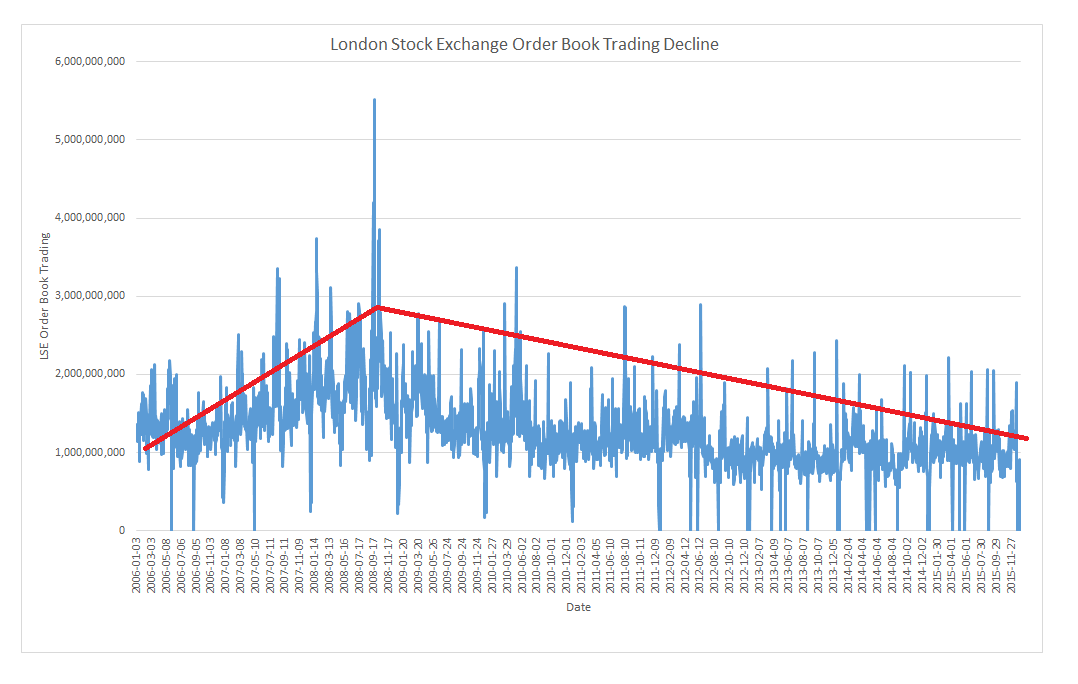
2015 saw the increased use of crowdfunding and private investment in Fintech firms – but also a decrease of IPOs and trades on the stock market. So what does the future hold for the stock market? In the modern world, has the traditional ambition to graduate to public company become irrelevant? Increase in private funding Fintech, one of the largest growth sectors, remains for the most part privately funded. Far fewer tech companies than expected floated on the stock market in 2015, instead choosing to stick with the copious private investment being offered and keep their finances away from prying eyes. Private funding rounds totalled $51 billion, according to CB Insights – more than six times the $8.26 billion raised in US tech and Internet public offerings this year. The number of companies in the industry did go public, 48, was one of the lowest ever according to data compiled by Bloomberg and many such as Etsy have share prices hovering at below IPO levels; market volatility has, understandably, led to many companies delaying their IPOs. Increase in crowdfunding The growth of crowdfunding has meant that finding hedge funds or very wealthy angels to invest is not the only way to achieve private funding – funding from the public is also now a viable option and has grown exponentially over the past couple of years. Crowdfunding five years ago was a relatively small industry, accounting for $880 million in 2010. However, the crowdfunding industry grew to over $16 billion in 2014 and is on track to account for more funding than venture capital. The World Bank estimates that crowdfunding will reach $90 billion by 2020, but if the current rate of growth continues, that figure will be hit by 2017. Crowdfunding has revolutionised the world of business finance and has been transformed into a viable form of investment, encouraging many companies that perhaps would have looked at going public to stay in the private sphere a little longer. Decrease in the market’s popularity 2015 was a rocky year for the stock market, hit by crises in both Greece and China over the summer, and so far 2016 hasn’t been much better. It seems that companies are picking up on the risks associated with the market and, whilst there is ready private funding available, staying out of the public sphere. Data going back 25 years shows that new IPOs are steadily decreasing, and 2015 was another bad year. The annual rate of companies joining global stock markets halved in the decade after 2000 compared with the decade before, according to the Organisation for Economic Cooperation and Development. Furthermore, the volume of trades on the London Stock Exchange has steadily declined since 2008, with overall activity in the stock market decreasing over the past eight years. This inactivity, combined with the uncertainty and volatility of the stock market, could well be a reason why private companies considering floating are staying away.
London Stock Exchange Order Book decline
Data: London Stock Exchange
So is this the end of the stock market as we know it? Whilst unicorn companies are riding a wave of private investment at the moment, in the long term this may not continue. Talk is already rife on the subject of whether companies such as Dropbox, which is currently valued at $10 billion, are worth their lofty valuations when their technology is such a fast-moving industry and staying ahead of the crowd is so difficult. Crowdfunding is an excellent option for raising short rounds of cash for short term expansions, but is not really a match for the amount of capital offered by floating on the stock exchange. However, over the past decade, there have certainly been changes to the way companies aim to expand and finance their business – with the general trend leaning towards keeping companies privately-owned for as long as possible. And with fewer regulations to comply with and a lesser need for transparency, its easy to see why.
Miranda Wadham on 06/01/2016

Oil plummets to 11 year lows on Saudi-Iranian tensions

0
The price of oil hit an eleven-year low on Wednesday as tension between Saudi Arabia and Iran increased, leaving an agreement to cap output on oil increasingly unlikely. Saudi Arabia cut diplomatic ties with Iran on Sunday after protesters ransacked the Saudi embassy in Tehran, protesting against Saudi’s execution of a senior Shia Muslim cleric. The United Arab Emirates (UAE) has also downgraded its diplomatic relations with Tehran. Whilst increased tensions between Middle Eastern countries usually trigger an increase in the price of oil, in the current market the opposite has proved true. Oil prices have fallen even further than their recent rock bottom, wiping 8 percent off the price of oil in the last three trading days alone and making an agreement between OPEC members on a cap on oil output increasingly unlikely. Both WTI Crude and Brent Crude are currently down 2.2 percent, at $35.97 and $36.42 respectively.
06/01/2016

2016: A bear’s guide

The US bull market will enter its seventh year in 2016, having restored some $15 trillion to share prices since 2009. At 82 months, the advance in the S&P 500 Index is poised to become the second-largest ever in 2016, eclipsing the 1950s bull market that saw share prices nearly quadruple. Despite the rally, the past seven years have not been pretty. We still aren’t sure whether the US economy is strong enough to stand on its own, or whether the bulk of its gains can be attributed to trillions of dollars in Federal Reserve stimulus and seven years’ worth of rock bottom interest rates. 2016 is expected to be a challenging year for the global financial system. Several issues stick out like a sore thumb, reminding investors that protection is the new objective in a low-yielding environment. 2016: The Year of Uneven Growth The global economy is forecast to grow 3.6% in 2016, according to an October estimate by the International Monetary Fund (IMF). However, there will be strong divergence between economies all over the world. Eurozone growth isn’t expected to be much stronger than it was this past year, while Japan is expected to rebound only modestly from a disappointing 2015. In emerging markets, Russia and Brazil are expected to contract next year, while China will enter year three of a protracted slowdown that is expected to continue for the foreseeable future. This is the backdrop that will define traders’ experiences next year. 2016: The Year of Modest Stock Market Gains While it’s difficult to predict an all-out bearish reversal for global stocks, it’s growing abundantly clear that 2016 “will have pretty much nothing to offer investors,” according to CNBC’s Jeff Cox. Goldman Sachs recently predicted that the S&P 500 will end 2016 close to where it began. European stocks are expected to lead the way next year, outperforming emerging markets as well as Wall Street, according to a recent poll by Reuters. However, European markets are expected to remain below peak levels reached back in April 2015, suggesting that growth will be hard to come by next year. Investors can expect to see continued volatility in China, as the world’s second-largest economy adjusts to a lower-growth environment. In India, stock prices are expected to regain their footing, although the overall trend is less optimistic than it was just a few months ago. Meanwhile, Brazil’s stock market is expected to “remain a very risky investment in 2016” amid a national recession. 2016: The Year of the US Dollar The dollar’s extreme bullishness leaves much to be desired for US multinationals, which are experiencing an earnings recession. Earlier this year Wall Street posted its first back-to-back quarters of earnings decline since 2009, thanks in large part to a more expensive greenback. The dollar is expected to strengthen even further next year, placing more pressure on US exporters. Combined with waning international demand, this could place added strain on the US manufacturing sector, which contracted in November for the first time in three years. Will a manufacturing recession force the Fed to delay future rate hikes? Only time will tell. 2016: The Year of Weak Commodities If weak international growth and weak equity prices weren’t enough, how about a continuing commodities recession? It’s becoming abundantly clear that commodities may struggle mightily in 2016 under the weight of a stronger dollar and uneven global demand. The price of gold is expected to fall closer to $1,000 an ounce in early 2016 before staging a modest recovery for the rest of the year. Meanwhile, oil prices continue to search for a bottom after a devastating 18-month rout that has pushed some global economies into recession. Both energy and precious metals are expected to weaken further next year. This content is sponsored by easy-forex, an easy-to-use online trading services provider. For more information on their service, visit easy-forex.com. easy-forex-logo_240x60 Risk warning: Forward Rate Agreements, Options and CFDs (OTC Trading) are leveraged products that carry a substantial risk of loss up to your invested capital and may not be suitable for everyone. Please ensure that you understand fully the risks involved and do not invest money you cannot afford to lose. Our group of companies through its subsidiaries is licensed by the Cyprus Securities & Exchange Commission (Easy Forex Trading Ltd- CySEC, License Number 079/07), which has been passported in the European Union through the MiFID Directive and in Australia by ASIC (Easy Markets Pty Ltd -AFS license No. 246566).

Leeds Property Opportunity

Trinity Place – Leeds UK

Sponsored Content

Trinity Place comprises of 94 purpose built ensuite, studio and 1 bed student apartments within walking distance of The University of Leeds. With over 70,000 students and a significant short fall of purpose built accommodation, rental demand for this asset class is strong over the long term. Developer is offering 8% NET rental returns for three years as part of a fully managed hassle free investment vehicle. Construction already underway with completion scheduled for Q3 2016

10 minutes walk from University and Leeds City Centre

Investment Highlights

⇒ Final availability remaining at £55,995

⇒ 3 years 8% NET rental agreement in place

⇒ Fully managed and hassle free for investor buyers

⇒ Brand new complete with social room, fitness gym and BBQ area

⇒Fully-furnished, self-contained apartments with private kitchens and bathrooms


Request Information Pack Now:

Terms and Conditions

The content of this website and it’s promotions has not been approved by an authorized person within the meaning of the Financial Services and markets Act 2000. Reliance on the promotions on the website for the purpose of engaging in any investment activity may expose an individual to a significant risk of losing all of the property or other assets invested.

The content of this website does not constitute an offer, solicitation or recommendation to acquire or dispose of any investment or to engage in any other transaction. The website should not be construed as advice or a personal recommendation to any prospective investor.

The information provided on this website is solely for information purposes only. The website and its content are not and should not be deemed to be an offer of or invitation to engage in any investment activity.

Any person accessing the website and considering potential investment opportunities featured on the website should make their own commercial assessment of an investment opportunity after seeking the advice of an appropriately authorised or regulated financial advisor. The products available are provided by a range of investment companies and are offered for investors with some degree of investment knowledge and experience, who wish to take an active responsibility for their investment decisions rather than for investors who may prefer to leave those decisions to a Fund Manager

Neither UK Investor Magazine nor the products it displays are authorised or regulated by the Financial Conduct Authority. The products and service available do not therefore offer recourse to the Financial Ombudsman Service or the Financial Services Compensation Scheme.

By requesting this information you agree to be contacted by the UK Investor Magazine and the organisation operating the above offer.

Huawei smashes tough smartphone market in 2015

0
Smartphone maker Huawei increased its shipments by 44 percent in 2015, sparked by demand in China and Western Europe. Huawei have rapidly grown their business over the last year, with sales rising by nearly 40 percent in the first six months of last year. Traditionally known for making cheaper smartphone models, the company released its latest flagship smartphone in Las Vegas yesterday which was priced at $699 and designed to compete with higher-end competitors Apple and Samsung. Huawei have consistently seen strong demand in a challenging market, becoming the only Chinese handset vendor to ship more than 100 million smartphones in a year last year.
06/01/2016

Fitbit shares plunge after unveiling new smartwatch

Shares in Fitbit (NYSE:FIT) fell more than 18 percent on Tuesday, as investors expressed concern over the company’s movement into the competitive ‘smartwatch’ market. Fitbit premiered its first new product in over a year in Las Vegas yesterday, their ‘Blaze’ smartwatch designed to text, place calls and control music playback – alongside Fitbit’s typical health features such as step counting and sleep tracking. The device will cost $200, for which Fitbit have already started taking pre-orders, and has a five day battery life. However whilst Fitbit have been very successful in their niche area of wearable fitness technology, seeing a doubling in their share price since their IPO in June, investors expressed concern yesterday at their ability to compete with the likes of Apple and Samsung in the smartwatch market. Their shares fell over 18 percent yesterday after the product’s unveiling. Fitbit closed up down 18.45 percent at 24.27 pence per share. The company has 52 week range of between 24.03 and 51.90.
06/01/2015

Sales figures indicate strong Christmas for John Lewis

2
The John Lewis Partnership have released a Christmas trading update, showing relatively strong performance in both its department store and Waitrose grocery chain arms. The group’s total sales rose by 4.1 percent to £1.81 billion in the six weeks to Jan, with John Lewis outperforming the Waitrose like-for-like. The department store saw gross sales rise by 6.9 percent; with Waitrose sales up by just 1.2 percent. In a statement, the Partnership’s Chairman Sir Charlie Mayfield commented: “Our performance reflects to a large extent the significant investment we have made in our distribution and IT capability. Despite the fact trade was even more concentrated across a number of very busy shopping days, our operations performed especially well. “Peak trade came particularly late this year and was more concentrated than usual in the days before Christmas. Waitrose had record trading days on 23 and 24 December, with sales up 6.0% and up 5.5% respectively. “Our strong Christmas trading performance gives us further confidence in the guidance provided at our interim results in September, where we indicated that we expected the full year Profit before Partnership Bonus, tax and exceptionals to be between £270m and £320m.” John Lewis has continued to outperform rivals due to a strong online site and a bias to the South-East of England. Their Christmas trading update showed far more favourable figures than that of Next, who were trading down 5 percent yesterday after warm weather caused their pre-Christmas sales figures to slide.
06/01/2015

BREAKING – Sainsbury’s make offer for Home Retail

0
Reports have been released today that suggest supermarket chain Sainsbury’s are considering making an offer for Home Retail, which includes the Argos and Homebase chains. This could be perceived as a new attempt by Sainsbury’s to keep their head above water in a difficult sector; all of the Big Four UK supermarkets have been blighted by weak sales and high competition from discount stores such as Lidl and Aldi. Diversifying into areas other than food and groceries may well prove to be a good move for the Group. Sainsbury’s have until the 2nd February to formally make the offer. LATEST Reports have come through that Sainsbury’s have had their offer for Home Retail rejected. Sainsbury’s shares are trading down 4 percent on the news.
05/01/2015

Giveaway entrepreneur wins approval from the Den’s toughest Dragon

Starting your own company can be difficult; but when your business impresses even the toughest of Dragons, you know you’re on the right track. This is certainly true for Deepak Tailor, founder of giveaway website LatestFreeStuff, who received validation from the infamously tricky Deborah Meaden on Sunday night’s episode of Dragon’s Den. For Ms Meaden, who is known for her investments in money-making businesses, taking a punt on a brand based entirely upon giving things away was a break from the norm. But with revenue of £350,000 and more than 300,000 monthly visitors, LatestFreeStuff.co.uk is more than a shot in the dark; it is a successful and viable business opportunity. Today the site lists over 600 free products from top brands and companies; it has a user database of over 120,000 members; and is currently working with the likes of Vodafone, O2, TasteCard, Amazon and Uber. The website brings users some amazing deals, free samples and the chance to ‘try before they buy’, and provides an excellent marketing platform for manufacturers and retailers to enhance their brand awareness. But why choose the BBC programme Dragon’s Den for investment, rather than arguably easier routes such as crowdfunding or bank loans? As company founder Deepak Tailor explains, the Dragons offer more than just money: “The main reason I chose Dragons investment was the brilliant connections that they have with the top brands in the UK. This was one of the fundamental problems at LatestFreeStuff, we had too many users, and not enough brands. I really felt like the dragons would be able to open up the doors with the brands that we want to work with in the future. This is something we couldn’t get from crowdfunding or traditional bank loans.”
dtho20141217jdeepaktailor001.jpg
Deepak Tailor, founder of LatestFreeStuff
“LatestFreeStuff has experienced tremendous growth,” Tailor adds. “When I first started my pitch none of them really seemed to understand what it was that I wanted, but once the penny dropped the Dragons all appeared to love my business, and I ended up getting three offers, which was incredible. Deborah Meaden made the best offer, and shaking hands on the deal was an amazing feeling.”
Thus far the company has grown virally through a mixture of word of mouth, social media and search engine traffic, with Deborah Meaden’s advice and investment, the aim was to take the platform to an international market, beginning with America, before spreading across the globe. Investment from Ms Meaden is just the beginning of the next phase of growth for Tailor and his business. To find out what it was about LatestFreeStuff that excited the Dragons, follow the link here.
Miranda Wadham on 05/01/2015

Share Tips of the Year 2016

Galvan 2016

Dear Reader

The hunt is on for next “Big Winners”…

A New Year brings New Opportunities.

In this Free Special Report you’ll discover the shares that look set to soar in 2016

Here’s just some of the stocks:

  • A UK Bank set to deliver capital growth and income

  • This company’s technology is used billion smartphones… Apple and Samsung depend on them

  • A little-known penny share that could make a fortune from the WiFi boom

Regards

The Galvan Research Team

P.S. Prior year editions have proved very popular, so don’t miss out.

Download the ‘Share Tips of the Year 2016’ for free now.

A copy will be sent to you immediately.

Galvan Research And Trading Limited
Authorised and regulated by The Financial Conduct Authority

Registered Office:

CMA House, Newham Road, Truro, Cornwall, TR1 2SU
Company No: 05054098

Risk warning

All investments are speculative and prices may change quickly and go down as well as up. There is an extra risk of losing money when shares are bought in some smaller companies including “penny shares”. There can be a big difference between the buying price and the selling price of these shares and if they have to be sold immediately, you may get back much less than you paid for them or in some circumstances, it may be difficult to sell at any price.

Trading in Contracts for Difference (CFDs) and forex may not be suitable for all investors due to the high risk nature of the products. You may lose all of your initial stake through the use of leverage and may be required to make additional payments by way of margin on a frequent and sometimes daily basis. Failure to do so can result in the closure of part or all of your position.

The value of a CFD or forex may be affected by a variety of factors, including but not limited to, price volatility, market volume, foreign exchange rates and liquidity. CFDsand forex are short term trading tools. Commissions on CFDs are charged on the leveraged amount (not the deposit) and therefore costs can build up when frequently traded. You should evaluate potential losses against affordability. Extended runs of losses as well as profits can occur.

Past performance is not necessarily a guide to future performance. If in any doubt, please seek further independent advice. Tax laws may be subject to change.

Privacy notice

By registering your details, you request us hereby to provide you on a continuing basis (in writing, email and by telephone) with investor updates, information on our own products and services and those of selected partners and third parties. To enable us to do so, and for our marketing purposes, you agree that we may process and hold your data in both manual and electronic form. You are free to “unsubscribe” from this service at any time. Should you wish to ask about the information we hold concerning you, you are invited to contact us at the above address. At no time will we provide your personal data to any other company except to our own associates, affiliates or agents. This notice is issued by Galvan Research And Trading Limited in accordance with the UK Data Protection Act. Be aware our telephone lines may be recorded or monitored for training purposes. To read our Privacy Notice in full please visit our website.