The FTSE 100 showed signs of much-appreciated stabilisation on Wednesday after posting one of the worst days since liberation day on Tuesday.
London’s leading index was 0.7% higher at the time of writing, having staged a 100-point rally from lows around 10,450 to 10,560 intraday.
“If yesterday was capitulation, today is investors catching their breath,” said Russ Mould, investment director at AJ Bell.
“Most of the main European stock markets regained their balance and either edged higher or held firm, much to the relief of investors who have witnessed two days of share prices flashing red.”
The Middle East Conflict has been a reminder of just how quickly markets can move if fundamentals and sentiment change abruptly. Just last week, commentators were counting down the FTSE 100 points to 11,000. Fast forward three days, and 10,000 was looking more likely.
But there has been a break in the selling today, with bargain hunters stepping in to sweep up beaten-down FTSE 100 names.
Markets tend to overreact, and traders are usually quick to look past the worst-case scenario and consider where we could be in a few months’ time.
With the war in the Middle East only likely to last a month at most – should Trump’s own guidelines be anything to go by – names such as Antofagasta, Entain, and IAG caught the attention of traders.
Miners were among the top risers on after sharp declines this week that some may argue were due anyway, given the strong start to 2026.
BP’s rally is beginning to fade as the stock fell back to levels similar to those last Friday. This may be a sign that the market doesn’t seem to foresee a prolonged conflict that sends oil to $100.
Housebuilders were among the worst-performing stocks as they fell in sympathy with Vistry, which posted poor results that showed slowing demand across the new build ecosystem.
Persimmon and Barratt Redrow were down between 0.5% and 1%.
This morning’s Interim Results from Netcall (LON:NET) could well guide investors towards a very useful purchase.
A strong first-half trading period and a record Order Book suggest that the momentum is growing for this £182m-capitalised group.
After the recent 37% fall in the group’s shares to the current 102p, could today’s results statement identify a very opportunistic time to buy into Netcall’s equity.
The Business
Founded in 1984 and based in Bedford, Netcall is a provider ...
Vistry shares sank on Wednesday after the partnerships-focused housebuilder posted a dismal set of 2025 results, packed full of reasons for investors to dump the shares.
Falling revenues, slowing completions, and faltering demand under the partnerships model all lead to Vistry shares opening down around 20% on Wednesday before the price recovered marginally.
Total completions fell to 15,658 units from 17,225 the previous year, dragging adjusted revenue down 4% to £4.2bn. A 3% rise in average selling price to £282k partially offset the volume decline, but wasn’t enough to prevent the top line from slipping.
The partnerships business, which accounts for 74% of completions, saw units fall 8% to 11,593 as uncertainty around government funding, particularly in the run-up to the Autumn Budget, caused partners to delay deals.
Vistry once looked like an interesting way to gain exposure to the government’s promises to build 1.5m homes. But with the government’s targets a long way from being achieved, the pain is being felt in Vistry’s results.
The private rented sector was also notably weaker, with PRS volumes dropping by 23% year-on-year as some partners paused delivery to refinance.
Adam Vettese, market analyst at eToro, said: “Vistry Group’s results have triggered a brutal price plunge at open, as markets punish a profit miss, volume weakness and a worrying 2026 outlook. Adjusted pre-tax profit came in at £269m, flat on last year’s £264m and below the £270m–£280m consensus whispered ahead. Revenue slid 4% with completions down sharply by 9%, a damning indictment of persistent buyer caution despite rate cuts.”
Vettese also explained that the focus on the partnerships model with local authorities, which was once a real differentiator for Vistry, is now becoming a major constraint as the sector’s demand slows.
“There is more to this beyond the ‘meets guidance’ headline, it’s a credibility blow. The partnerships model looked resilient in theory, but execution falters amid policy delays and soft demand,” Vettese said.
“Shares potentially look cheap at these levels, but only if Vistry nails deleveraging and SAHP wins. For now, it’s a resounding vote of no confidence from investors.”
Many of the issues outlined in today’s report are beyond Vistry’s control. That may be why shares fell so sharply, but it also highlights that an improvement to the backdrop could soon see them firing on all cylinders again.
SRT Marine Systems has signed a $261m contract with a new sovereign customer to supply a national maritime domain awareness system, significantly exceeding the roughly $200m expected value of the contract award when it was first announced in September 2025.
The formal signing took place at the customer’s premises with senior representatives from the client, the UK Government, UK Export Finance, and SRT in attendance. The commencement of the project is subject to the completion of a UKEF-supported finance package, which is now underway.
SRT Marine Systems announced a 95% increase in group revenue in the six months to December 2025. Contract wins like this will help the top line grow further still.
Under the deal, SRT will deliver its SRT-MDA System, which integrates multiple sensors, data feeds, and operational workflows to provide continuous maritime situational awareness.
CEO Simon Tucker said the contract marked the start of a long-term relationship, with the system enabling the customer to build up its surveillance capabilities progressively.
SRT also provided a broader update on its existing operations, noting that current geopolitical tensions in the Middle East have underscored the importance of sovereign nations maintaining independent civil defence and surveillance systems. The company said it continues to make good progress across its projects in Asia and the Middle East.
Following the new contract, SRT now has approximately £340m of active projects under implementation, the $261m contract signed and pending commencement, and a prospects pipeline estimated at up to £1.8bn. The company said the scale of its active and pending work reflects growing international demand for independent maritime domain awareness capabilities.
Dotdigital Group has acquired Alia Software, a New York-based AI-powered pop-up and list-growth tool built for Shopify merchants, in a cash deal worth up to $60m.
The initial consideration is $30m, with a further $30m in contingent payments over two years tied to Alia hitting growth and margin targets.
The deal is being funded from Dotdigital’s existing cash reserves and is expected to be earnings-enhancing in its first year.
Founded in 2022, Alia helps brands such as TOMS, Hexclad Cookware and ILIA Beauty convert anonymous website visitors into known email and SMS contacts through intelligent pop-ups and interactive experiences. The company has built a customer base of more than 2,700 merchants and holds a 4.7 out of 5 rating on the Shopify App Store.
Alia’s forward-looking ARR surged from roughly $1m at the end of 2024 to over $8m by 31 December 2025, while recognised revenue for the year came in at $4m.
For Dotdigital, the deal plugs in on-site conversion capability that is more advanced than its own pop-up offering.
“The acquisition of Alia further advances our CXDP vision by strengthening our on‑site conversion and first and zero‑party data capture capabilities,” said Milan Patel, Chief Executive Officer of Dotdigital.
“These are increasingly important areas for marketers as customer acquisition costs rise and privacy standards evolve. We’re delighted to welcome Shaan and the team to the Group. Importantly, Alia represents our continued pace of acquisition execution which has collectively transformed the Group’s capability, scale and market position across all three of our strategic pillars, while consistently maintaining strong profitability. This positions us well to capitalise on the opportunities ahead as the markets we serve continue to navigate and evolve.”
On 29 January 2026, Ian Lance presented an update on Temple Bar’s progress at a webinar organised by Frostrow Capital. A recording of this presentation is available below, with Ian providing an insight into how he and co-portfolio manager Nick Purves apply their disciplined valuation-focused, active investment approach, and the outcomes it has delivered for investors.
Past performance is not a guide to the future. The price of investments and the income from them may fall as well as rise and investors may not get back the full amount invested. Forecasts and estimates are based upon subjective assumptions about circumstances and events that may not yet have taken place and may never do so.
No investment strategy or risk management technique can guarantee returns or eliminate risks in any market environment. Nothing in this document should be construed as advice and is therefore not a recommendation to buy or sell shares. Information contained in this document should not be viewed as indicative of future results. The value of investments can go down as well as up.
This article is issued by RWC Asset Management LLP (Redwheel), in its capacity as the appointed portfolio manager to the Temple Bar Investment Trust Plc. Redwheel is authorised and regulated by the UK Financial Conduct Authority and the US Securities and Exchange Commission.
The statements and opinions expressed in this article are those of the author as of the date of publication.
Redwheel may act as investment manager or adviser, or otherwise provide services, to more than one product pursuing a similar investment strategy or focus to the product detailed in this document. Redwheel seeks to minimise any conflicts of interest, and endeavours to act at all times in accordance with its legal and regulatory obligations as well as its own policies and codes of conduct.
This document is directed only at professional, institutional, wholesale or qualified investors. The services provided by Redwheel are available only to such persons. It is not intended for distribution to and should not be relied on by any person who would qualify as a retail or individual investor in any jurisdiction or for distribution to, or use by, any person or entity in any jurisdiction where such distribution or use would be contrary to local law or regulation.
The information contained herein does not constitute: (i) a binding legal agreement; (ii) legal, regulatory, tax, accounting or other advice; (iii) an offer, recommendation or solicitation to buy or sell shares in any fund, security, commodity, financial instrument or derivative linked to, or otherwise included in a portfolio managed or advised by Redwheel; or (iv) an offer to enter into any other transaction whatsoever (each a Transaction). No representations and/or warranties are made that the information contained herein is either up to date and/or accurate and is not intended to be used or relied upon by any counterparty, investor or any other third party. Redwheel bears no responsibility for your investment research and/or investment decisions and you should consult your own lawyer, accountant, tax adviser or other professional adviser before entering into any Transaction.
The FTSE 100 tumbled on Tuesday as oil prices rose amid the ongoing conflict in the Middle East, raising concerns about knock-on effects on growth.
There was almost a sense of complacency in markets yesterday, with the FTSE 100 making measured declines and the S&P 500 closing marginally positive.
However, developments overnight have served as a reality check after Iran’s Revolutionary Guard said they would set any ships entering the Strait of Hormuz ablaze.
Around 20% to 30% of the world’s oil and gas passes through the strait, so any sustained closure could send shock waves through the global economy.
The fear here is that rising fuel prices scupper additional interest rate cuts and even lift inflation to levels that interest hikes enter the narrative.
“Despite an initial sanguine response to the Iran conflict seen on Wall Street on Monday, UK stocks recorded a meaningful drop on Tuesday morning,” said Dan Coatsworth, head of markets at AJ Bell.
“Asian markets were weak as concern grows about rising energy prices, and US futures suggest investors across the Atlantic are also starting to become more alarmed about the situation in the Middle East. The suspension of LNG production in Qatar is a particularly sensitive pressure point and has seen gas prices surge globally.”
The FTSE 100 was down 2.5% at the time of writing.
Although the market is focused on what’s happening in the Middle East, the flow of company earnings continues, and Intertek was the standout FTSE 100 corporate update on Tuesday. Unfortunately for investors, it was for all the wrong reasons.
Intertek shares tumbled after the group missed revenue expectations and only increased dividends by 5.4%. Investors didn’t like what they saw, and shares sank 15%.
Cyclical sectors dragged the index lower with miners Antofagasta, Melten, and Anglo American all falling more than 5%.
IAG was again the top faller as the grounding of flights and rising oil prices due to the war hit sentiment. IAG lost another 6% on Tuesday.
Banks were down heavily, as were the housebuilders.
Declines in Shell reflected souring sentiment on Tuesday, as the oil majors were unable to carve out meaningful gains despite rising oil prices. BP was higher by just 0.1%.
“This could prove to be highly profitable for both Shell and BP’s trading arms with Shell’s optimisation capabilities in LNG transit likely to be in particularly strong demand,” said Derren Nathan, head of equity research, Hargreaves Lansdown.
“Shell’s balance sheet strength also leaves it better placed to deal with any prolonged volatility and while BP’s buybacks remain on pause, we’re expecting Shell’s generous payouts are likely to continue this year.”
Smith & Nephew was the top riser with gains of 3.5% as it rebounded from a results-induced selloff yesterday.
Harvest Minerals (LON: HMI) appointed Mark Reilly as a non-executive director. He has been a director of many AIM and ASX companies, including Forte Energy. This sparked a 16.7% jump in the share price to 0.35p.
Caspian Sunrise (LON: CASP) reports the first oil production from the West Shalva contract area, although cold weather has affected flow rates. They should improve from the current 300 barrels of oil per day. Another well will be drilling in the first half of 2026 and there are plans to upgrade to a full production licence. The share price increased 13.3% to 2.55p.
Empyrean Energy (LON: EME) says the final investment decision gas been approved for the Mako gas project, offshore Indonesia. This is on the Duyung production sharing contract, where Empyrean Energy has a 8.5% interest. First gas could be produced in the fourth quarter of 2027. The project is fully funded at the joint venture level. The share price rose 15.4% to 0.075p.
CyanConnode (LON: CYAN) has negotiated a revised non-binding proposal from Esyasoft, which recently acquired Good Energy. The offer is 10.44p/share, valuing CyanConnode at £37.5m. The original indicative offer was 9.75p/share. The share price has not been above 10p since April 2025. The share price rebounded 11.3% to 9.125p.
RockRose Energy has acquired 2.3% of Deltic Energy (LON: DELT), for which its parent company Viaro Energy has made a recommended offer of 7.46p/share. The deal is dependent on approval by the UK authorities. The share price recovered 5.57% to 4p.
FALLERS
Central Asia Metals (LON: CAML) says the estimated life of its Sasa zinc and lead mine in North Macedonia is up until 2034 and this five year reduction of the mine life will lead to a non-cash impairment charge of up to $120m. The ore body has become more variable and knocked profitability. Exploration may help to extend the mine life. The company says that its dividend policy will not change. There was more than $8om in cash at the end of 2025. Full year results will be published on 19 March. The share price dived 22% to 187.1p.
Security technology and services provider Synectics (LON: SNX) increased full year revenues by 22% to £68.1m, with growth across the business, and earnings improved from 21.7p/share to 28p/share. A major gaming project generated £12m in revenues. Net cash was £14.1m at the end of November 2025. The total dividend is increased from 4.5p/share to 5p/share. This financial year is described as transitional with revenues falling 10% because of last year’s one-off contract and margins will decline. Longer-term growth is expected to accelerate. The share price fell 15.7% to 187.5p.
Kodal Minerals (LON: KOD) says arbitration proceedings have commenced regarding the indemnification claim by Kodal Mining UK, 51% owned by Hainan Mining, of the $15m payment to the government of Mali. Kodal Mining UK holds the Bougouni lithium project. The share price declined 15.9% to 0.345p.
Downing has cut its stake in Anpario (LON: ANP) from 4.09% to 3.12%. The share price dipped 9.35% to 485p.
Johnson Service Group (LON: JSG) has shown its ability to grow despite the weak consumer market hitting its core customer base in hotels and catering. Past capital investment has increased efficiency offsetting higher employee costs and enabling a further improvement in margins.
In 2025, revenues were 4% ahead at £535.4m and improving operating margins led to a 18% rise in underlying pre-tax profit of £64.5m. This excludes £6m of exceptional costs, including £1.7m on moving from AIM to the Main Market and restructuring costs. The dividend is raised by one-fifth to 4.8p/share.
Net debt rose from £115.6m to £159.2m, which was after £54.7m of share buybacks. There were three small infill acquisitions in the year for minimal cash outflow.
Hotel and catering generated most of the growth in revenues and profit with help from acquisitions, but organic growth in revenues was still 1%. New business and long-term contract extensions are being won. One major hotel client has signed a five-year renewal agreement.
Workwear generated organic growth of 2.4% and customer retention levels are 94%. This is currently a slightly higher margin business, but it is smaller generating just over one-quarter of group operating profit.
Jonhson Service Group fixes part of its energy costs ahead of time, so short-term oil price movements will not hamper the business. The outlook remains positive with plans to improve operating margins from 13.5% to 14%. Even so, the share price fell 7.4% to 133.4p, which is less than ten times forecast earnings.
Analysis for informational purposes only. Capital at risk.
Highlight
Cheung Kong’s Art of the Deal: While the market often views Hong Kong’s Cheung Kong Group as a traditional conglomerate, it actually operates as a highly disciplined, counter-cyclical capital allocator. It systematically acquires undervalued infrastructure, scales operations, and monetises these assets at peak valuation cycles.
The Stealth Play in British Infrastructure: CK Infrastructure (1038.HK / CKI.L) serves as a major proxy for British essential infrastructure. The firm remains a dominant operator in UK utilities, maintaining a highly diversified, cash-generative portfolio across the domestic water, gas distribution, and power generation sectors.
War Chest for the Next M&A: The 2026 divestments of UK Power Networks and Eversholt Rail have generated a massive liquidity pool to fund the next capital rotation. In our view, the group might deploy this capital toward distressed M&A targets such as the capital-constrained UK water utilities like Thames, Southern, and Yorkshire Water, alongside a continued expansion into decentralised renewable energy following its recent string of wind, solar, and EV charging acquisitions.
Cheung Kong’s Art of the Deal in UK Infrastructure
The market often assumes Hong Kong tycoon Li Ka‑shing’s Cheung Kong Group has transitioned into a passive holder of mature, low-growth assets. However, the conglomerate maintains a highly active business model with a strong connection to the UK and EU, holding sizable investments in essential infrastructure. Over the years, the group has systematically shifted capital from Hong Kong real estate to Western infrastructure markets to capture stable dividend yields from monopolies.
In particular, the group has a multi-decade track record of acquiring undervalued infrastructure, scaling operations, and executing exits at peak market valuations (counter-cyclical asset rotation), and it continues to demonstrate such capabilities currently.
Recent Exits: Funding the Next Cycle
The divestments of UK Rails and UK Power Networks in early 2026 provide the group with substantial liquidity to initiate the next capital cycle.
UK Power Networks: In February 2026, CK Group (via its listed vehicles CK Infrastructure, CK Asset, and Power Assets) sold UKPN to France’s Engie for £11 billion. Including £4.4 billion in dividends over the years, the cash return on UKPN exceeds 6 times the initial investment (£2.6 billion) over 16 years. Beyond favourable market timing, this premium valuation was driven by a fundamental operational turnaround, elevating UKPN from low regulatory ratings in 2010 to ‘Utility of the Year’ in 2025.
UK Rails: In January 2026, the group sold Eversholt Rail to Beacon for a reported £4 billion, a significant premium over the initial £2.5 billion purchase price in 2015.
UK Asset Portfolio
Among the group’s listed vehicles, CK Infrastructure (1038 HK/CKI: LSE) has a sizeable UK asset portfolio.
Historically, the UK has operated as CK Infrastructure’s largest market, contributing over 50% of profits. While this ratio will decline following the UKPN and Eversholt sales, the region remains a foundational profit center.
Source: The Company, AP
Currently, CK Infrastructure is a significant player in UK utilities and transport. The remaining portfolio includes
Water: A 39% economic interest in Northumbrian Water, serving 4.5 million people across England.
Gas Distribution: A 47.1% economic interest in Northern Gas Networks (6.7 million users), a 39% economic interest in Wales & West Utilities (7.5 million users), and a 40% economic interest in Phoenix Energy in Northern Ireland.
Power Generation: A 25% economic interest in the Seabank Power Station and a 40% economic interest in UK Renewables Energy, operating 32 onshore wind farms.
CK Infrastructure has executed over 30 acquisitions globally since its listing in 1996. Outside the UK, the company has various businesses in Canada, Europe, New Zealand, Australia, and HK/China.
Source: The Company, AP
Track Record of Deal Making
The 2026 infrastructure exits perfectly align with CK Group’s historical M&A framework. Over the past three decades, management has consistently demonstrated the ability to establish or acquire assets at low valuations and execute exits at peak market multiples.
The Orange UK Sale (1999): After launching the network in 1994, Hutchison Whampoa sold Orange to Mannesmann for £19.8 billion at the peak of the European telecom boom in 1999. This generated a $15 billion (HK$117 billion) profit and allowed the group to exit prior to the expensive 3G spectrum auctions and subsequent market correction.
The Hutchison Essar Exit (2007): Having entered the Indian telecom sector in 1992, the group built Hutchison Essar into a premier operator before selling its 67% stake to Vodafone for $11.1 billion. This exit immediately preceded a prolonged period of intense price wars and margin compression.
“The Center” Sale (2017): CK Asset sold a 75% stake in the 73-storey Hong Kong office tower for HK$40.2 billion ($5.15 billion), setting a global record for a single office building transaction. The sale crystallized returns just before shifting macroeconomic conditions triggered a prolonged downturn in the local commercial real estate market.
The European Telecom Tower Sale (2020): CK Hutchison sold its European telecommunications tower assets to Spain’s Cellnex Telecom for €10 billion, recording a net profit of approximately €6.6 billion.
Source: The Companies, AP
The Next Capital Cycle
Following the recent UK divestments, CK Infrastructure possesses the cash reserves required to evaluate new M&A opportunities, particularly distressed assets.
The Distressed UK Water Sector: The current debt crisis at Thames Water makes the utility a prime distressed M&A target, fitting CK Infrastructure’s strategy of acquiring and turning around undervalued assets. However, Thames Water’s strategic scale introduces regulatory and geopolitical hurdles regarding potential foreign ownership. Consequently, regional operators such as Southern Water and Yorkshire Water, which face identical pressures from high debt loads and escalating regulatory fines, represent alternative distressed targets.
Source: Ofwat, UK Parliament, AP
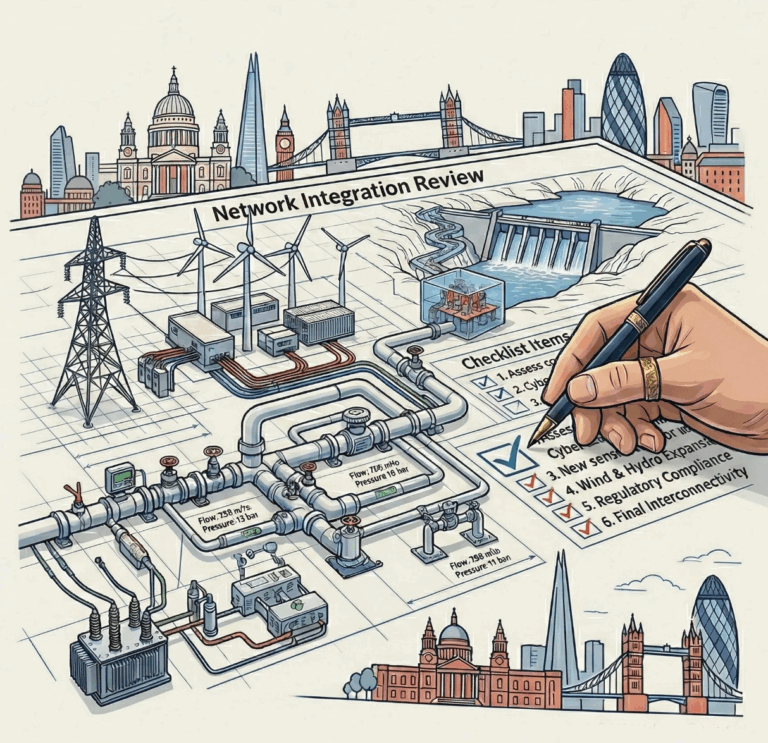
Renewable Energy: Simultaneously, CK Infrastructure is utilising its capital pool to scale operations beyond traditional utilities and into the renewable energy sector. Recently, the company executed several strategic acquisitions:
Wind: Acquired UK Renewables Energy, adding 32 operational onshore wind farms to the portfolio.
Solar and Hydro: Acquired UU Solar, taking ownership of 70 renewable generation assets with 68.7 MW in capacity.
EV Charging: Expanded into the European electric vehicle charging market by acquiring Chargemaker GmbH in Germany via its subsidiary, ista.
Smart Energy Management: Scaled smart building and energy efficiency data operations by acquiring Switzerland’s Alfred Aubort SA.
Hydrogen Network Conversion: Instead of strictly managing legacy gas pipes, the company is actively upgrading infrastructure—including Northern Gas Networks—to replace natural gas transmission with hydrogen blending.
This article is a “periodical publication” for information only and is not investment advice or a solicitation to buy or sell securities. This article does not constitute a “personal recommendation” or “investment advice” under UK FCA regulations. Investing in equities involves significant risk. The author holds NO position in the securities mentioned. There is no warranty as to completeness or correctness. Please do your own due diligence or consult a licensed financial adviser. Please read the Full Disclaimer before acting on any information. Images created with the assistance of Gemini AI.