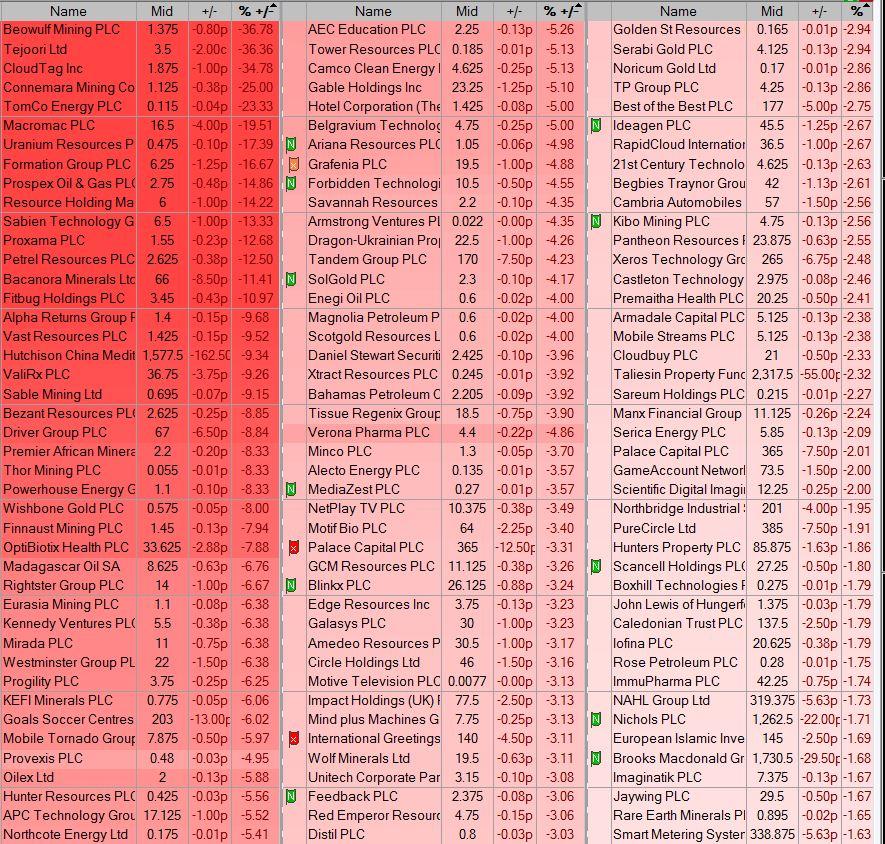
AIM movers: Atome nears funding deal and Impax Asset Management disappoints

169

Mercantile Ports and Logistics (LON: MPL) shares rose a further 118.2% to 1.2p while investors await a decision from the meeting of a consortium of banks to consider Mercantile’s debt proposal on Friday 10 April. One bank did not sanction an agreement for a one-time settlement of company debt with the consortium of banks. The court has told the Committee of Creditors holding the company debt to consider an offer to redeem 100% of outstanding debt. There are potential buyers interested in the port and logistics assets if they are claimed by the banks. An international oil and gas company is a potential provider of funds to help redeem the debt. The share price has more than trebled this week.

Atome (LON: ATOM) is in the final stages of negotiations for the funding of the Villeta fertiliser project in Paraguay. Definitive documentation with the equity consortium is expected by 17 April. The potential funders are likely to be at the IMF and World Bank spring meetings at that time. The share price rebounded 28.1% to 77.5p, which is the highest it has been since late 2024.

Eden Research (LON: EDEN) has completed a conditional placing taking the total raised in the recent fundraising to £10.8m at 4p/share. The cash will fund development of an additional fungicide for Late Blight and an insecticide to target spider mites, whitefly, aphids and thrips. The share price increased 14.6% to 3.15p.

Steppe Cement (LON: STCM) has increased cement sales in Kazakhstan in the first quarter of 2026 to 344,058 tonnes, from 276,217 tonnes in the same period last year. The average price was one-fifth higher at around $57/tonne. Market share increased to 16%. Capacity is being increased and the final estimated cost is $35m. The share price rose 10.5% to 21p.

FALLERS

Impax Asset Management (LON: IPX) published a disappointing quarterly update to assets under management. They fell 8% in the second quarter to £22.3bn, compared with the previous quarter, with net outflows in the quarter much higher than expected at £2bn. There was a small positive increase related to performance. Full year revenues are expected to be £109m to £113m and costs are being reduced. The share price slumped 25.55 to 93.55p, which is less than ten times prospective earnings.

Faron Pharmaceuticals (LON: FARN) says 70% of shares available in its offer to investors were taken up. The amount raised was €40.1m, or €32m after expenses, at €0.50/share. The cash will be used to fund “a randomised, 90-patient Phase II trial in frontline high risk myelodysplastic syndrome with bexmarilimab in combination with azacitidine as well as to accelerate the development of its lead asset bexmarilimab by providing it to up to five investigator-initiated trials”. The share price fell 11.2% to 43.5p.

Quantum Blockchain Technologies (LON: QBT) says a court has stopped enforcement of a €6m plus damages award against Sipiem relating to the Mediapolis business. The company has not been able to enforce the seizing of property of a former Sipiem director because he has declared bankruptcy. The liquidation of Mediapolis is being completed and a further distribution of €132,000 is expected to be received by the end of June. The share price dipped 6.85 to 0.48p.

Metals explorer Rockfire Resources (LON: ROCK) is continuing drilling to upgrade from an inferred resource to an indicated resource at the Molaoi zinc deposit in Greece. Strong germanium grades have been intersected in the southern zone. Copper and silver have also been identified in hole HMO-012, plus silver in hole HMO-013. Hole HMO-014 had the largest zinc values, but it caved and will be redrilled later. There are plans to buy a drilling rig. The share price declined 1.755 to 0.14p.

FTSE 100 ticks higher at end of dramatic week for Middle East

The FTSE 100 ticked higher on Friday as investors took stock of a dramatic week for geopolitics that has culminated in a fragile ceasefire in the Middle East.

There was a sense of calm to trading on Friday morning that hadn’t been felt since before the US and Israel launched attacks on Iran 28th February.

With talks ongoing and missile strikes in Lebanon overnight, stocks aren’t completely out of the woods, but investors should be encouraged by the FTSE 100’s near 1,000-point rally from March intraday lows to this week’s intraday high.

London’s leading index ticked gently higher past the 10,600 mark on Friday but showed little sign of the exuberance experienced earlier in the week.

The measured session for European stocks followed a rally on Wall Street overnight, sparked by reports that Israel and Lebanon were preparing for talks to end attacks on the country.

But this failed to translate to any meaningful upside for European stocks after both sides launched strikes at each other overnight.

Nonetheless, the overall direction of travel in the conflict will help boost sentiment, with the worst of it now seemingly in the past as all sides signal a willingness to sit down and thrash out a deal.

“While the term ‘ceasefire’ is used somewhat loosely, there has been enough perceived de-escalation in the Middle East to ease some of the pressure on risk assets we saw earlier in the week,” said Matt Britzman, senior equity analyst, Hargreaves Lansdown.

“The prospect of in-person talks between the US and Iran over the weekend is also helping steady nerves, offering hope that diplomatic channels remain open. Taken together, investors are becoming more comfortable that, while risks remain, the broader trajectory is moving in the right direction.”

Although a deal will be bullish for risk assets, equity markets have been quick to price in a resolution to the conflict that may seem a touch premature if oil prices remain at current levels. Brent was trading at $97.06 on Friday, a level that still risks stoking inflation as we enter the summer.

Michael Brown, Senior Research Strategist at Pepperstone, said: “if an Israel-Lebanon ceasefire can be agreed, that is in turn likely to increase the chances of a US-Iran deal being struck, thus raising the likelihood of a swifter normalisation of commodity flows through the Strait of Hormuz.”

There were very few movers of more than 2% at the time of writing on Friday, and most stocks were changed by less than 1%.

ConvaTec rose 3.5% to be the session’s best performer following a capital markets day yesterday in which the firm set out plans to accelerate

Compass Group was the FTSE 100’s top faller, losing another 2.6% on Friday.

Gold price approaches critical level of $4,800

Gold prices have rebounded sharply since the lows around $4,100 recorded in the middle of the war in the Middle East, and are now approaching the key level of $4,800.

Once relied upon as a safe haven and inflation hedge, gold failed to display either of these attributes as the US and Israel attacked Iran. Instead, it traded more like a risk asset, tracking stocks and ignoring the looming inflation risk.

Indeed, gold rallied with stocks after the ceasefire was announced and is now heading towards the key $4,800 level.

“Gold is currently experiencing one of its most sensitive and critical phases from both an investment and economic perspective, as it approaches the psychological barrier of $4,800 per ounce,” explained Rania Gule, Senior Market Analyst at XS.com.

Gule continued to outline a shift in perceptions of gold amid market volatility and changes in the investment thesis behind precious metals across different stages of the market cycle.

“In my view, this rally is not merely a temporary reaction to passing geopolitical events; rather, it is the result of the convergence of several fundamental factors, foremost among them the weakness of the U.S. dollar, declining Treasury yields, and heightened concerns surrounding global inflation and tensions in the Middle East.

“This combination creates an ideal environment for the continuation of gold’s positive momentum in the short and medium term, especially if markets continue to price in higher economic risks during the second quarter of the year.

“In my opinion, the most influential factor behind the current movement is not geopolitical tension alone, but rather gold’s return to its classic correlation with macroeconomic variables, particularly real yields.

“When yields on U.S. 10-year Treasury bonds decline, the opportunity cost of holding gold decreases, enhancing its investment appeal.”

Unite Group targets higher-quality portfolio as reservation rates slip

Unite Group, the UK’s largest owner and manager of student accommodation, has reported that 74% of beds are now reserved for the 2026/27 academic year, broadly in line with the same point last year at 76%.

The company reiterated guidance for occupancy at the lower end of 93-96% and rental growth of 2-3%, down from 4.0% achieved in 2025/26. Direct-let sales are running slightly ahead of last year, supported by targeted pricing adjustments and promotional activity.

The student accommodation market is changing, and Unite is adapting by accelerating its push to reshape its portfolio around the UK’s strongest universities.

The group has £130 million of disposals completed or under offer and is marketing a further £500 million of assets for sale over the next 6-12 months. Unite has put a portfolio of around 7,000 beds in lower-growth locations up for sale, drawing strong early investor interest, with capital values sitting well below replacement cost.

Unite also commented on the progress of its Empiric acquisition.

The Empiric acquisition is delivering £3 million in annualised cost synergies so far, with targets of £9 million this year and £17 million from 2027 onwards. Hello Student bookings sit at 33%, behind last year’s 48% at this stage, though Unite attributed the gap to a delayed sales cycle following a technology upgrade and has since brought Empiric properties onto its international sales network.

Quarterly fund valuations showed modest declines driven by yield expansion. USAF’s portfolio fell 1.7% on a like-for-like basis to £2,798 million, with yields widening 9 basis points to 5.4%.

The LSAV portfolio declined 2.4% to £2,034 million, with 13 basis points of yield expansion, bringing the weighted average to 4.8%.

Rental growth within the funds remained positive but was insufficient to offset the outward yield movement.

Unite Group shares were 1% higher shortly after the open on Friday.

Impax Asset Management sees AUM slide 8% in second quarter

Impax Asset Management, the AIM-listed sustainable investment specialist, reported assets under management of £22.3 billion at 31 March 2026, an 8% decline over the quarter.

AUM is down 8% over the past quarter but nearly half over the past year. Group AUM as of 31 March 2025 was £39.6 billion.

The drop reflects a challenging period for the sustainability-focused fund manager, which invests across the transition to a more sustainable economy.

“Since January, after a difficult three-year period for investment managers like Impax that focus on actively managed thematic strategies, markets have been considerably more favourable. During the second quarter, 63.4% of our AUM outperformed, notwithstanding the more recent market turbulence,” said Ian Simm, Chief Executive.

“As many asset owners base their investment decisions on historical numbers over at least one year, we were not surprised to see a continuation in net outflows, driven principally by redemptions from a small number of institutional investors. By contrast, net outflows in our wholesale channel were lower and we continue to see an improving trend in flows via our largest distribution partner.”

The CEO also acknowledged that lower AUM would inevitably lead to another year of revenue declines for the group. In the year to 30th September 2025, Impax revenues fell 16% to £141.9m and are expected to soften further again this year to £109m – £113m.

“Following the recent net outflows and these uncertain external tail risk factors, we expect that our revenue for the financial year will be in the region of £109m – £113m.  Against this backdrop we are taking further steps to improve our operating efficiency,” Simm said.

AO World delivers 11% revenue growth as profits hit top of upgraded guidance

AO World, the online electricals retailer, has rounded off a strong year with total group revenue growth of around 11% for the 12 months to 31 March 2026, driven by market share gains across all key categories.

AO World have released a strong set of numbers that reinforces the momentum AO has been building despite a soggy economic backdrop.

The headline number is adjusted pre-tax profit landing at the top end of its previously upgraded £45-50 million guidance range, representing roughly 15% year-on-year growth. Notably, that profit growth outpaced sales despite what the company described as material cost headwinds, suggesting genuine operating leverage is coming through in the business.

B2C revenue grew approximately 9.5%, with AO continuing to take share across its core categories. Cash generation was a particular standout, with free cash flow jumping to around £65 million from £23 million in FY25, a near threefold increase that underlines the improving quality of earnings.

The group expects to close the period with roughly £200 million in liquidity, providing a comfortable buffer heading into FY27. On the cost front, AO has hedged approximately 80% of forecast fuel usage and all of its electricity for the full FY27 trading year, providing insulation from recent geopolitical disruption.

“The numbers speak for themselves again and I am delighted to keep doing our talking on the pitch,” said AO’s Founder and Chief Executive John Roberts.

“Our shared economics strategy and membership model, built on the foundations of brilliant retail basics, continues to deliver results. We continue to build momentum and all key metrics continue to improve, with an exciting pipeline of new initiatives ahead.

“In the coming weeks, AO will become the first company globally to reach one million Trustpilot reviews with a 4.9 rating from customers. Having founded AO 26 years ago in a small office with three people and a dream, I am incredibly proud to have reached this milestone, which is a testament to the entire team. To achieve that in a logistically difficult category highlights the structural advantage we have been building with world class quality at scale. This underpins our reputation as the UK’s most trusted electrical retailer and the value of it sits on our balance sheet at zero.”

AIM movers: Van Elle bid and ex-dividends

4

Mercantile Ports and Logistics (LON: MPL) is pursuing legal remedies to regain control of port operating subsidiary, Karanja Terminal & Logistics. One bank did not sanction an agreement for a one-time settlement of company debt with the consortium of banks. The court has told the Committee of Creditors holding the company debt to consider an offer to redeem 100% of outstanding debt. There has been no progress and there are potential buyers interested in the assets. An international oil and gas is a potential provider of funds to help redeem the debt. A meeting will be held to consider Mercantile’s proposal on Friday 10 April. The share price rebounded 146.2% to 0.8p.

Van Elle (LON: VANL) is recommending a 52.3p/share cash bid from STRABAG UK, which values the ground engineering company at £58.8m. The share price has not been that high for more than three years. The directors had talks with other suitors before receiving this bid approach. Vienna-based STRABAG provides construction services, and it was seeking to expand in the UK. The share price jumped 56.15 to 51.5p.

A trade of 23,050 shares at 35p each has pushed up the share price of recently floated Africa-focused investment company Tapir Holdings (LON: TAPH) by 14.3% to 40p.

Wind energy services provider European Green Transition (LON: EGT) has a strong pipeline of repowering contracts that has accelerated since UK government policy changes. The ongoing services business provides visibility for revenues with upside from repowering contracts. The share price gained 15.85 to 8.25p.

RentGuarantor (LON: RGG) growth is accelerating with first quarter revenues more than doubling to £880,000 and this has sparked an upgrade. New partners have been brought onboard. It is also offering a new product with mydeposits that combines insuring rent deposits with the rent guarantee service. Allenby has increased its 2026 pre-tax profit forecast by 26% to £300,000. This would be a maiden profit. The share price improved 12.8% to 26.5p.

FALLERS

MobilityOne (LON: MBO) says that media comments that it has secured a full-fledged Shariah-compliant Islamic digital banking licence from the Labuan Financial Services Authority are not accurate. There are still outstanding conditions that have to be met. The share price slumped 21.8% to 10.75p.

Sorted Group (LON: SORT) shares continue to fall following last week’s news that itis asking for shareholder approval for the sale of its operating business, which was bought two years ago, for £1. Ongoing monthly operating costs will be around £18,000 and the board will seek to find an acquisition.  The company’s name will be changed to SGH. The share price slipped a further 17.9% to 11.5p.

Data analysis software and services provider Celebrus Technologies (LON: CLBS) says full year revenues are broadly in line with expectations at $23.3m, down from $38.7m because of a change in business model, and the loss will be around $200,000. Annualised recurring revenues grew from $13.6m to $15m. Two bank customers sold off parts of their businesses, so their payments were reduced. Some expected deals at contracted stage were lost or delayed and Celebrus Technologies is improving its skills in winning new clients. Cash was $32m at the end of March 2026. Another loss is anticipated for 2026-27. The share price declined 11.1% to 84p.

Oil and gas producer Zephyr Energy (LON: ZPHR) has been hit by a cybersecurity incident, which transferred £700,000 to a third-party account. There is enough cash for continuing activities, while the company attempts to reclaim the cash transferred. The share price dipped 7.35% to 3.15p.

Wishbone Gold (LON: WSBN) plans to acquire the Silver Lake project in Western Australia. Before that happens, historic data will be further analysed. If it goes ahead 3.57 million shares will be issued for the acquisition. The share price fell 7.04% to 33p.

Ex-dividends

BTG Consulting (LON: BTG) is paying an interim dividend of 1.5p/share and the share price fell 1p to 117.5p.

Bioventix (LON: BVXP) is paying an interim dividend of 70p/share and the share price declined 100p to £17.75.

Northamber (LON: NAR) is paying an interim dividend of 0.3p/share and the share price is unchanged at 27.5p.

Somero Enterprises Inc (LON: SOM) is paying a final dividend of 6.24 cents/share and the share price recovered 2.5p to 187.5p.

The UK Budget: 100 days on 

Luke Bartholomew, Amanda Yeaman, Rebecca Maclean and Thomas Moore.  

Last November’s Budget appeared to set the stage for a more positive outlook for UK equities. The Chancellor built herself some room to manoeuvre and tax hikes were not as severe as feared. The gilt market was tamed, and bond yields started to drop. There was a sense that the UK may be about to turn a corner.  

The Iran conflict has thrown a spanner in the works. Iran has blocked the all-important Strait of Hormuz, a crucial shipping lane for fossil fuels coming out of the Middle East. The oil price has spiked, along with gas and other commodities, with potential knock-on consequences for UK inflation. The turmoil has hit UK borrowing costs, with the gilt yield spiking higher as investors anticipate higher interest rates.  

The situation remains fluid, and the ultimate outcome depends on how long the Strait remains closed. It is plausible that some international coalition will be agreed to keep the lane open, but even if this is agreed, oil price spikes could last for six weeks. Aberdeen’s deputy chief economist Luke Bartholomew says every 10% increase in oil tends to be associated with a 0.2% increase in headline inflation at global level. A temporary closure is likely to add 0.5% to headline inflation this year.  

For the UK, he says, it may defer some of the tentative signs of recovery. At the start of 2026, PMI surveys had started to look stronger, and retail sales suggested a more confident consumer. Bartholomew says it is likely that inflation may fall to 2% and then rise higher again as the oil price shock is reflected in household bills. The Bank of England will almost certainly wait to lower rates, though the ultimate path is likely to be lower – the fundamentals of the UK economy need lower rates.  

A change of government remains a risk in the UK, he says. Chancellor Reeves has rebuilt some credibility with the gilt market. If the current government were to be replaced with one more open to deficit-financed spending increases, there could be dangers for the UK economy. This is an ongoing area of concern.  

Nevertheless, there are some reasons to temper pessimism around the UK economy. If the oil disruption is temporary, it is likely to defer rather than cancel interest rate cuts. A cut in April is still possible. And household balance sheets are very strong, with plenty of savings, so have some resilience.  

UK stock market: opportunities for active stock pickers 

Just as the problems in the Middle East have disrupted a developing recovery in the UK economy, they have also dented UK stock markets. 2025 was a strong year for the FTSE 100, and this strength was broadening out into smaller and medium-sized companies when the attacks were launched. The problem has been that sentiment towards this part of the market has correlated with UK borrowing costs. Higher gilt yields have hurt.  

However, across the UK market there are real opportunities for active stock pickers. In the Aberdeen Equity Income Trust, for example, investors’ new-found enthusiasm for companies with strong asset backing has provided a boost. This type of company is a natural hunting ground for manager Thomas Moore, who seeks out companies with strong cash flows, who can then pay that money to shareholders in the form of dividends.  

Many of the companies in the trust’s portfolio are insulated from the potential disruption of Middle East tensions. Rio Tinto, for example, is supported by the strength of global commodities demand, as is BP, while HSBC may be a beneficiary of higher-for-longer interest rates. BAT and Imperial Brands are also seeing strong cash flow and high dividend payouts.  

It is possible to find defensive options among smaller companies as well. Amanda Yeaman, manager on the Aberdeen UK Smaller Companies Growth Trust, says they always look for companies that are in charge of their own destiny rather than in thrall to the strength – or otherwise – of the UK economy. She says there are a range of undervalued companies showing real strength.  

Areas of resilience 

The small cap team are finding a range of infrastructure companies, for example, that are beneficiaries of government spending likely to span multiple years. That might be in transport, energy or water, but they have predictability of demand. These include companies such as Balfour Beatty, Morgan Sindall and Galliford Try. These are businesses where demand isn’t likely to dry up if the economy softens. They have predictable cash flows and resilient revenues. The trust also has some oil and gas exposure, and some exposure to defence companies, such as Avon Technologies and Chemring.  

Rebecca Maclean, manager on the Dunedin Income Growth Investment Trust, says the UK market still holds plenty of dividend opportunities as well. The team finds plenty of companies that can grow their dividend sustainably, such as Chesnara, which has built a multi-decade track record of paying and growing its dividend. Or NatWest, which has an attractive yield. The trust also holds TotalEnergies, which is providing some ballast as oil price volatility continues.  

But one of the greatest defences open to fund managers is understanding the companies in depth, the risks to their businesses, not just from the war in the Middle East, but more widely. For example, Maclean has been working to quantify the impact of AI on the companies held in the portfolio. She is speaking to management teams about their ‘moat’, and the extent to which they are going to be able to grow in a new AI environment. Are they investing enough to be ready for AI? Have they got financial resilience? This has helped her build conviction in certain areas and she has used share price volatility to top up positions.  

The UK’s Achilles heel is also its superpower. Valuations remain low in the UK market, relative to other markets and to their own history. By itself, that delivers some protection. In this type of environment, high expectations can be a significant risk.   

The US is now a huge part of most investors’ portfolios, while the UK has been sold down over time. Embedded expectations for the US are high, and it is reliant on the uncertain outcomes of artificial intelligence. The opposite is true for the UK. The UK stock market provides a different type of exposure, and some real diversification potential from the US. In difficult conditions, that may become more important. 

Important information 

Risk factors you should consider prior to investing:   

  • The value of investments and the income from them can fall and investors may get back less than the amount invested. 
  • Past performance is not a guide to future results. 
  • Companies selected for illustrative purposes only to demonstrate the investment management style described herein and not as an investment recommendation or indication of future performance 

Fund documentation and risks: 

The Aberdeen Equity Income Trust Key Information Document can be obtained here. 

The Aberdeen UK Smaller Companies Growth Trust Key Information Document can be obtained here. 

The Dunedin Income Growth Investment Trust Key Information Document can be obtained here. 

Issued by abrdn Fund Managers Limited, registered in England and Wales (740118) at 280 Bishopsgate, London EC2M 4AG, authorised and regulated by the Financial Conduct Authority in the UK. 

Find out more at aberdeeninvestments.com/trusts or by registering for updates. You can also follow us on XFacebook and LinkedIn. 

FTSE 100 slips as ceasefire realities set in

The FTSE 100 slipped on Thursday as the storming rally sparked by the ceasefire agreement started to fade.

London’s leading index was trading down 0.3% at 10,578 at the time of writing. Given that the FTSE 100 rallied 2.5% yesterday, today’s losses were minimal but did underscore nervousness about the ceasefire holding.

“The war may be paused, but we expect several effects to linger across four fronts: energy pricing, shipping/logistics, inventories, and market risk premia,” said Lale Akoner, global market analyst.

“Even after a ceasefire, Hormuz does not normalize overnight.  Market prices adjust much faster than physical flows, and shipping firms may need time just to regain confidence, with port activity taking about two months to normalize. Inventory rebuilding then takes longer still: energy analysts estimate roughly four months to restore OECD stocks to a more comfortable level.”

Israeli attacks on Lebanon overnight also kept tensions high as Iran labelled them a violation of the ceasefire terms. These attacks and Iran’s response may have contributed to oil prices rising again.

Oil prices have proved to be a sense check throughout the Middle East war, with Brent and WTI often decoupling from the emotional swings in equity markets. Investors will have one eye on the rebound in oil prices on Thursday and may be concerned that yesterday’s euphoria was a little premature, with inflation still a big risk over the coming months.

While the relationship between oil and the FTSE 100 index has varied since the 28th February, there is a clear inverse relationship between oil prices and several of the FTSE 100’s interest-rate-sensitive sectors, such as housebuilders and retailers.

A rebound in WTI and Brent to the $97-$98 region on Thursday saw this relationship kick in again as Barratt Redrow, Persimmon, Burberry and Marks & Spencer all fell.

Mortgage rates are reportedly little changed despite the ceasefire being called, which will dampen bargain hunters’ enthusiasm for housebuilders in the near term.

Compass Group fell 3% and erased all of yesterday’s gains. Fresnillo was another notable faller as silver prices faded from yesterday’s rally.

DCC shares rose 1.9% after Exane BNP upgraded their rating to outperform from neutral.

Standard Life was the FTSE 100’s top faller due to the stock trading ex-dividend. BP was the FTSE 100’s top riser with oil prices resuming their ascent.

Concurrent Technologies: next Monday’s Finals to show good growth and record order intake 

Next Monday, 13th April, Concurrent Technologies (LON:CNC) will release its Final Results to end-December 2025, they will be good and show real progress going forward. 
The £162m-capitalised group is a designer and manufacturer of leading-edge computer products, systems, and mission-critical solutions used in high-performance markets by some of the world's major OEMs, 
At the end of February, the group’s shares were trading at a 278p High, then the recent conflict hit the markets and this company too, easing them back to 173.50p before showing ...