Majedie Investments Portfolio Manager Q2 Commentary: returns independent of broader market direction

Overview  

Majedie Investments (MAJE), managed by Marylebone Partners, pursues a liquid endowment-style investment strategy with the objective to deliver an annualised return of at least 4 per cent above UK CPI (consumer price inflation) over rolling five-year periods. 

The approach is long-term and fundamentally driven. Like the leading US university endowments, it seeks to emulate, the strategy avoids market timing and instead emphasises patient capital allocation, drawing on a combination of actively managed equities and a select range of complementary asset classes. Unlike many endowment portfolios, however, Majedie avoids illiquid assets such as private equity, private credit, venture capital and real estate. All holdings are marked to market, preserving liquidity and transparency. 

The portfolio is organised across three segments: specialist external managers (spanning equity and absolute-return strategies), direct investments, and special investments. The latter provides exposure to differentiated opportunities that are unlikely to feature in conventional portfolios. 

Since Marylebone Partners assumed responsibility for the trust at the end of January 2023, Majedie has comfortably exceeded its CPI + 4 per cent objective. Over the period (to the end of March 2026), the trust generated an NAV total return of 34 per cent and a share price total return of 57 per cent, compared with cumulative UK CPI inflation of 11.6 per cent. The trust employs no gearing. Dividends remain a core component of total return, with quarterly distributions targeted at 0.75 per cent of quarter-end NAV, equivalent to an annualised yield of 3 per cent. 

Introduction 

Over the second quarter of Majedie’s financial year, Net Asset Value (NAV) rose by +0.2%, with gains in January and February largely given back in March. This was a strong relative outcome against weaker equity markets and heightened volatility. The MSCI ACWI fell -7.2% in March and ended the quarter down -3.2%, while Asian equities fell -13.7% in March and ended the quarter down -1.2%. For the first half of the financial year, NAV has risen +4.3%.  

Majedie’s resilience reflected two structural features of the portfolio. First, the underlying investments are idiosyncratic. Despite the portfolio’s equity-centric nature, returns can be substantially independent of broader market direction over periods beyond the short term. Second, our decision-making protocol leads us, and our underlying managers, to take profits when long-term investments approach medium-term price targets. In February, we reduced positions in copper and uranium stocks, leaving dry powder to deploy during the subsequent pullback. 

Market Commentary and Outlook 

Markets began the year anchored to resilient U.S. growth, cooling inflation and expectations of lower policy rates. That backdrop supported equities through January and February, while industrial and precious metals rallied sharply. At the same time, investors increasingly treated successive sectors as potential AI casualties, with software particularly affected. 

The market course changed in March as hostilities in the Gulf and disruption to tanker traffic through the Strait of Hormuz brought energy security back into focus. Oil prices rose as supply disruption shifted from tail risk to reality. The shock fed into rates, with higher crude prices reviving inflation concerns and leading markets to scale back expectations for near-term policy easing. The result was tighter financial conditions at the same time as growth expectations were revised down. The U.S. dollar strengthened, pressuring non-U.S. markets and contributing to a reversal in gold and other precious metals. Asian equities were particularly hard hit, reflecting the region’s dependence on imported energy. 

Following events in the Middle East, scenarios previously treated as tail risks may warrant greater weight in base-case thinking. We see three broad paths. The first is regime fracture within Iran, which could create short-term uncertainty but ultimately support markets if oil prices ease and regional stability improves. The second is a negotiated settlement, allowing passage through the Strait of Hormuz to resume under some form of arrangement, but with oil prices likely settling above prior levels. The third is destructive escalation, with energy infrastructure becoming both target and leverage. While precise probabilities are difficult to assign, the second path appears most likely. 

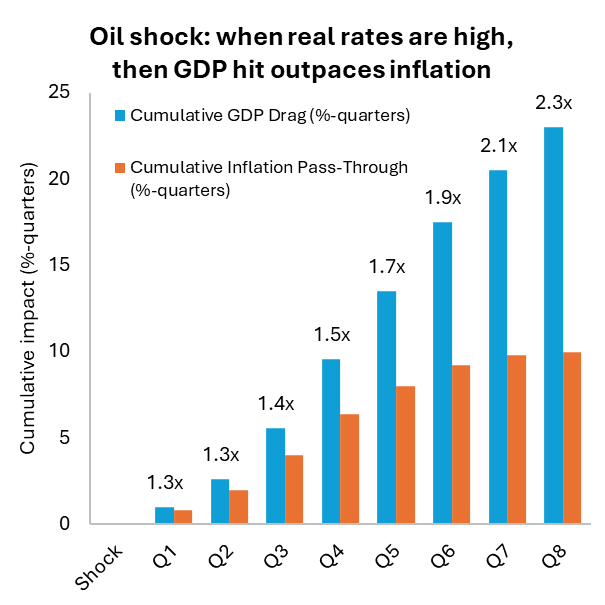
An oil shock is often treated first as an inflation problem, but history suggests the larger and more durable effect can fall on growth, particularly when real interest rates are already restrictive. Higher fuel costs act like a regressive tax on households and a margin squeeze for companies. In the current monetary regime, demand destruction may be more likely than a persistent inflation cycle. If growth falters and inflation proves less persistent than feared, the next move could be towards lower policy rates rather than the higher rates currently assumed by markets. 
Over time, share prices follow the delivery of earnings and, even more importantly, of free cash flow. Data shows that the most consistently cash-generative companies have outperformed the rest, by a meaningful margin. 

Some investors are currently extending confidence to one class of historically cash-generative growth company while withholding it from another. Hyperscalers are being given latitude to absorb near-term pressure on free cash flow margins, on the assumption that current investment will drive materially higher future cash generation. In contrast, software companies are increasingly being discounted on fears that AI will erode growth and margins. We view that assessment as too blunt. Some software models will come under pressure, especially those with limited differentiation. Others remain well positioned through customer data, systems-of-record status and deep operational embedding. 
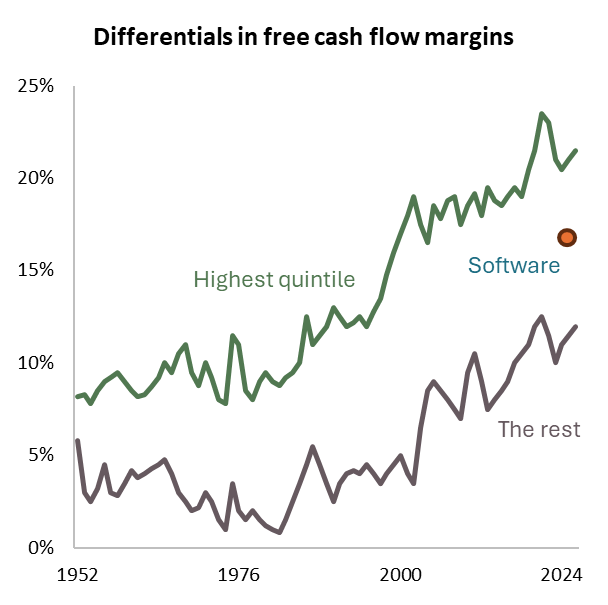
Source: Empirical Research. Large-Capitalisation Stocks: Forward Relative Returns of the Highest and Lowest Quintiles of Free Cash Flow Yield  

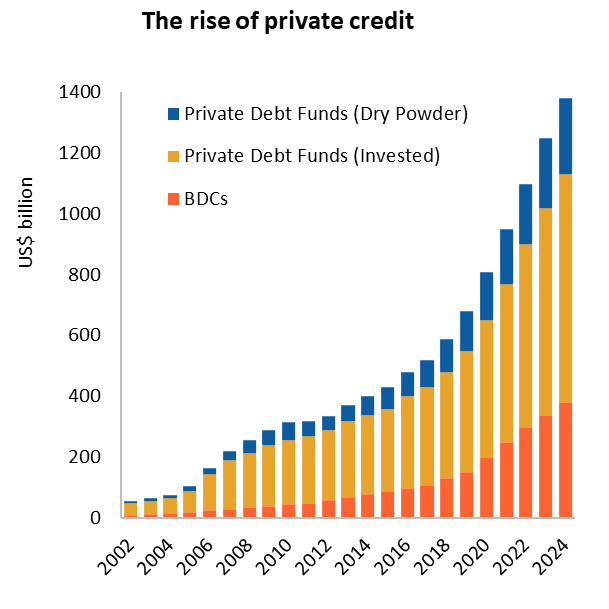
Private credit is also showing fault lines. Roughly US$1.2 trillion has been raised by private-credit firms over the past five years. As capital has flowed into a finite opportunity set, underwriting discipline is unlikely to have remained intact. Concerns are particularly acute in software lending, where loans have often been underwritten against high valuation assumptions, limited creditor protection, loose covenants and Payment-in-Kind features. Majedie has no exposure to private credit, and exposure to more liquid credit instruments was reduced last year. However, we remain mindful of second-order effects, including forced selling by overextended allocators. Our specialist credit managers remain focused on idiosyncratic positions already priced for adverse outcomes, with seniority, actionable catalysts and portfolio-level hedges providing downside protection.
 

Attribution 

The strongest contribution over the quarter came from commodity-related investments, followed by external manager allocations to the biotech specialist and a low-net exposure Shipping & Energy fund. The weakest performance came from  the Software specialist and Brown Advisory’s Global Focus strategy. We viewed this weakness as an opportunity and added to both on 1 April. 

Within External Managers, Absolute-return strategies mitigated the effect of weaker equity markets. All Absolute-return strategies made money, with the largest contribution from Fearnley Energy Alpha, supported by Contrarian Emerging Markets Fund. The Equity-centric component was down, broadly in line with markets, reflecting deliberate overweighting to Asia and some exposure to software stocks. Paradigm, the Biotech manager, performed well, benefiting from positive clinical data and takeover approaches for some of its largest holdings. 

Within Direct Investments, the largest contribution came from copper exposure through the Global X Copper Miners ETF and options, which were sold in January after copper stocks rose sharply. Computacenter plc., IMI plc. and ArcBest also contributed positively whilst Stabilus SE, Cancom SE and SS&C Technologies detracted. 

Special Investments performed well, led by the Sprott Uranium Miners ETF, which rallied sharply before retracing; we used the strength to trim the position. Bank of Cyprus was exited after a successful holding period, during which the company delivered strong earnings growth, increased its dividend payout ratio and re-rated. Bow Street Global Opportunities Fund and Orizon Valorizacao de Residuos also contributed positively. Oxford Biomedica plc., detracted after giving back gains following a takeover approach from EQT that did not progress, although we continue to see strategic value and fundamental upside. 

Positioning and Conclusion 

Amid geopolitical and macro uncertainty, we expect further volatility. Having reassessed probabilities, we believe the fundamental case for Majedie’s investments remains intact and have made few adjustments. In several cases, recent weakness has improved prospective returns. There were no meaningful changes to the team or business during the quarter, and integration within Brown Advisory is progressing well. 

Disclaimer: 

This publication is intended to be of general interest only and does not constitute legal, regulatory, tax, accounting, investment or other advice nor is it an offer to buy or sell shares in the Company (or any other investments mentioned herein).  

Nothing in this publication should be construed as a personal recommendation to invest in the Company (or any other investment mentioned herein) and no assessment has been made as to the suitability of such investments for any investor. In deciding to invest prospective investors may not rely on the information in this document. Such information is subject to change and does not constitute all the necessary information to adequately evaluate the consequences of investing in the Company.  

The shares in the Company are listed on the London Stock Exchange, and their price is affected by supply and demand and is therefore not necessarily the same as the value of the underlying assets. Changes in currency rates of exchange may have an adverse effect on the value of the Company’s shares (and any income derived from them). Any change in the tax status of the Company could affect the value of the Company’s shares or its ability to provide returns to its investors. Levels and bases of taxation are subject to change and will depend on your personal circumstances. 

Past performance is not a reliable indicator of future returns. Any return estimates or indications of past performance cited in this document are for informational purposes only and can in no way be construed as a guarantee of future performance. No representation or warranty is given as to the performance of the Company’s shares and there is no guarantee that the Company will achieve its investment objective.  

AIM movers: EnergyPathways gains gas storage licence and B90 set to move into new sectors

0

EnergyPathways (LON: EPP) will be awarded a gas storage licence by the North Sea Transition Authority for its MESH project. It covers up to 60 salt storage caverns. This is part of a project in the East Irish Sea. The gas storage facility could double the UK’s gas storage capacity. The share price jumped 15.4% to 9p.

Online gaming marketing business B90 (LON: B90) reported results in line with the recent trading statement and management intends to use the AI performance marketing technology it has developed to move into new sectors. Revenues more than doubled to €7.2m and pre-tax profit was €1.1m, up from €700,000. Importantly, there was €603,000 in cash generated from operations and net cash was €1m at the end of 2025. Development costs are expensed and the cash pile will continue to grow. Longer-term, moving into new sectors should boost growth. The share price rebounded 14.6% to 2.35p, which is around eight times forecast earnings.

Yet another upgrade for Ramsdens (LON: RFX) following the third trading statement in three months. Guidance for 2025-26 pre-tax profit has been upgraded from £24m-£28m to £28.5m-£31.5m. The gold buying operations are a part of the reason, but jewellery retail and pawnbroking are also doing better than expected. Foreign exchange is slightly weaker than expected due to lower margins and it could be hit by the Middle East conflict if flights and holidays are cancelled. If gold buying volumes continue at the current level, then there could be a further upgrade later in the year. The share price increased 8.44% to 417.5p.

Union Jack Oil (LON: UJO) has says the Crossroads well was spudded on 5 May. Drilling should last ten days. Union Jack Oil has a 43% interest. The share price improved 10.1% to 4.35p.

Driver safety technology developer Seeing Machines (LON: SEE) says automotive volumes more than doubled in the third quarter compared with the previous quarter, Royalty revenues in the quarter were greater than for the whole of the first half. There are 6.1 million cars fitted with Seeing Machines technology. There should be a positive EBITDA in the second half. The share price rose 9% to 4.5125p.

Ascent Resources (LON: AST) has received an update from the International Centre for Settlement of Investment Disputes concerning Energy Charter Treaty claim against the Republic of Slovenia. The announcement confirms that the arbitration tribunal has reached an advanced stage and that an award is expected to be issued to the parties in June. The share price gained 7.2% to 0.67p.

FALLERS

Biopharmaceutical company Avacta Therapeutics (LON: AVCT) is presenting new comparisons of preCISION payload release via AVA6103. The data suggests that the treatment could improve options for cancer patients. Other data indicates effectiveness in combination with antibody drug conjugates. The share price fell 2.6% to 75p.

Invinity Energy Systems (LON: IES) is successfully reducing the cost of the Endurium vanadium flow battery technology and making other cost savings. A contract with a Hungarian customer has been delayed and a potential US contract will take longer than expected to contribute. Revenues guidance for 2026 has been reduced to £13m and the loss could be £25m. Cash should still be £7m at the end of 2026. The share price dipped 1.47% to 16.75p.

FTSE 100 surges higher as US signals end to Middle East offensive

The FTSE 100 surged on Wednesday as traders cheered apparent progress toward ending the Middle East conflict.

Global equities reacted positively to a series of comments by US officials that signalled a de-escalation in tensions between the US and Iran. Marco Rubio said that the offensive stage of the conflict was over, while Trump’s comments suggested he was confident a deal with Iran could be struck.

The FTSE 100 was trading 2.2% higher at the time of writing.

Today’s move shows just how sensitive equity markets still are to developments in the Middle East. And how desperately traders want to see a deal between the US and Iran. 

“The market is celebrating an apparent late-night TACO Tuesday as the US pauses its plan to escort commercial ships through the Strait of Hormuz to focus on negotiations with Tehran,” said AJ Bell investment director Russ Mould. 

“A ceasefire which seemed to have been stretched to breaking point appears to be just about holding up. Hopes for de-escalation have been renewed by the latest developments as Donald Trump declares ‘Project Freedom’ to be done and dusted. 

“A rally for stocks and bonds has taken hold and oil prices have eased back from yesterday’s highs. However, oil is still comfortably in the $100-plus per barrel territory, which is worrying for inflation.”

But these worries had taken a back seat on Wednesday with 90 of the FTSE 100’s constituents trading in positive territory at the time of writing.

Fresnillo was the FTSE 100’s top riser as precious metals gold and silver rallied on overnight developments. Fresnillo surged 9%, but was still way below recent highs.

Rolls-Royce was 8% higher as the engine maker reacted positively to talks of a ceasefire. There were also gains for IAG, which shared the same sentiment.

The risk-on trade helped mining stocks higher, with Antofagasta jumping 8% and Anglo American climbing 7%. Housebuilders joined the party, with Persimmon and Barratt Redrow both adding around 5%.

Diageo issued quarterly performance data on Wednesday showing the group was still struggling with its North American business, where sales fell again. But it was a slightly better picture for the rest of the world with strength in LAC and Africa. Investors seem to think Diageo are turning a corner and shares rose 4% on Wednesday.

“Diageo’s Q3 trading update this morning shows tentative signs of stabilisation after a bumpy period, but the group is not out of the woods yet,” said Adam Vettese, market analyst for eToro.

“Organic net sales edged 0.3% higher in the quarter, a welcome improvement on the H1 decline. This was down to strong double-digit growth across Europe, Latin America & Caribbean and Africa, helped by Easter timing and World Cup stocking.”

Ramsdens Holdings: yet another unexpected Profits Upgrade could see shares, now 385p, trade back up to the 450p/470p range

This morning’s Trading Update from Ramsdens Holdings (LON:RFX), the pawnbroking, jewellery retail and foreign currency exchange services group, reported a strong first half-year to end-March. 
The Teesside-based group, with some 175 stores across the UK and a growing online business, made yet another upgrade to its profit guidance for the full year to the end of September 2026. 
In January the group’s shares peaked at 470p, since when they dipped to 335p before now trading at around the 385p level, where the market capitalisation is some £125m. 
The...

Is Diageo turning a corner?

Diageo has delivered a mixed third quarter, with strong momentum across Europe, Latin America and Africa partly offsetting continued softness in North America.

Reported net sales rose 2.3% to $4.48bn, while organic growth came in at a slim 0.3%. Crucially, the drinks giant has reiterated its full-year guidance.

Is Diageo turning a corner? The 4% increase in shares after third-quarter results were released on Wednesday would suggest the market thinks that they are.

“Diageo’s Q3 trading update this morning shows tentative signs of stabilisation after a bumpy period, but the group is not out of the woods yet,” said Adam Vettese, market analyst for eToro.

“Organic net sales edged 0.3% higher in the quarter, a welcome improvement on the H1 decline. This was down to strong double-digit growth across Europe, Latin America & Caribbean and Africa, helped by Easter timing and World Cup stocking.”

But North America remains a headache and the biggest drag on growth.

Organic net sales fell 9.4%, with US Spirits down 15.4% as soft market conditions, weak mix, tough comparatives from last year’s pre-tariff distributor buy-in and a double-digit drop in tequila all weighed. CEO Sir Dave Lewis admitted the offer “needs to be more competitive”, with action already underway.

However, the softness in the US was offset by strength elsewhere in the world.

Europe provided some reason for optimism, with organic sales up 8.8%, helped by Easter timing and pre-FIFA World Cup buy-in. Guinness continued its run of form, with double-digit net sales growth in Great Britain and Ireland, while spirits posted high-single-digit growth led by Johnnie Walker in MENA and Türkiye.

Asia Pacific saw sales edge down 0.8% due to softness in Greater China, where Chinese white spirits fell double digits, a c.3% hit at the regional level, though international premium spirits and a later Chinese New Year offered some support. Guinness was a strong performer here.

Latin America and the Caribbean delivered the largest geographical gain for Diageo at 16.2% organic growth, with Brazil up double digits on volume and price, and World Cup-related buy-in giving an extra lift.

Africa rounded off a strong quarter for the international footprint, with organic sales up 17.1% on double-digit growth in East Africa and in Southern, West, and Central Africa.

On the outlook, full-year guidance is unchanged: organic net sales down 2–3%, organic operating profit flat to up low single digit, and free cash flow of around $3bn. The fact that things have not got any worse will reassure investors.

Diageo’s lowly valued shares, trading at around 12x earnings, may start to attract value investors should the stabilisation continue.

EnergyPathways set to receive North Sea license for MESH project

EnergyPathways has secured a major regulatory milestone, with the North Sea Transition Authority set to award a Gas Storage Licence to its wholly owned subsidiary for the MESH project.

The licence paves the way for MESH to become Britain’s largest integrated energy storage facility.

The award covers a substantial offshore area in the East Irish Sea capable of hosting up to 60 large-scale salt caverns, opening the door to multi-terawatt-hour storage capacity, subject to consents and financing.

MESH’s natural gas storage element alone would double Britain’s gas storage capacity and provide around six days of national energy supply, with a deliverability of c. 15 million cubic metres per day.

Alongside it sits a planned 300 MW / 55 GWh compressed-air energy storage facility, set to be Britain’s largest long-duration energy storage asset, plus low-carbon dispatchable power generation and low-cost hydrogen production to feed planned industrial users in Barrow-in-Furness, including the company’s proposed graphite plant.

EnergyPathways is working with a Tier One partnership group of Siemens Energy, Costain, Wood and Zenith Energy, with FEED on the CAES component launched last week.

Final Investment Decision is targeted for 2028, with start-up by late 2031, and funding and capacity offtake discussions already underway.

Ben Clube, CEO of EnergyPathways, said: “I am delighted that we have met the NSTA’s criteria to offer EnergyPathways this crucial Gas Storage Licence, one of only a handful of energy licence awards in the last two years.”

“The current Middle East crisis serves as a stark reminder of Britain’s limited energy storage capacity that leaves it vulnerable to global supply shocks and the resulting impact of higher energy bills.

“The UK Government recognises MESH and other forms of long duration energy storage as having a vital role in lowering energy prices, bolstering energy security and achieving a clean energy system.

“With the award of this licence EnergyPathways will now move at pace to get to FID as quickly as possible. Both the gas storage and CAES storage will each be commercially viable in their own right, however there are several synergies and cost efficiencies between the two projects that can now be secured.”

Brave Bison wins major contract with Omnicom

Brave Bison has flagged another major win for its MiniMBA marketing training platform, with a multi-year partnership signed with Omnicom, the world’s largest advertising holding company.

The deal will see more than 1,000 Omnicom Oceania employees complete the MiniMBA programme, in what’s described as one of the largest coordinated investments in marketing capability across Australia and New Zealand.

MiniMBA is fast becoming a meaningful growth engine within the group. Today’s deal is a strong follow-up to MiniMBA’s February win with a global food and beverage giant, its largest contract to date, and underlines the momentum building since Brave Bison acquired and relaunched the business in August 2025.

Mark Ritson, Founder of MiniMBA, said:”You don’t often see this level of commitment to marketing effectiveness within a single organisation. This is about embedding a consistent way of thinking at scale across markets, clients and teams and that has the potential to materially lift the standard of marketing in the region.”

“This isn’t training for training’s sake. When you put more than a thousand people through a rigorous, evidence-based program like the MiniMBA, you’re improving decision-making at scale. That leads to better strategy, better allocation of budget, and ultimately, better commercial outcomes.”

Podcast: David Buik and Michael Wilson with Blondemoney’s Helen Thomas on local elections, oil and equity markets

In this episode, David Buik and Michael Wilson are joined by Helen Thomas, founder of Blondemoney, for a wide-ranging discussion spanning UK politics and global markets.

With local elections across England, Scotland and Wales approaching, Helen gives her take on what the results could mean for Labour, the Conservatives and Reform, and whether the traditional two-party system is truly finished.

The conversation turns to whether a poor result for Labour could trigger a leadership challenge for Keir Starmer, whether Reform has peaked too early, and the prospect of a Conservative-Reform coalition by 2029.

On markets, the trio discuss the resilience of equities, the risk of an oil price spike should tensions escalate in the Strait of Hormuz, and which sectors investors should be positioned in, and which to avoid.

AIM movers: Autins returns to profit and Fulcrum Metals funding

1

Light Science Technologies (LON: LST) has secured its first order as a supplier of the fire-resistant graphite barrier system, Injectaclad. The acquisition of the business was completed on 14 April. Light Science Technologies was previously only an installer. The contract is worth £410,000 and should be fully recognised this year. Additional work is on the horizon. The share price increased 17.7% to 1.825p.

Westmount Energy (LON: WTE) says that it intends to vote in favour of the bid by Eco (Atlantic (Oil and Gas) for JHI Associates. It is also buying an additional four million shares in Eco, taking its stake to 9.53 million shares. The share price improved 12% to 4.2p.

Acoustic and insulation materials developer Autins Group (LON: AUTG) returned to profit in 2025-26 even though revenues fell from £19.3m to £17.6m. There was an underlying net profit of £170,000, helped by an improvement in gross margin to 36.4%. This was despite a cyber attack at a major customer. There was an exceptional charge of £807,000 related to the cyber attack disruption and a cost relating to the German flooring business. Net debt is £1.6m. New contract wins provide a solid base for the current year, although expected revenues have been reduced from £24m to £22m. Post-tax profit estimate has been edged up to £800,000. Further growth next year could mean post-tax profit of £1.4m. this depends on vehicle production levels. There are consolidation opportunities. The share price recovered 11.8% to 9.5p.

Cadence Minerals (LON: KDNC) says the Amapa iron ore project has received a licence that will enable construction at the site that will enable the restart of the Azteca plant. The share price rose 8.91% to 5.5p.

FALLERS

Ethernity Networks (LON: ENET) has not received warrant exercises that it was counting on for cash, and the level of the share price means it is unlikely to happen in the short-term. Management costs are being reduced with the chief executive and R&D boss are reducing time on the business by 80%. Full year revenues are likely to be in the range of $1.6m to $1.8m. The share price slumped 37.5% to 0.0015p.

Fulcrum Metals (LON: FMET) has secured a £6m funding package with YA II to fully fund pilot plant development for Teck Hughes and Sylvanite tailings projects. This is a combination of equity and debt, plus an At-The-Market subscription facility with Clear Capital. There is an initial £500,000 subscription at 8.75p/share, plus £1m draw down of the convertible – conversion price of 11.375p/share. Once the company has gained shareholder approval for share issues a further £1.5m will be drawn down from the convertible. The share price slipped 11.4% to 7.75p.

UK Oil and Gas (LON: UKOG) shares returned from suspension following the publishing of accounts for the year to September 2025. The company has submitted a retrospective planning application for the Horse Hill oil field to Surrey County Council. This is to restore production consent. This is because of a court decision that the original granting of production was unlawful because there was no assessment of greenhouse gases. The share price declined 9.52% to 0.0095p.

Fusion Antibodies (LON: FAB) increased full year revenues from £1.96m to £2.13m and underlying gross margin nearly doubled to 43%. There was £1.04m in cash at the end of March 2026. There is potential non-dilutive funding. The board is cautiously optimistic about this year with increasing engagement with larger pharma companies. The share price fell 8.9% to 12.75p.

FTSE 100 falls as Middle East tensions rise, HSBC drags

The FTSE 100 fell on Tuesday as tension in the Middle East ratcheted up and HSBC weighed on the index.

London’s leading index was down 0.9% at the time of writing as traders reacted to news that the US had resumed attacks on Iranian boats in the Strait of Hormuz. 

Trump’s promise at the beginning of the conflict of a short, targeted war that would last 4-6 weeks is lying in tatters. 

Nowhere is Trump’s miscalculation being felt more than in the energy markets, where Brent oil prices are firmly above $110 and show little sign of material retreat, although Brent was slightly weaker on Tuesday after a surging rally yesterday. 

“The reignition of hostilities in the Middle East has fired up oil prices again, keeping investors on edge about the duration of the conflict,” said Susannah Streeter, chief investment strategist, Wealth Club.

“London’s FTSE 100 is in a downbeat mood, as wariness rises about how difficult the complex situation will be to resolve. Investors are also on edge as fears of interest rate hikes rise, and there’s fresh political uncertainty in the mix ahead of key local elections on Thursday.”

FTSE 100 movers

HSBC was the FTSE 100’s top faller, wiping off a significant number of points from the index in the process. Although there were improvements in key metrics, they missed expectations, and the market punished HSBC, sending shares down by 5%. 

“HSBC’s exposure to faster growing developing economies brings extra growth potential but there are risks too, and the Iran conflict has prompted meaningful impairments alongside first-quarter results,” said AJ Bell head of markets Dan Coatsworth.

“These, plus provisions for fraud-related issues in the UK, cast a shadow over the quarterly numbers with earnings coming in below forecasts. 

“The sizeable fraud-related charge is a reminder that risks don’t only exist in more far-flung parts of the world. It may also raise some questions about the robustness of controls within the business. 

“Revenue was better than anticipated and the company is seeing good growth in insurance and wealth management, particularly in Hong Kong. These are income streams which are less tied to interest rates and therefore more consistent.”

A mix of sympathy for HSBC and broader concerns about global growth dragged the rest of the FTSE 100 banking sector down with it. Lloyds was down 2.8%, and Standard Chartered lost 2.7%.

Weir Group fell 3% after Goldman Sachs cut its price target on the stock. BT, on the other hand, benefited from a broker update and rose 4%.

Intertek was the FTSE 100’s riser after EQT boosted its offer for the company to 5,800p. EQT previously offered 5,150p and 5,400p, which were rejected.