Chinese AI: Long-Tail Wins, Enterprise Walls, and the Energy Edge

2

Analysis for informational purposes only. Capital at risk.

The Long Tail Wins: By delivering 80–90% of Western flagship capabilities at just 20% of the cost, Chinese AI models are commoditizing the API spot market. On leading aggregator platforms, Chinese models surged from a 10% token volume share in January to 36% by late April 2026, capturing the price-sensitive compute of developers, SMEs, and startups.

The Enterprise Walls: Despite spot market success, geopolitical and compliance friction prevent Chinese LLMs from penetrating Western blue-chip enterprises. Additionally, Chinese providers currently lack the “harness” depth—the sophisticated workflow orchestration, safety guardrails, and tool integration—required to rival products like Gemini and Claude Code.

The Energy Edge: As AI workloads shift from GPU-heavy training toward energy-intensive inference, power supply is becoming the new compute bottleneck. China added roughly 8x the generation capacity of the US in 2025, providing a structural scale advantage as inference demand accelerates.

The AI Market: Three Tiers, One Battleground

The global AI market divides into three distribution tiers.

Direct enterprise APIs and cloud wrappers, such as Azure, AWS, and Google, serve large organisations.

Product subscriptions such as ChatGPT Plus, Claude Code, and Gemini NotebookLM create loyalty through integration of models and harness: the interface, workflows, and integrations layered around the underlying model.

Undoubtedly, US providers hold commanding positions in both tiers.

The aggregator tier is structurally different.

Platforms like OpenRouter allow developers to route queries dynamically across hundreds of models in real time. No contracts. No lock-in.

This segment represents less than estimated 10% of global token volume. However, as it is the only segment operating as a genuine spot market, it is where competitive pressure surfaces first.

The Spot Market: 10% to 36% Share in Four Months

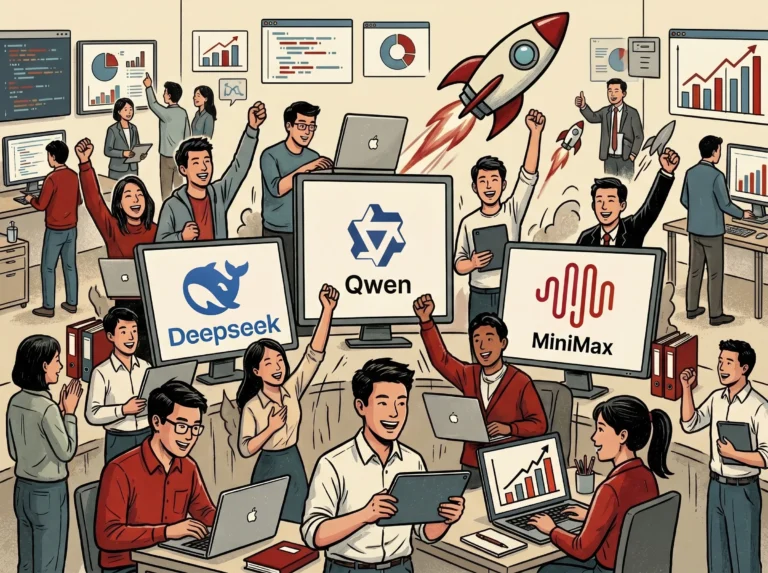
According to OpenRouter, a leading aggregator, major Chinese LLMs such as DeepSeek, Alibaba (Qwen), Moonshot (Kimi), MiniMax, etc, collectively captured a 36% market share of token volume in late April 2026, up from roughly 10% in early January.

Conversely, the combined share of major US hyperscalers dropped from 70% to 40% over the same period.

Source: OpenRouter, AP

Weekly token volume on OpenRouter has surged more than 3x in three months. Developers are running production workloads through Chinese models at scale.

Source: OpenRouter, AP

The mechanism is straightforward. Aggregators attract cost-sensitive developers and SMEs who use dynamic routing: simple, routine tasks go to the cheapest capable model; complex queries are reserved for premium US models.

Chinese LLMs have captured the bulk of that routine compute by delivering 80–90% of Western flagship performance at approximately 20% of the cost.

Source: OpenRouter, AP

The EV Playbook — and Its Second Chapter

This pricing strategy has a clear precedent.

Chinese electric vehicle manufacturers did not enter global markets by competing with BMW at the premium end. They commoditised good-enough transport: adequate range, functional design, accessible price. Volume followed. Then came the upmarket move — BYD now competes directly with European peers on performance, not just price.

Chinese AI is running the same sequence. Phase one is commoditisation of routine inference: capture the long tail of developer workloads that do not require frontier model capability. That phase is underway.

Phase two, moving upmarket into enterprise and application layers, is where the constraints currently exist.

Geopolitics and the Harness Barriers

Chinese LLMs face two barriers above the aggregator tier in the international market.

Compliance Wall: Western large enterprises hesitate to deploy Chinese LLMs due to compliance and data residency concerns. Chinese LLMs mitigate these concerns by making the model freely downloadable and allowing Western corporations to host it behind their firewalls.  In addition, enterprises in emerging markets such as Middle East, Southeast Asia could potentially face less friction compared with Europe and the US.

The Harness Gap: Success at the application and subscription tier depends not on model quality alone but on the surrounding architecture: the UI, safety guardrails, tool integrations, agent orchestration, and memory systems layered around the model.

For example, Claude Code outperforms a standard OpenClaw setup, even if OpenClaw uses the same underlying Claude model, due to the sophistication of Anthropic’s harness.

The same logic applies to NotebookLM, GitHub Copilot, and ChatGPT’s ecosystem. Western providers have years of harness investment embedded in products that Chinese developers have not yet matched.

QClaw is Tencent’s attempt to narrow that gap. Built on the OpenClaw framework, it adds enterprise security features, one-click installation, and pre-configured agent workflows for marketing automation, trip planning, and tax filing. Tencent is currently piloting it for overseas deployment. It is not yet near Claude Code or NotebookLM. It signals that the upmarket move is beginning.

The Blueprint Leak: Anthropic’s Harness Moat Got Mapped

In late March 2026, Anthropic accidentally published the entire 512,000-line source code of Claude Code. The exposure included proprietary multi-agent orchestration protocols, memory consolidation architecture, and tool-calling subsystems, key success factors of its flagship product.

Competitors can now study the design behind the most commercially successful agentic harness in the market, potentially levelling the playing field.

The Energy Edge

Previously, the AI supply constraint was related to training: GPU-heavy model development consumes massive compute. That constraint disadvantages Chinese developers through export controls on advanced Nvidia chips.

The workload is now shifting. As autonomous agent deployments scale, inference dominates total AI compute. Inference is a different problem, relying more on memory bandwidth, network latency, and power supply. That shift moves the battleground toward AI infrastructure capacity.

Source: Deloitte, AP

China’s power infrastructure is built for this. In 2025, China added an estimated 540 GW of new generation capacity, approximately 8.5 times total US additions. That surplus translates directly into continuous, low-cost power for inference data centres at scale.

US and European hyperscalers face the opposite dynamic: protracted grid interconnection queues, transformer shortages, and planning constraints that create meaningful lag between capital commitment and operational capacity.

This article is a “periodical publication” for information only and is not investment advice or a solicitation to buy or sell securities. This article does not constitute a “personal recommendation” or “investment advice” under UK FCA regulations. Investing in equities involves significant risk. The author holds NO position in the securities mentioned. There is no warranty as to completeness or correctness. Please do your own due diligence or consult a licensed financial adviser. Please read the Full Disclaimer before acting on any information. Images created with the assistance of Gemini AI.

Article provided by Asia Pulse.

ASA International Group: too cheap to ignore, shares at 213.50p on just 3.9 times earnings

 I got this stock wrong in early December 2024, when I estimated that its shares, then 70p, offered at least a 50% uplift in the short-term. 
The subsequent rise has seen them hit 248p in late February this year, up 354%, they drifted back to 176p a month later, on understandable short-term profit-taking. 
However, they are now on the up-tack again and look incredibly appealing. 
The First Quarter Trading Update issued yesterday by the ASA International Group (LON:ASAI) showed real strength, while highlighting just...

Aurora Innovation shares surge on 500 autonomous truck deal with Hirschbach

Aurora Innovation shares jumped in US-trading yesterday after announcing it has materially expanded its agreement with refrigerated freight specialist Hirschbach Motor Lines, with the carrier signalling its intent to put 500 Aurora AV trucks on the road.

The non-binding MOU sets out a path for deliveries to begin in 2027, with binding terms expected to land later this year.

“The Aurora Driver will provide consistent 24/7 service to our customers, making it an important growth lever for our business,” said Richard Stocking, CEO of Hirschbach Motor Lines.

“But autonomy isn’t just a business move – it’s a quality-of-life investment for our people. The Aurora Driver will handle the lengthier, less desirable routes, providing our drivers with greater flexibility. It’s a win-win.”

For Aurora, this means potentially hundreds of millions of dollars in multi-year revenue and around 500 million driverless miles, representing a step-change in commercial traction.

For the autonomous vehicle industry, the deal is a major step towards broader mainstream adoption, paving the way not only for Aurora’s continued expansion but also for the technology’s adoption across a variety of self-driving applications.

Hirschbach will subscribe to Aurora’s Driver as a Service model, under which the carrier owns the trucks while Aurora collects recurring revenue from the autonomy stack.

The 500 trucks will be deployed across high-volume Sun Belt corridors, with Aurora having recently extended driverless deliveries into Laredo, Texas in support of one of Hirschbach’s key customers.

Aurora Innovation, one of the UK Investor Magazine’s top stock picks for 2026, closed 15% higher yesterday.

Apple revenue beats expectations as iPhone sales impress

Apple shares rose in the pre-market after the iPhone maker announced strong quarterly results that beat analyst expectations, with iPhone sales propelling revenue higher.

Apple recorded quarterly revenue of $111.2 billion, up 17% compared to the same period a year ago. Analysts has predicted revenue of $109.66 billion.

Diluted earnings per share came in at $2.01, up 22%.

In recent years, sales of new iPhone releases haven’t been as strong as many investors would like to see, but the release of the 17 series has delivered this time around.

“iPhone achieved a March quarter revenue record, fueled by such extraordinary demand for the iPhone 17 lineup,” said Tim Cook, Apple’s CEO.

“During the quarter, Services achieved yet another all-time record, and we were excited to introduce remarkable new products to our strongest lineup ever. That included the addition of the iPhone 17e and the M4-powered iPad Air, along with the launch of MacBook Neo, which is captivating customers all around the world.”

While investors will be encouraged by recent iPhone sales, they may be more excited about what’s to come. For a plethora of reasons, Apple has fallen behind in the AI race. But this could all be about to change with Tim Cook’s departure and a new chapter for Apple that focuses more on AI.

“Apple’s long-awaited iPhone upgrade cycle is in full swing, and AI isn’t even part of the story yet,” said Matt Britzman, senior equity analyst, Hargreaves Lansdown.

“The headline numbers were strong, but the real message was in the guidance, which pointed to 14-17% revenue growth at the group level, against pre-results expectations closer to 9%, and even that comes with supply constraints clipping the wings a little.

“This is the power of Apple’s ecosystem in full view: even with an AI experience that has been more disappointment than differentiator, the brand still has enough pull to drag loyal consumers back into the upgrade cycle after years of stretching out their old devices.

“That brand power has bought Apple time, but loyalty won’t last forever, and the next leg of the story now rests on whether John Ternus can turn AI from a weak spot into a reason to go out and grab the latest devices.”

Mindflair makes investment in AI agent firm ManaMind

Mindflair has made a fresh investment in ManaMind, a London-based autonomous game testing company, via its stake in a fund managed by Sure Valley Ventures, with EWOR, Ascension, Syndicate Room and Heartfelt also participating.

Sure Valley Ventures led the US$1.5 million round, which will go on expanding the technical team, accelerating proprietary model development and pushing into new geographies.

ManaMind’s platform uses AI agents to play through games, flag bugs and generate actionable reports for studios — cutting the slog of repetitive manual QA, one of the more painful cost lines in modern game development.

Mindflair said early commercial traction is encouraging, with design partnerships already secured with mobile studio Included Games and hypercasual heavyweight Crazy Labs.

Nicholas Lee, Director of Mindflair plc, said: “ManaMind represents an interesting application of agentic AI in the global games industry, where quality assurance remains a significant cost and operational challenge for studios. By automating repetitive testing workflows, ManaMind has the potential to help development teams improve efficiency and game quality, and we are pleased to see SVV backing another ambitious AI business with clear commercial use cases.”

Power Metal Resources provides uranium project update

Power Metal Resources has announced a significant upgrade at its Perch River uranium project in Saskatchewan’s Athabasca Basin, which is held under its joint venture with Fermi Exploration.

Supplementary drill core sampling along the Rapids Fault Structure has confirmed the system is geochemically and mineralogically “fertile” for unconformity-related uranium deposits.

Power Metal believes recent samples indicate the project could host high-grade uranium.

The presence of sudoite, hydrothermal tourmaline and dolomite, combined with a 779 ppm boron hit in PR25-01 and anomalous radiogenic lead spread over a 400m strike, all point to a live hydrothermal system.

Fermi’s team believes last year’s drilling clipped only the distal, upper halo of the system, leaving the hydrothermal core and any uranium mineralisation it might host untested at depth.

ANT geophysics suggests the structure could extend more than a kilometre below the unconformity, with a secondary 4km fault to the west yet to see a drill bit.

CEO Sean Wade said the results “fundamentally upgrade” Perch River’s prospectivity, with the radiogenic lead acting as a direct vector toward potentially high-grade material at depth.

Beating earnings estimates and providing a solution to NHS waiting lists with One Health Group

UK Investor Magazine sits down with Adam Binns, CEO, and Derek Bickerstaff, Chairman, of AIM-listed One Health Group, the independent provider riding the NHS Patient Choice tailwind with 140 consultants across 40 locations.

FY26 delivered a 9% revenue beat at £32m, with EBITDA also ahead of consensus. Adam and Derek unpack where the upside came from, why consultations grew 20% while procedures grew 15%, and revenue 13%, and what that case-mix divergence means for the business going forward.

We dig into the demand backdrop as NHS waiting lists remain stubbornly high, the early contribution from the Urology specialism launched at the end of FY25, and what’s next on the speciality roadmap. Adam and Derek also walk us through the new Scunthorpe hub and whether this signals a wider rollout of the hub model.

We also look at why two of One Health’s largest commissioners have just shifted from one-year to five-year contracts and what that says about the visibility of future earnings.

The podcast ends with what One Health Group investors should be watching over the months ahead.

FTSE 100 jumps despite oil hitting $126, BoE keeps rates on hold

The FTSE 100 was higher on Thursday as US tech stocks led a global equity market rally that shrugged off oil prices hitting $126.

Investors also took the Federal Reserve and Bank of England interest rate decisions and accompanying commentary in their stride.

Both kept rates on hold and adopted a wait-and-see approach, which was enough to keep the bulls happy. As one would expect, the Bank of England warned of potential inflation risks, but only one member voted to hike rates now.

The FTSE 100 rose 1.3% shortly after the announcement.

Oil

Notably, global equities rose despite oil prices briefly exceeding $126, as developments in the Middle East took a turn for the worse.

“A fresh fire has been lit under oil prices, amid reports that attacks on Iran could resume,” said Susannah Streeter, Chief Investment Strategist, Wealth Club.

“The US military is understood to be preparing for a resumption of military action, dashing hopes of a lasting ceasefire and sending worries of a severe energy crunch surging. Brent crude hit a wartime high of $126 a barrel, before declining as uncertainty swirled.”

But the market has a knight in shining armour in US tech stocks, which helped lift the market. Investors were prepared to look through interest rate uncertainty and surging oil prices and focus on bumper earnings from tech giants and ongoing momentum in AI.

Alphabet shares were 7% higher, while Amazon rose 2% in the US premarket. For now, at least, this is proving enough to drive stocks higher.

Whether this lasts for the rest of the session remains to be seen.

FTSE 100 movers

Unilever was the standout FTSE 100 performer, surging 11%, as plans to invest in data centres and clean energy made a typically dull stock constrained by regulations and limited revenue growth seem relatively exciting.

“Plans for a massive flood of investment at water utility company United Utilities has created an unusual level of excitement for a part of the stock market historically seen as pretty boring,” Russ Mould said.

“The plan to support areas like data centres, clean energy and new homes is being taken as a game changer by investors for now, although delivering on this big programme of spending and remaining on time and on budget is the big challenge for the company.”

Whitbread shares were lower on Thursday after the group released a trading statement and a turnaround plan in response to activist shareholder pressure.

Shares fell around 3% as investors turned their noses up at mixed guidance and inflation risks.

“Whitbread’s shares have been trading strongly ahead of results, after the company’s five-year plan was leaked to the press earlier this week,” said Derren Nathan, head of equity research, Hargreaves Lansdown.

“Confirmation of that plan, a respectable increase in last year’s operational performance, and an encouraging start to the new financial year has been offset by a higher inflation steer and anaemic guidance for profitability in Germany.”

Persimmon shares rose 2.4% after releasing an upbeat trading statement that revealed an improvement in sales rates.

“Persimmon’s momentum continues to build in the early months of 2026, with a strong, all-round sales performance despite current market challenges,” said Aarin Chiekrie, equity analyst, Hargreaves Lansdown.

“Average weekly net private sales rates were up 3% over the first four months, and alongside an increase in average selling prices, top-line growth looks in good shape.”

AIM movers: IG Design recovery and ex-dividends

0

A positive trading statement by IG Design (LON: IGR) has led to upgrades for the year just ended and the current year. Ongoing gift wrap and stationery business is better than expected, although consumer confidence remains weak. In the year to March 2026, revenues were $292m, while the pre-tax profit estimate has been increased from $9.5m to $11.5m. This year’s pre-tax profit forecast has been raised from $12.3m to $14.3m, helped by an earnings enhancing acquisition in South Africa. Net cash is $72m before the £3.4m spent on the acquisition. The share price rebounded 22.3% to 68.5p.

Image Scan (LON: IGE) increased interim revenues from £350,000 to £1.32m and it returned to profit. Cash improved to £955,000. The order book is worth £1.27m. This means that there is a positive outlook for the second half, but the outcome for the x-ray scanning technology developer is dependent on the timing of the orders. The share price increased 21.9% to 1.95p.

Iodine producer Iofina (LON: IOF) reported better than expected figures for 2025. Revenues increased from $54.5m to $66.5m. Earnings jumped from 1.52 cents/share to 3.26 cents/share. A large plant will start production later this year leading to a big rise in production in 2027. More plants are in the pipeline. X-ray demand for iodine is keeping the price high and Canaccord is anticipating it staying above $70/tonne. This year earnings could reach 3.9 cents/share, and the 2027 figure has been upgraded to 6.3 cents/share. The share price gained 15.4% to 37.5p.

Empyrean Energy (LON: EME) says the operator of the Mako gas project has issued letters of award totalling more than $280m, which is more than four-fifths of the capital costs. First gas should be in the fourth quarter of 2027. The share price rose 13.6% to 0.0625p.

FALLERS

Celsius Resources (LON: CLA) continues to make progress with the Maalinao-Caigutan-Biyog Copper-Gold project and the development of the mine and process plant, which is out for tender. Equinaire Holdings says it acquired the loan held by Makilala Mining Company in order to become involved in offtake arrangements. The share price dipped 13.2% to 0.46p.

Property technology company Built Cybernetics (LON: BUC) moved into profit in 2025-26 and smart buildings revenues exceed architecture revenues for the first time. However, the master systems integrator business has been hit by poor demand, and the group could fall back into loss this year. Built Cybernetics has raised £570,000 at 1.5p/share. The share price declined 10.5% to 1.7p.

Atlantic Lithium (LON: ALL) had cash of A$13.9m at the end of March 2026 and this is enough to take it to the final investment decision on the Ewoyaa lithium project. A possible alternative development pathway has been proposed for the project. There are discussions with joint venture partner Elevra Lithium about amending the structure of the joint venture. Elevra currently has to contribute the majority of upfront capex. Canaccord Genuity assumes that construction approval will be received by the end of the year. The share price fell 10.2% to 14.55p.

Chesterfield Special Cylinders (LON: CSC) says interim revenues should improve from £5.4m to £6.4m and the loss should reduce. However, some UK naval work has been delayed until 2026-27. UK hydrogen related demand will also be delayed until next year. That means that full year revenues will be flat and the loss will be similar to the year before. The share price slipped 9.62% to 47p.

Ex-dividends

AB Dynamics (LON: ABDP) is paying an interim dividend of 3.08p/share and the share price slipped 13p to 978p.

Churchill China (LON: CHH) is paying a final dividend of 14p/share and the share price declined 31p to 335p.

Nexteq (LON: NXQ) is paying a final dividend of 3.9p/share and the share price fell 1.5p to 67.5p.

Synectics (LON: SNX) is paying a final dividend of 2.8p/share and the share price decreased 2.5p to 202.5p.

Persimmon shares rise on upbeat trading statement

Persimmon has reported a solid start to 2026, with private forward sales up 7% to £1.80bn and an improved sales rate carrying momentum from a strong 2025 into the new year.

After a string of disappointing housebuilder updates in recent week, expectations would have been low going into Persimmon’s update. But shareholders have been pleasantly surprised.

Net private sales per outlet per week rose 3% to 0.76 (or 0.67 excluding bulk sales), while average outlets nudged up 2% to 273 as the housebuilder pushes towards its target of operating from at least 300.

Total forward sales, including year-to-date legal completions, climbed 5% to £2.46bn, with the private average selling price up 5% to around £306,900 and total incentives holding steady at 4-5%.

Chief Executive Dean Finch said the business had started the year well, supported by an improved private sales rate and rising prices.

The conflict in Iran has not had any material impact on trading to date, although management is keeping a close eye on consumer confidence and there are early signs of supply chain inflation, particularly from higher energy costs, which are likely to feed through in H2 2026 and into 2027.

Mark Crouch, market analyst for eToro, says: “Persimmon’s update suggests a housing market that, for now, is holding firm, but the bigger picture for UK housebuilders is rapidly darkening. Persimmon’s numbers look solid enough, forward sales up, pricing holding firm, and volumes broadly in line with expectations.”

“But scratch beneath the surface, and storm clouds are gathering quickly. The war in Iran has sent energy prices sharply higher, feeding directly into inflation and pushing mortgage rates back up just as hopes of rate cuts were building. When it rains, it pours, and housebuilders sit squarely in the crosshairs of rising costs and weakening affordability.”

Persimmon shares were 2% higher at the time of writing on Thursday.