NextEnergy Solar Fund reconfirms its dividend prowess in full-year results

NextEnergy Solar Fund (NESF) has reaffirmed its prowess as an FTSE 350 dividend-paying powerhouse after releasing 2024 full-year results.

The solar energy-focused Investment Trust increased total dividends by 11% for the twelve months ended 31 March 2024, distributing dividends of 8.35 pence per share compared to 7.52 pence in the prior year period.

NESF has a reliable dividend yield of around 10%, which is covered 1.3x, suggesting little risk to payouts in the medium term. NESF is targeting 1.1x – 1.3x cover for the year ending 31 March 2025.

The increased dividend payout was supported by the expansion of installed capacity, which breached 1GW to stand at 1,015MW at the end of the period.

In addition, NESF has launched innovative initiatives to manage its capital, such as a capital recycling programme involving the sale of assets – one of which provided a 100% premium to its holding value.

“Over the year, NESF accomplished several impressive milestones,” said Michael Bonte-Friedheim, CEO & Founder of NextEnergy Group.

“These included the energisation of four new assets totalling 345MW, reaching over 1GW of net operating capacity, paying a fully covered full-year dividend of 8.35p per ordinary share, and achieving excellent returns for shareholders from our phased Capital Recycling Programme which has delivered significant value. With the recent announcement of an increase in dividend target to 8.43p, NESF is currently offering a dividend yield of approximately 11%, which stands as one of the highest in the sector and FTSE 350.

“NESF has been a key contributor to the UK’s progress towards its Net Zero targets to date and is well positioned to continue to be in the future.  The majority of NESF’s operating assets are located across the UK and have been essential in increasing domestic renewable energy generation and helping strengthen the UK’s energy security and independence.” 

NESF Net Asset Value

NextEnergy Solar Fund’s net asset value per ordinary share stood at 104.7 pence as of 31 March 2024, a decrease from 114.3 pence as of 31 March 2023. The ordinary shareholders’ net asset value was £618.6 million, down from £674.4 million at the end of the previous fiscal year.

The reduction in NAV was mostly due to lower energy price forecasts and a higher valuation discount rate. Should interest rates fall, discount rates would likely follow suit, providing a boost to NAV, although this is not a foregone conclusion given the relationship between discount rates and underlying base rates has a degree of variability from company to company.

Despite a lower NAV, the income generated by NESF increased slightly to approximately £80 million compared to around £79 million in the prior year period.

Increased income further demonstrates the opportunity in the trust’s share price, currently trading at a circa 27% discount to the NESF’s NAV.

UK inflation hits Bank of England target, but don’t expect a rate cut tomorrow 

After nearly three years above the Bank of England’s 2% target, UK CPI fell to 2% in May as food prices fall.

Rishi Sunak is, of course, claiming credit for the drop in inflation. However, in reality, inflation dropping back to 2% was always going to happen, and prices are still far higher than they used to be.

The inflation rate falling back to the BoE’s target will do little to boost his standing with voters, as the prices of some everyday items are still 30%—50% higher than they were three years ago. Prices are falling but from a very high level.

“Food prices actually fell in May, with the price of essentials like bread, cereals, vegetables and even chocolate dropping,” said Laura Suter, director of personal finance at AJ Bell.

“This month’s fall compares to a chunky rise in food costs a year ago, which helped to pull the inflation rate back down. However, we’re still paying more for food and drink than we were a year ago – and the overall food basket is still much more expensive than at the start of the cost of living crisis.”

The general sluggish environment for UK growth would also have helped temper inflation – although this isn’t the ideal remedy and has done Conservatives more harm than good.

From the markets perspective, and implication’s for tomorrow’s BoE rate decision, today’s inflation reading was a bit of a non event. 

The FTSE 100 fell and bond yields barely budged. The pound spiked against the dollar as traders reacted to the low chance of a rate cut tomorrow.

“Inflation hitting target means many will be expecting a cut to interest rates at the Bank’s meeting tomorrow. However, it would be very unlikely for the ratesetters to cut interest rates during an election campaign. The future path for inflation – and so rates – will be impacted by whoever becomes prime minister and how their fiscal policy shapes up. It’s highly likely the Bank will want to wait to see the outcome of the election and the final economic plans before making that first cut,” Suter said.

“With no meeting in July, that means all eyes are now firmly on the August MPC meeting for our first potential cut to rates.” 

Ratesetters will likely already have made up their minds on how they will vote and one month of inflation back at target doesn’t mean we are completely out of the woods. The Bank of England doesn’t want to risk cutting rates too early and will want to see inflation stabilise at current levels before acting.

That said, a rate cut at teh August meeting is now very much on the cards. 

Vertu Motors – Ahead Of Next Tuesday’s AGM The Shares Of The UK’s Fourth Largest Motor Retail Group Could Be Moving Higher

Vertu Motors (LON:VTU) was established in November 2006 with the strategy to consolidate the UK motor retail sector – effectively it was a ‘Buy-To-Build’ vehicle.

A senior management team, with a wealth of experience within the sector, was put in place and on 27th March 2007 the company acquired Bristol Street Motors, the 13th largest motor retailer in the UK.

Its subsequent acquisition strategy has been supplemented by focused organic growth driving operational efficiencies through its expanding national dealership network.

Today Vertu Motors is the fourth largest automotive retailer in the UK, with a network of 184 franchised sales outlets and 4 non-franchised sales operations from 143 locations across the UK.

The Group’s Brands And Its Dealerships

Its dealerships operate predominantly under the Bristol Street Motors, Vertu and Macklin Motors brand names.

Manufacturer partners are Audi, BMW, Citroen, CUPRA, Dacia, Ferrari, Ford, Honda, Hyundai, Jaguar, Kia, Land Rover, LEVC, Mazda, Mercedes-Benz, Mercedes-AMG, MG, MINI, Nissan, Peugeot, Renault, SEAT, SKODA, smart, Toyota, Vauxhall, Volkswagen and Volvo.

Its non-franchised operations include Vansdirect, Ace Parts, Powerbulbs and The Taxi Centre.

Ongoing Growth Strategy

It is intended that the group will continue to acquire motor retail operations to grow a scaled dealership group.

Its acquisition strategy is supplemented by a focused organic growth strategy to drive operational efficiencies through its national dealership network.

Management Comment

Commenting on the mid-May announced results CEO Robert Forrester stated that:

”It was pleasing to see the Group successfully navigating a difficult period of trading with declining used car values in the last few months of 2023. 

Used vehicle prices and margins have now stabilised and there has been strong cash generation from lower working capital reducing net debt below market expectations.

During the year, record revenues of £4.72 billion were achieved.

Moving to the new financial year, March and April 2024 were successful months. 

The Group delivered new retail like-for-like sales volumes ahead of the market decline in March and April. 

This demonstrates the robustness and strength of the Group’s operations.”

The Equity

There are some 337.6m shares in issue.

The larger holders include TDR Capital (9.76%), FIL Investment Advisors (5.22%), Janus Henderson Investors (5.05%), Santander Asset Management (4.22%), Nivag Holdings (4.10%), Close Asset Management (4.02%), Robert Forrester, Founder, (2.22%), William Dobie (2.09%), Norges Bank Investment Management (2.04%) and Ennismore Fund Management (1.40%).

In the middle of last month the group announced that is has agreed a new £3m share buyback programme, for up to 30m shares, all repurchased will be for cancellation.

Analyst View

Ian Robertson at Progressive Research considers that the group, in the last trading year to end February 2024, delivered a strong performance against a difficult market.

He noted that the current year had started well with trading ahead of management expectations for the first two months.

His estimates for the current year to end February 2025 are for sales of £4.97bn (£4.72bn), adjusted pre-tax profits of £42.2m (£37.1m), with earnings of 8.66p (7.8p) per share.

My View

Ahead of next Tuesday’s AGM I would expect the group to announce a Trading Update, which hopefully could show a continuation of the trend set in the first two months.

The shares, now at just 78.50p, have always been undervalued when set against the £255m capitalised group’s business.

They are not expensive, and I would expect to see them trading back over the recent 88p High scored last November, with 90p to 95p being a challenging price aim.

Fresh guidance from the company next Tuesday could well help the upwards move.

Games Workshop profits grow as momentum builds.

Games Workshop has reported robust growth in sales and profits for the 53 weeks ended 2nd June 2024.

It was another year of growth for investors, who have now enjoyed top-line growth in every year since 2017.

The table-top gaming miniatures company estimates its core revenue reached at least £490 million, an increase of £45 million or over 10% compared to £445 million the previous year.

Licensing income also improved, rising £5 million to £30 million and investors will look forward to developments in the recently announced licensing agreement with Amazon.

The firm’s pre-tax profits are projected to be no less than £200 million, reflecting a £29 million or 17% increase from the £171 million recorded in 2022/23. Contributing to the profit growth, the group paid out £18 million in equal cash bonuses to staff during the year to recognise their contribution, up £7 million on the prior year’s £11 million profit share.

Shareholders likewise benefited from the enhanced profitability. Dividends declared and paid rose to £138 million or 420 pence per share, compared to £136 million at 415 pence per share last year.

Games Workshop intends to publish its full Annual Report for the 2024 financial year on 30th July 2024.

Trading Strategies, Algo Trading, and Introducing New Technology with Interactive Brokers’ Gerry Perez

The UK Investor Magazine was delighted to be joined by Gerry Perez, CEO of Interactive Brokers UK.

This podcast explores Interactive Brokers, a pioneering online trading platform that has been operating for over four decades.

Despite its long history, Interactive Brokers is considered a financial technology (fintech) company due to its innovative trading tools and technologies aimed at increasing returns for investors.

The episode delves into Interactive Brokers’ algorithmic trading capabilities, examining whether expertise in coding is necessary to utilise these automated trading strategies. The discussion also addresses whether automation can effectively substitute for human decision-making during periods of market volatility.

FTSE 100 bounces back with European stocks

The FTSE 100 gained on Tuesday amid a broad recovery in the European shares after the announcement of a French snap election last week rocked equity markets.

London’s flagship index was 0.45% higher at the time of writing while the French CAC gained 0.4%.

“European markets enjoyed a strong start to Tuesday, with the FTSE 100 the biggest gainer among the continent’s key equity indices,” said Russ Mould, investment director at AJ Bell.

However, the chipper mood in stocks was capped by a series of significant events later in the week. Just as the US digested CPI and an interest rate decision within a tight time frame last year, UK investors will learn of the most recent CPI reading tomorrow before Thursday’s Bank of England’s interest rate decision.

“Attention then shifts back to the UK, with consumer price index data due on Wednesday, ahead of the Bank of England’s decision on Thursday, where rates are expected to remain unmoved,” said Guy Lawson-Johns, equity analyst, Hargreaves Lansdown.

As with the Federal Reserve last week, the main interest in the Bank of England’s rate decision will not be the decision itself but the accompanying commentary and subsequent press conference.

Tomorrow’s CPI reading could make the BoE’s job particularly tricky, especially if it comes in hotter than expected.

Despite the potential risks later in the week, the FTSE 100 gained on Tuesday with a distinct risk-on tone, with all the focus on a rebound in European stocks.

Whitbread was the top gainer after reporting strong growth in its German unit. UK sales could have been better, but shares rose over 3% on Tuesday. Ashtead was firmly at the bottom of the index after the plant hire group revealed the impact of higher interest rates on profits.

“US-focused plant hire firm Ashtead’s markets are slowing. Hot on the heels of news that it may be looking to move its main listing to the US, this was a slightly soft set of results,” said Matt Britzman, equity analyst, Hargreaves Lansdown.

“Whether you look at revenue, profit, or guidance, it’s hard to see much for markets to get excited about here. Management would be forgiven for giving slightly conservative guidance for the coming year after several disappointments of late, and it looks like that’s the case.”

Whitbread shares rise as German growth offsets soft UK trading

Whitbread shares booked a spot at the top of the FTSE 100’s leaderboard on Tuesday as the hotels group’s expansion into Germany builds momentum.

Growth in Germany helped offset weakness in the UK as the group’s expansion of hotel rooms in Germany was met by robust demand. UK accommodation like-for-like sales were down 2% in the first quarter while Germany steamed ahead with a 6% jump in sales.

German total sales growth was 15% and the UK was dead flat. 

The group expects its German operation to break even this year as it progresses towards a target of 10–14% return on capital. 

It’s fitting Whitbread released its Q1 results in the middle of the Euros football championship because the influx of fans to Germany is likely to play a part in Whitbread’s German operations achieving breakeven.

Investors were evidently pleased with the news and shares were 2.2% higher at the time of writing and the FTSE 100’s top riser.

“Following a sluggish start to the year, Premier Inn owner Whitbread has pulled things back and managed to deliver first quarter revenue just ahead the same period last. But there are some signs of softness in it’s UK hotels,” said Derren Nathan, head of equity research, Hargreaves Lansdown.

“After stripping out new room openings, UK accommodation sales were down 2%, with customers appearing to pull back on last-minute weekend breaks. Both occupancy and room rates have slipped a little, more noticeably in London. This isn’t hugely concerning though, as Whitbread is up against some very strong comparatives and continues to outperform the market. In the younger German accommodation division, growth is much stronger and remains on track to cross the break-even threshold later in the year. Euro 2024 is likely to provide something of a boost in this market too.”

AIM movers: Crossword Cybersecurity distribution deal and Surface Transform impairment

1

Crossword Cybersecurity (LON: CCS) has signed a partnership to jointly market its Rizikon supply chain cyber platform. The deal is with a UK subsidiary of a global aerospace and security company. The focus is sub-sectors within the UK critical national infrastructure market. There is potential to generate several million pounds over the next few years. The share price jumped 64.6% to 6.75p

Supercapacitors developer Cap-XX (LON: CPX) has appointed former ITM Power boss Dr Graham Cooley, Peter Fraser and Anthony Sive as non-executive directors. They have each been granted 10 million options exercisable at 0.08p/share. There will be a capital markets update alongside the publication of the results for the year to June 2024. The share price increased 40.5% to 0.111p.

Shares in Oil and gas projects developer Longboat Energy (LON: LBE) continue to rise following news it is selling its assets in Norway for $2.5m and the assumption of $8,5m of debt by the acquirer. This should save $1.25m in costs in 2025. The cash will be invested in the main asset, which is the 52.5% owned Kertang gas prospect, offshore Sarawak. A farm out process will be conducted in the second half of 2024. An updated competent person report is due at the end of the month. The share price recovered a further 35.4% to 16.25p.

Premier African Minerals (LON: PREM) is awaiting delivery of the conditioning tank and it should be commissioned by the middle of July. This should be the last modification of the processing plant at the Zulu lithium and tantalum. Water access has been arranged. Lower grade concentrates will be sold on an ex-mine gate basis. This will provide a small amount of cash flow. The share price improved 9.76% to 0.1125p.

FALLERS

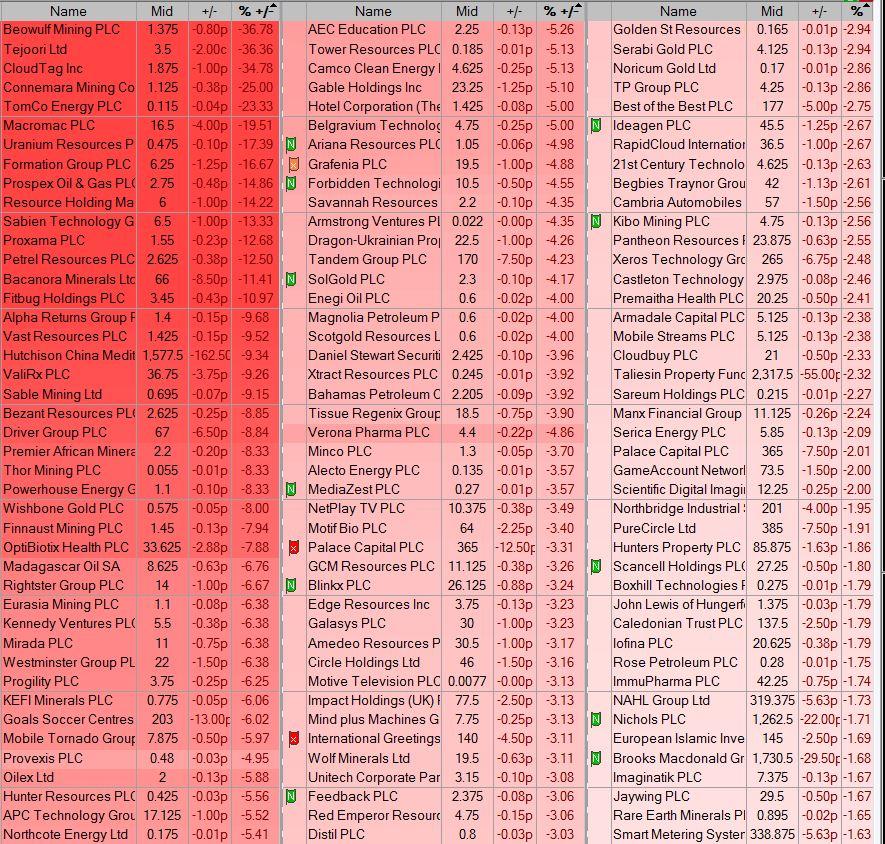
Slater Investments continues to reduce its stake in R&Q Insurance Holdings (LON: RQIH), which is trying to sell its Accredited business and is in financial difficulties. The stake has been more than halved from 11.7% to 5.64% over the past week. The share price fell by one-fifth to 0.08p.

Surface Transforms (LON: SCE) expects the 2023 audit to be completed in time to publish accounts before the end of June. The ceramic brake technology developer says that the delay relates to revenue recognition policy for development revenues and the policy is being changed to recognition when system integration is completed, which will reduce 2023 revenues by £1m. An impairment review of tangible and intangible is set to lead to a £3m charge. The share price declined 18.1% to 1.7p.

Oxford BioDynamics (LON: OBD) reported interim revenues of £327,000 from its diagnostic tests. It is still early days for the EpiSwitch PSE test in the US and sales are starting to build up following the receipt of the reimbursement code. Cash fell to £1.2m at the end of March 2024. The £9.9m fundraising cash was not received until after the end of March. That fundraising was at 9p, while the share price slipped 13.4% to 6.36p.

Xtract Resources (LON: XTR) says a review of pre-concentration options at the Bushranger copper project in New South Wales recommends further test work on pre-screening, gravity separation and coarse particle flotation. This project becomes profitable at a copper price above $10,000/tonne. Financial plans will be reassessed after the tests. The share price decreased 12.2% to 0.9p.

Premier African Minerals – With Its Finals Due Next Week Company Issues News on Its Undervalued Zulu Lithium Project

Ahead of announcing its Annual Results on Friday of next week, 28th June, Premier African Minerals (LON:PREM), the multi-commodity mining and natural resource development company focused on Southern Africa with its RHA Tungsten and Zulu Lithium projects in Zimbabwe, has this morning issued an Update on its Zulu Project.

The conditioning tank delivery and commissioning remains on track for completion during the week commencing 10th July, while the sale of concentrates on hand is now expected to proceed on an ex-mine gate basis.

CEO George Roach stated that:

“Premier sincerely hope the conditioning tank will be the last plant modification and on that note, the Board remains confident regarding the prospects for Zulu and we note that at this time the development of Zulu, a complete mine, has cost the Company the better part of US$75 million, and neither this nor the deemed valuation of Zulu agreed with our take-off partner is reflected in our current market capitalisation.”

PREM has a diverse portfolio of projects, which include tungsten, rare earth elements, lithium and tantalum in Zimbabwe and lithium and gold in Mozambique, encompassing brownfield projects with near-term production potential to grass-roots exploration.

The £33m capitalised group’s shares were up 7.3% at 0.1100p on the news.

Ashtead shares fall as higher interest rates erode profits

Ashtead shares fell on Tuesday after the group announced falling sales growth rates and diminishing profits.

The company was considered a growth powerhouse for many years due to its remarkable ability to shake off any economic constraints. This no longer seems to be the case and interest rates are partly to blame. 

Ashtead released results on Tuesday confirmed a prior slowdown in its core US business was not a blip. 

Fourth quarter sales growth slipped to 7%. Growth is still growth but the real concern for investors will be declining profit before tax over the full year period. Profit before tax fell to $2,230m in 2024 from 2,273m in 2023.

Higher interest rates were blamed for rising costs with financing expenses rising by around a third. Margins across all geographies were squeezed as a result. 

“Ashtead’s markets are slowing. Hot off the heels of news that it may be looking to move its main listing to the US, this was a slightly soft set of results,” said Matt Britzman, equity analyst, Hargreaves Lansdown.

“Whether you look at revenue, profit, or guidance, it’s hard to see much for markets to get excited about here. Management would be forgiven for giving slightly conservative guidance for the coming year after several disappointments of late, and it looks like that’s the case.

“But rental giant Ashtead is still demonstrating its strength, just in a softer market. The larger construction equipment players are taking market share, and that plays right into Ashtead’s hands. Mega-projects in the US will continue to act as a medium-term tailwind, and it was positive to see rental rates showing strength in the final quarter. This had been an area of concern going into the results. Longer term, the US rental market is fragmented and there’s a growing appreciation from end-users as to the benefits of rental over ownership.”