FTSE 100 closes in on record as UK GDP expands

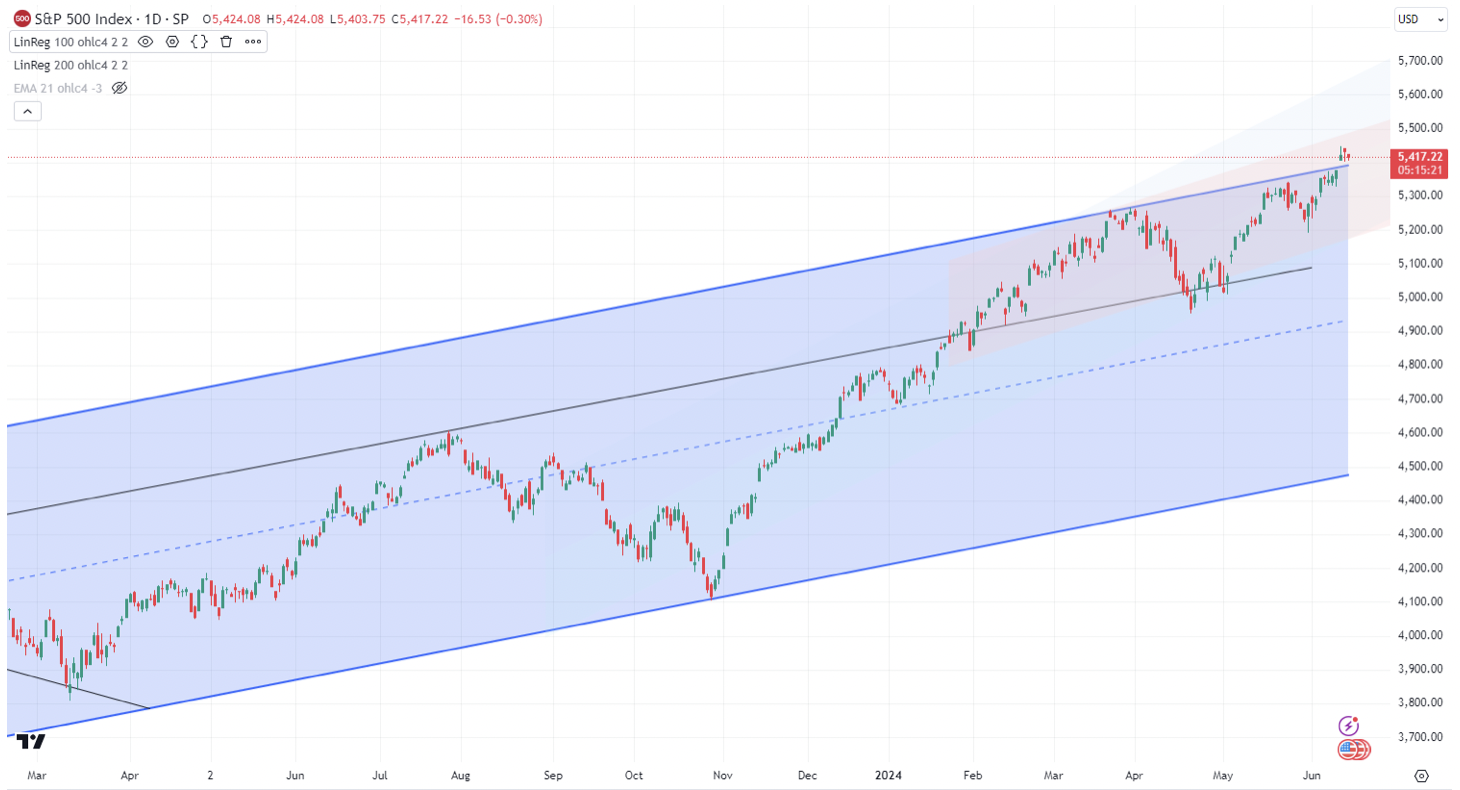
The FTSE 100 was closing in on a record closing high on Friday as the index smashed through 8,000 and continued past the record closing price in early trade.

The index did ease off as the session progressed and fell back below record levels.

“With the FTSE 100 breaking past the 8,000 level – and at 8,039 points at the time of writing – the blue-chip index is honing-in on a record high if it can hang on to those gains by the end of the day,” said Jason Hollands, Managing Director of Bestinvest

“Some positive headlines for the UK equity market will certainly be welcome news given it has been somewhat unloved in recent times and endured a raft of negative stories about investor outflows and companies switching their listings overseas.”

The FTSE 100 rose on Friday as traders digested the news that the UK economy grew 0.1% in February and looked set to exit recession. As FTSE 100 companies largely earn there revenues overseas, the move was a matter of improved sentiment rather than a more upbeat outlook for earnings.

“Gross domestic product rose 0.1% between January and February, which was in-line with expectations and thanks to growth in manufacturing, especially in utilities. These figures mean the UK economy is likely to have expanded in the first quarter overall, marking an end to recession,” said Sophie Lund-Yates, lead equity analyst, Hargreaves Lansdown.

“With that said, the levels of growth being displayed aren’t very inspiring, particularly for our large services industry. Falls in construction activity also indicate a broader malaise the UK is yet to shake off.”

Mining companies were among the top gainers as the inflation trade continued to support commodity stocks.

Oil majors Shell and BP enjoyed higher oil prices with BP among the best performers.

However, higher oil prices does no favours for airline profitability and easyJet and IAG sank as a result. EasyJet was down around 5% at the time of writing.

AIM movers: CleanTech Lithium boss resigns and R&Q slumps into loss

2

Significant share buying of Ovoca Bio (LON: OVB) early in the morning pushed up the share price from its low. Selling meant that the share price slipped back but it is still 36.4% higher at 0.75p.

CleanTech Lithium (LON: CTL) chief executive Aldo Boitano has resigned, although he will be a consultant, and Steve Kesler has taken over on an interim basis. This follows the revelation he entered into a loan agreement with his shareholding in the company as security in August 2023, but this was not revealed at the time. He transferred his 9.4 million shares to a custodian account nominated by the lender. It is unclear if any of the shares have been sold. The share price increased 20.9% to 13.5p.

Dr Graham Cooley has increased his stake in Distil (LON: DIS) from 7.07% to 8.18%. Yesterday, the spirits brands owner revealed that fourth quarter volumes declined by 47% and revenues were 23% down. The share price improved 18.2% to 0.65p.

Redx Pharma (LON: REDX) chief executive Lisa Anson bought 399,000 shares at 7.5p each, taking her stake to 562,183 shares. The general meeting to gain shareholder approval to leave AIM will be held on 19 April. The share price recovered 3.33% to 7.75p.

FALLERS

Bermuda-based R&Q Insurance Holdings (LON: RQIH) will make a significant loss this year. It is selling its joint venture to its partner Obra Capital. This will raise $27m in cash and Obra will give up $3m of preference shares in Randall & Quilter PS Holdings Inc. The disposal of the Accredited business should be completed by the summer. The share price slumped 45.5% to 2.995p.

Coal miner Bens Creek (LON: BEN) is laying off workers at its mine in West Verginia, which will be operated on a care and maintenance basis. There are 44 employees being laid off and that is described as “a substantial number” of the employees at the mine. Management is in discussions with largest shareholder and offtake partner Avani Resources to provide further finance. The hare price fell 32.4% to a new low of 0.575p.

Technology investment company Tern (LON: TERN) raised £420,000 at 2.4p/share. Tern is exercising warrants in Wyld Networks. The share price declined 21.7% to 2.7p.

Premier African Minerals (LON: PREM) has raised a further £1m at 0.17p/share. Two previous fundraisings this year have raised £4.5m. This will help to finance the Zulu lithium and tantalum project in Zimbabwe. The share price slipped 4.15% to 0.185p.

Wealth management company Team (LON: TEAM) raised £136,000 at 20p/share in its retail offer. The total raised is £1.25m. This will fund acquisitions and deferred consideration. The share price is 3.75% lower at 19.25p.

UK house prices: Three key data points for the property market

There have been early signs of improvement in UK housing market activity, but a step down in average house prices has kept any enthusiasm in check.

“The housing market right now is as reliable as the spring weather. You might set out with expectations of sunny skies, and walk straight into a rain storm,” said Sarah Coles, head of personal finance, Hargreaves Lansdown.

In this article, we examine three key UK housing market data points and assess the outlook for the property market.

March 2024 RICS UK Residential Survey

The March 2024 RICS UK Residential Survey had some tangible sources of optimism. The survey of Chartered Surveyors found a net 8% increase in buyer enquiries, up from 4% increase in the last month.

However, this is yet to filter through into sales with net sales down 5%.

“Overall, there are some real positives. More upbeat sentiment and expectations of rate cuts are persuading buyers and sellers back to the market in increasing numbers. They’re not yet rushing to agree sales or push prices up, but agents are confident that this is on the way once the weather cheers up and mortgage rates fall,” said Sarah Coles, head of personal finance, Hargreaves Lansdown.

“There are some negatives too. Agents across the country say that while buyers are back, demand is fragile, buyers are prone to changing their mind, and chains are still collapsing. Others say that the resurgence of supply means overpriced properties aren’t selling, and that buyers are driving a hard bargain.”

Bank of England Credit Conditions

The UK housing market has been remarkably resilient in the face of economic pressures. However, Bank of England’s latest Credit Conditions Survey paints a mixed picture, says Aaron Milburn, UK Managing Director at credit intelligence provider Pepper Advantage.

The bank’s survey of lenders found that default rates for mortgages and credit cards are up and are expected to rise further in the coming months.

“The continued boost to mortgage approvals is a cause for optimism; however, underlying pressures driven by stubborn inflation remain and are prolonging uncertainty, with mortgage default rates increasing. While some negative indicators appear to be plateauing, budgetary stress on borrowers remains high and is not necessarily spread evenly across regions and demographics, with some feeling debt pressures more strongly than others,” Aaron Milburn said.

“Though borrowing demand may be increasing, lenders will proceed cautiously. Some areas of the economy, such as services inflation, are still running hot – raising the prospects of higher rates for longer and extending the financial pressure on borrowers.”

Halifax House Price Index March

The Halifax House Price Index showed a respectable increase in the average UK house price over the last quarter, but there were signs of a wobble with a 1% drop in March month-on-month

“UK house prices grew in March on a quarterly basis, by +2.0%, with annual growth slowing to +0.3%, from 1.6% in February. Compared to last month, the price of a UK property fell -1.0% or £2,908 in cash terms, with the average property now costing £288,430,” said Kim Kinnaird, Director, Halifax Mortgages.

“That a monthly fall should occur following five consecutive months of growth is not entirely unexpected particularly in view of the reset the market has been going through since interest rates began to rise sharply in 2022. Despite this house prices have shown surprising resilience in the face of significantly higher borrowing costs.”

“Affordability constraints continue to be a challenge for prospective buyers, while existing homeowners on cheaper fixed-term deals are yet to feel the full effect of higher interest rates. This means the housing market is still to fully adjust, with sellers likely to be pricing their properties accordingly.”

Like the Nationwide average house price methodology, Halifax’s data has limitations, and it is important to look for trends across all indicators for a clear picture.

ISA investors shun UK stocks and equity funds during ISA season – AJ Bell

New data released by AJ Bell reveals the investment platform’s ISA investors shunned individual UK stocks and UK-focused funds and trusts during the busy ISA period starting 1st January 2024 and running to 5th April 2024.

Breaking down investor activity in funds and individual stocks, AJ Bell found ISA investors had a preference for global equity funds and US stocks enjoyed the biggest inflows.

The popularity of overseas funds is unsurprisingly given the strength of overseas indices in early 2024, but Laith Khalaf, head of investment analysis at AJ Bell, warned Jeremy Hunt’s new British ISA could face difficulties if current trends persist.

“Judging by the most popular investments with ISA investors so far in 2024, it looks like Jeremy Hunt is going to have to rely on individual stock investors to do the heavy lifting when it comes to the UK ISA. Fund and trust investors are still very much going global with their ISA money in search of superior returns,” said Laith Khalaf, head of investment analysis at AJ Bell.

“None of the twenty most popular funds and trusts chosen by ISA investors so far in 2024 appear to be eligible for the UK ISA, based on the rules currently proposed by the Treasury.”

Khalaf noted a grey area around Investment Trusts and the British ISA, which one would hope is clarified given the discounts some Investment Trusts trade at currently.

“There is however some confusion over whether investment trusts will be included, even those that invest overseas, on the basis they are themselves listed UK companies,” Khalaf said.

“Likewise, presumably the government would look favourably on allowing Greencoat UK Wind into the UK ISA, seeing as the trust invests in a portfolio of UK wind farms. As things stand though, the Treasury proposals for eligible investments only cover UK shares and bonds, and the funds and trusts that hold them.”

Most popular funds and trusts with ISA investors

FundsTrusts
FIDELITY INDEX WORLDJ P MORGAN GLOBAL GROWTH & INCOME
VANGUARD S&P 500 ETFALLIANCE TRUST
ISHARES S&P 500 ETFPERSHING SQUARE HOLDINGS
L & G GLOBAL TECHNOLOGY INDEXPOLAR CAPITAL TECHNOLOGY
HSBC FTSE ALL WORLD INDEXASHOKA INDIA EQUITY
VANGUARD LIFESTRATEGYGREENCOAT UK WIND
VANGUARD FTSE ALL WORLD ETFBRUNNER INVESTMENT TRUST
ROYAL LONDON SHORT TERM MONEY MARKETFIDELITY EUROPEAN TRUST
JUPITER INDIAAVI GLOBAL TRUST
VANGUARD FTSE GLOBAL ALL CAP INDEXJ P MORGAN AMERICAN

Source: AJ Bell, net flows from DIY investors in ISAs from 1 January 2024 to 5 April 2024 excluding AJ Bell funds.

Compounding the problem for the British ISA, individual stock investors also choose to look beyond London’s markets for a large proportion of their cash during the ISA season.

“Stocks that provide exposure to the US market and offer ways to play the artificial intelligence theme have been among the most popular choices for AJ Bell customers investing in an ISA between the start of January and the end of the tax year on 5 April. With some of the best gains in recent years having come from US shares, it’s no wonder investors have fished for opportunities across the pond,” said Dan Coatsworth, investment analyst at AJ Bell.

“Four out of the top 10 most popular stocks for AJ Bell ISA transactions by net flows are listed in the US. At the top is chips giant Nvidia which has delivered stellar share price gains since early 2023.”

The most popular stocks among AJ Bell ISA customers this year
By net flowsBy net buys
NvidiaBP
SamsaraNvidia
MicrosoftVodafone
PhoenixTesla
CleanSparkNational Grid
M&GBT
Legal & GeneralL&G
HSBCShell
ReckittGSK
BTHelium One
Source: AJ Bell. Data 1 January to 5 April 2024.

While AJ Bell’s data is bad news for the British ISA, it does demonstrate UK investors’ prudent approach to investment by making savvy picks in some of the world’s best-performing shares.

“Successful investing is often about looking for opportunities away from the mainstream and one multi-billion-dollar stock has attracted quite a bit of interest from AJ Bell customers despite being relatively unknown in the UK,” said Dan Coatsworth, investment analyst at AJ Bell.

“Samsara has been a hit with people investing in their ISA this year, perhaps because it offers a different way to play the AI theme rather than going down the obvious route of Nvidia or one of the big tech providers. Samsara runs a platform that brings together important operational data for businesses and governments, and it uses video technology that incorporates artificial intelligence.

“In third place on the ISA list is Microsoft, seen as a trusted way to play the tech space. Millions of people use its programmes on their computers, laptops and phones, while it is also a major player in the gaming space.”

Is Shurgard paying enough for Lok’nStore?

0

Belgium-based Shurgard Self Storage has secured a recommendation from the board for its 1,110p/share cash bid for self-storage operator Lok’nStore (LON: LOK), which has been on AIM for nearly 24 years.

The bid values the company at £378m and transaction costs could be nearly £30m. Debt is low with loan-to-value of 3.7% at the end of July 2023 and it was not expected to peak at much more than 13.3% after investment in new capacity.

The share price has risen above the level of the bid. It moved 17.2% higher at 1122.5p. Cavendish previously set a target price of 1352p.

Both companies have been trading for three decades. Lok’nStore moved from Ofex (Aquis Stock Exchange) to AIM on 28 June 2000, when it was valued at £36.5m. There have been share issues since then, including last July’s placing and offer that raised £20.5m at 765p/share, which had a negative effect on the share price.  

First half revenues increased by 4.9%, helped by price rises and increased occupancy. There is a pipeline of new openings over the coming years, which will enhance longer-term growth.

Forecast net assets are 1021.4p/share, rising to 1091.9p/share in 2024-25. This could increase to 1,196.2p/share by the end of July 2026.

That makes the level of the bid seem reasonable, given that there was a large discount to NAV prior to the offer. This bid is certainly good for Shurgard, which will gain greater scale in south east England and the Manchester area. It is currently focused on London and Thames Valley sites. The deal will also accelerate its programme of new openings.

There is plenty of scope for more self-storage capacity in the UK. There is significant investment interest in the sector.

Lok’nStore directors owning 19% of the company have irrevocably accepted the offer. However, there are no acceptances by the major institutional shareholders mentioned in the announcement.

More than two-fifths of the shares are owned by eight investors. There is no indication whether the bid is acceptable to them. The rise in the share price to above the offer level suggests that some people believe that the bid is too low.

The original recommendation price in 2021 was 605p. The bid offers an attractive outcome, particularly as there are dividends on top, but it is not overly generous. There could be a rival bid or institutions could try to get more from Shurgard. Investors should await developments.

FTSE 100 slips as ECB keeps rates on hold, ex-dividends drag

The FTSE 100 slipped on Thursday as several large dividend payers traded ex-dividend and investors sold equities in the face of an uncertain wait for interest rate cuts that may be few and far between when they eventually come.

Interest rates are a hot topic for the market currently, and unfortunately, for equity bulls, the outlook has become a lot worse in the past 24 hours.

The FTSE 100 failed to stage a recovery from yesterday’s selloff as concerns about a lack of interest rate cuts this year sapped enthusiasm for stocks. US CPI came in hotter than expected yesterday and the ECB kept rates on hold today saying they would keep rates at the current level until inflation falls – which could mean a long wait.

That said, the ECB is likely to be the first major central bank to cut rates, possibly in June, as the European economy weakens.

“With the European economy weak and inflation falling, interest rate cuts are justified and needed. The same is not necessarily true of the US, where economic growth ‘exceptionalism’ is keeping its inflation uncomfortably high, calling into question whether the Fed can cut rates at all this year,” said Ben Laidler, Global Market Strategist at investment platform eToro.

Higher oil prices added to inflation concerns after the US reported Iran was considering retaliatory measures against Israel, risking a serious escalation in Middle East tensions.

“After yesterday’s US inflation figures knocked the market for six, it’s no wonder that equities struggled for direction on Thursday,” said Russ Mould, investment director at AJ Bell.

“Hotter than expected inflation data has given the Federal Reserve yet another reason to sit on its hands and kick the prospect of a rate cut further down the road. The signs have been clear to see for a while and investors are now having to readjust their expectations for when we will finally see the much desired ‘pivot’ in monetary policy.”

The FTSE 100 was down 0.38% at session lows shortly after the ECB announced their rate decision on Thursday.

Ex-dividends

Aviva, Phoenix Group, and Lloyds all traded ex-dividend on Thursday and were among the top fallers. Aviva was the top faller, down 6.1%, after losing the rights to a chunky 22.3p dividend due to be paid 30th May. Phoenix Group was down 6%.

Easyjet was a big faller as oil prices spiked higher and travel stocks generally fell.

AstraZeneca was among the top risers after hiking its dividend 7% as shareholders voted on leadership remuneration.

“The main UK corporate news story today comes from pharmaceutical giant AstraZeneca, who have hiked their dividend by 7% on the same day as a key vote on leadership remuneration,” said Sophie Lund-Yates, lead equity analyst, Hargreaves Lansdown.

“Shareholders won’t be blind to the fact that this is a barely disguised sweetener, but it may quell appetites enough to get the divisive package through. The bigger picture for Astra still centres on the work it does on rarer and more complex treatments – dominating this area of the market takes very deep pockets, and that doesn’t appear to be under threat.

ASOS earnings preview: sales won’t be pretty

ASOS is set to confirm a sharp down in sales next week with the release of interim results for the 26-week period to 3rd March.

The company has already said sales will decline by 18%, so it will be no surprise when they report on 17th April.

It will be vital to see how they have managed the decline in sales. The company is under pressure to improve stock efficiency, and investors will be closely watching how much of the planned £600m targeted inventory reduction they have completed.

Achieving positive EBITDA for the full year is a big goal for ASOS. Any evidence suggesting they are on track to do this will be well received.

“ASOS has had a tough start to the year. Business transformation plans remain on track, but improving stock efficiency and reducing inventory levels comes at a cost,” said Guy Lawson-Johns, equity analyst, Hargreaves Lansdown.

“Full-year guidance remains unchanged, which includes 5-15% sales declines and positive cash generation. Investors will be looking for signs that better times are coming and that a return to growth in the final quarter of this year is still on the cards. 

“Active customer numbers will also be in the spotlight. It’s no secret M&S and Next have been growing sales in the third-party brands ASOS is known for, and newer entrants like Temu continue to be a threat. Ultimately, markets are looking for signs that the increased marketing spend and stock rationalisation are being well received by its target audience of fashion-loving 20-somethings.” 

ASOS shares are down 55% over the past year and will likely react positively to any improvements to previous guidance.

AIM movers: Revolution Bars fundraising and ex-dividends

1

Trading in Revolution Bars Group (LON: RBG) shares after it published interims to December 2023 and plans to raise up to £12.5m via a placing and seven-for-eight open offer late on Wednesday. Excluding a disposal gain and other exceptionals, the bars operator went from profit to loss due to higher finance costs. An impairment review will be undertaken at the end of the financial year. Net debt is £20m. The additional cash is required for a restructuring because the current money will be short of money by the autumn. A formal sale process has been launched as an alternative to the restructuring. The fundraising is at 1p/share. The share price is one-third ahead at 1.6p.

European Metals Holdings (LON: EMH) says the latest metallurgical testing on the 49%-owned Cinovec lithium-tin deposit produced an exceptionally clean lithium hydroxide product. This was using average grade material. WH Ireland believes that fair value is 184p/share, and this will be updated after the feasibility study is published. The share price increased 28.6% to 18p.

Self-storage operator Lok’nStore (LON: LOK) has agreed a 1,110p/share cash bid from Belgium-based Shurgard Self Storage. That values the company at £370m. The share price has risen above the level of the bid. It moved up 17.2% to 1122.5p.

Asia-focused oil and gas company Jadestone Energy (LON: JSE) shares returned from suspension 12.6% higher at 26.75p. This is because the deal to acquire oil and gas interests from Woodside Energy has been cancelled. The redetermination of the reserves-based loan is progressing. The 2023 results will be published on 29 April.

Cybersecurity services provider Corero Network Security (LON: CNS) has secured a $1.8m contract to supply distributed denial-of-service defence infrastructure to Missouri-based TierPoint. This is a replacement for an existing supplier. The share price rose 11.9% to 11.75p.

FALLERS

Oil and gas company Longboat Energy (LON: LBE) reported a loss of £9.3m in 2023. Initial production was acquired in Norway in January and assessing other opportunities in Norway and south east Asia. Cash fell from £12.1m to £3.7m and there is pressure on working capital. There are plans to farm out the Kertang prospect offshore Malaysia. The share price slumped 19.4% to 18.125p.

Spirits brands owner Distil (LON: DIS) revealed that fourth quarter volumes declined by 47% and revenues were 23% down. This was despite a 78% increase in advertising and promotional spending in the fourth quarter – although the full year spending was lower. The fourth quarter tends to be the quietest quarter and the third quarter was unusually strong. Exports did grow. The share price slipped 12% to 0.55p.

Premier African Minerals (LON: PREM) is raising £2m at 0.17p/share. Changes to the flotation plant at the Zulu lithium project could be completed before the end of the month. An interim working capital facility of $300,000 has been secured. Further funding is required. The share price fell 9.76% to 0.185p.

Botswana Diamonds (LON: BOD) has discovered a second anomaly close to the KX36 deposit in the Kalahari. The anomaly is around six hectares in size. It is near to the other anomaly. Drilling is being planned for both anomalies. The share price declined 6.25% to 0.375p.

Ex-dividends

Begbies Traynor (LON: BEG) is paying an interim dividend of 1.3p/share and the share price is 0.5p lower at 107p.

Bioventix (LON: BVXP) is paying an interim dividend of 68p/share and the share price rose 25p to £46.25.

Caledonia Mining Corp (LON: CMCL) is paying a dividend of 14 cents/share and the share price is unchanged at 865p.

i3 Energy (LON: I3E) is paying a dividend of 0.26p/share and the share price fell 0.19p to 11.77p.

Johnson Service Group (LON: JSG) is paying a final dividend of 1.9p/share and the share price declined 2.3p to 126.3p.

Northamber (LON: NAR) is paying an interim dividend of 0.3p/share and the share price is unchanged at 35p.

Synectics (LON: SNX) is paying a final dividend of 3p/share and the share price is 3p higher at 26.75p.

Somero Enterprises (LON: SOM) is paying a dividend of 20.59 cents/share and the share price slipped 6p to 370p.

Rapid growth in autonomous vehicle safety solutions with Guident’s Harald Braun

We are joined by Harald Braun, CEO of Guident, a Tekcapital portfolio company. The UK Investor Magazine was delighted to welcome Harald back to the podcast to discuss Guident’s latest development. 

The focus of this Podcast is two recent Guident announcements demonstrating commercial momentum and a substantial addressable market.

We discuss the expansion of the agreement with AuVe Tech and its significance for Guident.

Highlighting Guident’s vehicle-agnostic approach to autonomous vehicle safety, Harald Braun’s team recently inked a deal with robotic surveillance and inspection company Star Robotics. We examine the implementation strategy and discuss other possible applications.

We finish by exploring the feedback Harald is receiving from investors and what excites them the most about Guident’s growth story.

Oil prices spike on Iran attack threat

Oil prices spiked higher overnight after the US warned Iran could be planning an imminent attack in retaliation for a missile strike on its consulate in Syria.

Any action would risk a dangerous escalation in the Middle East, and oil prices jumped higher to reflect the potential risk to supply. Analysts are uncertain of the course Iran will take with the country’s proxies in the operating area. Some predict it may be a cyber attack.

“The oil price has come under renewed pressure as conflict in the Middle East threatens to escalate, which would disrupt supply. US intelligence officials have warned of an imminent attack from Iran. US inventories of oil continue to build higher than expected, helping to remove some heat from the price,” said Sophie Lund-Yates, lead equity analyst, Hargreaves Lansdown.

Brent oil was trading at $90.65 at the time of writing.

In terms of the implications for the wider market, higher oil prices couldn’t come at a worse time for equity bulls after the US CPI came in hotter than expected yesterday. Higher oil prices have, however, helped the commodity-heavy FTSE 100 outperform on Thursday. 

Oil prices will be watched closely for any move towards $100. Should Brent breach this level, it would further dash interest rate hopes.