
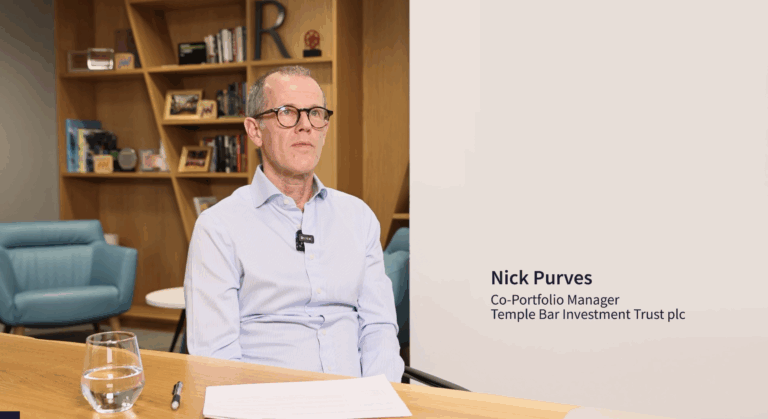
Nick Purves, Manager of Temple Bar Investment Trust, discusses the trust’s recent performance, highlighting what has worked well and where challenges have emerged. He also provides insight into the current portfolio positioning, explores whether sentiment towards the UK market is shifting, and outlines what investors can expect from Temple Bar moving forward.
Temple Bar Investment Trust: Investment Update April 2026
FTSE 100 gains ahead of busy week for central banks
The FTSE 100 rose on Monday as investors geared up for a busy week of central bank action, which will see interest rate decisions from the Bank of England, the Federal Reserve, and the ECB.
European stocks started the week on a positive note, with financial and energy shares helping the FTSE 100 rise 0.2%.
“Equity markets pushed ahead in Europe despite oil prices creeping ever higher,” says Russ Mould, investment director at AJ Bell.
But a series of central bank meetings later this week means the relative calm in markets may not last for long. The meetings will provide an insight into central bank thinking and help set expectations for interest rates later this year.
Investors will watch keenly for any hint of interest rate hikes that could upset demand for risk assets through the summer.
“Central bankers meet this week just as warnings about a severe energy crunch mount,” said Susannah Streeter, chief investment strategist, Wealth Club.
“While no change is expected at the Bank of England, the Fed or the European Central Bank, outlook statements will be closely watched for guidance about what could lie ahead for interest rates. Officials at the Bank of England are set to stay super wary.
“While price pressures are clearly mounting, the economy is set to struggle and that could limit the chances of inflation becoming embedded. So, while they are likely to indicate that a fresh hike could be ahead, there are unlikely to be any knee-jerk moves, until there’s more clarity about the length of the Iran conflict. “
FTSE 100 movers
Burberry was the FTSE 100’s top riser as the luxury brand continued its recovery from the war-induced sell-off. The decline in Middle Eastern shoppers in Europe has been a major concern for luxury names, but the recent rally suggests those worries are starting to subside.
M&G rose 1.7% after Berenberg analysts bumped their price target up to 370p.
Whitbread was among the gains on reports it was planning to sell off £1.5bn worth of its hotels.
“Reports suggest it will sell one in five of its freehold hotel properties and lease them instead,” Russ Mould said.
“It is increasingly common for hotel operators not to own the buildings in which they operate, and for Whitbread it would mean a big cash injection and a pot of money that could be returned to shareholders.
“Whitbread has found life harder going in recent years, particularly in the UK, and needs to do something to win back the market’s support.”
Asia-focused financials Standard Chartered, HSBC and Prudential caught investors’ attention on Monday with the three all trading higher by around 1%.
Firmer oil prices made BP and Shell obvious places to deploy cash. BP rose 1.1% and Shell was 0.5% higher.
Entain was the FTSE 100’s top faller after Bank of America analysts slashed its rating to neutral.
One Health Group shares jump on strong revenue growth

Specialist NHS care provider One Health Group has made an impact in its first full year as an AIM-listed company, reporting revenue and EBITDA ahead of market expectations in a trading statement released on Monday.
The group delivered double-digit growth across every key metric, with revenue risinh 13% to £32.0m for the year to March 2026, comfortably ahead of the £29.4m consensus.
Underlying EBITDA is also said to have surpassed the £2.3m market consensus.
Growth was driven by new NHS patient referrals, which climbed 11% to 18,931 as consultations jumped 20% to over 50,700. Surgical procedures rose 15% to 8,113.
One Health provides NHS care for patients referred for treatment in Orthopaedics, Spine, General Surgery, Gynaecology and Urology, operating from 40 of their locations across the UK.
The company expanded its consultant base by 10% to 88, opened three new outreach clinics, bringing the total to 40, and increased its surgical operating facilities by 40%, from 10 to 14.
Construction of One Health’s first purpose-built surgical hub in Scunthorpe is underway, on track for delivery within a year and within the £8m to £9m budget. The company says the hub is central to the company’s strategy of building owned capacity in underserved areas with high NHS demand. Management said further locations are being assessed for future development.
Adam Binns, Chief Executive Officer, said: “We are delighted to deliver a strong year end trading update ahead of market expectations for our first full year following our AIM listing and that construction of our first surgical hub commenced during this period.
“NHS national waiting lists remain very high, despite continued NHS efforts and recent modest reductions, and we are proud that One Health remains well-positioned to continue to reduce pressure on the NHS by providing free high-quality care across underserved areas.”
The trading update was warmly received by the market, and One Health shares were trading 4% higher at the time of writing.
AIM movers: Christie beats upgrade and Kazera Global requires short-term funding

Professional services provider Christie Group (LON: CTG) beat previously upgraded profit forecasts for 2025. Pre-tax profit jumped from £2.6m to £6m, helped by the sale of loss making operations, and the dividend was raised 56% to 3.5p/share. Additional hires will increase costs this year, so profit is forecast to fall to £4.6m. The share price is one-quarter higher at 150p, which is 11 times prospective 2026 earnings.
Some positive news from AOTI (LON: AOTI) with additional data on its TWO2 treatment showing effectiveness in treatment of hard to heal wounds and a low level of recurrence. Hospitalisations and amputations were low. AOTI is still awaiting the CMS coverage determination for the wider Medicaid population in the US. That will give greater access to the treatment. The share price recovered 18.8% to 50.5p.
Oscillate (SRVL), which is changing its name to Serval Resources, has moved from Aquis to AIM. A placing and offer raised £2.96m at 22.5p/share to finance exploration of licence areas in the Kaoko Basin in Namibia and the Kalahari copper belt in Botswana. The share price is 17.8% of the issue price at 26.5p.
Membrane-free electrolyser technology developer Clean Power Hydrogen (LON: CPH2) has signed a memorandum of understanding with ABE Gruppe concerning a potential supply and installation of up to 175MW of capacity over ten years. ABE is a subsidiary of BKW a large Swiss infrastructure and energy services group, and it also has operations in Germany and other European countries. This would be a significant deal for Clean Power Hydrogen, and it would generate service revenues. The share price increased 10% to 11p.
FALLERS
South Africa-focused heavy mineral sands company Kazera Global (LON: KZG) is reducing its cost base and improving efficiency of operations, including director fee deferrals until the end of August, so that there is a pathway towards sustainable cash generation. Additional short-term funding is required. Talks continue with a potential partner for heavy mineral sands operations at Whale head Minerals. Obtaining the 2A mining right will increase the scale of the project. The Deep Blue Minerals operation has put inland diamond mining on hold due to diesel shortage, although recovery of beach and marine gravels production derived from heavy metal sands production is continuing. Discussions continue with Hebei Xinjian about the African tantalum project and the recovery of outstanding debt. The share price slumped 22.2% to 1.05p.
Celsius Resources (LON: CLA) says it was not informed of Makilala Mining Company selling and assigning its loan under the Omnibus Loan and Security Agreement to Equinaire Holdings. Celsius Resources is assessing its position. The share price dipped 15.4% to 0.55p.
Content management systems provider Ingenta (LON: ING) improved revenues by 1% to £10.3m, with 89% recurring. Gross margin improved, but that was more than offset by increased sales and marketing spending. Pre-tax profit fell from £1.7m to £1.6m. Net cash was £4.7m at the end of 2025. Revenues are likely to be flat this year as declines in legacy products are offset by new business. Cavendish has put its target price under review. The share price slid 6.98% to 100p.
digital content technology and direct carrier billing services provider Bango (LON: BGO) is focusing on higher margin and subscription business. Subscriptions revenues were 22% ahead at $22.2m and annualised recurring revenues 30% higher at $18.2m. Net revenues retention was 117% last year, which indicates the growth in spending by existing customers. The payments revenues were lower, but higher margin business rose. Overall group revenues for 2025 fell 2% to $52.2m. Adjusted EBITDA was 7% higher at $16.4m, which was more than the capitalised development spending of $13.6m. There were exceptional charges of $6.4m, which relate to the restructuring of the business and cost savings. Net debt was $9.2m at the end of 2025. R&D spending should reduce this year, and new business continues to be won. The share price fell 8.39% to 71p.
Yellow Cake NAV grows as physical uranium holdings increase to 23 million pounds

The value of Yellow Cake shares was underscored by its latest quarterly update, which shows shares are trading at a discount to the underlying value of its assets.
Yellow Cake, which holds physical uranium to capture price appreciation, bolstered its physical uranium position in the first quarter, adding more than 1.4 million pounds and ending March with 23.1 million pounds of U3O8, up from 21.7 million pounds at the start of the year.
The increase came primarily from the delivery of 1.33 million pounds from Kazatomprom at $75.08/lb, the exercise of Yellow Cake’s 2025 purchase option, and a 100,000-lb spot market purchase delivered to Orano’s facility in France.
The value of those holdings rose 9.7% over the quarter to $1.94bn, driven by the expanded stockpile and a modest increase in the spot price from $81.55/lb to $83.95/lb.
The estimated net asset value per share climbed 5.0% to £6.33, helped further by sterling’s depreciation against the dollar. The pro forma NAV as of 24 April stood at £6.34 per share. This compares to a share price of 594p on Monday.
Providing commentary on the market backdrop, Andre Liebenberg, CEO of Yellow Cake, said: “The first quarter of 2026 marked a transition from policy ambition to large-scale implementation, accentuated by the conflict in the Middle East once again highlighting the importance of energy security.”
“With 39 nations now committed to tripling nuclear capacity, the World Nuclear Association projects global capacity could reach 1,446 GWe by 2050, surpassing the targets launched at COP28 in 2023. This momentum is evidenced by China elevating its 2030 target to 110 GWe, near double its current capacity, and the U.S. ‘UPRISE’ initiative, which fast-tracks reactor uprates to power the AI and data centre revolution.
“While we welcome the progress of long-dated supply projects like NexGen Energy’s Rook I and Denison’s Phoenix, the market remains structurally tight today. We see utilities increasingly prioritising security of supply, driving term prices higher as they compete for limited available material.
“Against this backdrop, Yellow Cake continues to deliver tangible value for shareholders. Our oversubscribed US$110 millionplacing and the exercise of our Kazatomprom option have grown our holdings to 23.1 million pounds, with committed purchases expected to increase holdings to approximately 24.4 million pounds.”
Christie Group hikes dividend after operating profit nearly doubles in bumper 2025

Christie Group shares surged on Monday after the professional and financial services group announced bumper preliminary results for 2025.
Christie Group has delivered a standout year, with operating profit from continuing operations almost doubling and the board hiking the final dividend 57% to reflect what it called a transformative period for the business.
Revenue from continuing operations jumped 19.2% to £70.6m, comfortably ahead of board expectations, with an unexpectedly strong burst of deal completions in the final weeks of the year pulling forward activity originally pencilled in for early 2026.
Operating profit surged 95.5% to £6.9m, lifting margins from 5.9% to 9.7% in a step change that management said demonstrates the operational gearing now embedded in the business and a clear path towards margins above 10%.
Earnings per share from continuing operations rose 87.9% to 19.37p, and the full-year dividend increased to 3.50p from 2.25p, with the 57% uplift in the final payout signalling the board’s confidence in the outlook.
Investors were evidently delighted with the group’s financial performance, and shares were 25% higher at the time of writing on Monday.
The group enjoyed growth across all business divisions during the period, but the Professional & Financial Services division was the engine room, with sales rising to £59.6m
Christie & Co, the business brokerage and service, which is celebrating its 90th year, produced record fee income after the average brokerage fee on business sales climbed 26%, even as volumes held broadly steady at 1,164 transactions worth nearly £2bn.
European operations grew fee income 37%, with a record year in France and notable wins including the sale of the Vienna Marriott. Valuations surged 63% to nearly 8,000 units, covering £14.5bn of assets, boosted by major pub estate mandates from Marston’s and Greene King. Christie Finance grew fee income 15% and secured £292m of debt for clients, up 38%.
The insurance arm also contributed, with the renewal book growing 23% in value and client retention rising to 87%.
The Stock & Inventory division delivered a steadier 5.4% revenue increase to £11.0m, returning to profitability with an operating profit of £0.75m.
Dan Prickett, Chief Executive of Christie Group, said, “We are delighted to report an excellent set of results for 2025 which illustrate the strong progress we have made during the year. We outperformed original expectations quite substantially, in part due to exceptionally strong deal flow in Q4. We sold 1,164 businesses in the year with a total value nearing £2.0bn – up 45% year on year – while also boosting our average brokerage fee by 26%.”
“After driving strong growth over the year alongside strategic divestments, the Group is now well positioned to deliver on our strategic objectives in the years ahead as we focus on driving revenue and earnings growth from our continuing operations, strengthening our balance sheet further and delivering enhanced value for our clients, staff and shareholders.”
Strategically, the group has now shed both of its persistent loss-makers, Orridge and Vennersys, sharpening focus on higher-margin operations. The disposals, combined with strong trading, lifted the net cash position to £9.4m from £4.9m a year earlier, with zero external borrowings.
Looking ahead, the UK transactional pipeline stood 9.6% higher at the start of 2026 than a year earlier, with instruction levels remaining robust through the first quarter. International and finance brokerage pipelines are also ahead.
“While still relatively early in the new financial year, momentum in 2026 has been encouraging,” Dan Prickett said.
“As a result, absent of disruption from the current geopolitical backdrop, we remain confident in delivering another year of positive progress and achieving our third consecutive year of selling over 1,000 businesses.”
Headlam Group receives requisition notice after period of poor performance

Headlam Group has confirmed it received a requisition notice on 24 April from First Seagull AS, the Norwegian shareholder which holds a 10.05% stake, calling for a general meeting to overhaul the flooring distributor’s board.
The notice was received after a period of poor share price performance, made worse by the recently announced final results, which outlined plans to manage a revenue decline by focusing on core customers.
Headlam has posted EBITDA losses in each of the last two years and generated £499m revenue in FY2025.
Headlam shares are down 63% over the past year to 28p, valuing the company at just £22m.
Some shareholders have had enough. The notice proposes removing the chair and two non-executive directors, replacing them with two FS nominees, including Stian Husvaeg, managing director of First Seagull. If convened, the meeting would sit alongside Headlam’s scheduled AGM rather than replace it.
The board said it is reviewing the notice with its advisers but pushed back on the move, pointing to its recently refreshed line-up, a new executive team and two new non-executive directors, which it believes have the right experience to deliver the turnaround strategy already underway.
AIM weekly movers: Deltic Energy bid approaches
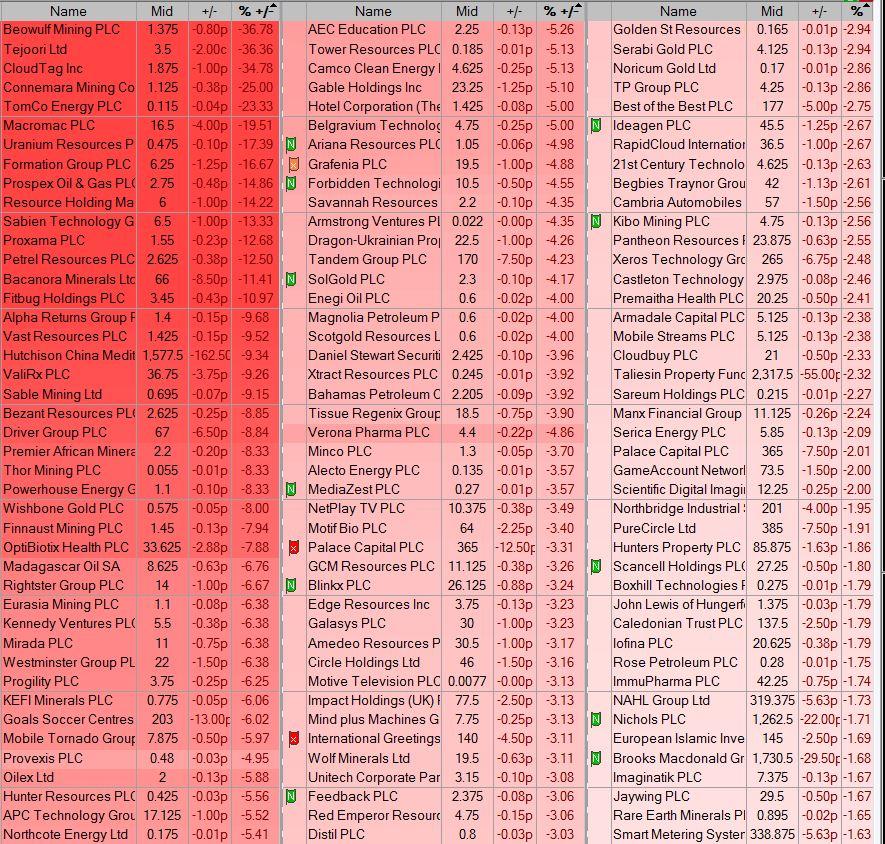
Deltic Energy (LON: DELT) says it is in discussions with three parties – Capricorn Energy, Petrogas International E&P Coöperatief U.A. and (iii) Blue Concept Hld AS, a private Norwegian company – about potential cash offers for the company. The share price doubled to 5p.
Active Energy Group (LON: AEG) is acquiring a 2.5 MVA grid connection located at Taweela, UAE for £1.25m in cash and shares. The cash portion of £625,000 will be deferred and paid in two equal parts over 12 months. This takes total grid connection capacity to 15.5 MVA. The share price gained 30.8% to 0.1275p.
Smart video technology company SEEEN (LON: SEEN) has acquired media library and streaming software provider MEDIAL for up to £1.2m in cash and shares issued at 6p each. The acquired business made a pre-tax profit of £210,000 in the year to April 2025. SEEEN can sell its services to the acquired company’s customer base and offer training packages. The company appointed Zeus as nominated adviser and broker. The share price increased 28.6% to 4.5p.
Professional services provider Diales (LON: DIAL) says interim operating profit will be 43% higher at £1m on revenues up 10% at £23.7m. Cash was £3.9m at the end of March 2026. The interims will be published on 1 June. The share price gained 27.3% to 28p.
FALLERS
Mercantile Ports and Logistics (LON: MPL) continues to try to regain control of the Karanja Terminal & Logistics subsidiary. Mercantile says it can repay the related debt, but the proposal was rejected by the consortium of banks. They prefer an alternative plan from Adani Ports and Special Economic Zone Limited and that has been approved by the courts. The company has appealed. The share price had been rising because of optimism about the outcome of the repayment proposal, and it has slumped 77.4% to 0.475p.
Powerhouse Energy (LON: PHE) has raised £400,000 in a placing at 0.2p/share and could add a further £250,000 from a retail offer. The cash will be used to progress the development of the Ballymena waste to hydrogen project in Northern Ireland. This will include gaining permitting and the design of the project. The company will also develop alternative fuels that can come from the distributed modular generation units. The share price dropped 35.3% to 0.22p.
Clinical messaging technology developer Feedback (LON: FDBK) continues to talk with the NHS about the deployment of its technology. However, a decision has been delayed until the end of the year or early next year. This means that there will be no significant boost to revenues until next year, although the existing contract with Queen Victoria Hospital in Sussex. Feedback is not renewing its contract with the Royal Berkshire NHS Foundation Trust. There should be enough cash until the middle of 2027. The share price slipped 32.3% to 9.75p.
Litigation financing company Manolete Partners (LON: MANO) had a better second half performance and full year realised revenues dipped from £29.5m to £28m. Cash receipts rose to £26.6m. There were non-payments by some debtors, though, and they are worth £4.7m which could lead to a provision in the accounts. Net debt was £11.5m at the end of March 2026. Forecast revenues from cases is £67m. The share price fell 25.9% to 40p.
Aquis weekly movers: Oscillate and Shortwave Life Sciences moving to AIM

Purebond has increased its stake in Delta Gold Technologies (LON: DGQ) from 3.1% to 3.7%. An issue of shares after the exercise of warrants at 30p each raised £71,000. The share price jumped 29% to 120p.
Valereum (LON: VLRM) has agreed terms of a definitive exclusivity agreement with Quorium Global Photonics SPC. The existing $200m medium term loan notes with VGOLD-CORE tokens valued at $279.5m. These will be released at $13.975m each quarter over five years. Valereum has settled its dispute with Blubird and will receive 504,524 shares in Blubird (5.66%), plus two BLU tokens over two years. The share price recovered 27.3% to 3.5p.
Oscillate (LON: SRVL) shareholders approved the move to AIM and the share price is one-fifth higher at 0.6p.
Ajax Resources (LON: AJAX) has had the exclusivity agreement for the purchase of the Paguanta project in Chile extended to 15 May. The share price gained 16.7% to 8.75p.
Shortwave Life Sciences (LON: PSY) has raised £215.000 at 1.5p/share and is planning to move to AIM. Ut has options over antimony gold and polymetallic licences in Slovakia and the Saturn gold project in Western Australia. Keith Coughlan, a director of European Metals Holdings, has replaced Ron Lipsky on the board. Steve Xerri owns 6.4%. The share price rose 13.6% to 1.25p.
Adam Back is investing £585,500 in Connecting Excellence Group (LON: XCE) at 1.75p/share. He will own around 8%. The company has bought ten Bitcoin for £585,000. The share price increased 11.1% to 2p.
M3 Helium, which Mendell Helium (LON: MDH) has an option to buy, has secured a trailer to deliver helium from the Rost 1-26 well. The share price improved 6.12% to 6.5p.
FALLERS
S-Ventures (LON: SVEN) raised £9,382 from its retail offer at 3.5p/share and issued 428,571 shares to new joint broker Oberon Capital. The retail offer takes the total raised to £310,000. The share price slipped 57.1% to 0.75p.
Astrid Intelligence (LON: ASTR) says that earlier in April, a subnet operator withdrew from the Bittensor network and liquidated a substantial part of their holdings, leading to volatility. This led to a decline in value of some subnet tokens. Astrid was not materially impacted at an operational level. The share price fell 16% to 0.105p.
Sulnox Group (LON: SNOX) has been granted a patent in Hong Kong for an improved demulsification methodology. The share price declined 8.33% to 55p.
Wishbone Gold (LON: WSBN) raised £1.1m via a placing arranged by Marex Financial at 26.35p/share. Every two shares come with a warrant exercisable at 40p each. A rig has been mobilised for the Red Setter project. The share price dipped 7.94% to 29p.
AIM movers: Atome secures financing for Villeta project and Pulsar Helium denies fundraising rumours

Pulsar Helium (LON: PLSR) says that rumours of a placing are false. Communications circulated by a third-party broker are false and the company is considering legal action. The share price rebounded 8.51% to 91.8p.
Celsius Resources (LON: CLA) has initiated an emergency alternative conflict resolution process to protect its interest in a dispute relating to Sodor Inc’s failure to pay $5m to acquire 60% of Makilala Mining Company and PMR not subscribing for shares in processing company for the MCB project. The application for interim orders will be concluded in early May. Celsius Resources wants Sodor and PMR arrangements relinquished to enable a stake to be sold to another partner. The share price gained 7.41% to 0.725p.
Team Internet Group (LON: TIG) is progressing talks with parties interested in acquiring its domain names business and it is worth more than the current market capitalisation. Previously it was estimated to be valued at £120m. Team Internet Group is talking to fixed income investors about changes to the financing of the group. Trading is in line with expectations. The share price increased 3.13% to 33p, which values the company at £83.7m. Net debt is estimated at $99.6m.
Oil and gas company Ascent Resources (LON: AST) has provided Utah Brine Corporation, 51% owned by Neometals, access to 24 inactive oil and gas wells in the Paradox Basin in Utah. An exploration target has been defined for potash and lithium mineralisation. The exploration target (JORC 2012) ranges from approximately 94 to 325 Mt of Muriate of Potash and approximately 1.9 to 6.5 Mt of contained Lithium Carbonate Equivalent. Work programmes are being planned. Ascent Resources is entitled to a gross smelter return of 2.5% to 3.5% of gross revenues from its acreage and it also has 4.9 million unlisted options in Neometals exercisable at 10 cents each. The share price improved 4.35% to 0.6p.
North Sea oil and gas producer Serica Energy (LON: SQZ) is considering a bond issue in the Nordic market. This would be used to repay any drawings under the existing debt facility of $525m. Net debt was $78m at the end of 2025. The share price rose 3.13% to 279.9p.
FALLERS
Atome (LON: ATOM) has raised £6.59m via a placing at 60p/share in addition to an £18m subscription by Casale, the EPC contractor for the planned Villeta green fertiliser facility, directors and existing shareholders. A retail offer raised £1m, which was double the original intention. Once shareholders approve of the share issues the final investment decision will be declared. Atome will have enough cash to take a 29.8% in the Villeta project. Atome will receive 100% of revenues until it has a 15% IRR on its $60m carried value in the project and after that 29.8%. The share price slipped 25.9% to 66p.
Agriculture technology and fire protection company Light Science Technologies (LON: LST) reported full year revenues up from £8.6m to £11.7m and it made a £100,000 pre-tax profit, compared with a loss in 2024. Agricultural technology business continues to grow from a low base. Passive Fire Protection was hit by building approval delays last year and it has a £20m pipeline for 2026. Shore forecasts a £1m pre-tax profit in 2026. The share price declined 18.5% to 1.325p.
Quicklime producer Firering Strategic Minerals (LON: FRG) is raising £2.5m at 1p/share. The cash will fund an increase in ownership of main subsidiary Limeco and help progress to exercising the final tranche of the Limeco option. Two more kilns could be brought online in the future. The share price fell 17.7% to 1.05p.
Arc Minerals (LON: ARCM) has raised £3m at 0.4p/share. This fully funds the exploration campaign in the licence area in the Zone 5 Corridor of the Kalahari Copper Belt. The share price dipped 10.5% to 0.425p.