FTSE 100 slips as Trumps says he’s in no rush to end war

The FTSE 100 was lower on Friday after the US President said that he was in no rush to end the war with Iran, sending oil prices higher and stocks lower.

While it’s difficult to know whether he actually means he’s in no rush or if it’s just another negotiating tactic, we do know that markets are growing tired of Trump’s posturing, and fears are mounting that the impasse in the Middle East could lead to a global recession.

This was reflected in a Brent oil price of around $105 and an FTSE 100 trading below 10,400 at 10,387 at the time of writing.

Susannah Streeter, chief investment strategist, Wealth Club, said: “Brent crude is up around 20% on the week and is trading around the hot level of $105 a barrel, as any hopes of an immediate easing of the crisis are shattered.

“President Trump has stressed he’s in no rush to end the war, and with the ceasefire extended for another three weeks, there’s set to be fresh financial pain ahead as key shipments from the region remain blocked. That is set to keep costs elevated for a vast array of commodities, from oil and gas to fertiliser and helium, which are vital for electronics manufacturing.”

If the uncertainty in the Middle East wasn’t enough to unnerve investors on Friday, a Bank of England official has weighed in, labelling global equity markets overvalued.

“An official from the Bank of England has warned of a potential global stock market correction,” says Russ Mould, investment director at AJ Bell.

“Deputy governor for financial stability Sarah Breeden told the BBC that current share prices didn’t reflect economic pressures facing the markets.”

FTSE 100 Movers

Mondi was the FTSE 100’s top faller on Friday after the paper and packaging maker warned of rising prices due to the war in Iran, adding to a string of London-listed companies signalling a negative impact from the conflict.

“There’s no papering over the cracks in packaging outfit Mondi’s latest update. The business is heavily exposed to rising energy and raw materials costs and that’s putting significant pressure on profit, Russ Mould said.

“Mondi is increasing its prices but cannot pass on costs overnight so investors won’t see evidence of this until later in the year.”

Mondi shares were down nearly 8% on Friday.

At the other end of the leaderboard, British American Tobacco was the FTSE 100’s top riser after analysts at Morgan Stanley upgraded the stock to ‘overweight’ from ‘underweight’. BATS shares rose 3%.

JD Sports has had a tough week, made worse by rising oil prices on Friday, which sent the stock down 3% to near its worst levels since the beginning of the Middle East conflict.

BP and Shell helped provide some balance to the index with gains of around 1%, but this wasn’t enough to offset weakness in mining companies such as Antofagasta and Anglo American that were among the many cyclical stocks that dragged the FTSE 100 lower on Friday.

Intel shares surge as Q1 sales smash estimates driven by AI data centre sales

Intel shares surged on Friday after the chipmaker announced revenue grew 7% on renewed demand for data centre CPUs.

Concerns that Intel was losing out to its peers in the AI race have been tempered by these results, which show the group’s offering is finally helping boost sales after a prolonged period of falling quarterly sales.

Sales for the first quarter rose 7.2% compared to a year ago to hit $12.67bn, with AI data centre sales doing much of the heavy lifting.

While investors will be delighted with the first-quarter performance, the strong share price reaction can largely be attributed to robust guidance for the second quarter, when Intel sees sales rising to £13.8bn – $14.8bn, well above analyst expectations.

Intel is also guiding 20 cents earnings per share in Q2, versus analysts’ estimates of 9 cents.

“There’s beating earnings expectations and then there’s smashing them – with no hint of hyperbole, it’s fair to say Intel has done the latter with its latest quarterly results,” said Russ Mould, investment director at AJ Bell.

“Chief executive Lip-Bu Tan is strident in asserting that Intel is seeing a big boost as businesses move beyond just training up machines and begin putting them to work on specific tasks. This means increasing demand for ‘Intel inside’ as customers tap its flagship central processing units.

“For years Intel has looked like yesterday’s man in the chip space, but the company’s latest earnings suggest it has caught up – helped by an unconventional investment from the Trump administration and additional funds from Nvidia last year.”

The US government invested $8.9bn in Intel at $20.47 per share and has enjoyed a 4x return, based on a premarket price of $83.30 per share.

UK retail sales jump as fuel prices rise

UK retail sales rose 0.7% in March, with rising fuel prices contributing to higher spending. But stripping out fuel leaves growth at a more modest 0.2%.

The headline figure actually masks a worrying period for consumers, who are being forced to spend more on fuel rather than elsewhere in the economy as the impact of the Middle East war takes hold.

Couple this with a revision lower for February’s figure to 0.6% from 0.4%, and there’s clear evidence of pressure on the retail sector. That said, the three months to March still paint a positive picture, with sales up 1.6% on the previous quarter.

Danni Hewson, AJ Bell head of financial analysis, said: “The jump in retail sales in March actually heralds bad news for the sector, as consumers rushed to fill up their vehicles amid rising petrol and diesel prices.”

“Not only was the increased price of a tank eating into household budgets, but some motorists were bringing forward this purchase. There have been concerns about rising prices and potential shortages as a result of the war in the Middle East which have so far not materialised.

“People can only spend a pound once and if they’re choosing to shell out more than normal on fuel, they’ll have less to spend on other purchases.”

This was being felt in London equity markets on Friday, with retailers such as JD Sports falling after the news was released.

Mondi Q1 EBITDA slips as rising costs bite

Mondi has reported a softer start to 2026, with underlying EBITDA easing to €212 million in the first quarter from €214 million in Q4 2025, as the packaging and paper group grappled with mounting cost pressures across its operations.

Shares were down 5% in early trading on Friday as Mondi became the latest company to warn of the impact of the war in Iran.

A concern for investors will be that profits fell despite higher sales volumes in both the Corrugated Packaging and Flexible Packaging units, with volume gains offset by lower average selling prices and rising energy-related input costs towards the end of the quarter.

Margins in the converting operations came under pressure, with Corrugated Solutions and Paper Bags bearing the brunt, while Consumer Flexibles held up on resilient end-market demand.

The cost backdrop has been further complicated by heightened geopolitical tensions in the Middle East, which have driven up energy, raw materials, and logistics costs across the business.

Mondi has limited direct exposure to the region but is feeling the knock-on effects and is pushing through price increases in response, although the full benefit is not expected to land until the third quarter, given the customary lag.

Adding to the pressure on reported earnings, Mondi now expects its full-year forestry fair value gain for 2026 to be nil, following a recent drop in South African wood prices, a step down that will remove a useful tailwind from the numbers.

There are a number of reason for investors are cautious, and management appears to recognise this by taking action on costs.

The group announced the closure of three further converting plants in April, a Consumer Flexibles site in Hungary and Corrugated Solutions facilities in Poland and Germany, taking recent closures to six and reducing headcount by 450 this year.

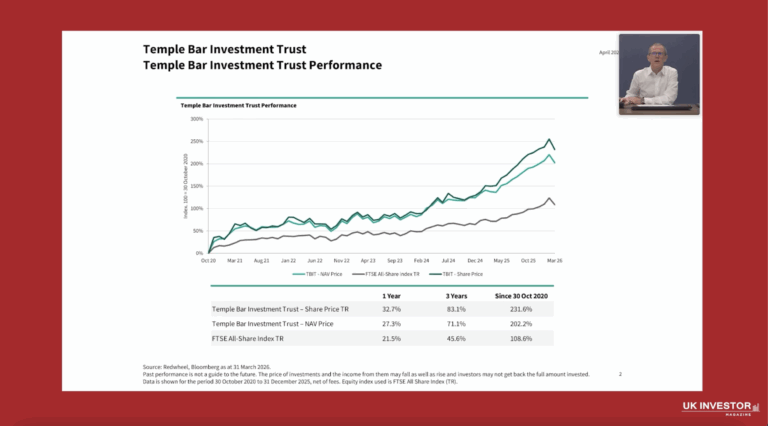
Temple Bar Investment Trust Investor Presentation April 2026

Temple Bar is a well-established investment company, taking a value approach combined with deep fundamental analysis to offer something distinct to investors. The Trust is managed by Nick Purves and Ian lance of Redwheel , who have more than fifty years of investment experience between them and have been working as a partnership for over fifteen years.

Download the presentation slides.

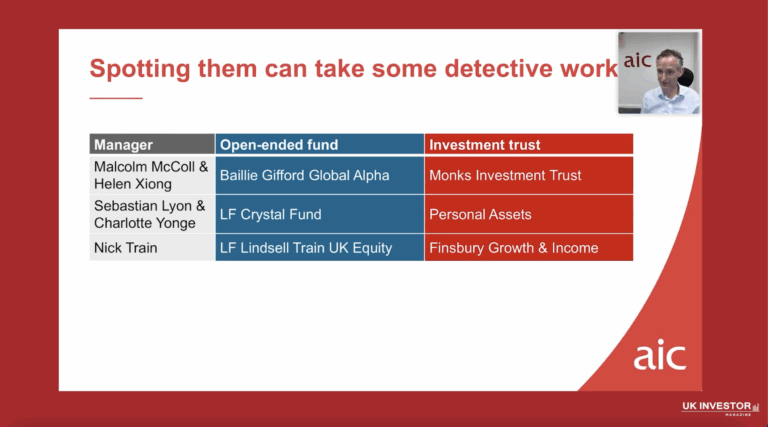
The Curious Case of Sister Funds – AIC Presentation April 2026

The Association of Investment Companies (AIC) was founded in 1932 to represent investment trusts – the oldest form of collective investment. Today, the AIC represents 350 investment companies, investment trusts, venture capital trusts (VCTs) and other closed-ended funds.

Download the presentation slides.

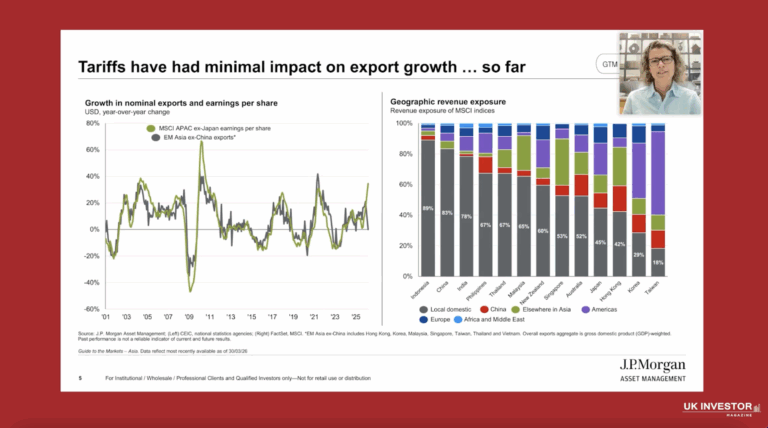
JPMorgan Emerging Markets Growth & Income Investor Presentation April 2026

JPMorgan Emerging Markets Investment Trust plc (JMGI) seeks to maximise total returns by identifying high-quality companies across the market cap spectrum that aim to deliver sustainable long-term growth and a predictable dividend to income seekers. JMGI’s enhanced dividend is calculated as 4% per annum based on the NAV as at close of business at the end of the preceding financial year.

Download the presentation slides.

Computacenter boosts full year expectations after strong Q1

Computacenter has had a strong start to 2026, with first-quarter trading coming in significantly ahead of both last year and its own expectations, prompting the technology services group to upgrade its full-year guidance.

Group Technology Sourcing revenue led the charge, powered by hyperscale customers in North America and the UK, while Services revenue also edged ahead on the back of strong organic growth in Professional Services. A dip in Managed Services was more than offset by momentum elsewhere.

North America delivered what the company described as an excellent quarter, helped along by a record product order backlog carried over from the end of 2025 and stronger-than-expected hyperscale volumes.

The UK also posted excellent growth in Technology Sourcing, with AI-related project completions feeding through and Professional Services continuing to build. Germany was steady, though Professional Services there remains subdued, and Western Europe nudged slightly ahead.

On the outlook, Computacenter now expects a much stronger first half than previously thought. While management flagged the usual caveats around the macroeconomic and geopolitical backdrop, and a tougher comparative in H2, it now anticipates full-year results will be comfortably ahead of market expectations, assuming no material deterioration in conditions.

Computacenter shares are around 50% higher over the past year, and today’s update has helped extend the rally with a 3% gain.

Build a Resilient Corporate Travel Policy for Volatile Markets 

Rising transport costs, disruption across rail and air networks, and ongoing economic uncertainty are forcing UK businesses to reassess how they manage travel spend. What was once a routine operational cost is now a clear area of financial risk. A well-structured travel policy provides a way to manage that risk. It gives organisations control over spend, supports operational continuity and maintains employee performance without restricting essential travel. 

What Defines a Resilient Corporate Travel Policy? 

A resilient travel policy is designed to manage uncertainty while keeping spending predictable. It combines flexibility in bookings, clear cost controls, compliance with HMRC rules and contingency planning. 

Together, these elements give finance teams visibility over travel costs while allowing business-critical trips to proceed. They also reduce exposure to last-minute price changes and disruption, which remain common in the UK market. 

Factors Shaping Business Travel Policy 

Rail accounts for most UK domestic business travel, yet fares remain volatile, and disruption is frequent. Strikes and delays often force last-minute changes, which quickly increase costs when policies lack flexibility. 

Compliance adds another layer of complexity. HMRC rules determine how travel expenses are treated, including what qualifies as business travel and how reimbursements are handled. Poorly structured policies create tax risk and increase administrative burden. 

Sustainability is also shaping decision-making. Many organisations now prioritise rail over domestic flights and require some level of emissions tracking. However, cost and time constraints still apply, which makes trade-offs unavoidable. 

This combination of cost pressure, disruption and compliance requirements means policy design needs to be both structured and adaptable.  

Key Strategies for Controlling Corporate Travel Costs 

Move to Dynamic Travel Budgeting 

Fixed annual travel budgets are less effective in a volatile environment, particularly when rail and air fares can shift within weeks. Many UK firms now review travel spend monthly. 

This allows finance teams to adjust budgets in line with pricing trends and business demand, rather than applying broad restrictions that may limit revenue-generating activity. The shift in budgeting also affects how bookings are managed. 

Prioritise Flexible Booking Options 

Lower upfront cost often leads to higher total spend when plans change. Non-refundable tickets can become expensive if rebooking is required at short notice. 

A clear policy defines when flexibility is necessary, particularly for routes with known disruption risk or trips tied to uncertain schedules. Rail travel during periods of industrial action is a common example, where fixed tickets can quickly lose value. 

Introduce Structured Approval Workflows 

Approval processes control unnecessary travel without slowing down essential trips. A tiered system keeps oversight where it matters. 

Low-cost, policy-compliant bookings can be approved automatically, while higher-cost or international travel requires a manager’s sign-off. This approach maintains efficiency while keeping spending under control. 

Use Travel Management Platforms 

Travel management tools give organisations real-time visibility over bookings and spend. They also enforce policy rules at the point of booking, which reduces manual intervention. These systems can flag out-of-policy bookings, track unused tickets and help teams respond more quickly to disruption. 

Build in Contingency Planning 

Disruption is a consistent feature of travel. Policies need to include clear guidance on alternative routes, rebooking procedures and support for employees affected by delays. 

Without this structure, organisations are forced into reactive decisions that increase both cost and operational disruption. In time-sensitive situations, some organisations may also consider premium alternatives such as private jet hire for critical travel, where delays would have a direct financial or operational impact. 

How To Balance Travel Cost Savings With Employee Productivity 

Cost control should not reduce employee effectiveness. Travel conditions have a direct impact on productivity, particularly for longer journeys or client-facing roles. 

Effective policies set clear expectations while allowing reasonable flexibility. This often includes allowing higher travel classes for longer journeys or setting minimum accommodation standards. 

Fairness and transparency remain important. Employees are more likely to follow a policy that is consistent and clearly explained, especially when travel conditions are demanding. 

Managing Sustainability Alongside Cost 

Sustainability targets are now part of many travel policies, but financial and operational constraints remain. Rail-first approaches and emissions tracking are becoming standard in larger UK organisations. 

A practical policy allows informed decisions rather than fixed rules. Rail may be preferred for shorter journeys, while flights remain appropriate where they offer a clear time or cost advantage. 

Practical Takeaways for Business Leaders 

Corporate travel policy is a controllable area of spend that supports wider financial stability. In uncertain conditions, the focus should be on structure and adaptability rather than restriction. Key actions include adopting flexible budgeting, defining when flexible fares are required, implementing tiered approval processes, using travel management tools for visibility and preparing for disruption through clear contingency planning. A resilient approach ensures that travel supports business performance while keeping costs predictable. In a volatile market, that balance has a direct impact on cost control and operational performance. 

AIM movers: Mirriad Advertising desperate for cash and ex-dividends

0

Professional services provider Diales (LON: DIAL) says interim operating profit will be 43% higher at £1m on revenues up 10% at £23.7m. Cash was £3.9m at the end of March 2026. The interims will be published on 1 June. The share price increased 19.2% to 28p.

Active Energy Group (LON: AEG) is acquiring a 2.5 MVA grid connection located at Taweela, UAE for £1.25m in cash and shares. The cash portion of £625,000 will be deferred and paid in two equal parts over 12 months. This takes total grid connection capacity to 15.5 MVA. The share price gained 12.4% to 0.15p.

Microchip designer and supplier EnSilica (LON: ENSI) has won two new space contracts and one could be worth more than $50m over its life. There should initially be $6,8m of non-recurring engineering revenues in the next three years and potential UK Space Agency funding of up to $3m on top. EnSilica should return to profit this year. The share price improved 11.4% to 73.5p.

Translation software and services provider RWS Holdings (LON: RWS) says interim revenues will be around 5% higher at £360m, with organic constant currency growth of 7%. Underlying pre-tax profit should be one-third higher at £24m after cost savings. Net debt was £33m at the end of March. Low single digit constant currency growth in revenues is expected for the full year.  The share price recovered 11.3% to 93.75p.

FALLERS

In content advertising technology developer Mirriad Advertising (LON: MIRI) says trading conditions are difficult, and the US joint venture partner has performed below expectations. Costs have been reduced, but cash is running out. The board believes it may have to place operating subsidiaries in administration or liquidation if no new capital is raised. That would lead to a suspension in trading of the shares. The share price slumped 73.3% to 0.0008p.

Powerhouse Energy (LON: PHE) has raised £400,000 in a placing at 0.2p/share and could add a further £250,000 from a retail offer. The cash will be used to progress the development of the Ballymena waste to hydrogen project in Northern Ireland. This will include gaining permitting and the design of the project. The company will also develop alternative fuels that can come from the distributed modular generation units. The share price dipped 28.8% to 0.21p.

Helium projects developer Rift Helium (LON: RIFT) joined AIM on Wednesday having raised £8.09m at 10p/share. The shares initially went to a premium but ended the first day at 9.75p. They have fallen a further 7.69% to 9p.

Deltic Energy (LON: DELT) says it is in discussions with three parties – Capricorn Energy, Petrogas International E&P Coöperatief U.A. and (iii) Blue Concept Hld AS, a private Norwegian company – about potential cash offers for the company. The share price more than doubled yesterday and it has fallen back 13.3% to 6.5p.

Health and beauty brands owner Creightons (LON: CRL) is changing its name to Potter & Moore, which has always been the main trading name, as part of a corporate rebrand. Full year revenues were flat at £53.8m with problems at customers and reduced contract manufacturing business hampering the progress of the business. Gross margin was maintained as NI and other cost increases were offset by improved efficiency. Even so, pre-tax profit is expected to decline from £3.5m to £2.7m. Cash was £3.6m at the end of March 2026. The share price fell 6.38% to 22p.

Ex-dividends

Airea (LON: AIEA) is paying a final dividend of 1p/share and the share price declined 0.5p to 23.5p.

Mortgage Advice Bureau (LON: MAB1) is paying a final dividend of 15.3p/share and the share price slipped 27.5p to 545.5p.

MP Evans (LON: MPE) is paying a final dividend of 42p/share and the share price fell 46p to £17.08.

Uniphar (LON: UPR) is paying a final dividend of 1.31 cents/share and the share price is 1p lower at 349p.