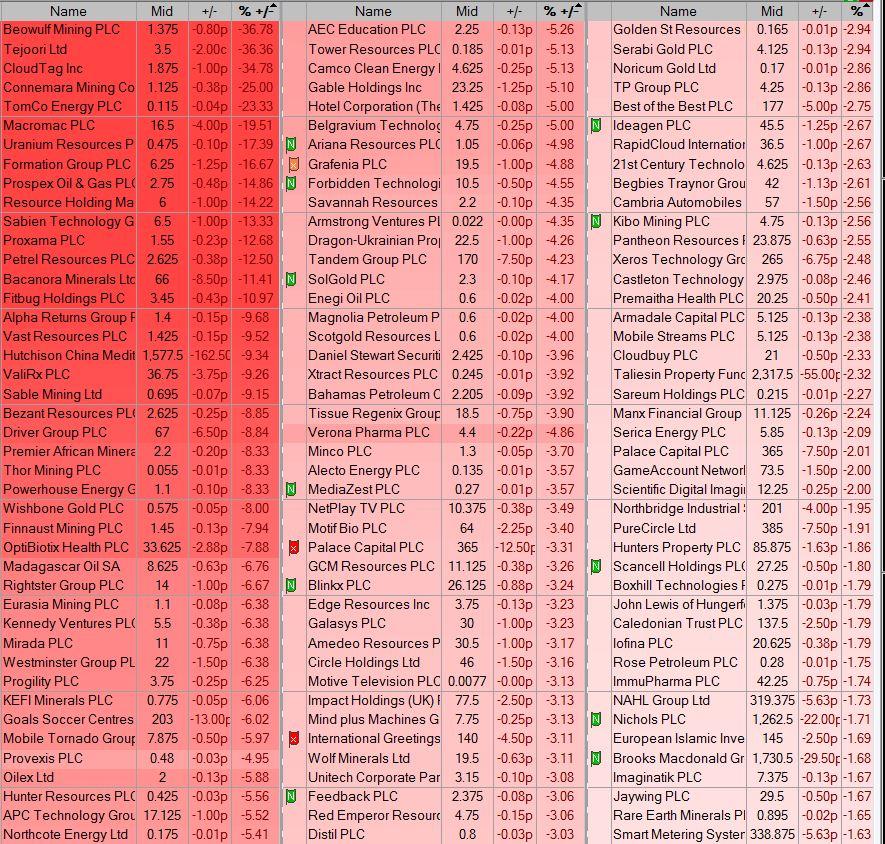
Quantum Blockchain Technologies (LON: QBT) says it intends to commence mining of other cryptocurrencies in the Bitcoin family: Bitcoin Cash and Bitcoin SV. Those currencies have much lower prices than Bitcoin, but mining is less capital intensive. The share price jumped 15.2% to 2.275p.
Audio visual products distributor Midwich Group (LON: MIDW) generated 2022 revenues of £1.2bn, up by 40%. Organic growth was 20%. This means that profit will be better than expected – consensus was £40.9m. The share price is 11% higher at 546p.
Asia-Pacific focused oil and gas producer Jadestone Energy (LON: JSE) is making progress to restoring production at the Montara Venture FPSO in February. Additional investment in the Stag field could double production of 4,000 barrels of oil/day. The share price increased by 10.7% to 78.8p.
Video games company Team17 (LON: TM17) says trading was strong in the second half of 2022 and profit is significantly ahead of expectations. The share price is 7.88% ahead at 445p, which is back to the level at the end of 2022.
The first Southwark well had a disappointing gas flow rate and that hit the IOG (LON: IOG) share price, which is down 53.7% to 7.75p. A second well will be drilled. There is concern that the Southwark field, where £100m has been invested, may not be commercially viable. A €100m Nordic bond matures in September 2023 and this will need to be refinanced.
Omega Diagnostics (LON: ODX) has a strong order book but it will not help the year to March 2023 when revenues will be one-quarter lower than forecast and the loss will be higher. That is partly down to insufficient production capacity. The order book could be worth £5m by the end of March. The share price slumped 12.4% to 3.35p.
N4 Pharma (LON: N4P) has completed two in vivo studies using its Nuvec delivery system that demonstrate it can be administered orally. The share price fell 8.82% to 2.05p.
Pensions administrator STM (LON: STM) says 2022 trading was broadly in line with expectations. There will be one-off costs for the integration of the Mercer pension portfolio acquired in July. There will be a three-year review of strategy and the results should be announced with the full year figures in March. The share price slipped 5.17% to 27.5p.
Alan Green joins the Podcast as we discuss key market themes and a selection of UK equities.
We discuss:
Burberry (LON:BRBY)
Argo Blockchain (LON:ARB)
AB Dynamics (LON:ABDP)
UK inflation has began to fall and the FTSE 100 continues to flirt with all time highs. We look at what could derail a rally and the key influences on stocks.
Burberry has been a major beneficiary of Chinese economic expansion over the past 20 years. We run through this morning’s update as China reopens.
Argo Blockchain have secured financing to avoid a worst case scenario in the short term, we look at whether the recent jump in Argo shares is a dead cat bounce, or can be sustained.
UK CPI inflation fell to 10.5% in December, down from 10.7% in November, as the UK joins other major economies in experiencing falling rates of inflation.
Inflation in the UK fell for the second time in a row after declining from 11.1% in October, a trend that could see UK inflation drop below 10% in the coming months.
Although there will be relief inflation rates are falling, price growth still remains stubbornly high and will be eroding household spending. Despite headline inflation rates falling, people in the UK will continue to pay higher prices for their food and energy.
“Whilst prices at the pump have been falling, now back to levels last seen in February 2022, a lot of the important stuff is still going up. Energy costs, despite the government shaped cushion that’s in place, are still making a big impact on our lives and as temperatures plummet our energy saving measures have done all they can to limit bill rises,” said Danni Hewson, AJ Bell financial analyst.
“Then there’s food. The Christmas shop had to be spread out over a couple months just to make all those treats vaguely affordable. Chocolate and sweets that are a staple of most homes over the festive season were among those items in our basket with a much bigger price tag than we’re used to. And other less seasonal staples like milk, cheese and eggs are still driving prices up at a rate that will keep making life difficult for many people.”
In addition, inflation rates above 10% will leave the Bank of England little option but to continue with further rates hikes in the coming months.
“Sticky inflation means the market is still expecting more interest rate rises in the near future, from 3.5% to around 4.5%. We could see a rise of 0.5 points when the MPC meets in February. However, as times get tougher further down the line, they’re expected to make cuts. It means that fixed rates for both mortgages and savings may well have peaked,” said Sarah Coles, senior personal finance analyst, Hargreaves Lansdown.
CML Microsystems (LON: CML) has acquired a base in Silicon Valley and broadened its product range through the purchase of Microwave Technology Inc. This will help to accelerate growth.
CML is paying up to $18m for Microwave Technology Inc, which has been trading for four decades, and this will be paid out of the cash pile and the issue of shares. US regulatory approval is required and that should happen by the summer. Microwave Technology Inc generated revenues of $6.5m and lost £132,000.
The acquired business used to be a manufacturer of semiconductors and then moved to a fabless model focusing on Monolithic Microwave Integrated Circuits (MMICs). These cover 1Ghz and above frequencies and provide additional opportunities for CML. Microwave Technology Inc is predominantly a US business and there will be opportunities to sell products in other markets.
At 490p, the shares are trading on 22 times prospective earnings for the year to March 2023. That would reduce to 18 times earnings for next year before taking into account the acquisition, which should be earnings enhancing.
The expanded product range and additional expertise make the combined business more valuable. CML has developed a range of new products that are still to build up their sales, so there is plenty more to come in the future.
Exciting AVA6000 RNS could be just the start of a multi-billion-pound bidding war for FTSE AIM minnow.
It’s perhaps not controversial to state that long-term investors in Avacta (LON: AVCT) shares have had their faith tested over the past few years. The FTSE AIM biotech has been caught in waves of investor overexuberance and despair — reaching a record 273p during the Reddit-induced meme hysteria of early 2021 — and lows of 42p less than a year ago.
Credit: Google
But for small-cap investors looking for the next big thing, nerves of steel and a willingness to wade through paper losses remain the essential pre-requisite to success. And with its latest RNS, their patience is starting to pay off.
Avacta shares: condensed investment case
Avacta has developed two proprietary platforms that it believes could be medicinally revolutionary.
The first, Affimer, has been developed as an alternative to the $100 billion antibody therapy market, and is proposed to eliminate the many negatives of using antibodies to combat disease, including the reliance on the response of an animal’s immune system, their poor specificity with unintended side effects, and the high cost of manufacture.
The second, pre|CISION, is a newly developed chemotherapy platform which only activates within fibroblast activation protein (FAP)-rich tissue which occurs in cancerous tumours. The company hopes that the platform will alleviate many of the unwanted side-effects of chemo.
Financially, Avacta has something in common with smaller biotechs; while revenue increased to £5.5 million in H1 2022, operating losses mounted to £9 million. But hasn’t deterred investors, and indeed, the company has entered multiple partnerships with big players including a joint venture with DaeWoong Pharmaceutical, a licence agreement with Point BioPharma, and a $400 million partnership with LG Chem.
Avacta has ambitions to develop an M&A-led strategy, building a wide defensive moat around its growing position within the European immunodiagnostics markets. As a first step, it has conditionally agreed to acquire IVD distributor Launch Diagnostics for £24 million, with an earn-out capped at £13 million.
Launch should work synergistically with Avacta; three-quarters of its 2021 revenue of £32.75 million was derived within the UK, and the company boasts an impressive gross margin of 44-50%. Moreover, Launch’s covid-related revenue was discounted by 80% as part of the deal, as at the time, it seemed the pandemic was essentially over. With cases rising sharply in China as the country exits lockdown, this is no longer guaranteed.
Promisingly, Avacta is part-funding the takeover by taking an issue of a 6.5% £55 million 5-year, unsecured bond (convertible at 118.75p) to Heights Capital, a subsidiary of titan Susquehanna International. The investing titan does not lend money loosely.
AVA6000: the RNS investors were waiting for
Avacta has multiple treatments in development, but its flagship is undoubtedly pre|CISION platform based AVA6000. The pro-doxorubicin chemotherapy drug saw Phase I trials begin in August 2021, with Avacta hoping to make a serious improvement in the anthracyclines market, which is expected to grow to $1.38 billion by 2024.
For context, AVA6000 has already been granted Orphan Drug Designation by the US Food and Drug Administration. As well as providing tax credits for taking on the risk of developing novel treatments, the designation means Avacta will benefit from seven years of market exclusivity in the US, a benefit described by CEO Alastair Smith as a ‘significant commercial advantage.’
On 17 January, the company finally released a long-awaited AVA6000 RNS entitled ‘Successful Completion of Fourth Dose Escalation.’ It was almost excessively positive, stating that ‘that AVA6000 continues to show a very favourable safety profile in the fourth dose cohort of the ALS-6000-101 dose escalation phase 1 clinical trial.’
Impressively, the company conducted analysis on tumour biopsies procured from six patients that indicated ‘doxorubicin is being released within the tumour tissue confirming the tumour targeting potential of the pre|CISION technology.’
With AVA6000 continuing to be well tolerated, in cohort 4 patients, the company saw a ‘marked reduction’ in the ‘typical toxicities associated with the standard doxorubicin chemotherapy administration.’ These include the well-known adverse side-effects of chemotherapy, including myelosuppression, nausea, vomiting, mucositis, cardiotoxicity, and perhaps most poignantly, hair loss.
The marked reduction specifically in doxorubicin cardiotoxicity, though not quantified, was observed even at double the normal dose, strongly suggesting that the targeting platform is working. Indeed, analysis of tumour biopsies across several cohorts show that ‘AVA6000 targets the release of doxorubicin to the tumour tissue at therapeutic levels which are much higher than the levels being detected in the bloodstream at the same timepoint.’
At present, the UK Safety Monitoring Committee has recommended continuation to higher dose cohorts to establish the maximum tolerated dose, described by CEO Alastair Smith as ‘an unexpected and very positive development’ — of course, investors now already know that at least double the normal Doxorubicin dose is well tolerated.
Smith remains ‘delighted with the very positive data,’ enthusing that ‘the pre|CISION platform has the potential to significantly improve the safety and tolerability of chemotherapies.’ Incredibly, the CEO now envisages the treatment could mean ‘chemotherapy without side effects.’ His words, not mine, and absolutely revolutionary assuming AVA6000 continues to commercialisation.
This is all very promising news, and Avacta’s share price has responded by rising by 17% to 161p (at time of writing). However, it’s worth noting that this is still early days; only 19 patients have been enrolled across all four cohorts so far. There is a long road between now and commercialisation, including Phase 2 and Phase 3, in addition to regulatory approval. This is a risk — and the biotech graveyard is littered with failed advanced phase treatments.
Valuation
Valuing Avacta is an extremely complex task. While investors are rightly focussed on AVA6000, this is only one treatment using the pre|CISION platform, with more than a dozen others in the potential pipeline including AVA3996, its next candidate. Affimer is also exceptionally promising, and potentially worth more than the company’s current market cap alone.
But to value AVA6000: the markets have not reacted fairly to the RNS, with the entire company’s market cap still under £425 million. To big pharma — FTSE 100 giant AstraZeneca, for example — this is little more than pocket change.
As a reminder, Smith told investors as far back as April 2018 that ‘Sanofi’s recent acquisition of a clinical stage comparator to Avacta (Ablynx) for $5 billion highlights the potential valuation of a clinical stage platform technology…with a pipeline of assets in development.’
In fact, AstraZeneca has just completed a $320 million acquisition of Neogene Therapeutics, which specialises in novel T-Cell receptor cancer therapies and is now pursuing a $1.8 billion deal for US-based Cincor. They’re not the only pharma giant on the prowl, as the high interest rate environment both reduces the valuations of speculative biotech stocks and makes investors and scientists alike more amenable to takeovers to fund research.
Importantly, Avacta has announced it plans to hold a Science Day on 23 February, specifically targeted at ‘city analysts and fund managers.’ This will almost certainly be used to provide exact AVA6000 trial details in order to focus the minds of would-be buyers; once the data is in public hands, it will not be long before a bidding war starts — though this is just my opinion.
One curveball that investors may want to consider is the long tenure of Smith. The CEO has led the company for nearly 18 years, and previously worked as a Professor at the University of Leeds. PwC research shows that the average FTSE 100 CEO lasts about five years, with AIM CEOs lasting even less.
It is very possible that Smith will want to continue to hold onto Avacta’s independence, in which case license deals and its history of strategic partnerships will come into play. Note, this is only speculation, but it can be hard for returns-focused investors to remember that this is the man’s scientific Magnum Opus.
But if there is a targeted buyout for Avacta, the price commanded could well be in the billions. The global oncology drugs market was worth circa $141 billion in 2019 and is projected to reach $394 billion by 2027. It’s hard to put a price on chemotherapy without side effects — both financially and in terms of human advancement.
But as outlandish — or not depending on your philosophical perspective — as it sounds, I believe that £3 billion could be a conservative estimate.
This article has been prepared for information purposes only by Charles Archer. It does not constitute advice, and no party accepts any liability for either accuracy or for investing decisions made using the information provided.
Further, it is not intended for distribution to, or use by, any person in any country or jurisdiction where such distribution or use would be contrary to local law or regulation.
FTSE 100 retreated from the verge of breaching all time record highs on Thursday following an instalment of Chinese economic data stopped the rally in its tracks.
The Footsie fell 0.3% after confirmation the Chinese economy grew just 3% in 2022.
The 3% growth rate was better than some estimates but still the second worst level of growth since the 1970s. Stringent COVID restriction closed large portions of the Chinese economy in 2022 and a softer growth rate verifies the negative impact of the policy.
“The FTSE 100 fell just short of its record highest close on Monday night and was treading water on Tuesday after Chinese fourth quarter growth figures showed the impact Covid had on the world’s second largest economy,” said AJ Bell investment director Russ Mould.
“China has particular influence over the FTSE 100 thanks to a heavy weighting for commodity stocks of which the country is a rapacious consumer. Rio Tinto’s latest update saw the miner warn of potential supply chain issues and labour shortages in China.”
Anticipation around a Chinese reopening has helped lift global stocks and the data has likely spurred a bout of profit taking, as opposed to instilling concerns about the outlook for the Chinese economy in 2023.
The FTSE 100’s miners were mixed in early afternoon trade on Tuesday with Rio Tinto gaining and Glencore trading down 1.5%.
However, the main drag on the FTSE 100 was a raft of UK domestic-facing stocks reacting to the news of record wage growth, and prospect of more interest hikes by the Bank of England.
Retails stocks JD Sports, Sainsbury’s, Next and Fraser Group fell in sympathy with Ocado and on the possibility of further pain for households, if rates are hiked further.
Berkeley Group was down 2.5% a day after directors sold notable stakes in the housebuilder while Persimmon dipped 0.7%.
Oil and gas company Tower Resources (LON: TRP) have risen by 31.3% to 0.21p following yesterday’s fundraising news. Tower Resources is raising up to $6m with a place over 24 months. The initial tranche of $1.7m will be raised at 0.36p a share – more than double the previous market price.
Active Energy Group (LON: AEG) says that there was an increase in interest in CoalSwitch biomass fuel. There is also interest in the technology. Player Design Inc has started building a CoalSwitch production facility at Ashland, Maine. First production should be in the second quarter. Litigation over operational permit breaches at the Lumberton site continues, although the North Carolina authorities have confirmed that the company was in full compliance with the permit. This stie was sold for $3.9m last year. The share price rose 19.2% to 4.65p.
United Oil & Gas (LON: UOG) has agreed to sell the Maria discovery, offshore UK, to Quattro Energy. There is an initial cash payment of £2.45m, plus £1m on approval of a field development plan due in late 2023. There could also be up to £2.25m in production bonuses. The purchaser is awaiting new funding. United Oil & Gas will focus on assets in the Mediterranean and North Africa. The share price is 13.9% higher at 1.15p.
AVA6000 shows signs of targeting tumours and that has pushed up the Avacta (LON: AVCT) share price by 17.4% to 162p. A phase 1 study involving six patients indicates the release of active doxorubicin at the tumour site. AVA6000 appears to be safe and higher does will be used to assess the maximum tolerated dose.
Kibo Energy (LON: KIBO) says that there is potential to introduce an additional revenue stream to its South African 2.7MW plastic-to-syngas power plant from the production of synthetic oil. An integration study will determine the impact on the project. The share price increased by 12% to 0.14p.
Footwear retailer Unbound Group (LON: UBG) has fallen to a new low after weak pre-Christmas trading and Royal Mail strikes. There has been some improvement in recent weeks. Gross margins are being maintained and cost savings identified. The operations are being reviewed to improve efficiency. Investment in the Unbound platform designed to sell additional products to the company’s database has been slow in building up sales and the short-term focus is on the core Hotter Shoes business. The share price slumped 42.2% to 3.9p.
Rail strikes and cold weather hit Revolution Bars Group (LON: RBG) at the end 2022 and it is expected to make a loss for the year to June 2023. Like-for-like sales fell 9% in the first half. Recently acquired Peach Pubs increased its revenues. Capital investment is being delayed while trading remains tough. The share price reduced by one-quarter to 5.55p.
Great Western Mining (LON: GWMO) has raised £800,000 at 0.08p a share. This will be used to build a mill at Mineral County, Nevada to produce gold and silver concentrates and further exploration. The share price declined by 28.3% to 0.0825p.
Networking technology company Ethernity Networks (LON: ENET) is raising £1.55m at 7p a share, including £212,000 invested by the chief executive. The share price fell 26.3% to 7p. A broker option could raise an additional £150,000. The shares come with a warrant exercisable at 15p each. Full year revenues were 10% higher at $2.9m with $600,000 of sales delayed until 2023. Management believes revenues of $9m are possible this year.
Cybersecurity software provider Corero Network Security (LON: CNS) 2022 revenues were below expectations at $20.1m, which is 3% lower than last year. Annualised recurring revenues are $14.4m. EBITDA is set to be between $1.4m and $1.8m which is within the previous range of $1m-$2m. Net cash is $4.4m. The share price slipped 11.5% to 8.5p.
Ocado provided a festive trading update for their retail division on Tuesday in which the online food retailer announced a higher number of weekly orders, but at a lower average basket value.
The online delivery service is partnered with Marks & Spencer and the premium food delivery service was evidently hit by shoppers tightening their belts and purchasing 8.3% less items per shop. Price inflation of 7.6% meant Ocado’s average basket value slipped 1.3%, compared to the same period last year.
Ocado noted 7.6% price inflation was the lowest of all major UK supermarkets for the period.
“While Ocado is winning new customers, people are buying less. This has an outsized impact on online deliveries which cost roughly the same to make whether the order is two potatoes and a block of cheese or a full weekly shop,” said AJ Bell investment director Russ Mould.
“Even with tiered charging based on how much you order, shrinking basket sizes are still likely to have a material impact on margins. Ocado is also at a premium price point which isn’t exactly aligned to the pressures on household budgets in the UK.”
Ocado shares were down 5.5% at 763p at the time of writing.
Ocado Technology
As we discussed last year, Ocado has a split personality to the extent they provide retail services to UK consumers, but at the same time operate a technology business establishing Customer Fulfilment Centres (CFCs) utilising the Ocado Smart Platform.
This side of the business has earned Ocado the title of being one of few FTSE 100 tech stocks, and has previously been priced as one.
“Ocado shares were the biggest faller in the FTSE 100 last year, with its share-price down 62%. The company’s management have been arguing for years that the company should be priced as a technology stock – and last year the market did exactly that – rerating its shares in line with other growth shares,” said Garry White Chief Investment Commentator at Charles Stanley.
“There has been a lack of clarity for investors on what the company is. Is it essentially a barely profitable supermarket – or is it a barely profitable high-tech cutting-edge group?”
Ocado’s retail margins are ultra thin and investors will watch closely for revenue growth in the technology solutions business following the rollout of additional centres to companies including Kroger in the US.
The diversified financial services provider and retailer Ramsdens Holdings (LON:RFX) has reported a significant advance in its results for the year to end September 2022.
Revenues were 62% better at £66.1m (£40.7m), while the groups pre-tax profits increased substantially to £8.3m (£0.6m). Its net assets rose to £41.8m (£36.1m), while earnings rose 17.4 times from 1.2p to 20.9p per share, easily covering a 9.0p (1.2p) per share dividend.
It operates through four segments: Foreign Currency Exchange, Pawnbroking, Purchase of Precious Metals, and Jewellery Retail.
The company engages in the sale and purchase of foreign currency notes to holidaymakers, as well as offers prepaid travel cards and international bank-to-bank payments; and provision of pawnbroking and related financial services.
It also provides precious metals buying and selling services; and retails new and second-hand jewellery. Additionally, the company offers other services such as cheque cashing and Western Union.
Strong growth across all divisions
The results showed strong growth across all four of its main revenue streams.
The last year reported a big recovery in its foreign currency side as international travel started to return to better levels. Its profits were nearly quadrupled.
The retail jewellery business was up 50%, while the group’s pawnbroking loan book was 40% bigger at £8.6m.
The precious metals buying segment increased its volumes last summer by 50%.
Chief Executive Peter Kenyon stated that:
“Ramsdens delivered a very strong performance in FY22, once again reflecting the strength of our diversified income streams. The strong rebound in our foreign currency exchange volumes, coupled with increased demand for our excellent quality and value for money jewellery, has enabled the Group to deliver significantly increased profitability.
This momentum continued through Q1, with strong jewellery sales during December driven by continued consumer demand for premium watches.
While fully aware of the economic challenges that lie ahead, with our trusted brand and proven, well invested and diversified business model, I remain very optimistic about Ramsdens’ future prospects.”
Analyst Opinion – increased Target Price to 260p
James Allen at Liberum Capital has upgraded his estimates on the back of the latest news from the group, rating the shares as a Buy, looking for 260p.
For the year to end September 2023 he is now looking for sales to rise to £75.4m (£66.1m), lifting pre-tax profits to £8.9m (£8.3m), lifting earnings up to 21.3p (20.7p) and its dividend to 9.6p (9.0p) per share.
Conclusion – looking for an early rise
At 213p this group’s shares are undervalued and look very capable of an early rise to 250p.
UK wages rose at one the fastest paces ever recorded and piled pressure on the Bank of England to continue to tighten monetary policy with further interest rate hikes.
UK wages rose 6.4% in November, the highest on record apart from during the pandemic when the unconventional nature of the economy and government support saw dramatic swings in wages.
“UK wage growth picked up more than expected in November, rising to 6.4% from 6.1%, and is running at the highest level since records began in 2001, excluding the distortions during the pandemic,” said Rupert Thompson, Chief Economist at Kingswood.
Although wages grew at near record levels, wage growth still lagged behind inflation, meaning households’ spending power was still falling in real terms.
Nonetheless, the jump in wages will put pressure on the Bank of England to continue with another rate hike to help cool soaring prices. If the Bank of England hike at their next meeting, it will be the 10th rate hike in a row.
“Wage growth might not be keeping up with inflation, but it will give UK central bankers cause for concern as it tries to tame inflation and prevent it from becoming embedded in the fabric of our lives,” said Danni Hewson, AJ Bell financial analyst.
The pound rose against the dollar as traders bet on additional rate increases next month. GBP/USD was trading at 1.2212 at the time of writing.