Harland & Wolff – really starting to hum and giving increasing confidence

The news machine at Harland & Wolff (LON:HARL) is certainly getting into gear.

Just a month ago the maritime and offshore industry fabrication group announced a significant win with the Fleet Solid Support Programme Subcontract with Navantia UK, to cover delivering works to that company worth between £700m to £800m to H&W over a seven-year period. This contract could prove to be a ‘game changer’ as its progresses.

In the middle of last month, it reported that it had completed the first hull for the Cory Barges fabrication contract.

The next day the group updated investors that it was switching its four barges contract work from its Belfast facility over to its recently acquired Methil site in Scotland.

On 20th February it announced that the group had secured six new smaller contracts within the defence, cruise and ferry and commercial fabrication markets, worth over £10m and taking 18 months to complete.

At that time Group CEO John Wood stated that:

“Since the commencement of 2023, we are seeing an uptick in the level of enquiries flowing through all the yards for multiple projects. Whilst securing the longer-term FSS Programme as part of team Resolute was a major milestone for the Company, the Company must continue to rely on securing and executing smaller projects across its yards, adding to the experience and skills of the workforce. I am delighted that we have significant traction across all our markets and are moving forward to consolidate our position as a partner of choice in each market.”

The next day the group reported that it had submitted plans to extend its fabrication halls at its Belfast facility, as part of its £77m Recapitalisation Plan for the FSS Programme, which will involve upgrades on its automated and robotic machinery. 

The extension to the halls is expected to give substantially improved production flow, enabling the group to be more efficient and cost effective.

Business Update and Outlook statement

The group has now produced a Business Update and Management Outlook report for 2023 and 2024.

It has a backlog of confirmed contract revenue of some £900m, extending over the next seven years.

It also has a weighted pipeline of new business reckoned to be in excess of £3.6bn in revenues over the next five years.

The company has reported a contract win ratio of 34%, suggesting that it would have a Backlog figure of some £1.24bn.

That would take the Backlog up to around £2.14bn, helping to deliver the group’s medium-term targets.

Accordingly, the company has upped its guidance levels expecting its target revenues to be between £100m to £115m this year and then £200m to £230m next year.

Importantly it expects its cashflow to be breakeven in 2024.

The group’s Management considers there to be a continuing improvement in market conditions across the five markets in which the company is engaged. 

Higher charge-out rates are working their way through the contracts (new and existing) to reflect the inflationary environment and preserve a blended gross margins target range of between 24% and 27% in the medium term.

CEO John Wood commented that:

“It is gratifying to see the levels of activity that are already present in all of our yards, with the knowledge that this is only going to increase steadily – and materially – from this point.

The Harland and Wolff machine is really starting to hum and our ability to operate flexibly across multiple facilities will become increasingly important as an industry differentiator as our workload expands. 

We look forward to the future with increasing confidence.”

The Business

The group operates through five markets: commercial, cruise and ferry, defence, energy and renewables and six services: technical services, fabrication and construction, decommissioning, repair and maintenance, in-service support and conversion.

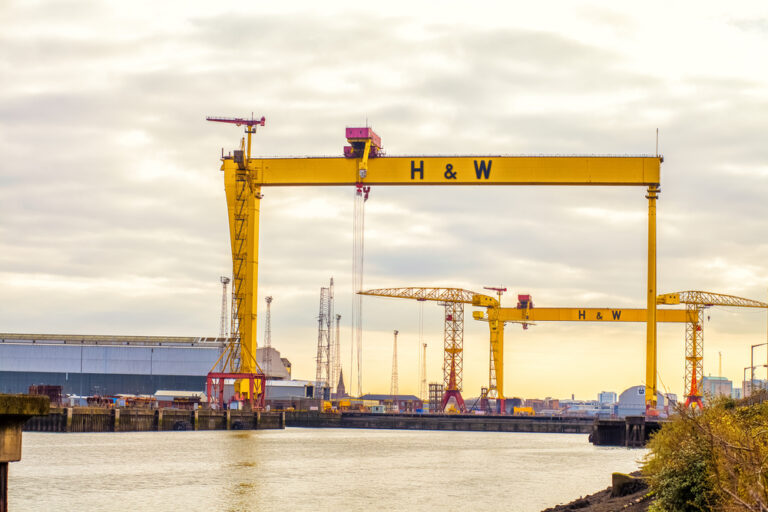
Its Belfast yard is one of Europe’s largest heavy engineering facilities, with deep water access, two of Europe’s largest drydocks, ample quayside and vast fabrication halls. 

The group also has two Scottish-based yards, focused upon work for the renewables, energy and defence sectors.

In addition, it also has a sizeable undercover drydock at Appledore.

The group also owns the Islandmagee gas storage project which is expected to provide 25% of the UK’s natural gas storage capacity.

Analyst Opinion – reiterating the Buy recommendation

Analyst Peter Renton at the group’s NOMAD and Joint Broker Cenkos Securities has a Buy recommendation out on the company’s shares.

His estimates for the current year to end December look for a 350% rise in group revenues to £100m and then for 2024 a doubling of that figure to £200m.

On the basis of those figures, he looks for a pre-tax loss this year of £34.1m falling to £20.0m next year.

Conclusion – shares could easily double

If all this was not good enough to excite investor interest, it is well worth noting that the group’s management estimates that the sale of 100% of the Islandmagee gas storage development project could generate between £35m to £50m – that is more than the group’s current market capitalisation of £30m, with its shares at 17.15p.

They have trebled in price since last November and have peaked at 29p within the last year.

At the current price medium-term investors could easily see the shares double.

AIM movers: T42 IOT shipping container focus and Inland Homes resignations

0

T42 IOT Tracking Solutions (LON: TRAC) says 2022 revenues were around $4m, with 50% coming from SaaS contracts. There is an increasing focus on the shipping container sector and new orders have been won that will boost revenues in 2023. A significant improvement in revenues is being targeted for 2023. There could even be add-on acquisitions. The share price rose 13% to 6.5p.

Cadence Minerals (LON: KDNC) provided a corporate update this morning. The Hastings Technology Metals share price has fallen thereby reducing the value of the stake received when Cadence Minerals swapped its 30% stake in mineral concessions in the Yangibana rare earths project. Even so, Hastings is making progress in developing the mine and ore reserves increased by one-quarter to 20.93Mt at 0.9% total rare earth oxide grade. That increases the mine life to 17 years and production could start in 2024. Shipping of iron ore concentrate from the Amapa iron ore project should recommence in the next six months. The share price is 7.66% ahead at 14.4p.

ValiRx (LON: VAL) has incorporated a new subsidiary called Inaphaea BioLabs, which will offer pre-clinical and drug testing services. It will also undertake work previously outsourced by ValiRx. The share price improved 6.67% to 12p.

Accrol (LON:ACRL) has signed a licensing agreement with Unilever, which will enable the tissue products manufacturer to sell a kitchen towel product under the Lifebuoy brand. This is a brand with strong recognition among consumers. This will be a higher priced product than the products currently produced by Accrol. A new paper mill is being built. The share price increased 7.58% to 33.35p.

Non-executive directors of Inland Homes (LON: INL) have all resigned because of related party issues that they were not informed about at the relevant times. That would leave the residential property developer with one director, so Simon Bennet is staying on for a fortnight so another director can be appointed – if not the shares will be suspended. Founder Stephen Wicks is likely to return to the board. There will be further announcements about the related party issues. The share price slumped 23.3% to 7.75p, which is a new low.

Waste-to-energy technology developer EQTEC (LON: EQT) has been unable to complete the share purchase agreement between Deeside WTV Ltd and Logik WTE. The agreed date has passed but discussions continue. EQTEC is also talking to other potential investors in the Deeside project, which includes material recovery and anaerobic digestion facilities. This will delay revenues for EQTEC. Altair Group has reduced its stake in EQTEC from 18.2% to 12.2%. The share price dived 17.7% to 0.255p.

Artemis Resources Ltd (LON: ARV) is raising A$2.55m at A$0.015 a share and exploration activities are likely to restart after the strategic revies is complete. Trading as recommenced on ASX. The carrying value of the Fox Radio Hill processing plant will be impaired by A$12.5m. The share price is down 13.3% to 0.845p.

Communications services provider Mobile Tornado Group (LON: MBT) is raising £500,000 through a subscription at 2p a share and capitalising £259,490 of debt owed to InTechnology at the same share price. The market price fell 4.76% to 2p. Avi Tooba resigned as chief executive in January, although he remains with the company. The focus is building up the customer base.

Aston Martin Lagonda Global Holdings – where is Goldfinger when you need him?

Lawrence Stroll, boss of the iconic car brand, has declared that the group ended 2022 with its strongest order book in years and that he is highly confident that it will achieve the target to deliver 10,000 wholesales over the coming years, and with it, a significantly enhanced financial performance.

Aston Martin Lagonda Global Holdings (LON:AML) has reported a 26% improvement in revenue in the year to end December 2022 to £1.38bn (£1.09bn), while its adjusted operating loss was 59% higher at £117.9m (£74.3m).

The Group Operations

Tracing its roots back to 1913 this group, which was founded by Lionel Martin and Robert Bamford, and from 1947 was led by David Brown. Over the years it has endured seven bankruptcies and transformed its operations substantially.

Today the company designs, creates, and exports cars.

The group manufactures its sports cars range in Gaydon, Warwickshire while its luxury DBX SUV range is manufactured in St. Athan, Wales.

The company’s activities take in the design, development, manufacture, and marketing of vehicles, as well as the sale of parts, servicing, and automotive brand activities.

The group’s products in the ultra-luxury automotive space, include GT, Sport, Super GT, SUV, mid-engine supercar, mid-engine hyper car, and sedan.

Its current models include the Vantage, DB11, DBS, DBX, the Aston Martin Valkyrie, and Valhalla.

Outlook – year on year growth sought

Group CEO Amedeo Felisa stated that:

“We remain on our way to achieving our target of c.10,000 wholesales, aligned with our ultra-luxury strategy.  In addition, we are well on track to deliver our medium-term financial targets of circa.£2bn revenue and circa £500m adjusted EBITDA in 2024/25.

For 2023 we expect to deliver significant growth in profitability compared to 2022, primarily driven by an increase in volumes and higher gross margin in both Core and Special vehicles. More specifically, we expect significant year-on-year growth and positive free cash flow in the second half of the year.”

Conclusion – profitability to improve this year

The scars of this group’s corporate history should be healing by now, especially after the additional funding given last year.

A year ago the company’s shares were trading at over 1050p each, since when various mishaps have helped them collapse to a low of 85p, that was at the start of November last year.

Ahead of the latest figures they were looking a lot steadier at around the 200p level before the results.

On the results news they have leapt 9% to 218p in reaction.

Persimmon shares sink on forecasts of lower margins, sales and completions

Persimmon’s full year results cast a shadow over their performance in the coming year despite an increased number of completions and higher average sales prices in 2022.

Persimmon shares were down over 8% following an update punctuated with warnings over the outlook for 2023 as the housebuilder battles higher mortgage rates and the cost of living crisis.

Commenting on the outlook for 2023, Persimmon CEO Dean Finch said “the sales rates seen over the last five months mean completions will be down markedly this year and as a consequence, so will margin and profits.”

The company said their forward sales rates fell to 0.3 in the fourth quarter of 2022 but had rebounded to 0.52 in the first eigth weeks of 2023.

“Persimmon, like its peers, has seen a slight pickup in sales since the start of the year. But overall, the outlook for the year ahead remains downbeat,” said Charlie Huggins, Head of Equities at Wealth Club.

“New home buyers are clearly exercising greater caution, and frankly who can blame them. Mortgage payments for first time buyers have significantly increased over the past year. When combined with the limited availability of high loan to value mortgages and the end of the Help to Buy scheme in England, it’s no surprise that the housing market has seen a marked slowdown.”

Persimmon 2022 results

Although the market rightly focused on the outlook for the year ahead, 2022 wasn’t a complete disaster for Persimmon.

New home completions rose to 14,868 from 14,551 and the average sales price rose to £248,616 from £237,078.

Operating profit for 2022 increased to £1,006.5m on an underlying new housing margin gross margin of 30.9%.

Three Important Things To Look For In An Investment App

According to research by Business of Apps, over 130 million people in the UK use an investment app to manage their portfolios. As a result, new apps are continuously being introduced to the market to keep up with growing demand. While most of these apps are safe to use, some apps could put your money at risk. To ensure that you choose the best investment app in 2023, here are three important things to look for.

1. Security

One of the most important factors that you simply cannot overlook when choosing an investment app is security and regulation. The best investment apps in the UK will adhere to strict security protocols that will protect your funds as well as your personal information. 

Some key security features to look for include multi-factor authentication, password protection, data encryption and regular malware removal. It is also worth checking whether the app has been registered with a regulatory body such as the Financial Conduct Authority (FCA). Each of these factors will help to keep your money safe when using an investment app. 

Additionally, investment apps should never share your personal information with third parties – especially your bank details! You can typically find out whether or not an app does this by reading through the terms of use. This is an important factor to look out for before putting any money on the line.

Image source: Pexels | Image owner: Anna Shvets

2. Customer support 

Investment apps should offer effective support services to their customers so that issues can be fixed promptly and efficiently. If an app doesn’t offer sufficient support, you may be unable to solve problems which could leave you at a loss. The absence of customer support is also a sign that an app isn’t reliable

The best mobile investing apps should offer several customer support services such as live chat, a helpline and in-depth FAQs. While you may not need these at first, having access to great customer support could be very helpful in the long run!

3. Educational resources

It is a good sign if an investment app offers resources that can be used to improve your knowledge and help you make better investing decisions. When deciding which app to use, try to look for an app that offers a range of educational resources and research tools so that you can make the most of your investments. 

Understanding how to make smart investment decisions can prevent you from making investment mistakes and reduce your risk of loss. Some of the most popular investment apps provide users with detailed guides, videos and even courses that can help you to improve your skills. It is always worth checking if these are provided before signing up for a platform.

Conclusion

Investment apps are a great way to access the stock market and build your portfolio in 2023. However, choosing the wrong app could put your money at risk and cause problems in the long run. To be safe, we recommend looking for the three factors mentioned above when deciding which investment app to use. It is also worth noting that profits can never be guaranteed, so always be prepared to lose what you invest.

FTSE 100 hit by stronger pound

A stronger pound sent the FTSE 100 lower on Tuesday as the Brexit deal on Northern Ireland helped lift sterling against the dollar.

The breakthrough agreement saw GBP/USD rise 0.5% to 1.2131 and FTSE 100 slip back beneath 7,900.

While the agreement is good news for the UK economy and UK companies, it is not favourable for London’s leading index packed full of companies earning their revenue overseas. The FTSE 100’s overseas earners suffer in periods of sterling strength, and are supported by a weaker pound.

The FTSE 100’s inverse relationship with the pound has become prevalent in periods of market volatility related to Brexit negotiations ever since the vote to leave in 2016. Today’s deal between the UK and EU was no exception.

FTSE 100 sectors exposed to the UK including financials, banks and housebuilders rallied on the agreement, but their support was not enough to offset losses in overseas earners. Kingfisher was a notable riser, gaining 4%.

Heavyweights including AstraZeneca, Diageo, Unilever and British American Tobacco were all weaker on the day and dragged on the index.

Ocado

A disappointing update from Ocado meant the premium online retailer was the FTSE 100’s worst performer, falling as much as 10%.

Ocado’s 2022 revenue edged fractionally higher but the cost of living crisis was blamed for lower average basket sizes and there was little improvement in their solutions business EBITDA.

“Ocado: so much promise and so little joy. Three years ago, it was on the cusp on a significant shift in consumer behaviour. The pandemic forced people to buy their groceries online, meaning any company that didn’t have a robust set-up to pack and deliver food and drink to households had to think fast to gain this capability,” said Russ Mould, investment director at AJ Bell.

“Ocado had the best moment in its existence to sell its technology platform to grocers around the world. Sadly, the deals have been few and far between, leaving investors wondering when it will ever make a sustainable profit.”

abrdn

Investors were pleased with abrdn’s robust 2022 full report and confirmation their strategic plan was beginning to bear fruit. A focus on their Adviser and Personal business, which includes the acquisition of Interactive Investor, helped offset weaker revenue from their Investments unit due to poor market conditions.

“We are building a stronger abrdn. As we exit year two of our three-year strategic plan, the structure of our group is now broadly set. We are increasingly well positioned for growth,” said Stephen Bird, Chief Executive Officer of abrdn.

“In one of the toughest investing years in living memory, the resilience we have created in our business model helped us to deliver adjusted operating profit of £263m.”

abrdn shares were 4% higher at the time of writing.

Videndum – record results point to an even better 2023

FTSE 250 company Videndum (LON:VID) is certainly growing at a very good pace.

The international provider of premium branded hardware products and software solutions to the growing content creation market, has reported excellent results for its 2022 Trading Year.

With 90% of its revenue coming from professional content creators, the group showed an impressive 14% growth in sales to £451m (£394m), with a 27% advance in pre-tax profits to £54.0m (£42.4m), taking earnings up 29% to 90.1p (69.9p), enabling an increase of 14% in its dividend to 40p (35p) per share.

CEO Stephen Bird stated that:

“Videndum delivered another record performance, despite a challenging H2 2022 macroeconomic environment. This is testament to the quality of our people, operational excellence and our leading, premium brands which allow us to manage pricing to more than offset inflationary headwinds. We executed well on our strategy, delivering organic growth, margin improvement, good cash generation and growth through M&A.”

The Business

Uniquely positioned at the heart of the content creation market, the group which used to be called The Vitec Group, has been transformed over the last decade.

Videndum’s customers include broadcasters, film studios, production and rental companies, photographers, independent content creators, vloggers, influencers, gamers, professional sound crews and enterprises.

The group’s product portfolio includes camera supports, video transmission systems and monitors, live streaming solutions, smartphone accessories, robotic camera systems, prompters, LED lighting, mobile power, carrying solutions, backgrounds and motion control, audio capture and noise reduction equipment.

Employing some 2,000 people across the world in 11 different countries, the business is organised into three Divisions: Media Solutions, Production Solutions and Creative Solutions.

The fundamental growth drivers of the business have remained very positive, underpinned by technology change driving shorter product replacement cycles.

The group’s market-leading, premium brands allow it to manage inflationary headwinds with pricing actions and to manage its supply chain challenges.

Conclusion – market price estimates of 1500p for the shares

The £423m capitalised group has shown a very impressive trading year in 2022, hopefully it will continue to do so in 2023.

The company’s shares fell 20p to 910p on the results, but there are currently market estimates suggesting a Target Price of over 1500p in the due course.

Travis Perkins, Cadence Minerals, and Kavango Resources with Alan Green

Alan Green joins the UK Investor Magazine Podcast for our regular instalment of companies and markets.

This week, we discuss:

  • Travis Perkins (LON:TPK)
  • Cadence Minerals (LON:KDNC)
  • Kavango Resources (LON:KAV)

We start with exploring the current FTSE 100 trading range and whether a break to the upside, or downside, is more likely.

The first company we discuss is Travis Perkins and their full year results. Cost inflation has dogged numerous companies and Travis Perkins is not immune. Travis Perkins revenue rose 8.9% but operating profit margin was eroded by higher input prices.

Cadence Minerals has a broad portfolio which is broken down and attention paid to their current valuation.

Download Kemeny Capital Cadence Minerals report.

We conclude with a look at Kavango Resources.

AIM movers: Safestay occupancy recovers and Baron Oil disappoints

1

Hostels operator Safestay (LON: SSTY) generated higher than expected revenues in 2022 as occupancy levels continue to rebuild reaching 63%. There are Safestay hostels across Europe in cities, such as Barcelona and Pisa. Revenues were £19m, compared with a forecast of £17.9m. A small pre-tax loss is forecast with a move back to profit expected this year. The share price jumped 27.5% to 25.5p, which is the highest it has been for nearly three years.

Diagnostics tests developer Abingdon Health (LON: ABDX) says interim revenues fell from £1.7m to £1.1m but second half revenues will be significantly higher. Abingdon Health has broadened its customer base. There is £4.4m in the bank. Breakeven could be achieved during 2024. The share price recovered 15% to 5.75p.

Online brand protection services provider Brandshield Systems (LON: BRSD) increased annual recurring revenues by three-fifths to $8.42m, with client numbers almost trebling to 183. More than two-thirds of customers are in North America. The trading statement says that reported 2022 revenues are 55% ahead at $6.39m, but there will be a significant loss. Shore expects 2023 revenues of $9.4m and a reduced loss. The share price moved up by 13.7% to 5.8p, but it is still near to its low since Brandshield reversed into Two Shields Investments.

WH Ireland has upgraded its 2023 forecasts for LifeSafe Holdings (LON: LIFS) after the fire safety products supplier published a full year trading statement. The 2022 revenues were £3.9m, having been £1.3m at the interim stage. US sales are accelerating. The 2023 forecast revenues have been raised from £5.5m to £6.5m with a slight reduction in the loss to £400,000. The share price reached a new low on Monday but is 12.1% ahead at 37.5p.

Baron Oil (LON: BOIL) has published the competent person report on the 75%-owned Chuditch gas project, which shows lower than expected prospective resources. Even so, Allenby believes that the 1.1tcf contingent resource for the Chuditch-1 discovery underpins the potential and it has increased its risked valuation of Chuditch to 1.027pa share. Baron Oil has until 18 June to make a drill or drop commitment. The share price fell 15.1% to 0.175p.

Super capacitors developer CAP-XX Ltd (LON: CPX) has been hit by supply problems and destocking. Interim revenues fell by one-third and the second half recovery will not be as strong as previously thought. Cenkos has cut its 2022-23 forecast revenues from A$8.33m to A$4.18m and slashed its estimate for next year. CAP-XX is expected to move to a net debt position by June 2023. The share price is 10.2% down at 2.65p – a new low for the year.

Beowulf Mining (LON: BEM) says there was a 73.5% take up of its rights issue, which raised £5m. This is on top of the £1.4m raised in a placing and PrimaryBid offer at 2.06p a share. The share price fell 9.89% to 2.05p. There was £1.78m in the bank at the end of December 2022, but also £1.85m of borrowings. The cash outflow from operations and investing in 2022 was just over £3m.

Block Energy (LON: BLOE) has started testing on the WR-B01Za well in the West Rustavi / Krtsansi field in Georgia. Data indicates a good reservoir containing oil and significant gas. Even so, the share price declined 9.52% to 0.95p.

McBride – a much cleaner profits recovery is in sight

We all know this group’s household and personal care products and it sells over 1bn of them a year.

It is the leading European manufacturer and supplier of private label and contract manufactured products for the domestic and professional cleaning/hygiene markets,

However, over the last couple of years its trading has been tough.

The pace of cost inflation and price increase negotiation time lags helped to push the group into significant losses.

But it is now becoming apparent that measures taken by the group’s Management have been effective and will take it back into profitability in its next year to end June 2024.

For the six months to end December from its continuing operations the group had a turnover of £426.3m (£323.4m).

The half-year adjusted operating loss of £7.9m (£16.9m) was due primarily to exceptional raw material, packaging, logistics, energy and labour cost rises, which were unable to be fully recovered by price increases in the first half. 

 CEO Chris Smith stated that:

“The first half year required continued high levels of attention to margin recovery in light of ongoing inflationary pressures. Whilst there are some early signs of stabilisation in certain input costs, many raw material costs remain historically high. Energy and employment costs continue to apply further inflationary pressure, and accordingly, we continue to action mitigations including price increases, product engineering and cost control.

It is pleasing to have returned to positive adjusted operating profit in the last two months of the period, with momentum improving into the second half as a result of higher volumes from new business wins, better customer service levels and pricing actions fully annualising. All of this is supported by consumer behaviour creating a more favourable environment for private label products.

Group Operations

Established way back in 1927, the Manchester-based McBride (LON:MCB), manufactures and sells private label household and personal care products to retailers and brand owners in the UK, Germany, France, Australia, the rest of Europe, the rest of Asia-Pacific, and otherwise internationally.

The company operates through five segments: Liquids, Powders, Unit dosing, Aerosols, and Asia Pacific.

It employs 3,400 people across 18 locations in 12 countries.

The group develops, manufactures and distributes products for both Private Label clients in the retail segment and Contract Manufacturing for established brands. 

In addition, it also has a growing portfolio of its own successful brands within the household category.

Analyst Opinion – estimates of profits in the next year

The consensus view is that the group will this year, to end June, see sales up £200m to £874m, while the massive £35.3m loss of 2022 will be sliced back by £10.0m to £25.3m.

For the coming 2024 June figures some £911m sales are estimated, with a bounce back to £3.55m of pre-tax profits.

Conclusion – shares could move forward again

Five years ago this group’s shares were trading at around 160p, a year ago they were down to 50p.

They are now 24p, at which level the whole group is only valued at £42.5m.

With the hopes of a recovery into profits over the next year or so the shares could well start to move forward again.