Fiinu shares: FTSE AIM fintech to consider for 2023

Fiinu Bank (LON:BANK) will soon offer a Plugin Overdraft solution to millions of customers without anyone needing to switch their existing bank. The stand-alone unbundled overdraft can potentially be a Monzo-like phenomenon, and the long-term investing opportunity is immense.

About four years ago, 32 million people — or 62% of the population — used some form of overdraft annually. Today, only about 20% of the 100 million personal current accounts population include access to overdraft, whilst the cost-of-living crisis is increasing the demand.

The gap between supply and demand has resulted in over £10 billion short-term credit funding gap in the market and an increase in non-bank lending. By way of example, more than 21 million have resorted to BNPL, and according to FCA, some of these alternatives can have adverse effects on credit files. Fiinu’s primary research suggests that 53% of the population would be very likely to add a Plugin Overdraft to their current account for as long as they didn’t need to change their bank. Fiinu Bank plans a soft launch in late spring and a full launch this summer.

According to Panmure Gordon’s research (Jan 2023), the FTSE AIM fintech group with a ticker “BANK” could fetch a valuation of £1.2 billion — though, as usual with AIM investing, this is not a risk-free trade.

Plugin Overdraft: how it works

Fiinu was founded in 2017, by second-time entrepreneur Dr Marko Sjoblom, as a fintech platform and a provider of consumer banking products. The publicly listed group comprises two separate businesses: Fiinu Bank, which has been granted a restricted deposit-taking, will offer the flagship Plugin Overdraft, and Fiinu Services Ltd, which will provide Bank Independent Overdraft platform to other banks.

Podcast: Fiinu Plc: why this newly London-listed FinTech could be the next Monzo-like phenomenon

Fiinu CEO, Chris Sweeney

The Plugin Overdraft is an ‘unbundled’ overdraft solution. Fiinu provides customers with an overdraft facility by intelligently using the Open Banking scheme without anyone needing to switch their current account away from their present bank. Fiinu Bank loan book is funded through one-year fixed-term deposits, FSCS-guaranteed of up to £85,000.

The solution gives the customer access to mainstream credit, an overdraft, from a third-party bank, and unlike some non-bank alternatives, it does not negatively impact their credit score. According to the Experian website, an overdraft in the credit file can improve credit scores.

After receiving the restricted deposit-taking licence in July 2022, Fiinu is now in the ‘mobilisation’ period, where newly authorised banks typically operate for 12 months before fully opening up to trade. 

As with any other retail bank authorised by the Bank of England regulators, the PRA and the FCA, the company is currently undergoing its technical audit. It is also advancing its operational capabilities, recruiting senior managers, building out risk, internal audit, and compliance functions, investing in IT systems, contracting with third-party suppliers, and finalising the company’s recovery plan. At the same time, the PRA/FCA continue to assess whether the group is ready to exit mobilisation and become fully operational.

For context, the total deposits a new bank can accept in the mobilisation period is just £50,000 — little more than pocket change in banking terms. Fiinu plans to exit the mobilisation by 7 July 2023 after submitting a Variation of Permission to the PRA/FCA alongside evidence that required actions and capital is in place.

Fiinu FTSE AIM IPO

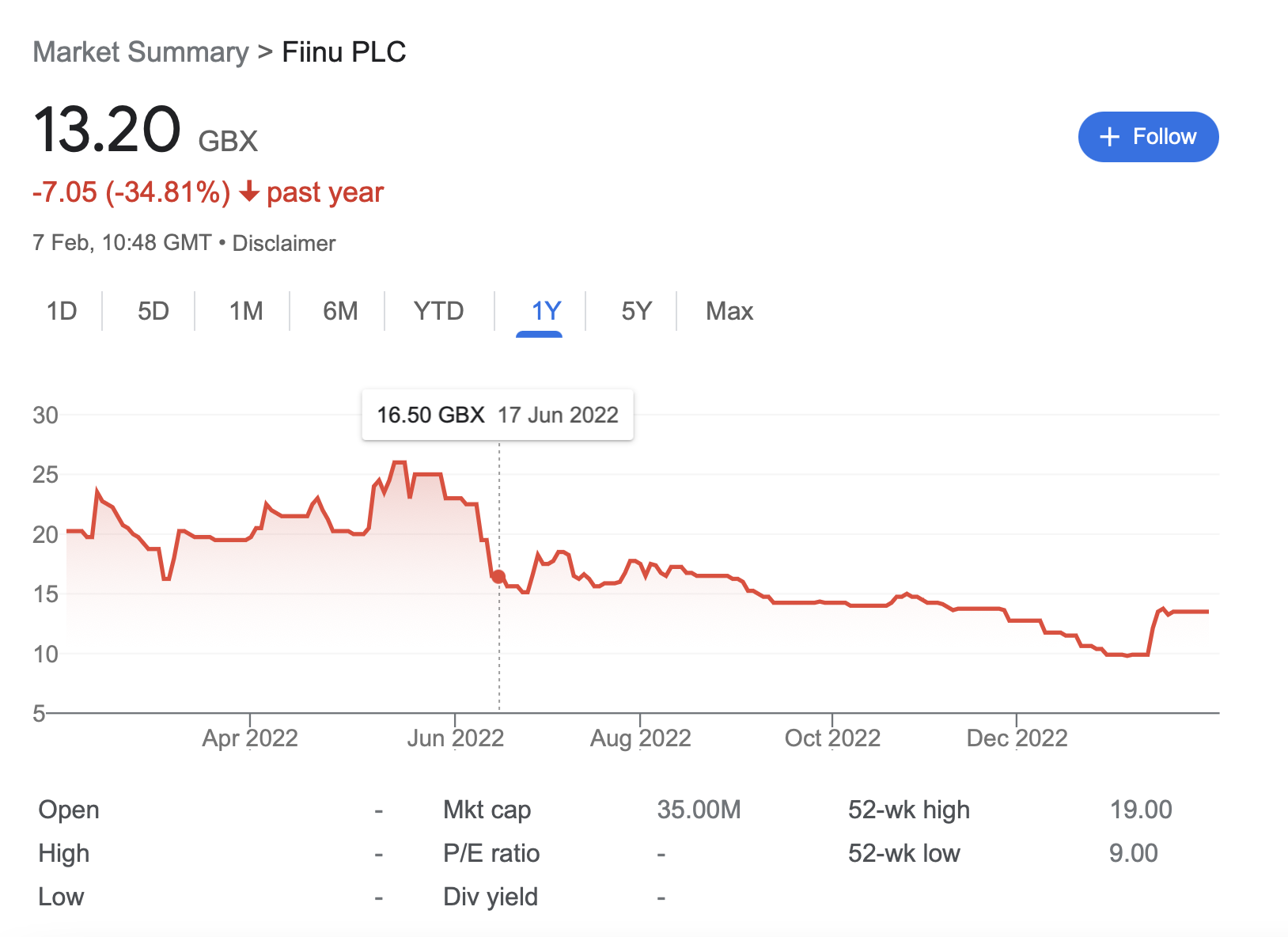
Fiinu launched its IPO mid-July with a valuation of circa £53 million (20p a share). In common with most tech-focused companies, the AIM company has fallen in value to circa £35 million just after launch. However, it’s risen by a third over the past month, with the volatility suggesting it remains in price discovery.
It’s worth noting that gaining its banking licence and launching the IPO was a five-year process. CEO Chris Sweeney argues that the company’s ‘unique Plugin Overdraft is the gateway to better financial inclusion and a welcome addition of a product made possible through Open Banking.’

Meanwhile, the founder, Dr Marko Sjoblom, believes the platform will ‘create a new market where unbundled overdrafts will increase financial fairness and freedom for everyone, everywhere.’ The company raised £14 million when it became public and expected to raise further funds by the end of the mobilisation period.

Recent developments

On 19 December, Fiinu announced that TransUnion will be ‘supporting Fiinu Bank to help enable its innovative overdraft solution, using TransUnion Open Banking capabilities and credit reference data.’ The Open Banking information will be used to check eligibility without impacting anyone’s credit score.

TransUnion director Stephen Wishart notes that ‘the use of TransUnion Open Banking capabilities, alongside our credit reference data, will provide a comprehensive view of the individual’s financial situation, helping Fiinu to assess the finance that’s right for the individual’s needs.’

Most recently, the FTSE AIM company provided an operational update on 26 January in advance of full year-financial results expected in April. Describing the ‘significant progress’ made since the IPO, the company listed a reel of achievements; signing a contract with core banking platform Tuum, hiring key management personnel, signing a contract with a decision engine services provider, and selecting a critical Payment Initiation Service Provider.

In addition, Fiinu has received regulatory senior management functions (SMF) approval for the CFO, chief risk officer, and chair of the board risk committee. As is the core banking platform configuration and testing, all key microservices to support new customer onboarding and payments are now completed. System integration testing is currently ongoing with support from contractor Maveric NXT to provide assurance testing. 

And most importantly, the FTSE AIM company remains on target to ‘exit from mobilisation following the required capital raise and subject to regulatory approval’ in July 2023.

However, the bank needs to raise £35-40 million before it exits mobilisation. But confident it will achieve this in the set timeframe and promises to ‘provide further regular updates as the business plan progresses over the coming months.

Potential valuation

Before getting into the specifics, there are three general points to consider for a potential valuation.

First, the UK and the world are generally on the straits of tightening monetary policy, with the UK base rate at 4% and rising. This is sub-optimal for a fintech like Fiinu seeking to get finance on decent terms — and it will need further financing to become self-sustaining; however, retail deposits tend to be the cheapest form of loan-book funding, especially in comparison to wholesale funding.

Second, valuing a company on its potential is, by its very nature, an imprecise exercise with a wide degree of variance. Fiinu has a banking licence, an excellent business idea, and a solid roadmap to profitability. However, things do go wrong, and this is not a risk-free investment — capital risks, credit risks, interest rate risks, liquidity risks, operational risks, and even potential conduct risks are the common pitfalls. Fiinu is not immune to these problems.

The third point is that Fiinu has serious potential. Other fintechs which have spotted a lucrative gap in the market — including Monzo and Wise — have jumped to multi-billion-dollar valuations. Wise has unbundled international transfers from the personal current accounts and proven the model as its valuation is nearly £6 billion.

This could be a similar opportunity to get in on the ground floor for those with a healthy risk appetite. Getting a UK banking licence is no easy task — possibly the most significant hurdle — which has already been cleared.

Now for the details.

Panmure Gordon analysts have put together an excellent research note and extrapolated their opinions based on a realistic hypothetical future model.

Under their model, they expect that Fiinu will grow to 500,000 customers within five years of operation, breaking even in year three, becoming fully profitable in year four, and will have broken even in aggregate by the end of year five.

Breaking this prediction down, they expect 75,000 net new customers in year one, another 75,000 in year two, and then further scaling up in years three to five. Panmure assumes initial average lending of £300 per client, with each use of the Plugin Overdraft lasting for circa 120 days per year/10 days per month. In terms of pricing, it assumes a competitive 32bps.

However, as previously mentioned, Fiinu must find £35-40 million in equity funding in the next four months. Panmure estimates this will need to rise to £100 million based on ‘conservative base case assumptions over the first few years of operation.’ To put this in context, Monzo needed to raise over £450 million in the same period, which is still loss-making.

For perspective, more rapid growth or collaboration with other financial services companies will require more capital to scale up and ensure smooth customer access to credit. However, such an increased growth rate would act as proof of work to potential lenders; therefore, additional financing would be reasonably easy to access.

But under Panmures, many assumptions, including that the customer base grows to 700,000 customers by year 10 — which seems a reasonable target — a DCF valuation would suggest an implied value of £1.2 billion within the next decade.

I think the terms and sourcing of Fiinu’s required financing is the key hurdle to overcome. After that, one problem that the company may have understated is getting those first 75,000 customers in year one; they may be underestimating just how hard it is to get UK consumers on board with new products, especially credit products, even if it is in their own best interests.

My final comment is Fiinu’s future competition problem.

Fiinu is currently targeting customers excluded from arranged overdrafts by traditional banks who must now seek far more expensive finance elsewhere. Suppose Fiinu can demonstrate that it can profitably offer overdrafts to these excluded customers. In that case, banks may again offer these customers overdrafts on better terms.

Fiinu would then compete for customers with the multi-billion-dollar titans. However, this is a future problem, most likely for the 2030s rather than today.

And at 13.2p per share, Fiinu is a solid speculative FTSE AIM opportunity for 2023.

This article has been prepared for information purposes only by Charles Archer. It does not constitute advice, and no party accepts any liability for either accuracy or for investing decisions made using the information provided.

Further, it is not intended for distribution to, or use by, any person in any country or jurisdiction where such distribution or use would be contrary to local law or regulation.


AIM movers: Zinc Media momentum and Bens Creek selling

4

TV programmes producer Zinc Media (LON: ZIN) says 2022 revenues beat recently upgraded estimates through organic growth and a better than expected contribution from recent acquisition The Edge. That should mean that the loss should be lower than the £1.4m forecast. Zinc Media has already secured £15m of revenues for 2023, compared with the full year forecast of £35.7m. There is £3.8m of cash. The share price jumped 15.6% to 96.5p.

Smart building software provider Smartspace Software (LON: SMRT) increased revenues by 36% to £7m in 2022-23. The loss fell and the company should be near to breakeven this year. More than two-thirds of revenues are recurring. Workplace optimisation and customers trying to reduce costs should help Smartspace Software. There are opportunities to sell other services to existing customers. The share price improved 14.3% to 48p.

Live Company Group (LON: LVCG) is creating a 50/50 joint venture with M Group, which will invest £630,000, called Live Company Japan KK. This will generate a licence fee of £100,000 for Live Company Group. The share price moved off its recent low by rising 13.5% to 2.1p.

Sportingbet founder Mark Blandford has joined online gaming company B90 Holdings (LON: B90) as a strategic adviser. Sportingbet started out on Ofex (now Aquis Stock Exchange) before moving to AIM in 2001 and then to the Main Market before being taken over by William Hill and GVC (Entain (LON: ENT)). Yesterday, £500,000 was raised via convertible loan note. The share price is 1.5% higher at 3.625p.

Further buying of shares by a director has helped the Unbound Group (LON: UBG) share price to recover. Non-exec Alastair Miller bought an initial 416,396 shares at 4.8p a share. Premier Miton previously cut its stake in the footwear retailer from 13.6% to 7.83%. The share price rose 9.37% to 5.25p.

Selling has hit coal miner Bens Creek (LON: BEN) shares There have been many trades worth between £100,000 and £900,000 at 18p a share and another worth £3.8m at 17.1p a share. The share price has slumped 18.8% to 19.5p.

Morses Club (LON: MCL) shares continue to fall ahead of the cancellation of the AIM quotation on 13 February. Asset Match will provide a matched bargains facility for the shares. They slipped a further 17.8% to 0.3p and that is an all time low.

In 2022-23, the profit of Sanderson Design Group (LON: SDG) was in line with expectations, but cash is lower than forecast. The interior furnishings supplier grew licensing revenues by 23% and this will help it meet the pre-tax profit forecast of around £12.7m, even though overall revenues were slightly lower than expected. Net cash was £15.2m at the end of January 2023, because inventory remains high. The share price fell 7.6% to 121.5p.

Founder Richard Mays has stepped down as a non-executive director of Prospex Energy (LON: PXEN). He says he is still committed to the long-term prosperity of the oil and gas company. He owns 1.4 million shares having sold 1.34 million shares at 14p each during January for tax-related reasons. The share price is 2.78% lower at 17.5p.

FTSE 100 helped higher by BP and UK banks

The FTSE 100 was a beneficiary of major oil results on Tuesday with BP echoing Shell in releasing surging profits for 2022 alongside increased returns to shareholders.

BP shares were 5% higher at the time of writing on Tuesday with Shell jumping on BP’s tailcoats and gaining 2%. The combination of both companies gains added a significant number of points to the index and helped the FTSE 100 higher by 0.5% to 7,879.

“BP may be enemy number one in the public’s eyes for its record profits, but its latest success has helped to drive up the FTSE 100, which in turn will benefit people up and down the country with exposure to UK stocks in their pension,” said Russ Mould, investment director at AJ Bell.

As the FTSE 100 bounces back from a soggy session yesterday, traders will be eyeing all time highs of 7,901 set on Friday last week.

UK Banks

UK banks were among the top risers as we approach quarterly updates from Lloyds, Barclays and Natwest. Lloyds is scheduled to release full year results 22nd February and Natwest’s and Barclays results are due 17th February and 15th February respectively.

UK banks have been benefitting from higher interest rates but investors will be watching closely for any provisions for bad debts caused by softer economic conditions.

Lloyds, Barclays and Natwest were trading between 1% to 1.5% higher at the time of writing.

With the banks and oil majors rising, there was notable risk-on tone to equity trade on Tuesday which also saw cyclical sectors such mining and the housebuilders gain.

“Over the past month or so, investors have become more optimistic that we’re near the top of the rate rise cycle, hence why you’ve seen higher-risk companies do well on the stock market,” Mould said.

“If this optimism turns out to be misplaced then we’ll likely see investors flock back to sectors where you can typically find value stocks such as banking, energy and tobacco. In a way, today’s movement on the FTSE 100 already reflects this investor thinking.”

Sanderson Design Group – strong product sales and licensing income offset by Russian pull-out

The £94m capitalised Sanderson Design Group (LON:SDG) is a luxury interior furnishings company that designs, manufactures and markets wallpapers, fabrics and paints. 

In its latest Trading Update the group reported strong performances from the Morris & Co. brand, licensing and North America were offset by the group’s withdrawal from the Russian market, and a small decrease in manufacturing revenue.

The company’s high-margin licensing activities performed very strongly in the year to end January 2023, with revenues up approximately 23% at £6.4m, buoyed by the signing of new agreements and the renewal or expansion of existing licensing arrangements. 

Overall total revenue for the group for the last year was £112.0m (£112.2m), while the end-year net cash position was £15.2m.

The Business

The company derives licensing income from the use of its designs on a wide range of products such as bed and bath collections, rugs, blinds and tableware.

The group’s brands include Zoffany, Sanderson, Morris & Co., Harlequin, Scion, Clarke & Clarke and Archive by Sanderson Design. Its products are sold globally.

The group, which employs some 600 people, has showrooms in London, New York, Chicago, Amsterdam and Dubai. 

Analyst Opinion – still rated as a Buy, looking for 205p

Matthew McEachran at Singer Capital Markets rates the group’s shares as a Buy, looking for 205p as his Target Price.

He goes for adjusted pre-tax profits of £12.7m (£12.5m), with earnings of 13.9p (13.0p) and a dividend of 3.69p (3.50p) per share.

His estimates for the current year now underway are for £116.1m sales and a slightly lower £12.0m profit, with earnings of 12.7p and a standstill dividend of 3.69p per share.

David Jeary at Progressive Research considers that the group managed to steer a steady course in uncertain times.

His estimates for the last year are for adjusted pre-tax profits of £12.7m, worth 14.3p per share in earnings.

He expects to review his 2024 estimates when the group reports its final figures in April.

Conclusion – treading water

The group’s shares at 131p are likely to tread water for a while yet.

The opportunity in deglobalisation with RBC Wealth Management’s David Storm

The UK Investor Magazine was thrilled to welcome David Storm, Chief Investment Officer for British Isles and Asia at RBC Wealth Management.

David provides a comprehensive assessment of the global economy before discussing RBC’s approach to capital allocation.

We start with an exploration of the current macro environment and discuss how deglobalisation is impacting growth due to supply-chain disruptions and increasingly hostile trade relations.

This leads us into the inflationary environment and David explains why he thinks market expectations may be disconnected from reality as we move towards the end of the tightening cycle.

We finish with a look at specific asset classes and equity sectors gaining the attention of RBC’s Multi-Asset portfolio managers.

REACT Group – LaddersFree helping the cleaning group to step up

This group’s profits could treble this year.

REACT Group, the leading specialist cleaning, hygiene, and decontamination company, reported a 78% lift in its revenues in the year to end September 2022, to £13.7m (£7.7m).

The group saw its adjusted EBITDA up 20.0% at £953,000 (£795,000).

The performance represents a strong like-for-like organic growth of some 17% enhanced by the £8.5m acquisition of LaddersFree in May 2022, which contributed to the second half of the financial year. 

The Business

Momentum from the final few months of the previous year has continued into the new financial year, and despite the usual slow down across the festive period, the first quarter has delivered a record performance for the group.

The group reports three main areas of business; firstly, Contract Maintenance, where it delivers regular cleaning regimes, (such as in the healthcare, education, retail and public transport sectors); and secondly Contract Reactive, where it is the first responder to an on-call emergency response service operating under a formal contract or framework agreement, typically 24-hours a day, 7-days per week, 365-days of the year. Those two areas together are recurring in nature, having continued to grow at pace and represented some83% of revenue in FY22. 

The third area is Ad Hoc, where REACT provides a solution to one-off situations outside a framework agreement, such as for fly tipping, void clearance, and decontaminations.

CEO Shaun Doak stated that:

“We are delighted to report a strong financial performance for the year. The acquisition of LaddersFree has been transformational as it continues to win new blue-chip clients. 

The transaction has not only broadened the Group’s offering but has enabled the business to cross sell other business services into existing and new customers. This was evident in the recent new £800k contract win to provide services from all three segments of the business through a coordinated programme to a large fast-service food restaurant across all its sites in the UK. 

Strong demand for the Group’s services has continued into the current year and as a result the Board is confident of the outlook for the business.”

Analyst Opinion – shares are a Buy looking for 1.5p Target Price

Greg Poulton at Singer Capital Markets has current year, to end September 2023, estimates for £20.0m (£13.7m) revenues and a trebling in its adjusted pre-tax profits to £2.1m (£0.7m). Reflecting the acquisition equity issue earnings per share are expected to stand still at 0.1p per share.

Conclusion – shares are undervalued

With its shares currently around 1.1p each they are trading on only a 7.8 times price-to-earnings ratio, which is undervaluing the group’s potential.

BP shares jump on profit surge and record buyback

BP have followed in Shell’s footsteps in releasing bumper 2022 full year results buoyed by higher oil prices during the period subsequent to the Russian invasion of Ukraine.

BP’s Underlying Replacement Cost Profit for 2022 more than doubled to $27.6bn, up from $12.8bn in 2021. Surplus cash flow rocketed to $19bn and provided plenty excess cash to increase the dividend and expand the buyback programme.

A total loss attributable to shareholders of $2.5bn was recorded in 2022 due to a $24bn charge related to the writing down of their Russian Rosneft asset.

However, this will be an irrelevance at this point with the focus almost entirely on bumper cash regeneration and returns to shareholders.

BP announced a $2.75bn buyback programme which was welcomed by investors with BP shares gaining 3.5% to 493p at the time of writing on Tuesday.

The fourth quarter dividend was increased to 6.61 cent from 6 cent in the third quarter.

“With so much cash being generated, BP has followed Shell in hiking its dividend, with the final payment for Q4 rising by another 10% to leave it 21% above the equivalent payment last year. If that sounds like a big jump, remember that the company slashed its payout back in the pandemic and the new level is still 40% below where it stood in Q4 2019,” said Steve Clayton, Fund Manager at HL Select.

The strong level of cash generation helped BP reduce Net Debt to $21bn from $30bn last year.

Energy Transition Investment

Speaking in an interview with Bloomberg TV, CEO Bernard Looney alluded to increased investment in their current infrastructure to service to energy needs of today, while increasing investment in the energy transition by $8bn this decade.

BP aims to increase their network of EV charging points by 65% over the next two years, when compared to 2021. In addition, investment in green hydrogen projects is gathering pace after the signing of MoUs in Mauritania and Egypt.

Tekcapital shares react positively to portfolio company updates

Tekcapital have released another instalment of portfolio company news with the market taking the updates positively and Tekcapital shares jumping 5% on Monday.

Having broken out of a tight trading range last week, Tekcapital shares have appeared to build a new level of support around 20p after an update from MicroSalt and Innovative Eyewear.

Old resistance has held as new support for TEK shares on Monday following news MicroSalt has secured yet another distribution agreement. MicroSalt has inked a deal with US Salt, a major distributor of salt products in the Northeast of the United States.

“We are proud to work with US Salt in their efforts to offer low-sodium solutions to their customer base. US Salt as a leader in salt distribution, offering lower sodium as an active option in its ingredient listing. Excess sodium intake is one of the world’s leading health concerns, and we believe that partnerships like this are a great way to expand our efforts to address the sodium reduction challenge.” Said Rick Guiney, CEO of MicroSalt.

MicroSalt have recently appointed Zeus Capital as their NOMAD for an AIM-listing which is expected in the coming months.

Innovative Eyewear

Tekcapital’s NASDAQ-listed smart eyewear company Innovative Eyewear produced spectacular share price gains last week and Monday saw the release of an update on the software powering the ‘smart’ element of their eyewear.

Innovative Eyewear said their Vyrd app will now support an “On Air” feature that will allow users to communicate in chat rooms of up to 100 people through their Lucyd smart eyewear. This presents various opportunities for collaborative work through Lucyd eyewear, particularly in the fitness industry.

“We are supporting our hardware platform with audio-focused software to enable seamless communication, content generation and social interaction on our frames as well as other wearables,” said Innovative Eyewear CEO Harrison Gross.

“The introduction of the On Air feature to our Vyrb app is a milestone where we have enhanced the popular and useful real-time chat functionality found in other social apps, by adapting it to an ecosystem purpose-built for wearable communications.”

Innovative Eyewear shares were trading at $2.27 on the NASDAQ shortly after the open on Monday and are now up 84% year-to-date.

A new frontier in Vietnam

Vietnam currently accounts for 30% of the MSCI Frontier Market Index, making it the largest and most developed constituent of it, so when can we expect the country to step up to the Emerging Market Index?

The rapid rise of the retail investor in Vietnam has transformed the country’s capital markets. Two and a half million new trading accounts were opened in the past year alone, with the overall market value surpassing US$ 300 billion since the stock market opened two decades ago. Daily liquidity now averages close to US$1 billion, and more than 80% of this activity comes from domestic investors, whose investment into the stock market replaced US $2 billion or so of foreign capital that was pulled out of Vietnam during the pandemic years. 

Yet despite greater local interest and this increasing size and liquidity of the stock market, Vietnam is still classified as a ‘Frontier’ country by leading global equity index providers. It is the largest and arguably most developed constituent of the MSCI Frontier Markets Index (MSCI FM), with Vietnamese companies accounting for 30% of the US$88 billion represented in the index, but the curveball of a year that was 2022 has inevitably delayed its inclusion in the much larger – US$6 Trillion – MSCI Emerging Market (MSCI EM).

Indices, such as the MSCI FM and the much larger MSCI EM, are widely used as a benchmark for active and passive global institutional investors and fund managers. The MSCI FM comprises 99 companies from 29 countries and six Vietnamese listed companies are already in the top ten stocks. When a country’s stocks are included in the index, there is typically an increased allocation from investors who use that benchmark. 

The high stakes and potential growing aches

To be eligible for inclusion in the MSCI EM, a company must have a market capitalisation of at least US$ 1 billion, as well as a minimum level of trading activity and liquidity. The country must also have regulations in place that allow foreign investors access to its stock market, along with a sufficiently developed infrastructure for trading and settlement. Interestingly, other Asian countries, including China, India, Indonesia, Korea, Malaysia, Philippines, Thailand, and Taiwan already represent a third of the 24 constituents of the MSCI EM. 

It goes without saying that when and if Vietnam was to be included, the country would attract significantly more foreign capital and potentially see a re-rating in the valuation of several of the companies listed on its stock markets. Some studies have also suggested that such an upgrade would also reduce market risk, lower the cost of capital, and make the equity market more suitable as a source of domestic financing.

Today Vietnam does not fully meet the 18 criteria for inclusion set by MSCI and falls short on the key aspects of openness and equal treatment for foreign investors. As MSCI’s evaluation is based on feedback from institutional investors, brokers, and custodians, there would need to be a visible and demonstrable improvement in areas such as the amount of ‘free float’ available to foreigners after taking into consideration foreign ownership restrictions. Currently more than 10% of Vietnam’s market is impacted by such ownership restrictions, and more than 1% of the Vietnam Index suffers from lack of room for investors as a result. 

Although progress has been made, there are short-term and mid-term impediments to improving the perception in investors’ minds. Exchange infrastructure needs to be enhanced with a facilitating central counterparty clearing system that reduces trade settlement periods and removes the current requirement to ‘pre-fund’ investor accounts. Theoretically, much of this can be addressed when the stock market system is upgraded. The good news is that the Vietnam Securities Depository and Clearing Corporation (VSDC) was established in December 2022, and this should allow the new ‘KRX’ trading platform to go live midway this year. However, we still have mid-term issues, which are primarily about easing capital flows and opening more of the addressable market to foreign investors. 

MSCI conducts its reviews of countries annually and usually announces its findings every June. The review process for Vietnam as with all countries would be done in stages, not overnight. First, if enough progress is identified, Vietnam would be added to the watchlist ‘for potential upgrade’. One year later, if all went to plan, there would be an announcement made stating that the country would be included. Then, assuming all is well another year on, it would receive actual inclusion. It had been hoped that the first phase could be completed by June 2023, leading to inclusion by June 2025, but given the roller-coaster ride of 2022, this timeframe has probably slipped by at least one year.

Moving forward 

The most important point is that these incremental steps needed for eventual inclusion would benefit everyone investing in Vietnam in the long-term. Although the actual amount of inflow to the market might be modest, maybe US$5 to US $10 billion initially, the prestige would also be welcomed by the government. Indeed, over the last twelve months or so, the focus of the general secretary of the Communist Party, Nguyen Phu Trong, has been on cleaning up misconduct in the system by pursuing private and public corruption and refining some of the rules related to bond issuance. Last year, the heads of the stock market and the regulator were removed, and there have been some short-term delays in implementing upgraded market infrastructure. A new chairwoman has been appointed to the State Securities Commission and she has just reaffirmed the launch of the new exchange trading platform and additional capital market developments. 

Sadly, as we saw, sentiment among the six million or so domestic investors weakened for much of 2022 as global markets declined and local anti-corruption cases rattled local real estate stocks. Vietnam’s market fell by more than 35% and became one of the world’s laggards despite it being its champion only one year before. Thus, the market certainly could do with some positive news, as the eyes of investors likely stay on global events, such as the war and fear of recession and trajectory of US interest rates and inflation. Closer to home, investors will be watching signs of greater stability in the bond and real-estate markets. 

Nevertheless, there is no urgency for Emerging Market inclusion amongst domestic investors and for foreign investors who wish to invest in Vietnam they can already do so through specialised funds, such as London-listed Vietnam Holding managed by Dynam Capital. Eventual inclusion would be a significant step for Vietnam, putting it more firmly on investors’ radars, but looking down the road there will be many opportunities to reap even before that happens. 

The market is appealingly cheap, with stocks trading at around 10 times earnings and companies forecast to grow their earnings by an average of 10% in 2023. Resilient growth combined with weak local sentiment has started to attract foreign investors’ interest once again and in 2022 foreign net inflows were recorded for first time since 2019. 

Growth at a reasonable price has been one of the mantras for Vietnam Holding over the past five years when it comes to its concentrated portfolio of public companies listed on the Vietnam stock exchanges. Whether you view Vietnam as the largest Frontier Market, or one of the smallest Emerging Markets, it is a country that could add some sensible diversification to your portfolio in 2023.

This article has been written by Craig Martin, Chairman of Dynam Capital. Dynam is the Fund manager for LSE listed Vietnam Holding (VNH).

FTSE 100 retreats from record high as geopolitics brings equities back down to earth

The FTSE 100 retreated on Monday as stocks came back down to earth after the shooting down of a suspected Chinese spy ballon over the weekend.

The FTSE 100 was trading at 7,845, down 0.7%, at the time of writing on Monday.

’It’s glass half empty time on financial markets as unease spreads about a deteriorating geo-political backdrop and realisation that more interest rate hikes are set to be inflicted on economies,” said Susannah Streeter, senior investment and markets analyst, Hargreaves Lansdown.

“The shooting down of a suspected Chinese spy balloon off the coast of South Carolina has dashed hopes that reproachment between Washington and China could be achieved, causing a slide on the Hang  Seng in Hong Kong and the Shanghai Composite.”

The FTSE 100’s exposure to China was a significant drag on the index with miners and oil companies falling as traders sold companies reliant on the Chinese economies demand for natural resources.

US futures were heading for a weaker open as the prospect of lower rate in 2023 were dashed by robust US jobs data on Friday.

GBP/USD

The FTSE 100 was supported by sterling weakness last week after the Bank of England hinted at slowing rate hikes and the US economy added blow out 517,000 jobs in January.

However, sterlings influence on stocks diminished on Monday as GBP/USD’s declines reversed as the pair gained 0.12% to 1.2067.

Overseas earners were a major factor in the FTSE 100 reaching the all-time closing high of 7,901. With heavyweights such as Diageo, AstraZeneca and Unilever flat on Monday, pressure from commodity stocks drove a weaker index.

Gold M&A

Precious metals miner Fresnillo was among the FTSE 100’s top risers following news Newmont had approached Newcrest will a $16.9bn takeover offer.