Hydrogen Utopia International (LON: HUI) has signed a memorandum of understanding with Poland-based Elkard in relation to a plastic waste processing plant producing energy. They will start looking for a suitable site and the two companies will share the costs. Hydrogen Utopia International was the best performer on the week with a 34.9% increase to 7.25p.
Invinity Energy Systems (LON: IES) is having a good week. Early in the week it announced a sale of a a 0.8MWh Invinity VS3 flow battery system to Equans Belux and then it won a California Energy Commission project as part of a consortium developing a large solar-plus-storage microgrid. Invinity Energy Systems will provide a 10MWh vanadium flow battery system. Delivery is expected in 2023. There is also a new relationship with US Vanadium, which could lead to a joint venture. The share price is 31.2% higher at 30.5p.
Rural Broadband Solutions (RBBS) edged up 0.4% to 2.32p following the announcement the previous Friday that Tiger Infrastructure Partners Fund III is investing in its two operating subsidiaries. It will invest up to £75m, £16m initially, and own 85% of a new company that will acquire the subsidiaries. Rural Broadband Solutions, which is changing its name to Global Connectivity, will receive £825,000 over three years as a partial repayment of loan to one of the subsidiaries. The existing warrants are being extended to 21 April 2024 and the exercise price reduced to 3p a share.
==========
Fallers
Valereum (LON: VLRM) has appointed First Sentinel Corporate Finance as corporate adviser and the share price declined by 17.2% to 13.25p.
Oscillate (LON: MUSH) has appointed Steve Winfield as a non-executive director. He is a previous colleague of Professor Sir Chris Evans, and he is a director of fellow Aquis company Igraine (KING). The shares fell 5.5% to 0.605p.
EPE Special Opportunities Ltd (LON: EO.P) had net assets of 242.3p a share. The share price was down 3.57% to 135p.
Arbuthnot Banking Group (LON: ARBB) has completed the sale of Arbuthnot Latham’s West End office. The offer was previously indicated as £60m. Chairman and chief executive Sir Henry Angest bought 25,000 shares at 820p each. The share price slipped 0.6% to 820p.
It has been a good week for drug developer Evgen (LON: EVG), which is partnering with Swiss biotech Stalicia for the potential use of SFX-01 for the treatment of autism spectrum disorder and other CNS disorders. This deal could generate up to $160.5m in milestone payments and double-digit royalties, although that is a long way away. The upfront payment is $500,000 with a further $500,000 once a volunteer study is completed in the first half of 2023. If the FDA approves an investigational new drug admission that will spark a $5m payment – possibly next year. Evgen is also undertaking an additional early-stage study for the treatment of glioblastoma using SFX-01. This could de-risk a phase II study and help to secure a partner. It will help to better target brain tumours. R&D costs will be lower and cash resources should lase best performer on the week with a 77.2% jump in the share price to 5.05p.
Identity management software provider Intercede Group (LON: IGP) says trading is in line with expectations and it is acquiring password security management software company Authlogics for an initial £2.5m, plus up to £3m depending on growth in annualised recurring revenues. This broadens the scope of the Intercede business. Net cash will still be £7.9m. The share price rose by 47.4% to 56p.
Powerhouse Energy (LON: PHE) rose 42.7% to 1.384p after it said that it expects to finalise the agreements for special purpose vehicle for the plastics-to-hydrogen project on the Protos Plastics Park before the end of the year. A new site for the company’s headquarters is under negotiation.
Tanfield Group (LON: TAN) has agreed a settlement for UK proceedings with Foulston Siefkin for £3.98m. This relates to the disposal of the Snorkel work platform business. It is continuing its proceedings against Ward Hadaway in the UK and US. The UK trial starts on 7 November. The share price rose 37.5% to 2.75p.
Escape rooms and bars operator XP Factory (LON: XPF) shares have been rising since the beginning of October and the improvement has accelerated this week with a 36.9% rise to 19p. In the first half of 2022, revenues were £8.12m and it is on course to be profitable next year. Finance director Graham Bird bought 100,000 shares at 13.25p each. John Story has reduced his stake from 8.7% to 4.88%.
==========
Fallers
Shares in DeepVerge (LON: DVRG) slumped 62.9% to 2.875p after the company admitted that it was seeking to raise cash via a share issue to repay a loan facility agreed in March with Riverfort Global Opportunities PCC and YA II. A £500,000 repayment was due on 16 October, but this can be delayed if the whole loan and interest is repaid immediately after a fundraising. DeepVerge also needs more cash for working capital. There are no firm details and management is still trying to secure the funding.
Europa Oil & Gas (LON: EOG) fell by 50% to 1.1p because the Serenity SA02 well in the North Sea was not oil bearing. The gross well cost is forecast to be £10.4m with £4.8m paid by Europa Oil & Gas and £5.6m by i3 Energy (LON: I3E). WH Ireland has reduced its estimate for i3 Energy from 66p a share to 49.35p a share. The i3 Energy share price fell 15.5% to 23.2p. John Festival, chair of i3 Energy bought one million shares at C$0.355 each and chief executive Majid Shafiq acquired 206,607 shares at 24.2p each.
Bion Holdings (LON: BION) has returned from suspension following the publication of results for the 16 months to April 2022. The operating business was sold at the end of the period and the company is a shell. Bion raised £1m in a placing at 0.3p a share and the cash was received after the balance sheet date. There was a two-fifths drop in the share price to 0.15p. It will not complete a reverse takeover by 20 October, so the shares will be suspended again.
Sierra Oncology Inc is returning the rights to SRA737, which was jointly developed by Sareum Holdings (LON: SAR) and the Institute of Cancer Research, to the CRT Pioneer Fund. It is a treatment that targets cancer cell replication. Sierra Onclology was acquired by GSK in July. The share price fell by 37.2% to 135p.
Property lending platform operator Lendinvest (LON: LINV) fell on the back of a trading statement. The share price declined 36.4% to 62p. Platform assets under management are one-third higher at £2.4bn, but finnCap has downgraded its full year forecast. Interest rate volatility is hampering margins. Chief executive Rod Lockhart bought 27,111 shares at 67.5p each and chief investment officer bought 60,000 shares at 63.75p each. The July 2021 placing price was 186p.
Investment manager Premier Miton Group (LON: PMI) reported assets under management of £10.6bn at the end of September 2022. That is £3.3bn lower than one year earlier. There were net inflows for fixed income funds. Full year results will be published on 2 December. The share price fell 5.6% to 92.5p.
Faron Pharmaceuticals (LON: FARN) shares fell 7.14% to 162.5p following the completion of the placing raising €8.4m at €1.85 each. The share price is still above the Euro equivalent. The cash will be used for the acceleration of the bexmarilimab, which is an immunotherapy treatment for difficult-to-treat cancers, clinical development programme and manufacturing.
Spirits supplier Distil (LON: DIS) continues to decline after yesterday’s interims. It is 11.8% lower at 0.75p. Sareum Holdings (LON: SAR) is also continuing its decline after Sierra Oncology Inc announced earlier in the week that it is returning the rights to SRA737. There was a further 11.5% fall to 135p.
Tanfield Group (LON: TAN) has agreed a settlement for UK proceedings with Foulston Siefkin for £3.98m. This relates to the disposal of the Snorkel work platform business. It is continuing its proceedings against Ward Hadaway in the UK and US. The UK trial starts on 7 November.
Lebanese restaurants operator Comptoir Group (LON: COM) has appointed former Leon boss Nick Ayerst as its chief executive. The former chief executive resigned last month after pressure from founder Tony Kitous, who still owns 48% of the company. The interim chief executive will return to a non-executive capacity on the board.
The FTSE 100 breathed a sigh of relief in Friday’s session on reports the Chancellor has been sacked, igniting hopes of a broad reversal in the damaging mini-budget proposals and recovery in UK assets.
The FTSE 100 was trading at 6,908, up 0.85% at the time of writing while gilt yields fell.
Investors were attempting to price an increasing fluid situation on Friday with the Chancellor’s sacking raising questions about the future of the Prime Minister. Speculation was also mounting about who the next Chancellor would be, and what their approach would be to rethinking economic plans.
It was later confirmed Jeremy Hunt would step into Kwartengs shoes.
A group of senior Tories have been holding discussions + have decided the following: the sacking of @KwasiKwarteng will prompt them to come out publicly next week + call on @trussliz to resign. My source: “These are serious people. The PM will find it difficult to survive.”
Some investors will be questioning whether today’s gains are simply a bear market rally and whether losses are set to resume as we move towards key central bank meetings in November.
The Bank of England is also set to end bond purchases today, risking potential choppiness in the very near term.
“There will be a long way to go and significant bridge building ahead before the UK risk premium disappears. The cost of government borrowing fell further earlier, with gilt yields dropping as speculation swirled that there would be a change at the Treasury, an indication that investors in the UK might welcome this change to the front seat line up,” said Susannah Streeter senior investment and markets analyst, Hargreaves Lansdown.
As we reported earlier this week, the FTSE 100 UK banks and housebuilders are traders’ equity proxies for the UK’s economic and political outlook. Both sector rose following the sacking of Kwasi Kwarteng but are likely to remain volatile in the coming sessions.
Lloyds, Natwest and Barclays gained as did housebuilders Persimmon, Barratt Developments and Taylor Wimpey. A reversal in the mini-budget proposals has the power to ease pressure on the mortgage market and household spending.
After significant weakness earlier in 2022, both onshore and offshore Chinese equity markets have recently bounced back strongly.
In the period from the end of April to July 22, the Shanghai A-share Index outperformed the S&P 500 Index by 11% and the MSCI Emerging Markets Index by 15%. This rebound came after Chinese equities had underperformed for much of the previous year, following the Common Prosperity drive, which began in summer 2021.
The important question for investors now is: Can this improvement be sustained?
Drivers of earlier weakness
A challenging economic backdrop has weighed on Chinese equities since late 2021. The latest consensus expectation is that China’s economic growth will halve to 4.2% in 2022 from 8.4% in 2021.1 This slowdown reflects the country’s ongoing real estate downturn and its zero-Covid policy, which has resulted in economically damaging lockdowns in major commercial centers including Shanghai and Shenzhen. China equity investors have also had to contend with unhelpful regulatory conditions, both home and abroad.
Easing headwinds
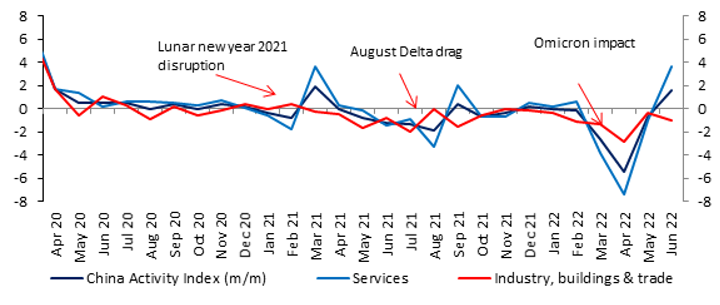
Moderation of some key headwinds has driven the the recent rally in China equities. On the Covid front, China’s zero-tolerance approach has been effective in reducing the number of new cases very significantly. The seven-day average of daily new cases was less than 1,000 as of July 24 — a small fraction of earlier this year, in mid-April, when there was a high of nearly 30,000 cases. This has enabled some controls to be relaxed, including less stringent quarantine rules. This has given way to an uptick in Chinese economic activity lately (Chart 1).
Chart 1: Recovering China economic activity
Source: Research Institute, abrdn, July 2022
On the regulatory side, there have also been clear signs of the new regime bedding down, allowing some easing of pressures. For example, in June, the government gave tentative approval for Ant Group, an affiliate of e-commerce giant Alibaba, to revive its initial public offering in Shanghai and Hong Kong.
Comparatively helpful policy backdrop
Another contributor to improved performance lately has been China’s comparatively much more helpful monetary and fiscal backdrop. Unlike virtually all other major central banks, the People’s Bank of China has not felt the need to join the global trend of sharply raising policy interest rates. On the contrary, since the start of 2022, it has eased policy on multiple occasions through a combination of interest-rate and reserve-requirement cuts. China has been able to adopt this markedly different monetary stance because, compared to the rest of the world, it’s experienced very low inflation, which was running at just 2.5% year-over-year in June.
On the fiscal front too, policy in China is more supportive compared to the rest of the world. For example, our economists think infrastructure spending especially could get a significant boost from efforts to bring forward local government bond issuance.
Valuations not prohibitive for further outperformance
Despite the recent rally, the valuation of China equities remains more attractive compared to many global equity markets. For example, the MSCI China Index forward price-earnings (PE) ratio of 11.1 suggests significant cheapness compared to the MSCI US Index and MSCI All Countries World Index, which have forward PE ratios of 16.3 and 14.2, respectively.2
Despite the recent rally, the valuation of China equities remains more attractive compared to many global equity markets.
At the same time, the forward earnings projections for China corporates seem more than adequate. For 2023, consensus estimates are for 7% revenue growth and 4.7% net margin, which would produce 15% earnings-per-share growth, relative to the expected lower base of 2022.3
Risk factors
However, optimism regarding the outlook for China equities should be qualified by respect for some weighty risk factors. First, while restrictions have been incrementally easing in the past two months, the dynamic zero-Covid policy has not been discarded. This means that new restrictions are still possible, although we think that future lockdowns are likely to be much more targeted and adaptive.
Second, the important property sector, which by some estimates, together with related services, accounts for around 25-30% of China’s GDP, remains a headwind. Until further deleveraging is completed, the sector will probably remain vulnerable to adverse news flow. Recently for example, concerns have been rising that mortgage defaults could rise owing to a wave of homeowners joining a nationwide mortgage payment boycott for unfinished homes. However, given potential contagion risk, we expect the authorities to be very proactive in addressing this issue.
Putting everything together
Putting everything together, we think there are enough reasons to be relatively optimistic regarding the outlook for Chinese equities. In particular, the combination of these factors suggests scope for continued outperformance:
Easing Covid restrictions
easing regulatory pressures
Accommodative monetary and fiscal policy
Relatively undemanding valuations
However, investors would be wise to temper their optimism with due appreciation of the risks, especially regarding the dynamic Covid policy and unresolved stresses in the key real estate sector.
Overall, we think the present environment underscores the need for a selective investing approach that favors Chinese companies with attractive fundamentals, low exposure to the macro risk factors and undemanding valuations.
1 Consensus Economics, 11 July 2022 2 Global Index Briefing: MSCI Forward P/Es, Yardeni Research Inc., 19 July 2022 3 China Equity Strategy – Bullish 2H22 outlook on macro & micro, J.P.Morgan, 22 June 2022
IMPORTANT INFORMATION
Foreign securities are more volatile, harder to price and less liquid than U.S. securities. They are subject to different accounting and regulatory standards, and political and economic risks. These risks are enhanced in emerging markets countries.
Indexes are unmanaged and have been provided for comparison purposes only. No fees or expenses are reflected. You cannot invest directly in an index.
Past performance is not an indication of future results.
Projections are offered as opinion and are not reflective of potential performance. Projections are not guaranteed and actual events or results may differ materially.
Other important information:
Issued by Aberdeen Asset Managers Limited which is authorised and regulated by the Financial Conduct Authority in the United Kingdom. Registered Office: 10 Queen’s Terrace, Aberdeen AB10 1XL. Registered in Scotland No. 108419. An investment trust should be considered only as part of a balanced portfolio. Under no circumstances should this information be considered as an offer or solicitation to deal in investments.
Emerging markets asset manger Ashmore Group said assets under management fell $8bn to $56bn as of the end September 2022.
Declines in fixed income assets accounted for the majority of the AuM reduction after severe volatility and interest rate risks rocked the asset class. Ashmore has a substantial Fixed income business which makes up the majority of their assets under management.
Of the $8bn fall in AuM, $5bn were net outflows and $3bn was adverse investment performance.
“Global fixed income and equity markets fell over the quarter reflecting continued uncertainty around geopolitical risks, higher inflation and increasingly hawkish central banks,” said Mark Coombs, Chief Executive Officer, Ashmore Group.
“This has increased the risk of recession in many countries and pushed bond yields higher and equity valuations lower in both Developed and Emerging Markets. Investor risk appetite therefore remains limited in the near term and Ashmore’s AuM movement this quarter reflects the impact of lower market levels and investors continuing to reduce risk.”
Mondi had a successful third quarter judging by the 55% jump in EBITDA continuing operation as volumes and sales price rose.
The paper and packaging maker enjoyed EBITDA of €450m in Q3 2022 compared to €290m Q3 2021 as they more than compensated for rising input cost.
The Corrugated Packaging unit enjoyed higher selling prices but saw volumes dip while Flexible Packaging saw both resilient demand and rising prices.
In the paper business, Uncoated Fine Paper was the stand out performer with higher prices and volumes.
Input cost
Mondi had to navigate rising fuel and wood costs in the quarter but were able to mitigate rising energy cost as most of their European plants produce the required power internally through biomass power generations.
Mondi are continuing with their €1 billion expansion plans, noting a €400 million Czech Republic paper mill set to come online in 2025.
Russia asset are being classified as held for sale as they pursue the sale of Mondi Syktyvkar for around €1.5bn.
“We continue to partner with our customers, helping to lead the way towards a circular economy with our unique portfolio of innovative and sustainable packaging and paper solutions. We also remain focused on operational efficiency and cost control,” said Andrew King, Chief Executive Officer.
“Our ambitious expansionary capital investment programme is progressing well, as we continue to invest in our cost advantaged asset base to capture opportunities in our structurally growing packaging markets, enhance our competitiveness and deliver sustainably into the future.”
The FTSE 100 experienced a whipsawing session on Thursday as a rally sparked by hopes the UK government would U-turn on some of their radical tax cuts was stopped in its tracks by higher than expected US inflation data.
The FTSE 100 sank more than 120 points in minutes after US CPI inflation came in at 8.2% versus expectations of 8.1%. However, the month-on-month 0.6% jump in prices was the major concern for markets.
London’s leading index had staged a strong rally earlier in the session after reports the UK government could be set to U-turn on radical tax cuts that sent a shock waves through markets in September.
U-turn reports – although not officially confirmed and lacking details – are likely the result of mounting pressure on the Prime Minister and Chancellor. There have been calls for them to resign from their own party’s MPs and her administration is persistently lambasted in the media.
Liz Truss had been further humiliated yesterday by a recording of her meeting with the King. King Charles appeared to respond ‘oh dear’ to her arrival at their weekly meeting.
A scene straight from the Office.
Truss: “Your Majesty… Lovely to see you again.”
King: “Back again. Dear oh dear. Anyway…”
Political awkwardness and unintentional comedy at its finest.
The King aptly summed up the markets, and many UK voters, perception of Liz Truss’s tenure as Prime Minister and a U-turn could be a political move to save her job.
A U-turn on some elements of the mini-budget could trigger a sustained rally in UK assets including the pound and UK equities.
Nonetheless, the reports of a potential U-turn could not contend with US inflation data news and the FTSE 100 was firmly in the red at the time of writing, down 1.3% at 6,734.
US inflation at 8.2% means the Federal Reserve will likely push on with rate hikes in the order 75-100 bps in November and are a long way off pivoting to an easing on policy.
UK banks
A look at the intraday chart of UK banks highlights the volatile nature of the session. Lloyds and Barclays had been up over 6% before the inflation data but sank with the wider market. A roll back of tax cuts by the UK government would boost market confidence in UK assets and help the mortgage market.
However, it was the FTSE 100’s overseas earners that drove sharp declines in the FTSE 100 as the dollar soared.
The cyclical sectors such as miners were the most heavily hit on concerns ongoing adjustments to interest rate hikes would hurt the global economy.
The pound staged a rally on Thursday on hopes the UK government would consider elements of their radical tax cuts announced in the recent mini-budget.
GBP/USD surged over 160 pips to 1.1263 following reports there could well be a U-turn on tax cuts. Recent government comments indicated Liz Truss and Kswasi Kwarteng had dug in on their initial plans but breaking news at lunch time on Thursday suggested they could be set to drop some proposals.
There has been no official confirmation from the UK government so far.
Confidence in the UK government has been destroyed and the Prime Minister is facing a revolt by back bench MPs with some calling for her to quit.
Optimism around a potential U-turn was evident in a broad range of UK assets including domestic-facing equites and bonds.
Scirocco Energy (LON: SCIR) has more than made up for its share price dip earlier in the week following news from 50%-owned Energy Acquisitions Group, which owns an anaerobic digestion plant in Northern Ireland. This generated EBITDA of £602,000 in the year to September 2022, which is after the costs of facility upgrades and the running costs of Energy Acquisitions Group. The cash generated can help to fund further acquisitions. Scirocco Energy is selling its oil and gas interests. The share price jumped 24.3% to 0.23p
Echo Energy (LON: ECHO) shares improved 13.7% to 0.29p, after two-thirds of bondholders voted for the proposed restructuring. If shareholders approve €15m of bonds will be converted into shares at 76.4% premium to yesterday’s closing price.
Invinity Energy Systems (LON: IES) is having a good week. It previously announced a sale of a system and today it has won a California Energy Commission project as part of a consortium developing a large solar-plus-storage microgrid. Invinity Energy Systems will provide a 10MWh vanadium flow battery system. Delivery is expected in 2023. There is also a new relationship with US Vanadium, which could lead to a joint venture. The share price is 14.6% higher at 31.5p and it is one of the best performers of the week so far.
Gaming machine hardware and software supplier Quixant (LON: QXT) had a strong third quarter and this has sparked a second 2022 upgrade this year. finnCap has increased forecast revenues from $109.1m to $115.1m, while earnings estimates are one-fifth higher at 11.9 cents a share. This is further confirmation that demand is strengthening now that casinos are back up and running and there is good visibility for the rest of the year. The share price is 7% ahead at 175p.
Data analysis software provider WANdisco (LON: WAND) has generated bookings of $61.2m so far this year with the majority coming in the third quarter. This is already higher than expectations for the full year and there is more to come. There was $26.3m in the bank at the end of September 2022, helped by upfront cash payments on contracts. Losses continue and that cash could be almost used up by the end of 2023. The share price is 4.9% higher at 482.5p.
Spirits supplier Distil (LON: DIS) has changed its model to direct selling the major UK customers and using distributors for the rest. This resulted in a sharply increased loss in the six months to September 2022. Alex Baker has joined as commercial director, having been with the previous distributor. Net cash is £950,000. Any profit generated in the second half will not be enough to cover the interim loss. The share price slumped 19.1% to 0.85p.
Georgia-based oil and gas producer Block Energy (LON: BLOE) shares fell 13.5% to 1.925p a share after its third quarter figures. Third quarter production and revenues were lower than the same period last year, partly due to maintenance stoppages and lack of power supply. There is $1.1m in the bank
Artemis Resources (LON: ARV) has announced a new resource for the Greater Carlow project in Western Australia. Even so, the share price fell 9.48% to 2.625p. There are 704,000 ounces of gold equivalent (gold, copper and cobalt) at an average grade of 2.5g/t. This is a significant improvement on previous resource estimates. The gold grade increases at depth. There is further potential for increasing the resource.
Anglo Asian Mining (LON: AAZ) produced 43,081 gold equivalent ounces in the first nine months of 2022, down from 48,487 ounces in the same period last year. Full year production should be between 54,000 and 58,000 ounces. After paying the final dividend there was still cash of $15.3m. The 3.559p a share interim dividend will be paid on 3 November. The share price fell 3.76% to 64p.
Ex-dividends
Caledonia Mining Corporation (LON: CMCL) is paying a dividend of 14 cents a share and the share price is 15p lower at 910p.
Cenkos Securities (LON: CNKS) is paying an interim dividend of 1p a share and the share price is unchanged at 45p.
Crestchic (LON: LOAD) is paying an interim dividend of 1.33p a share and the share price fell 10p to 255p.
Facilities by ADF (LON: ADF) is paying an interim dividend of 0.46p a share and the share price is 0.5p lower at 42.75p.
i3 Energy (LON: I3E) is paying a dividend of 0.14p a share and the share price has fallen 0.425p to 23.725p.
Inspired Energy (LON: INSE) is paying an interim dividend of 0.13p a share and the share price is unchanged at 11.15p.
MP Evans (LON: MPE) is paying an interim dividend of 12.5p a share and the share price is 27p down at 823p.