JD Sports Fashion appoints Andy Higginson as chair

JD Sports Fashion shares rose 2.4% to 125.3p in late morning trading on Friday after the retailer announced its appointment of Andy Higginson as group chair.

Higginson is set to take up the position from 11 July 2022, following an extensive search by the board with the support of an external search company.

The move comes after the widely-publicised resignation of Peter Cowgill as chairman after 18 years in the position.

JD Sports Fashion commented that Higginson was an experienced and trustworthy retailer and chair, with over 28 years of continuous non-executive director experience on PLC boards, including almost 15 years at Big 4 grocer Tesco.

“The Board was impressed with the high-quality candidates that we met throughout the recruitment process,” said JD Sports Fashion interim chair Helen Ashton.

“Andy, however, stood out as the best candidate with his extensive Board experience including as a Chair and his strong track record in the international retail sector. It is a testament to the quality and attractiveness of JD that we have recruited Andy to the important role of Chair.”

“JD is a great business with a clear strategy, occupying a unique place in the market and we look forward to working with him on our global development opportunities.”

Higginson’s latest role was as chair of William Morrison Supermarkets from January 2015 until the business was taken over by private equity firm CD&R LLP in November 2021, during which time he managed a huge turnaround of the business and delivered value realisation for shareholders.

The chair-elect for JD Sports Fashion is also currently employed as senior director at Flutter plc.

“Having closely followed JD’s success over the years, I see it as an exceptional business, with a strong strategic position,” said Higginson.

“The Board has clearly been addressing its governance and risk management structure and I very much look forward to working with the Board and the senior management team, including our new CEO once appointed, to bring my experience to bear and capitalise on the strength of the brands, market positions and channels to market including the global retail store network.”

Unite Group sales exceed pre-pandemic levels in Q2 2022

0

Unite Group shares were up 1.4% to 1,122p in early morning trading on Friday following a confirmation of high demand in sales over Q2 2022, with 90% of student rooms sold for the 2022 to 2023 academic year, exceeding pre-pandemic levels of 89%.

The student accommodation firm reported positive pricing progress, particularly as the impact of Omicron eased, with progress driven by inflation-linked rental uplifts for its multi-year nomination agreements and strong demand for direct-let beds.

Unite commented it expected to deliver occupancy rates of 97% for the next academic year and hit rental growth at the top end of its guidance at 3% to 3.5%.

The company mentioned its concerns surrounding cost inflation and noted its staff and utilities expenses as its two largest costs.

Unite said its utilities costs were fully hedged across 2022 and 2023, alongside a significant portion of 2024, with its recently completed review of its operating model set to deliver further efficiencies which will partially mitigate wider cost pressures.

It also reportedly benefited from growing recurring income through asset management fees from USAF and LSAV, linked to NOI and NAV, which offset approximately two-thirds of its share of overheads.

The firm announced its limited near-term refinancing requirements, with less than 10% of see-through debt maturing before late 2024 and interest rates fixed or capped for 85% of its existing investment debt.

Unite also confirmed it had forward hedged £300 million of future debt insurance at rates meaningfully below market levels. Additionally, as a result of rising interest rates on the variable portion of its debt, its see-through borrowing costs increased 3.3% at the end of HY1 2022.

The student accommodation company further updated its portfolio valuations, with its USAF property portfolio independently valued at £2.9 billion, representing a 3.5% climb on a like-for-like basis over the Q2 term.

The rise was driven by rental growth of 0.8% and a 0.13% point reduction in property yields.

Meanwhile, Unite’s LSAV investment portfolio was independently valued at £1.9 billion, representing a 4% increase on a like-for-like basis over the period.

Unite said the climb was driven by rental growth of 1.1% and a 0.12% reduction in property yields.

“We continue to make good progress with bookings for the 2022/23 academic year with reservations now ahead of pre-pandemic levels, demonstrating the strength of student demand,” said Unite Group CFO Joe Lister.

“This momentum underpins our confidence in a return to full occupancy for the 2022/23 academic year and rental growth at or just above the top end of our guidance of 3.0-3.5%. We are well protected against inflationary pressures through annual re-pricing of our income and cost hedging but, like others, are not immune from the impact of rising costs and interest rates.”

“We continue to see significant investor demand for student accommodation, reflecting the sector’s positive outlook, as demonstrated by valuation increases for USAF and LSAV in the quarter.”

Osirium Technologies momentum continues

0

Cloud-based cybersecurity provider Osirium Technologies (LON: OSI) says positive trading momentum continued into the second quarter. Osirium is winning new customers and first half bookings increased by 30% to at least £1.18m.

The Osirium share price rose 17% to 6.75p, which values the company at £2.6m. That is 1.5 times the current forecast 2022 revenues of £1.74m, where there could be scope for an upgrade later this year.

AIM-quoted Osirium focuses on Privileged Access Management (PAM) and related services that can be easily deployed. They prevent cyber attacks accessing customer accounts information and remove unnecessary access powers. This is a fast-growing segment of the cybersecurity market and Osirium more than doubled its customer base last year.  

Interim revenues increased from £740,000 to £910,000. Deferred revenues increased by 14% to £1.91m, which indicates future growth. Annualised recurring revenues are £1.61m, up 11% over six months.

Osirium is generating more income from contract wins with average contract size rising. Osirium won its first major US contract in May. It was with a New York Stock Exchange-listed bank. This was won via a channel partner. Healthcare and education are other sectors where Osirium is winning business.

Existing customers are adding other company products to their orders. A telecoms customer, which initially signed a three-year deal at the end of 2020 is adding two other products to the agreement.  

Osirium remains loss-making and the 2022 underlying loss is set to be around £3.5m, which is similar to 2021. Earlier this year, £1m was raised at 6p a share. By the end of the year, the company is likely to have net debt.

Vistry expects FY 2022 pre-tax profit at top end of market forecasts

0

Vistry shares were up 2% to 830.2p in early morning trading on Friday, after the group reported an expected FY 2022 adjusted pre-tax profit at the high range of market forecasts.

The company highlighted strong HY1 performance, supported by on-going positive market trends, and positive demand across all business sectors with an 11% rise in HY1 average weekly private sales rates to 0.84 against 0.76 the last year.

Vistry confirmed its housebuilding completions climbed to 3,219 units from 3,126 year-on-year, with FY 2022 adjusted gross margins anticipated at 23% ahead of target.

The firm added its partnerships continued to deliver growth, including a 24% increase in higher margin mixed-tenure completions to 1,106 units against 895 units in HY1 2021, alongside an overall partnerships adjusted operating margin for the FY expected at 10% over target and a return on capital employed in excess of 40%.

Its partnerships also secured 2,166 plots over the period from 1,499 plots the year before, and margins on new land at the upper end of its target range consistent with Vistry’s partnership medium term targets of over 12% operating margin and above a 40% return on capital employed.

Vistry further announced a promising forward sales position, with total housebuilding and partnerships’ mixed tenure forward sales growing 16% to £2.1 billion from £1.8 billion in the previous year and 92% of total forecast units for FY 2022 secured.

The group added it had experienced a successful term in the land market with housebuilding replenishing its land bank, securing a lower number of 3,360 plots compared to 4,143 the last year, at an average gross margin and return on capital employed both in excess of 25%.

Vistry drew attention to another positive HY term of cash generation, with net cash climbing to £115 million on 30 June 2022 against £31.6 million year-on-year, reflecting its high performance in the period. Its month-end average net debt for the rolling 12 months to 30 June was £73 million compared to £239 million in HY1 2021.

“The Group has delivered an excellent first half performance, significantly exceeding our expectations at the start of the year. Demand has been strong across all areas of the business and our forward sales positions further strengthened,” said Vistry CEO Greg Fitzgerald.

“The business is in great shape and well positioned to maximise the broader market opportunities.  With leading capability across all housing tenures and being one of the largest private sector providers of affordable housing, the Group is uniquely positioned within the housebuilding sector, and we continue to drive the benefits from our Housebuilding and Partnerships combination.”

“Whilst mindful of the wider economic uncertainties, we are positive on the outlook for the Group and expect to see significant margin progression in the full year, with adjusted profit before tax for FY 22 to be at the top end of market forecasts.”

Power Metal Resources sets sights on future demand for Uranium

Power Metal Resources is a diversified junior explorer with an exciting portfolio of global projects that spans ten metals including gold, lithium, tungsten, copper, PGMs, and Uranium.

Power’s strategy has been to build a diverse portfolio of assets and add value to each through internal exploration. They then seek to lock in this value through either bringing in a JV partner or disposing of the assets, possibly through an IPO.

Indeed, Power Metal Resources is currently preparing IPOs for subsidiaries Golden Metal Resources and First Development Resources.

These IPOs will of course provide an opportunity to lock in any value created at the projects, and have rightly been a main focus for the Power Metals team this year.

However, it was evident Power Metal Resources is already planning their next big move when Paul Johnson spoke at the UK Investor Magazine Summer Investor Evening 2022.

The Power Metals CEO made it clear they saw significant further growth in Uranium demand, and are aligning their portfolio accordingly.

“At Power Metal we see an opportunity to further build our uranium profile. This will be accomplished by undergoing exploration on our existing exploration portfolio, the acquisition of additional interests, as well as through investment holdings in new uranium focused entities that we can help to create,” Paul Johnson said in a recent update on their uranium activities.

Power Metal Resources & Uranium

Paul Johnson was clear in his views that nuclear would be central in meeting the world’s future cleaner energy demands. In addition, they have identified a potential shortfall between current levels of production capacity and forecast demand.

“Uranium prices sit far below the point of economic production for most miners of the yellow metal, so producers worldwide mothball their mines and instead buy uranium directly from the physical market at a lower cost,” Power Metal Resources said in their recent report on the Uranium market.

“Meanwhile, as we enter the 2020s, Covid-19 hits remaining production considerably and several nations begin to stockpile uranium as a matter of national security.”

“Suddenly, this previously oversupplied market is starting to look much tighter in the face of ongoing (albeit historically modest) demand. And with this, uranium prices once again begin to rise, hovering around the $27-32/lb range.”

To ensure Power Metal Resources captures any upside in Uranium prices, they have secured high-grade uranium mineralisation in the Athabasca Basin, Canada.

Power Metal Resources, through its wholly-owned Canadian subsidiary, controls a combined 41,196- hectares covering 7 project packages.

In addition to the Athabasca Basin, Power Metal’ subsidiary, First Development Resources, operates the Selta project in Australia.

Alien Metals Q&A with Bill Brodie Good

The UK Investor Magazine was delighted to once again welcome Bill back to the Podcast following our Summer Investor Evening last week.

Due to time constraints we weren’t able to deliver all of the questions from our online audience so Bill kindly joined us to address some great points from investors.

Alien Metals’ full presentation from last week can be found below.

New Aquis admission: Visum Technologies

Visum Technologies has bought on-ride video technology that has been developed over a number of years. Progress has been slow with a lack of cash not helping. Management believes that there is a commercial product, but it needs to sign up more theme parks and ride operators.
The flotation will provide cash for further development and the ongoing costs of the business, as well as giving the company a higher profile. Consolidation opportunities are mentioned in the prospectus, but it is a bit early for that. Management needs to show that there is a commercial business.
The shares have been tradi...

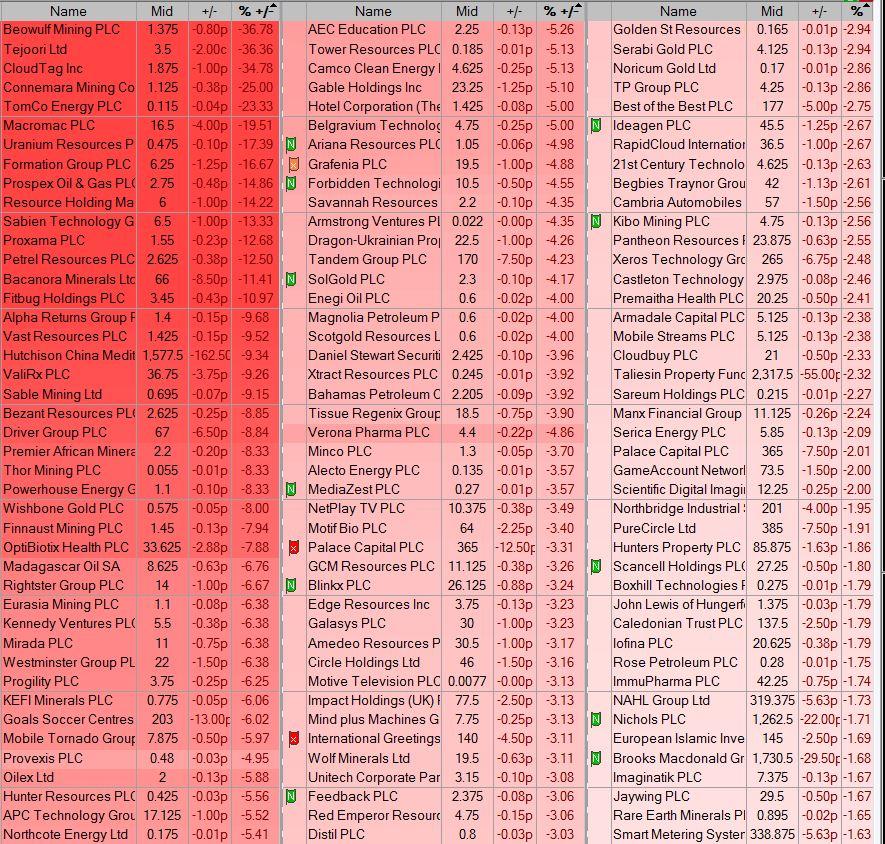
FTSE 100 rallies as Boris quits

The FTSE 100 moved higher on Thursday after Boris Johnson finally threw in towel on his time as Prime Minister.

Stocks in London rose in line with global equities as investors continued to pick up bargains after a period of heavy selling.

Commodities surge

Miners stormed ahead with Antofagasta rising over 8% at the time of writing, while Anglo American and Glencore added over 6%.

Shell and BP added a significant number of points to the FTSE 100 as they gained 3% and 4% respectively.

“This continued the recovery from a big sell-off at the start of the week and followed mixed trading in Asia. Resources stocks were in heavy demand with Shell releasing a teaser ahead of its second quarter results, which revealed just how well it has done out of the recent strength in energy prices,” said AJ Bell investment director Russ Mould.

However analysts pointed to potential risks to commodities companies given the backdrop of slowing growth and possibility of a recession.

“The big risk for Shell and BP going forward is that slowing economies could pull down the price of oil but for now there is an expectation that demand will keep outstripping supply,’’ said Susannah Streeter, senior investment and markets analyst, Hargreaves Lansdown.

Persimmon

Persimmon was one of the FTSE 100’s top fallers after the builder signalled it was starting to feel the impact of supply chain issues. The housebuilder fell over 5% as it also said planning application hold-ups were hindering its activity.

“Persimmon could be the canary in the coal mine for housebuilders, one of the last sectors holding on to post-pandemic euphoria. The group said that supply chain snarls were starting to eat into revenues as materials and labour shortages kept the group from delivering as many new homes as it expected,” said Laura Hoy, Equity Analyst at Hargreaves Lansdown.

“Planning holdups thanks to the pandemic were another issue as backlogs have kept some 1,500 sites due to open over the next 5 years in limbo. This is a Persimmon-specific problem given the group prefers to buy land without planning at a lower cost to boost profits.”

AIM movers: Jet2 uncertainty and Simec Atlantis Energy tidal boost, plus ex-dividends

0

Airline and tour operator Jet2 (LON: JET2) more than trebled revenues in the year to March 2022, but the loss from continuing operations also increased from £369.9m to £388.8m. Seat capacity increased from 2 million to 7.1 million and average load factor edged up from 66% to 69.2%. The company’s own cash is £1.08bn. The prospects for this year depend on the aviation sector returning to a level of stability, as well as future bookings. The shares fell 12.8% to 776.2p.

Simec Atlantis Energy Ltd (LON: SAE) has secured a contract for difference for the MeyGen tidal energy site in Scotland that guarantees £178.54/MWh for 15 years. This covers 28MW of power in Scotland. The full project can generate much more than this. This has helped the share price recover most of its losses in the past few weeks. The share price jumped 83.1% to 2.3p. Last week, bondholders voted to defer interest payments due on 30 June. The total payments of £350,000 are deferred until September.

Diagnostics company Novacyt (LON: NVCT) reported a slump in interim revenues from £52.2m to £16.5m – non-Covid revenues fell from £4.8m to £3.5m. Full year revenue expectations have been reduced to £25m – from £35m-£45m – and it will move back into loss. Costs are being reduced and they should reach an annualised level of £17m by the end of the year.  There is still £99.6m in the bank. The share price slumped 24.9% to 111.75p, although it is above its low for the day.

In-game brand advertising technology company Bidstack (LON: BIDS) increased interim revenues from £820,000 to £2.1m and gross margins are improving. Revenues from the Azerion media sales partnership are building up. New advertising standards could make media buyers more confident about purchasing in-game advertising. The shares are 14% higher at 2.85p.

Symphony Environmental (LON: SYM) has received new orders for its d2p anti-insect technology from Rivulis, which makes drip irrigation products. The orders are worth more than $340,000. Rivulis has placed smaller orders in the past. This is for a range of irrigation pipes for farmers. This follows last week’s agreement with bread maker Bimbo. Symphony could breakeven this year. The shares rose a further 8.6% to 19p.

Radiation and bio-detection technology developer Kromek (LON: KMK) has secured a distribution agreement with Smiths Detection Inc for its wearable radiation detection and identification products in North and South America. This boosted the share price by 7.8% to 9.975p.

Ex-dividends

Polar Capital (LON: POLR) is paying a 32p a share final dividend and the share price fell 29p to 481p.

Camellia (LON: CAM) is paying a 102p a share final dividend and the share price fell 25p to 6175p.

Concurrent Technologies (LON: CNC) is paying a 1.4p a share final dividend and the share price fell 3p to 75p.

James Cropper (LON: CRPR) is paying a 7.5p a share final dividend and the share price fell 40p to 895p.

Lift services and electrical components manufacturer Dewhurst (LON: DWHT) is paying a 4.5p a share interim dividend and the share price is unchanged at 1075p.

Next Fifteen Communications (LON: NFC) is paying a 8.4p a share final dividend and the share price fell 10.5p to 922.5p.

Premier Miton (LON: PMI) is paying a 3.7p a share interim dividend and the share price fell 4p to 117.5p.

Tavistock Investments (LON: TAVI) is paying a 0.07p a share dividend and the share price is unchanged at 8.625p.

Currys cautious about short-term prospects

0

Better than expected results from telecoms and electrical goods retailer Currys (LON: CURY) perked up the share price, but management is cautious about the trading outlook and a profit fall is anticipated.  

Underlying pre-tax profit of £155m was expected, but the outcome was £186m, although this was partly down to one-off factors, including a revaluation of the telecoms network debtor. There were cost savings of £69m in the UK and a switch from online to store sales helped margins. The past problems obtaining products are easing.

Revenues dipped from £10.3bn to £10.1bn, although they were flat on a constant currency. There was a decline in the UK revenues that was offset by growth in Greece. On a constant currency basis there was growth in the Nordics. Group like-for-like revenues were 3% lower.

The final dividend is 2.15p a share, taking the total to 3.15p a share. Net cash was £44m at the end of April 2022. The pension liability was reduced from £482m to £257m.

Guidance

There remains uncertainty about consumer spending. The 2022-23 pre-tax profit is likely to be in the range of £130m-£150m, partly due to lower margins. The business will continue to be cash generative and there are plans for capital investment of £140m-£160m.

Currys is targeting an underlying operating margin of 3% by 2023-24. Last year, the operating margin improved from 2.5% to 2.7%.