GenIP has received 57 new report orders from returning clients. The orders come from two major US research universities and a UK institution.
The AI-powered innovation intelligence company secured 50 Invention Evaluator report orders from two US universities with strong commercialisation track records.
One institution ranks consistently in the National Academy of Inventors’ “Top 100 US Universities Granted Utility Patents”. The other operates one of America’s most active university innovation hubs, tracking thousands of invention disclosures, patent filings and spinoff ventures annually.
A UK university that first engaged GenIP in June 2025 has placed a further seven report orders.
The repeat business validates GenIP’s AI-enabled analytical products in supporting technology transfer decisions, the company said.
Melissa Cruz, GenIP’s CEO, noted the company is seeing increased inbound referrals from universities reporting improvements in licensing workflows after adopting GenIP’s evaluations.
“The continued return of leading institutions reinforces the market’s need for faster, more reliable decision-support in technology commercialization,” said Melissa Cruz, CEO of GenIP.
“We are also seeing a rise in inbound referrals from universities that have reported meaningful improvements in their licensing workflows after adopting our evaluations. This combination of repeat business and organic referrals gives us strong confidence in our growth trajectory as we expand our AI-powered product suite and support more clients globally.”
Over the past decade, India’s key growth narratives have centred around three pillars: 1) favourable demographics 2) structural reforms and 3) robust digital infrastructure development. One of the positive fallouts of this is the exponential surge in assets of India’s mutual fund sector.
Transformation of Indian Investment Culture
Historically, Indian families preferred investing in traditional assets like gold, real estate, or bank deposits, leaving equity markets predominantly to international investors. This landscape has fundamentally shifted as millions of households now embrace investing in equity, evolving from conservative savers into proactive wealth builders.
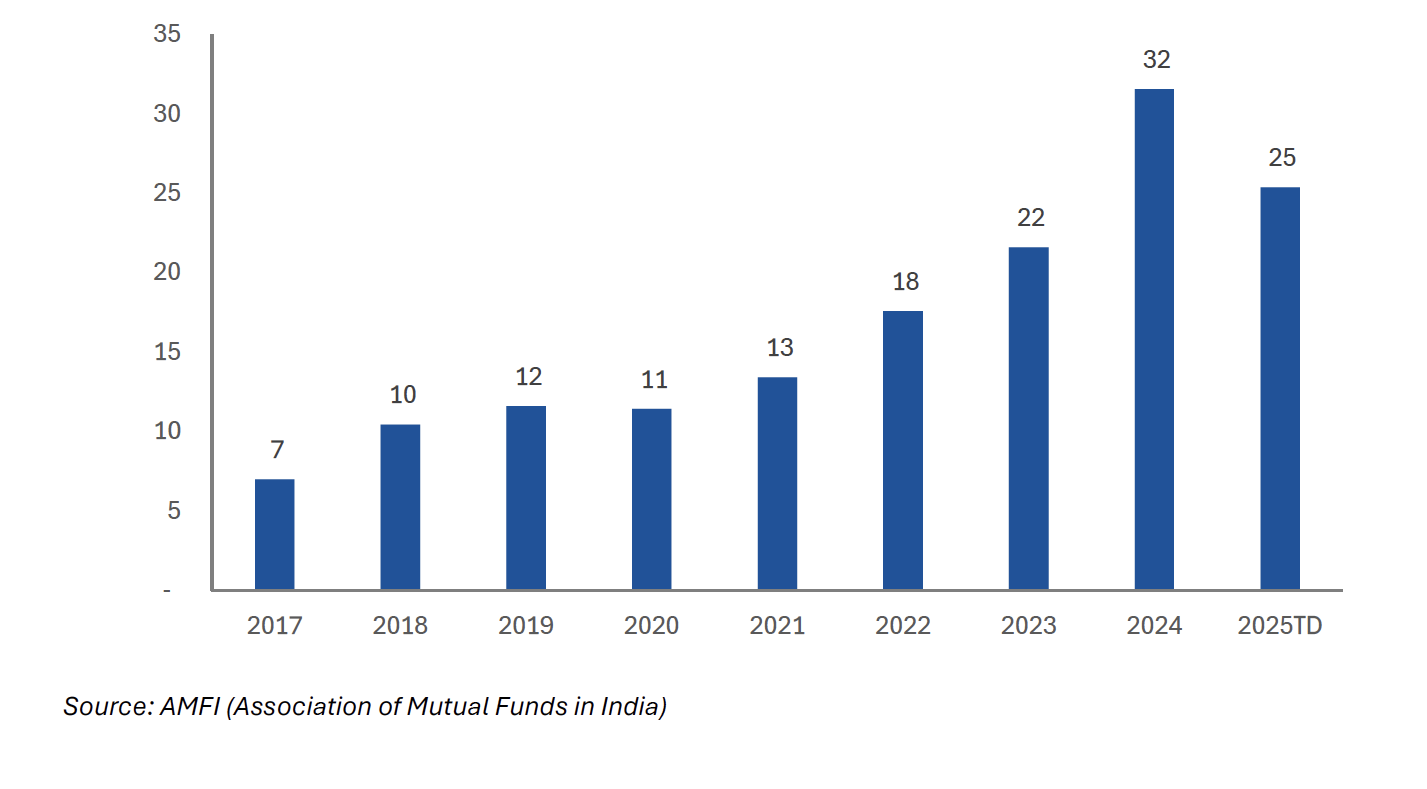
The domestic Mutual Fund industry has experienced significant expansion over last two decades, with Assets Under Management (AUM) multiplying approximately 44 times to reach US$773 billion by March 2025! In the last 5 years itself, it has grown more than 3 times. This tremendous growth stems from sustained capital inflows, currently averaging around $4 billion monthly, with gross inflows through Systematic Investment Plans (SIP) alone contributing over US$3 billion per month. SIPs represent an investment methodology by which a person can contribute fixed amounts to selected mutual fund schemes on monthly, quarterly, or annual basis, typically spanning six months to several years.
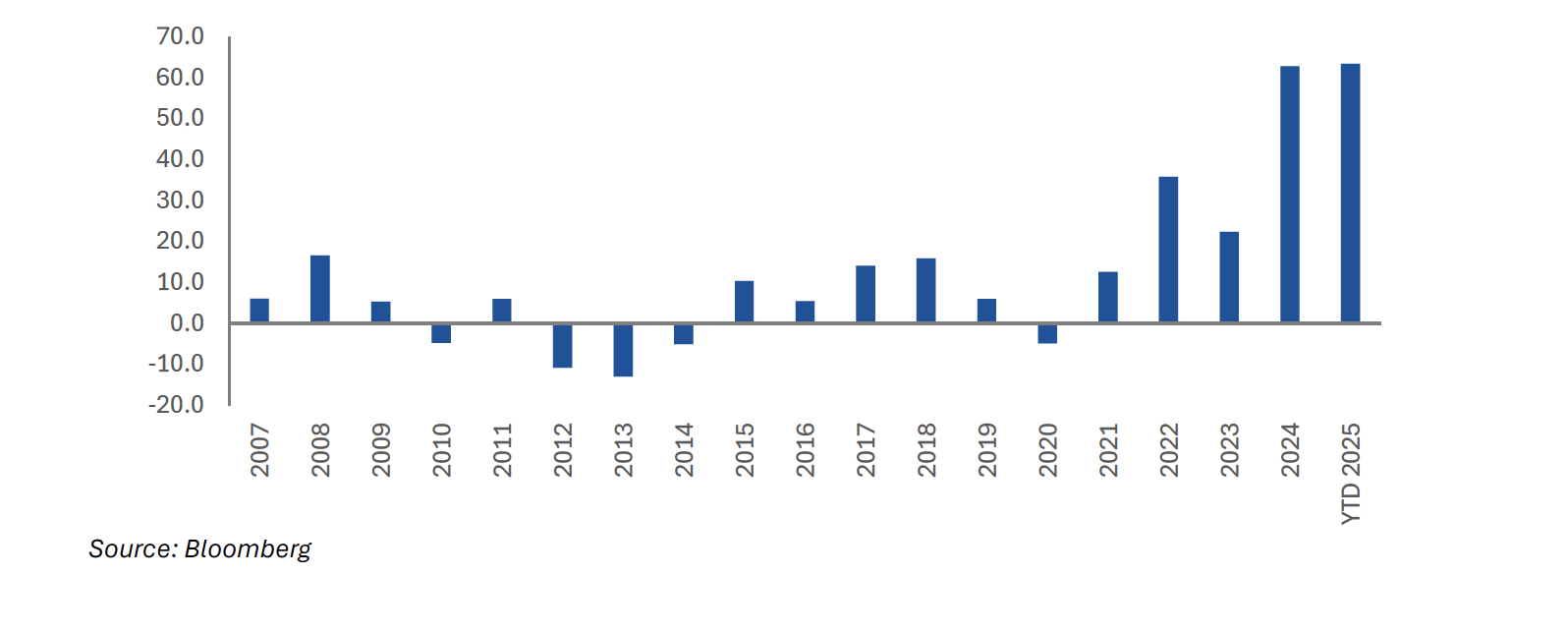
The corporate equity ownership structure reflects this dramatic transformation. Foreign Portfolio Investors (FPI)’s stake at 18.8% in NSE500 companies as of March 2025 is at a decade low, while domestic institutions have reached a record high of 19.2%. In fact, since 2021, domestic institutions have invested over US$192 billion compared to FPIs being net sellers of approximately US$8 billion, highlighting this remarkable reversal.
Figure 1: Domestic Institutional Equity Flows over the years (US$ bn)
Catalytic Events and Digital Revolution
Several pivotal events reshaped this landscape beginning with 2016’s demonetization, which triggered a reallocation of resources from physical to financial assets and led to change in mindset on hoarding cash. Simultaneously, fintech applications emerged during India’s mobile internet expansion, fostering increased digital transaction adoption and confidence. The 2021 COVID-19 lockdowns, combined with elevated savings rates, further accelerated investor migration toward equity markets and mutual funds.
But a lot of credit should go to active marketing by the industry. Since 2017, the Association of Mutual Funds in India (AMFI) has been carrying out an investor education campaign “Mutual Fund Sahi Hai” (Mutual Fund is the Right Choice). Visibility is high, as AMFI strategically positions its advertisements during the Indian Premier League (IPL). The 2025 edition of IPL had over 1 billion viewers across television and digital platforms.
AMFI’s comprehensive marketing initiatives encouraged serious SIP consideration among investors. Mutual funds emphasized affordability with entry points as low as Rs500 (£5), enhancing accessibility and adoption. Consequently, SIP contributions have emerged as the primary driver of sustained inflows, growing from approximately US$350 million a month a decade ago to over US$3 billion a month currently. Active SIP accounts have exceeded 95 million, representing 20% of the industry’s total AUM.
Leading distributors identify liquidity and small ticket sizes as crucial criteria favouring mutual funds over alternative investment options. Retail investors are now looking at investing over a 5–10-year investment horizons, and these are now being looked at akin to an EMI, but for wealth creation. These concepts have resonated with retail investors, resulting in higher mutual fund inflows even during high volatility periods.
Figure 2: Inflows through Systematic Investment Plans (US$ bn)
Digital Infrastructure and Democratisation
The above would not have been possible without the digital revolution which has fundamentally transformed investor behaviour patterns. Tech-savvy younger generations increasingly utilize online platforms and mobile applications for mutual fund investments. User-friendly interfaces have democratized investing, making it accessible to broader population segments, while mutual funds now provide convenient platforms for seamless investment tracking and redemption.
Reflecting the capital markets’ digital transformation, India’s top three brokers are all online/digital platforms: Groww, Zerodha and Angel One. As digital transactions accelerated, mutual funds expanded distribution networks nationwide, increasing participation from smaller towns and semi-urban areas.
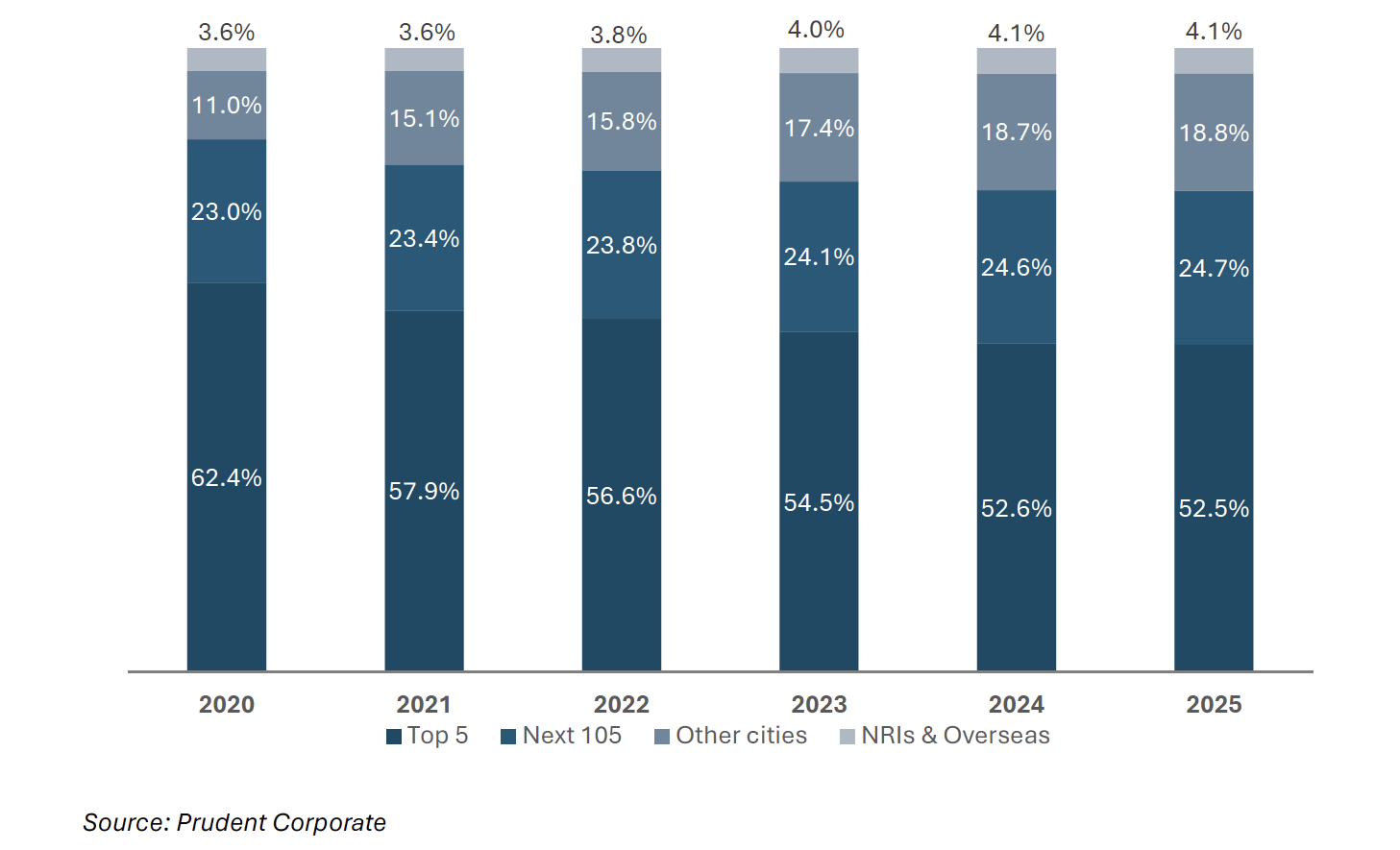
According to AMFI data, the top 5 cities’ share declined from 62% in 2020 to 52% in 2025, while contribution from towns beyond the top 110 cities increased from 11% to approximately 19% during the same period. This trend demonstrates investment diversification beyond major metropolitan centres, indicating enhanced financial inclusion and investment activity in smaller cities.
Figure 3: Rising penetration in urban & semi-urban cities
Is it sustainable?
The question we often ask ourselves is whether these domestic flows are sustainable? Even after the strong inflows, mutual fund industry’s current AUM-to-GDP ratio stands at just approximately 20% compared to the US at 100%+, indicating ample room for growth. Mutual funds represent only about 12% of Indian household financial assets (March 2025) versus 20%+ in the USA. Going by macroeconomic factors like young demographics, digitally native population, and higher economic growth, these flows look sustainable.
Notably, mutual fund inflows have demonstrated resilience over the past year despite negative equity returns (-5% for BSE Sensex as of September 30, 2025) and increased volatility from geopolitical disruptions. However, prolonged market consolidation and subdued returns could potentially moderate future flows.
Gareth Powell, Head of Healthcare at Polar Capital, explains why he believes sentiment in the healthcare sector may be bottoming out after almost three years of headwinds.
He highlights three key drivers supporting his outlook: strong volume growth, broad new product cycles, and renewed M&A momentum. With US policy concerns easing, valuations near multi-decade lows, and investor interest starting to return, he sees good reason to be optimistic about the potential for a healthcare recovery.
Poolbeg Pharma (LON: POLB) has been granted a patent for POLB 001 by the European Patent Office. This covers the treatment for severe influenza and there are other potentially patentable uses. The share price gained 10.1% to 4.05p.
Rail and transport data software and services provider Tracsis (LON: TRCS) reported full year figures in line with its trading statement. Tracsis remains highly profitable despite uncertainty in the rail sector and is ready to take advantage when there is more certainty of funding. The share price increased 8.53% to 350p.
US focused oil and gas company Zephyr Energy (LON: ZPHR) says there are growing levels of interest in gas from the Paradox Basin in Utah and the process of securing farm in partners continues. Debt refinancing means that borrowings with the existing provider are $22.1m and a further $2m has been lent by another lender at an interest rate of 14%/year and it can convert at 3.75p/share. The share price improved 6.25% to 2.55p.
Eyewear supplier Inspecs (LON: SPEC) says trading improved in October with order books 10% higher than one year ago. US tariff disruption will affect the timing of shipments. Full year revenues of £191m and EBITDA of £17.7m are expected. The share price recovered 4.82% to 74p.
Video games developer Everplay (LON: EVPL) has appointed Mikkel Weider as chief executive. He was the founder of Nordisk Games and has been on the boards of other games companies. The share price has risen 3.67% to 353.5p.
Ampeak Energy (LON: AMP) has received the final £3.5m of the £8.5m loan from Cardiff Capital Region. This will enable the development of the 480MWh AW2 project at the Uskmouth Energy Park, where Ampeak has a 50% stake. The share price is 1.45% higher at 3.5p.
FALLERS
Industrial equipment distributor HC Slingsby (LON: SLNG) is asking for shareholder approval to leave AIM. The shares are illiquid and the cost of being on AIM adds to the company’s loss. There is already support from shareholders owning 73.2% of the shares. HC Slingsby transferred from the Main Market to AIM on 24 May 2005. It has been on the Londo Stock Exchange for many decades. The cancellation could be on 23 December. No matched bargain facility is planned. The share price dived 52% to 60p.
Whisky supplier Artisanal Spirits (LON: ART) has been hit by the US government shutdown, having already been hampered by tariffs. It is taking more than six weeks to gain approval from the US authorities for new product labels. This means that $3.2m of shipments will not clear customs this year. This will reduce EBITDA by £2m. The US strategy is being changed and the contract with the current distributor will end in March 2026. There will be a stock provision of more than $2m. Full year underlying revenues ae expected to be flat, excluding one-offs. The share price declined 19.8% to 32.5p.
Ex-dividends
Caledonia Mining Corp (LON: CMCL) is paying a quarterly dividend of 14 cents/share and the share price is unchanged at 2160p.
Cavendish Financial (LON: CAV) is paying an interim dividend of 0.3p/share and the share price dipped 0.25p to 10p.
Fonix (LON: FNX) is paying a final dividend of 5.9p/share and the share price slipped 4p to 189p.
FRP Advisory Group (LON: FRP) is paying a dividend of 1p/share and the share price improved 1.5p to 144p.
Greencoat Renewables (LON: GRP) is paying a dividend of 1.7 cents/share and the share price fell 1.7 cents to 67.1 cents.
Young & Co’s Brewery A shares (LON: YNGA) is paying a interim dividend of 12.22p/share and the share price fell 9.5p to 748.5p.
Young & Co’s Brewery shares (LON: YNGN) is paying an interim dividend of 12.22p/share and the share price rose 5p to 635p.
Yu Group (LON: YU.) is paying an interim dividend of 22p/share and the share price declined 35p to 1485p.
The FTSE 100 was sharply higher on Thursday after AI giant Nvidia beat earnings estimates in the US overnight, and Halma and Games Workshop compounded the uptick in sentiment with strong updates.
The FTSE 100 rose on the developments, trading 0.8% higher at the time of writing.
After a couple of weeks of jittery markets and concerns about AI, global equity investors were provided the reassurance they needed overnight as Nvidia reported Q3 revenues of $57bn and, most importantly, issued positive guidance.
“While bubble fears won’t be completely dispelled by last night’s Nvidia earnings, signs of robust demand mean that investors are able to see the upside from here,” said Chris Beauchamp, Chief Market Analyst at IG.
“The 15% stock price drop into earnings, and the accompanying 5% drop in indices, seemed to clear the air nicely, taking out some excessively frothy sentiment. Overall the bulls got what they wanted last night, while bearish investors (hello, Michael Burry) will still be able to argue that such exuberant spending will ultimately end in tears.”
Cloud data centre firms that buy and rent out Nvidia GPUs, including CoreWeave and Nebius, were sharply higher in the US premarket as the AI trade looked to be back on.
Rebounding sentiment around AI fed into a global equity rally, with around 75% of the FTSE 100 constituents trading in positive territory on Thursday.
Games Workshop was the FTSE 100’s top riser, surging 12%, after saying profit before tax would be at least £135m in 2026, up from £126m in 2025.
“A typically short but ultimately sweet trading update from Games Workshop has fired up enthusiasm for the stock in the market today,” said Russ Mould, investment director at AJ Bell.
“Despite a difficult economic backdrop, the company expects to deliver meaningful growth in profit and revenue in the first half of its financial year.
“Games Workshop’s resilience is underpinned by dedicated fans who collect figures and play its games. This success has led to a valuable library of intellectual property, from which it has been able to drive extra revenue. Some may be impatient with the pace of Games Workshop’s efforts to tap into this potential but the company, quite rightly, is protective of its IP and hesitant about agreeing deals which might alienate devotees and tarnish its reputation.”
Halma shares were up around 12% following the release of half-year results that showed revenue rocketed 15% higher during the period. Investors were also clearly delighted to see adjusted profit before tax surge 29%.
JD Sports was the FTSE 100’s top faller as investors digested another lacklustre trading update that pointed to slowing like-for-like sales. Shares were down 3% at the time of writing.
Morningstar believes the UK market is a hidden gem for investors, highlighting its low valuations and the Bank of England’s ability to cut interest rates in its Global Outlook for 2026 report.
UK stocks delivered 20% gains in 2025, among the best globally, yet negative media headlines continue to hold back investors from taking meaningful positions in UK assets, according to Morningstar. Fund flow data shows persistent outflows from UK equity funds throughout 2024 and 2025.
The research house notes that UK equities trade at a price-to-earnings ratio of just 14x, approximately half that of the US, while offering dividend yields that exceed other G7 markets.
From an economic perspective, Morningstar expects meaningful monetary easing throughout 2026 and beyond as labor market conditions cool. With economic conditions getting gloomier by the day, the Bank of England now has greater scope to lower interest rates, which should help put the economy back on track. They expect that lower interest rates will help growth return to its trend pace of around 1.7% in the coming years.
“With economic slack widening, the Bank of England has scope to cut interest rates meaningfully in 2026 – with the full extent of monetary easing not fully priced into money markets, in our view,” explained Grant Slade, Economist at Morningstar.
“With meaningful cuts to public spending unlikely in next week’s budget, we think the UK’s debt metrics are unlikely to materially improve in coming years. Still, we think some of the negativity surrounding the UK’s fiscal profile and its likely impact on medium-term economic performance is overdone.”
UK small-cap stocks remain one of the most undervalued segments, attracting interest from corporate and private equity buyers. Morningsta highlights recent examples, including Carlsberg’s acquisition of Britvic and Thoma Bravo’s takeover of Darktrace.
Morningstar also drew attention to the UK housing sector as offering value, with builders such as Persimmon, Barratt Redrow, and Taylor Wimpey trading at attractive levels. Any reduction in interest rates should act as a meaningful tailwind for the sector, the firm notes.
Looking at gilts, UK government bonds have suffered from concerns about fiscal stability, but Morningstar suggests that much of the weakness stems from liquidity and supply-and-demand dynamics.
Interestingly, demand from defined-benefit pension buyers has fallen by around 50% in recent years, creating a roughly 40 basis points premium in 10-year gilt yields relative to fair value.
For long-term investors, locking in this yield could prove rewarding as markets reprice to reflect normalized conditions, according to the report.
Nvidia shares rose on Thursday after the chip giant reported earnings that beat estimates and provided much-needed reassurance that the demand for AI compute was still rising.
Nvidia posted record revenue of $57.0 billion for the third quarter ended October 26, 2025. The figure represents a 22% increase from the previous quarter and a 62% jump year-over-year.
Data Center revenue drove performance, reaching $51.2 billion, up 25% quarter-on-quarter and 66% year-on-year.
Nvidia saw strong demand for its cloud solutions, which the company said had sold out.
“Blackwell sales are off the charts, and cloud GPUs are sold out,” said Jensen Huang, founder and CEO of NVIDIA.
The company maintained strong profitability with gross margins of 73.4% on a GAAP basis and 73.6% on a non-GAAP basis. Earnings per diluted share came in at $1.30 for both measures.
Nvidia returned $37.0 billion to shareholders through share repurchases and cash dividends during the first nine months of fiscal 2026, which is equivalent to Tesco’s entire market cap.
“Nvidia bears the weight of the world, but like Atlas, it’s standing firm under that towering mountain of expectations. Third quarter results delivered the goods and then some, a 4% beat on the top and bottom line came with a side of more good news in the form of a monster $65 billion revenue guide for the fourth quarter,” said Matt Britzman, senior equity analyst, Hargreaves Lansdown.
“While AI valuations are dominating the news feeds, Nvidia is going about its business in style. There are certainly pockets of the AI space where valuations needed to take a breather, but Nvidia is not in that camp. In fact, while shares have performed well this year, the valuation has gotten more attractive as earnings growth has raced ahead.”
Britzman was also upbeat on Nvidia’s outlook, pointing to the group’s dominance and a deep moat that protects its valuation.
“Looking ahead to next year, demand isn’t in question, Nvidia already has a massive backlog of orders. What’s new is that its market dominance is facing scrutiny.
“Key customers are exploring viable alternatives, at least on paper, as they seek faster compute and diversification away from a single supplier. The real question is how those alternatives stack up. Designs and promises of similar performance are one thing; track record at scale is another, and no one matches Nvidia there. Its breadth remains underrated: a full data center business spanning chips, software, networking, and more. Even if rivals can offer parts of the stack, Nvidia’s fully integrated solution will be hard to beat.”
JD Sports has issued steady third-quarter trading, with total sales rising 8.1% at constant currency rates, though the retailer has cautioned on weaker near-term consumer indicators ahead of its crucial peak trading period.
The sportswear giant reported group like-for-like sales down 1.7% for the 13 weeks to 1 November, with organic growth of 2.4%. Performance varied significantly across regions, with Asia Pacific emerging as the standout performer.
JD Sports has been under pressure for some time, so today’s lackluster results won’t come as a surprise to investors. To some extent, they were to be expected.
North America, representing 37% of Q3 sales, saw like-for-like sales decline 1.7%, though organic growth reached 3.0%. Excluding Finish Line stores, the picture improved considerably with like-for-like sales down just 0.2%. The region experienced continued softness in footwear as key product lines reached end-of-cycle, though the running category showed encouraging momentum.
Europe delivered resilient results with like-for-like sales down 1.1% but organic growth of 4.0%. The region’s sporting goods businesses performed well, with apparel sales proving robust against softer footwear demand.
JD said the launch of Italy’s new e-commerce platform showed promising early results.
The UK remained the most challenging market. Like-for-like sales fell 3.3%, though this represented an improvement on Q2’s trajectory. Unseasonably warm September weather impacted apparel sales and outdoor businesses, whilst the online business faced market-driven promotional pressures.
The retailer now anticipates FY26 profit before tax and adjusting items will fall within the lower end of current market expectations, noting the critical importance of Q4’s peak trading period.
Despite near-term headwinds, the company maintains it is “controlling what we can well” through strict operating and financial discipline.
“JD has thrown caution to the wind regarding its near-term outlook, citing weaker macroeconomic and consumer data points as the reason for cutting its full-year profit guidance,” said Aarin Chiekrie, equity analyst, Hargreaves Lansdown.
“While that’s disappointing, the longer-term opportunity ahead looks promising given its strong market position. Trading at just 6.3 times next year’s earnings, the valuation offers plenty of upside potential if it can return to growth in key markets. And if investors are patient enough to ride out some uncertainty over the next couple of years, it could prove to be a very attractive entry point.”
WeShop Holdings (NASDAQ: WSHP) shares soared to $200 each by the end of trading, although it fell back to $122 in after hours trading on Wednesday.
Forbes published an online article on WeShop in the afternoon. It was cautious about the company which it called “financially fragile” and said the shares were “a high-risk, high-volatility speculative play with a potentially bumpy ride ahead”. However, it points out that the US market can be attracted by the story rather than fundamentals.
The share price had gone above $237 earlier in the day, having closed at $36.47 the previous day. The Forbes article may have sparked profit-taking after the close. There is still an opportunity to take advantage of the price rise to raise money.
The market capitalisation has soared to $4.66bn. The volume traded on Wednesday was 268,436 shares. Remember, this is just the A shares. Ther are also B shares issued to shoppers using the social commerce platform.
WeCap (LON: WCAP) owns 11.8% of WeShop. That is 806,022 shares directly and 2.08 million shares via a 23.5% holding in Community Social Investments Limited (CSIL). WeCap has a discounted capital bond of £6.97m. Even taking this off, the valuation appears to be around 22p/share – based on the $122 share price. WeCap shares rose 50% to 2.7p, which is still below the level in September, valuing it at £15.4m. There were 34.9 million shares traded on Wednesday.
Hot Rock Investments (LON: HRIP) has a portfolio of shares, as well as 150,000 shares in WeShop. This stake is valued at $18.3m. The Hot Rocks Investments share price has not moved from 1.2p, which values it at £2.8m. There have been two trades this week.
The FTSE 100 was largely flat on Wednesday as calm descended over global equities after a tumultuous week driven by concerns about AI valuations and interest rate expectations.
London’s leading index was marginally higher at the time of writing and looked set to flip between negative and positive territory for the rest of the session.
“Investors will breathe a sigh of relief that the market sell-off has lost momentum,” said Russ Mould, investment director at AJ Bell.
“Pockets of Europe and Asia were up on Wednesday, and futures prices imply a similar trend when Wall Street opens later today.
“It’s the good news everyone wanted. The key question is whether this is simply the calm before the storm.”
And the storm Mould alluded to could come later today with Nvidia earnings, which hold the key to the immediate trajectory of global stocks.
“Nvidia reports tonight and the slightest bit of news to disappoint investors has the potential to whip up a tornado across global markets. Investors will be hanging on Jensen Huang’s every word and looking for clues that big investment in AI is worth it,” Mould said.
The FTSE 100 was split nearly 50:50 between winners and losers, with investors taking a stock-specific view ahead of Nvidia’s earnings.
Fresnillo soared to the top of the leaderboard as gold prices extended gains above $4,000. Fresnillo rose 6% while Endeavour rose 3%.
Severn Trent shares were 1% lower despite announcing rising revenues and profits.
“Severn Trent’s latest trading update demonstrates strong momentum, with a 57% profit jump and robust capital investment, reflecting solid execution amid a complex regulatory environment,” said Adam Vettese, market analyst for eToro.
Sage was 3% higher on upbeat earnings and a fresh £300m share buyback.
BAE Systems and Babcock were the top FTSE 100 fallers, with BAE losing 2.3%.