Tristel share price fell as much as 17% on Monday afternoon post Half-Yearly report.
The market reacted to a disappointing Tristel update, sending their shares sharply lower as earnings fell due to normalisation of purchasing activity by the NHS.
Tristel’s reported revenues have dropped 7% as compared to H1 of 2021. This caused a profit before tax to drop to £1m as compared to £2.4m from the corresponding period of 2021.
Paul Swinney, the Chief Executive is not displeased by Tristel’s performance and has commented on their plans to make a comeback in the markets. They have refocused their business from Anistel and Crystel which was their animal health and Pharma products. They are focusing on their carbon dioxide technology and maintaining the hospital market whilst getting ready to enter the North American market.
“We are getting closer to entering the North American market, preparing to launch Duo Ophthalmology in Canada before the end of the year. In the USA we have re-commenced state-by-state registration of Duo Ultrasound under our EPA approval and are confident we will complete the FDA De Novo submission for Duo by June this year,” commented Paul Swinney, Chief Executive.
Sylvania Platinum has released its half-year financial statement for the end of 2021.
The Platinum Group Metal (PGM) producer reported net revenue generated for its HY2 period totalling $69.1 million, against a significantly higher HY1 2021 revenue of $84.9 million.
The company had experienced a few reported setbacks, including the shutdown of its Lesedi operations through Q1 which were further exacerbated by water shortages which continued into Q2.
The plant recorded alternative water supplies following the end of Q2, and added that it had sourced a new water supply via additionally installed boreholes. It also reported the commissioning of a newly constructed tailings dam facility that is set to prevent additional water shortages.
“Through the continuous efforts of our employees and operations that drive sustainable production, and assisted by the strong PGM basket price, the Company continues to generate sufficient cash to fund both expansion requirements and to return value to shareholders,” said Sylvania’s CEO Jaco Prinsloo.
“As a result, I am pleased to announce that, in addition to the annual dividend paid during the period, the Board has approved the payment of a second Windfall Dividend of 2.25p per Ordinary Share, payable in early April 2022.
“As with the first Windfall Dividend paid in April 2021, this dividend payment is based on excess cashflow generated from PGM prices achieved above long-term broker consensus prices for these metals for the 2021 calendar year.
“Actual achieved production, metal prices, ZAR exchange rate, as well as our share of mineral royalties, corporate and dividend withholding taxes have been taken into account in the determination.”
Sylvania Platinum currently holds multiple mineral asset and opencast mining operations including shallow mining projects Volspruit and Grasvalley on its northern limb, alongside four “hot spot” PGM targets located to the extreme north of its northern Bushveld Igneous Complex.
Having traded largely positive on Monday morning, the FTSE 100 began to slip around lunchtime and the selling accelerated on Monday afternoon in thin trade following the reports by Interfax.
“Joe Biden has cautiously agreed to the talks with Vladimir Putin, brokered by France’s Emmanuel Macron, following urgent phone calls on Sunday. As the details of the summit are thrashed out, shivers of trepidation at the prospect of war in Eastern Europe are still likely to cause fresh ripple effects on stock movements this week,” said Susannah Streeter, senior investment and markets analyst, Hargreaves Lansdown.
AstraZeneca
Despite most FTSE 100 shares trading on the red on Monday, AstraZeneca marched higher on news of successful trials of breast cancer treatment Enhertu.
“Today’s historic news from DESTINY-Breast04 could reshape how breast cancer is classified and treated. A HER2-directed therapy has never-before shown a benefit in patients with HER2-low metastatic breast cancer,” said Susan Galbraith, Executive Vice President, Oncology R&D, AstraZeneca.
AstraZeneca shares were the FTSE 100’s top riser gaining 2.7%.
Polymetal & Evraz
The gold price has rallied significantly throughout the the Ukraine-Russia crisis but the higher prices were not enough to support Polymetal share on Monday which sank over 8%.
Polymetal has precious metals operations across Russia and the threat of increased tensions in the region is denting sentiment around the stock, despite a rise in gold prices.
Dechra Pharmaceuticals also slipped after the group said revenue grew 15.9% at Constant Exchange Rates, helping underlying operating profit grow 22.0%.
The Synairgen (LON:SNG) share price fell back to pre-Covid levels at one point on Monday following the disappointing phase III data for the SPRINTER trial for SNG001 use in hospitalised Covid-19 patients. The share price has recovered since then, but it has still lost four-fifths in one day. There is cash in the bank, but Synairgen’s fortunes need to be reassessed.
The headline data for the trial did not meet primary or secondary endpoints. finnCap believes that the disappointing results may be due to the changing nature of Covid strains, and the treatment currently used. This has chang...
Cadence Minerals shares rose in early trade on Monday following the 84% NPV increase of their Yangibana Rare Earth joint venture.
Cadence Minerals shares were 2.7% higher at the time of writing following the announcement on Monday.
The operator of the Yangibana project, Hastings Technology Metals, said on Monday the post-tax NPV of their joint venture with Cadence Minerals had increased 84% to $A1,012 million.
The Life of Mine (LoM) pre-tax Free Operating Cashflow also enjoyed a sharp jump with a 71% increase to $A4,376 million.
The updated study now forecast production of 3,400tpa of NdPr Oxides which Hastings say is capable of supplying up to 8% of forecast global NdPr demand.
Cadence Minerals own 30% of three mining licenses and six exploration licenses at the Yangibana project in Australia.
“Today is a significant milestone for the Hastings team that is the result of an extensive amount of work carried out over a number of years. The updated project economics tell a story of a world-class rare earths project that will be capable not only of delivering up to 8% of global NdPr demand for a period of at least 15 years but generate significant, long-term value for all shareholders,” said Hastings Technology Metals’ Executive Chairman Charles Lew commented.
“The Hastings team has done a tremendous job since 2017 to optimise and de-risk the Yangibana project, both technically and commercially, to make it an even more compelling investment proposition. Since its discovery in 2014, we were always confident in the quality of the rare earths resource endowment at Yangibana. As it turned out, the steady progress we have made over the years has converged with a strong global rare earths magnet market underpinned by the global energy transition and electric mobility. As the updated project economics demonstrate, Yangibana will be a financially and operationally robust, long-life project.”
In addition to the Yangibana project, Cadence Minerals also has investments in Iron Ore through the Amapa project and various Lithium assets.
by Alex Crooke, Co-Head of Equities – EMEA and Asia Pacific | Portfolio Manager
The old investment adage about not putting all your eggs in one basket is probably as old as investing itself. In fact, it would be no surprise to learn that the philosophy emerged at the same time as some of the earliest boom and bust cycles where particular investments went from zero to hero and back again in a very short space of time. Think money mania in the 1720s; tulip mania in the 1830s; railway mania in the 1840s. Unfortunately, it also seems that history has a habit of repeating itself. As an investing species, we don’t often learn much – what was the great financial crisis of 2008 if it wasn’t an ill-fated investment in a single asset class – the mortgage. In this article, we look at how the Bankers Investment Trust, has navigated the tricky market environment to deliver solid returns for investors.
However, one thing has changed since the dawn of investing in 1720. Crises no longer tend to be just parochial matters affecting a single or small number of countries. As the world has become ever more connected, more global, so have the crises. None more so than the recent and, sadly, ongoing global COVID pandemic. Markets around the globe were universally affected, with the effects of restrictions and lockdowns changing not only our movements but also our buying habits, with subsequent knock-on effects on the companies we buy from. Airlines and holiday companies were out, whilst pharmaceuticals and grocers either plummeted or soared.
What is also clear is that when the panic sets in, logic is thrown out of the window too. So, whilst portfolios exposed to these kinds of companies plummeted in late February/early March 2020, so too did non-correlated assets. Who would have thought the share prices of things like music rights, or the nuclear power industry would also have fallen? But fall they did – the sell-off was indiscriminate as investors scrambled to find ‘safe’ assets like cash and bonds.
Source: Bloomberg 31/12/2021
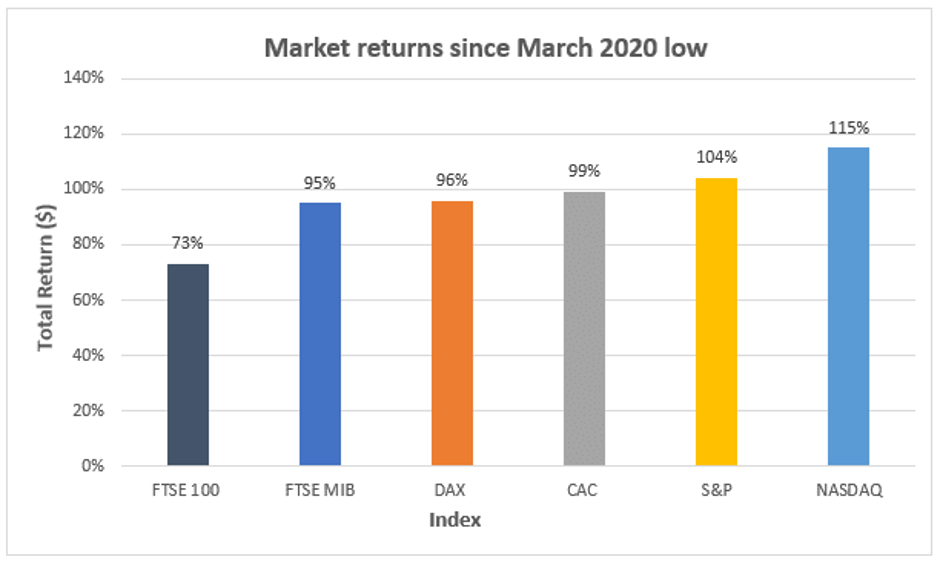
So, what can the average investor take away from the chaos of 2020/1 as we look forward to a new year? Well, it’s hard to argue that in such extreme circumstances having a globally diversified portfolio would totally have shielded you from the volatility we saw at the beginning of 2020. However, what is also true, is that some countries have bounced back better than others. For example, in the UK, the FTSE 100 went from 7,674 on 3rd March 2020 to 4,994 just 20 days later – a fall of 36%. Since that low, the FTSE 100 has gone up by 73%, which sounds healthy until you compare the rebound in other countries – Italy and Germany are up over 95%, whilst France is closer to 100%. In the US, the numbers are staggering: the S&P 500 has grown 104% since its low in March 2020, and the NASDAQ is up a whopping 115%.
The same story of differing fortunes also applies when you look across the sectors. Some of the best performing sectors in the US in 2021, were those that saw negative results in 2020. For example, the energy and real estate sectors were the worst performing in 2020, but were the best performing 2021. Meanwhile, the tech sector bucked the trend performing strongly in both years as growth stocks remained in vogue due to the threat of renewed lockdowns. In the UK, the Travel and Leisure sector is still 25% lower than its pre-Covid peak2, whereas the Pharmaceuticals sector is basically back where it started. Meanwhile, the Electronics sector has surged ahead, up 31% over its pre-Covid level.
The reasons for these differences are harder to decipher in some cases than the numbers are to read. Clearly, the Travel and Leisure sector continues to be on its knees as we refrain from foreign holidays, and the airlines got hit with the double whammy of grounded planes and soaring fuel prices. But when it comes to country-level recoveries, it’s perhaps harder to fathom. Despite a largely successful vaccine rollout, the UK just hasn’t done well. Perhaps the lingering and persistent cough that is Brexit is still at play? Indeed, supply chain issues persist, driving inflation to over 5%, but that is not just a UK phenomenon. According to data from the Organization for Economic Co-operation and Development, the UK’s GDP is projected to be nearly 3.4% smaller in 2021 than in 2019, while Japan and Germany are projected to be 3% and 2% smaller, respectively3. In contrast, the Chinese economy is projected to have grown 10.6% larger for the whole of 2021, compared to 2019 – despite its own difficulties handling covid-19.
Whatever the reasons, markets are now in a more normal place – what some are calling the “new normal”. As such, the arguments for not having all your proverbial eggs in one basket seem as good as ever. One such solution is the Bankers Investment Trust, part of the Janus Henderson range of investment trusts. The Trust invests in large and medium-sized companies across the globe that offer attractive growth and income opportunities for shareholders looking for long term returns. It is managed by Alex Crooke, whose role is to decide where to allocate capital – to take advantage of some of those regional/sectorial differences we have discussed. Once the money is allocated globally, the Trust comprises of concentrated regional portfolios run by regional specialists whose sole role is stock selection across sectors.
2021 hasn’t been a year without challenges for the Trust. Inflation, supply chain issues, the tapering of central bank support for economies, combined with rising energy prices and labour shortages, have been headwinds for all global investment vehicles. However, Alex and the team have been expecting these headwinds and have continued to invest in line with the themes they identified over 12 months ago. For example, looking to find cyclical companies that will benefit from the global economic recovery as countries ease lockdown restrictions. In addition, Alex has been reducing exposure to overvalued companies where valuations may be at risk as volatility increases. A great example here is the technology sector in the US market, which is trading significantly higher than its 20-year average.
In Asia, China has proved a challenge too. Beijing has adopted a “Zero Covid” policy and is not only enforcing lockdowns but it is shutting down entire cities to try and eliminate the virus. This has disrupted activity within the services sector, especially contact intensive businesses such as hotels and restaurants. Meanwhile, major Chinese tech companies took a hit early on in the year after Beijing embarked on an unprecedented regulatory clampdown on the sector. Finally, sentiment towards China soured further as the property scandal revealed cracks in the country’s housing market – estimated to be around 29% of China’s GDP.4 This has led Alex to take a more measured approach to the country.
So how has this approach performed overall in a diversified portfolio since the start of 2020? Despite the challenging market environment, the Trust has returned 27% (including dividends) reinvested.5 At the same time, investors have also benefitted from a rising dividends, in fact, the Trust has increased its dividends every year for the past 55 years – making it an AIC Dividend Hero.
Regarding the outlook for 2022 and beyond, the team remains optimistic as economies continue to recover. This confidence is also reflected in announcements from central banks signalling their intentions to reduce their quantitative easing and raise interest rates. The recovery in corporate earnings is also encouraging with global dividends expected to return to their pre-pandemic levels in 2022. That being said, risks still remain with inflation the key concern. So far companies have managed to pass on costs to consumers; however, the question is how sustainable this is moving forward as prices continue to rise. In addition, there will be challenges around rising energy prices for both consumers and businesses and how this will affect energy usage – a critical component of the economy. The ongoing impact of Covid on economic activity and supply chain is also likely to restrict economic growth in the short term. Though growth is expected to be more moderate this year compared to last year Alex and the team believe that there is still further upside for markets this year. As such, they are hard at work figuring out which companies will benefit from the prevailing market environment.
Discrete year performance % change (updated quarterly)
Share Price
NAV
30/09/2020 to 30/09/2021
11.0
18.6
30/09/2019 to 30/09/2020
9.1
6.5
28/09/2018 to 30/09/2019
8.1
6.6
29/09/2017 to 28/09/2018
11.5
12.4
30/09/2016 to 29/09/2017
27.6
19.4
All performance, cumulative growth and annual growth data is sourced from Morningstar.
Cyclical stock – A cyclical stock is a stock that’s price is affected by macroeconomic or systematic changes in the overall economy. Cyclical stocks are known for following the cycles of an economy through expansion, peak, recession, and recovery. Most cyclical stocks involve companies that sell consumer discretionary items that consumers buy more during a booming economy but spend less on during a recession. Quantitative easing – An unconventional monetary policy used by central banks to stimulate the economy by boosting the amount of overall money in the banking system.
Disclaimer
References made to individual securities should not constitute or form part of any offer or solicitation to issue, sell, subscribe, or purchase the security. Janus Henderson Investors, one of its affiliated advisors, or its employees, may have a position mentioned in the securities mentioned in the report.
Not for onward distribution. Before investing in an investment trust referred to in this document, you should satisfy yourself as to its suitability and the risks involved, you may wish to consult a financial adviser. This is a marketing communication. Please refer to the AIFMD Disclosure document and Annual Report of the AIF before making any final investment decisions. Past performance does not predict future returns. The value of an investment and the income from it can fall as well as rise and you may not get back the amount originally invested. Tax assumptions and reliefs depend upon an investor’s particular circumstances and may change if those circumstances or the law change. Nothing in this document is intended to or should be construed as advice. This document is not a recommendation to sell or purchase any investment. It does not form part of any contract for the sale or purchase of any investment. We may record telephone calls for our mutual protection, to improve customer service and for regulatory record keeping purposes.
Issued in the UK by Janus Henderson Investors. Janus Henderson Investors is the name under which investment products and services are provided by Janus Capital International Limited (reg no. 3594615), Henderson Global Investors Limited (reg. no. 906355), Henderson Investment Funds Limited (reg. no. 2678531), Henderson Equity Partners Limited (reg. no.2606646), (each registered in England and Wales at 201 Bishopsgate, London EC2M 3AE and regulated by the Financial Conduct Authority) and Henderson Management S.A. (reg no. B22848 at 2 Rue de Bitbourg, L-1273, Luxembourg and regulated by the Commission de Surveillance du Secteur Financier).
Funeral director Dignity (LON: DTY) is not showing any significant signs of improving performance and a poor fourth quarter performance led to a profit downgrade.
There was a 10% increase in deaths in the UK. but Dignity reported a lower profit. This appears to be due to the offsetting effect of lower pricing and higher costs. Peel Hunt has reduced its 2021 pre-tax profit forecast from £34m to £25.5m.
The outlook for profit remains poor with the likelihood of a normalising death rate. There could even be a lower than normal death rate over the next few years.
Securitisation covenant
Dignity is...
Animal genetics services provider Genus (LON:GNS) is expected to report lower interim profit on 24 February. China has been a weak market because of low pig prices and no recovery is likely in the year to June 2022.
Peel Hunt forecasts a 22% dip in interim pre-tax profit to £37m. China is expected to be responsible for a £13m profit decline, which is more than the amount expected for the group.
The interims should include further information on the pig genetics market in China and how it is holding up in the rest of the world. The bovine market is also important and there has been limited focu...
The FTSE 100 ground out gains on Friday despite ongoing concern around a possible invasion of Ukraine by Russia.
The FTSE 100 was trading 0.4% higher in afternoon trade on Friday as markets looked past Ukraine-Russia tensions to better than expected retail sales and a fairly decent set of figures from Natwest.
“The FTSE 100 ticked higher on Friday as nervousness around a potential all-out conflict in Ukraine persists,” says AJ Bell financial analyst Danni Hewson.
“Better-than-expected retail sales suggest that, for now, the increased cost of living is not preventing Britons from hitting the shops.”
JD Sports were 1.6% higher at the time of writing and Whitbread added 0.9%. Burberry shares also cheered the propensity of Brits to splash their cash gaining 2%.
Although shoppers bounced back from an Omicron-induced lull in December, analysts cautioned the good times may be short lived.
“Retailers will be cheering on signs that shoppers are voting with their feet to support the high street, but plenty of big spenders may slink away in the months to come. The sales uplift in January shows the Omicron recovery is underway but retailers haven’t yet recouped all of December’s losses,” said Susannah Streeter, senior investment and markets analyst, Hargreaves Lansdown.
“At some point lockdown savings will be spent, and the rapid rise in prices on supermarket shelves, energy bills and petrol forecourts, combined with looming tax increases, is highly likely to put a dampener on consumer spending.”
NatWest shares dipped 2% after they announced a return to profit but failed in increasing their Net Interest Margin, a key measure of banking profitability.
“Natwest has slipped a little bit behind target on cost reduction, thanks to higher inflation, which may be adding to some investor nervousness and the company is yet to see any progress on that key measure of profitability – net interest margin,” said Danni Hewson.
Nonetheless, Lloyds and Barclays shares rallied in anticipation of similarly positive updates in the coming days – without the negativity observed in Natwest’s report.
Natwest has posted strong growth and has returned to profitability and posted £2.9bn – compared to 2020 losses of £753m.
Lending grew by £7.8bn in 2021 thanks to strong growth in mortgages.
Chief executive Alison Rose said: “NatWest Group delivered a strong performance in 2021 as we returned to profitability, made progress against our strategy and distributed more than £3.8 billion of capital to our shareholders, including £1.7 billion to the taxpayer,”
“We are acutely aware of the challenges that many people, families and businesses continue to face up and down the country and are working alongside our customers to provide the support they need – whether that is managing their money better, saving for a house or retirement or starting or growing a new business – as well as playing a leading role in the transition to net zero,”
Shareholders will receive 7.5p per share.
Despite the boost in profits, analysts highlighted concerns some investors may have about the cost of living crisis and the impact on household debt, and the ability to service that debt.
“Expectations are set pretty high for the UK banks heading into their latest reporting season and this helps explain why, despite a return to profit and otherwise pretty positive update, Natwest got us off to a subdued start in terms of its share price,” said AJ Bell financial analyst Danni Hewson.
“After all the banking sector is one of the few industries which will be waving flags and cheering as interest rates are increased as it allows them to generate a higher return from their lending activities.”
“The better than expected earnings and hike in the outlook were, to some extent, baked in, and investors may be concerned about the possibility of an increase in bad debts as its customers face a cost of living crisis. This could outweigh any boost to profitability from higher rates.”