FTSE 100 eases after strong week

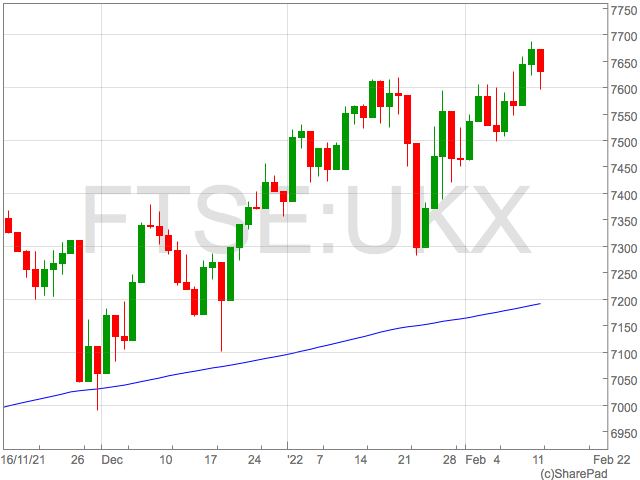
The FTSE 100 eased on Friday after a strong week of gains that saw the index trade at the highest levels since the beginning of the pandemic.

The FTSE 100 was trading 7,627, down 0.4% going into the close on Friday. Although the index was down on Friday, the FTSE 100 rebounded from sharper selling earlier in the session to trade marginally above key support levels around 7,620.

Trade was led by US equities which sank overnight on fears around inflation and interest rates. This meant the FTSE 100 opened lower, but later tracked the recovery in US futures higher during the session.
UK GDP

Markets learnt of the UK’s strong economic performance in 2021 on Friday but the bumper reading did little to inspire confidence.

Investors seemed unimpressed with the UK’s 7.5% growth in 2021 with domestic facing sectors such as housebuilders barely moving.

GDP is backward looking economic indicator and despite grinding out 1% growth during the ‘lockdown by stealth’ in Q4, both households and investors will be looking forward to conditions in 2022 with soaring inflation and the prospect of multiple rate hikes.

“Will 2022 see the UK quickly shake itself off after December’s blip or will supply constraints and those rising prices keep the lid on things?  One percent growth in Q4 is pretty good going when you think about those empty high streets dressed up for a Christmas party that never took place.  Household consumption has been a key factor in the UK’s growth story, the question is will households still have the fire power as additional budget pressures exert a choke hold,” said Danni Hewson, AJ Bell financial analyst.

Overseas earners

With the majority of shares in the FTSE 100 down on Friday, those that showed some signs of positivity were predominately companies that earn a large proportion of their revenue overseas.

Unilever rebounded from selling yesterdays as investors contemplated the company’s strategy and decision to proceed with share buybacks and hold off on any major acquisitions. Unilever shares were 3.3% higher at the time of writing.

Energy companies continued their rally on Friday as BP and Shell gained. Miners were mixed as copper miner Antofagasta pushed 2% higher but Rio Tinto, Glencore and Anglo American fell.

Betting companies Entain and Flutter also gained as investors positioned for the relaxation of betting laws in the US.

Is Scottish Mortgage Investment Trust now a buy?

The Scottish Mortgage Investment Trust has become the FTSE 100’s proxy for the health of the US tech sector in recent months as concerns of interest rate hikes rock the world’s biggest technology shares.

The Scottish Mortgage share price has been in the hands of traders that target the trust because of it’s tech-heavy holdings that include Netflix, NIO, Tencent, Tesla and Amazon.

Such has been the volatility in US tech shares so far in 2022, Scottish Mortgage shares are now down 19% year-to-date having found support around 1,000p.

With shares building a base well below recent highs, investor may well be asking is Scottish Mortgage Investment Trust now a buy?

Scottish Mortgage Investment Trust shares chart – Source SharePad

One measure – and by no means an absolute indicator – is investor activity in their trading accounts. AJ Bell provides insight into investor views around Scottish Mortgage with the rankings of popular stocks in their client’s ISA accounts in January.

The Scottish Mortgage Investment Trust was the most popular trust with AJ Bell Youinvest ISA investors in January.

“ISA investors clearly weren’t put off by the fact that two of the most popular funds in recent years, Fundsmith Equity and Scottish Mortgage, saw a considerable downturn in January thanks to a sell-off in US tech stocks. Fundsmith Equity fell by 10% and Scottish Mortgage fell by 19%, as key tech holdings slumped over the course of the month,” said Laith Khalaf, head of investment analysis at AJ Bell.

“Of course, performance shouldn’t be judged over such a short period, and the exceptional track record of the managers of both Fundsmith Equity and Scottish Mortgage means they have an awful lot of credit in the bank, which explains why investors are looking through a temporary dip in form and continuing to back them for the long term.”

Scottish Mortgage and technology shares outlook

Although the popularity of Scottish Mortgage with AJ Bell’s clients highlights investors are still confident the trust will recover, this by itself is not enough to judge whether the stock is worth buying at these levels.

For a more calculated approach, investors must consider the immediate outlook for US tech shares and the broader investor sentiment around highly valued companies in a period monetary conditions are beginning to tighten.

The prospect of cheap money being removed from the market has thrown tech shares into the spotlight as their high valuations started to look vulnerable with rising bond yields.

The announcement of the highest rate of US inflation in 40 years will do nothing to subdue concerns around interest rates and analysts are now predicting the Federal Reserve will increase rate by 150bps in 2022.

“This would amount to 150 bps in rate hikes this year, vs our previous forecast of three 25 bps rate hikes,” wrote HSBC’s U.S. economist Ryan Wang in a note.

If such an increase rate comes to pass investors should expect further volatility in technology shares and Scottish Mortgage in 2022.

In addition, Scottish Mortgage is trading at a 2.6% premium to their Net Asset Value (NAV) suggesting there is scope for downside in shares if sentiment around tech sours further.

However, further weakness in the Scottish Mortgage share price could be viewed as a buying opportunity for investors given the historical ‘sell the rumour, buy the fact’ market positioning around interest rate increases and tighter monetary policy.

Kitwave price target increased by Canaccord after food service acquisition

Analysts at Canaccord Genuity have reiterated their buy stance on AIM-listed Wholesalers Kitwave, and increased their price target from 210p to 240p after Kitwave completed the acquisition of MJ Baker Food Service for £24.5m.

MJ Baker offers its customer base over 3,500 products across ambient, chilled and frozen food categories, together with alcohol, confectionery and non-food items.

MJ Baker will bolster Kitwave’s existing wholesaling business which already services 38,000 independent businesses throughout the UK.

“The acquisition of M.J. Baker is an excellent addition to our Foosdservice division and expands the Group’s nationwide reach into the South West.  M.J. Baker is renowned for providing a quality delivered solution to its customers, a key part of the Kitwave Group ethos,” said Paul Young, Chief Executive Officer of Kitwave.

Following the integration of MJ Baker, analysts at Canaccord see Kitwave Kitwave representing significant value when compared to their peer group on a price/earnings basis.

“The business is trading at a c.52% discount to our selected peer group average of c.18.7x, which we believe is unjustified given the Group’s superior forecast earnings growth. We reiterate our BUY rating and increase our target price to 240p from 210p reflecting the upgrades,” Canaccord said in a note.

Analysts at Cannacord see the MJ Baker acquisition increasing EBITDA by 9% in 2022 taking into consideration 8 months of ownership during the period.

Investing for Income with Get Income’s Kimmo Rytkonen

The UK Investor Magazine is joined by the founder of investment platform Get Income for a discussion around income investing and Get Income’s Crowdfunding platform on Seedrs.

Kimmo has extensive experience in FinTech and has been involved in successful exits in the sector. He’s identified an opportunity for investing in loans and the income opportunities for investors who can invest from €10.

Get Income have surpassed their target on Seedrs and are now in over funding.

You can find out more information on the Seedrs website here:

https://www.seedrs.com/income/

Private Sector Leasing Edinburgh: An ethical property investment opportunity

Sponsored by Link Housing

Socially conscious property investors can provide a lifeline for households facing homelessness while investing in Scotland’s most in-demand property market with the City of Edinburgh Council’s Private Sector Leasing (PSL) scheme. 

Edinburgh is regularly recognised as one of the top cities in the UK for property investment – including being named by Real Estate specialist Colliers as the Top UK Residential Investment City in December 2021 – due to the capital’s solid potential for high rental yields and capital growth, not to mention its outstanding qualities as a place to live and visit.

For investors seeking long-term investment in this thriving residential market, PSL provides a hands-off opportunity with complete property management and guaranteed rental income for three or five years. Investors who want to manage repairs themselves can also do so.

Over 1,000 investors currently let their Edinburgh property to the Council through PSL, creating a supply of safe emergency accommodation across the city. The City of Edinburgh Council funds the management costs, so property owners get professional management services at no cost to them whilst helping those in need.

The scheme has been managed by Link Housing Association since 2010. Benefits include:   

  • Guaranteed rent paid quarterly in advance (even if the property is empty through no fault of your own) 
  • Market-linked rental assessment
  • No void periods   
  • No letting agency fees  
  • Tenant damage covered  
  • Regular property visits 
  • 3- or 5-year lease  
  • ISO-accredited maintenance service 
  • Optional repairs service 

Link PSL also has a network of local contractors to help source properties suitable for PSL and carry out refurbishment to meet current legislation.

Trouble free investment management 

Ken, a current landlord with Link PSL said, “Link’s PSL scheme is a godsend for landlords looking for trouble free management. I have half of my property portfolio on the scheme, and this is the half I can most relax with. There are no voids, rents are paid 3 months in advance without fail and there are no issues regarding getting your property back at the end of the contract. Staff are professional, courteous and helpful! 

I have been a serial landlord for almost 20 years and can honestly say that Link PSL has saved me through each property downturn. A guaranteed income for 3 or 5 years paid in advance with no voids – it can’t get any better!”

The priority of many investors is income security, whilst for others it will be the positive social impact of their investment. With PSL, investors don’t have to choose between the two.

Find out more:  

www.linkhousing.org.uk/PSLor email psllandlordteam@linkgroup.org.ukto request a call back for a no obligation informal discussion about letting a vacant property or portfolio through the scheme or selling a vacant property to Link PSL for the scheme. 

Link also offers quality build to rent portfolio management and affordable factoring services. 

Link PSL is accredited with Landlord Accreditation Scotland and a registered Letting Agent under the Letting Agent Registration (Scotland) Regulations 2016 (Registration Number LARN1907019).  

AstraZeneca revenue surges on vaccine sales

AstraZeneca revenues surged in 2021 as the Pharma giant rolled out the COVID-19 vaccine and saw strong growth in oncology and immunotherapy drugs.

AstraZeneca revenue rose 41% (38% at CER) to $37.4bn including COVID-19 vaccine sales and 26% excluding vaccines sales.

“Astrazeneca’s results showed  a total revenue increase of 41% to $37,417m including COVID-19 vaccine revenues. The company managed to achieve 14 positive Phase 3 readouts across nine medicines in 2021, and 22 regulatory approvals and authorisations in major markets which further boosted its market dominance in the field,” said Walid Koudmani, market analyst at financial brokerage XTB.

Astra will create a new business unit for their COVID-19 vaccines but in an interview with Bloomberg TV, the Astra CEO said they expected volumes to fall as we move out of the pandemic. Although vaccine sales boosted Astra’s sales, the overall impact of the pandemic on profitability was negative.

“Covid vaccine sales added $4bn to sales at AstraZeneca, but coronavirus had the opposite impact on profits. Outfitting staff with PPE and providing tests together with increased investment in vaccine and treatment development all weighed on the bottom line,” said Laura Hoy, Equity Analyst at Hargreaves Lansdown.

Hoy also highlighted the impact of acquisitions on Astra’s profit but was confident growth would support a dividend hike in the future.

“The real driver for Astra’s profit decline was the Alexion acquisition. The purchase brought Rare Diseases under the Astra umbrella and our fist glimpse at performance for this sector wasn’t too shabby. Management were confident enough in the promise of future growth that they announced a dividend hike,” said Hoy.

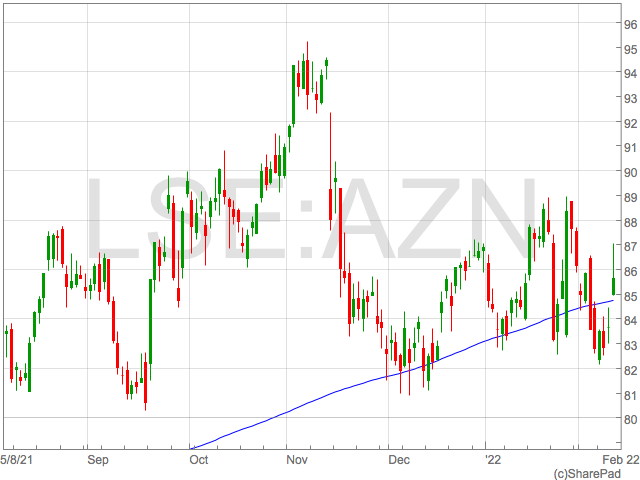
Astra shares were up 2.3% at the time of writing on Thursday morning.

Unilever to avoid major acquisitions as margins squeezed

Unilever achieved the fastest sales growth in nine years in 2021 but the impact of rising prices meany underlying operating profit margins were squeezed by 10 basis points.

Unilever recorded a 6.2% constant currency rates to €52.4bn, up from €50.7bn in 2020. The jump in revenue helped produce a 16% increase in net profit to €6.6bn, up from €6bn.

However, the market’s focus was on margin pressure and the impact of rising input prices.

“The promise of share buy backs and a softly-softly approach to acquisitions won’t give Alan Jope much of a break from the mounting criticism over the way the business has been run. Inflation is flashing as a big warning light in these results and the worst may be yet to come,” said Susannah Streeter, senior investment and markets analyst, Hargreaves Lansdown.

“Despite the fastest underlying sales growth in nine years, coming in at 4.5%, the fall in the underlying operating margin is already painful. Input costs are rising dramatically and prices are being pushed up as result by 4.9% in the fourth quarter.”

Although Unilever shares dipped over 3% in the initial market reaction, there were positives from Unilever’s results in the form of strong growth in emerging markets.

“Our thirteen billion-Euro brands grew 6.4%. Priority markets of China, India, and the US grew at 14.3%, 13.4%, and 3.7% respectively. Our growth in e-commerce was 44%, ahead of global channel growth and bringing e-commerce to 13% of turnover. We have continued to re-shape our portfolio into high growth spaces, acquiring in Prestige Beauty and Functional Nutrition, and agreeing the sale of our Tea business,” said Unilever, Chief Executive Officer, Alan Jope.

The Unilever CEO also addressed ongoing speculation around the revisiting of a bid for GlaxoSmithKline’s consumer business and said spare cash would be used on share buybacks instead.

“We have engaged extensively with our shareholders in recent weeks and received a strong message that the evolution of our portfolio needs to be measured. We therefore do not intend to pursue major acquisitions in the foreseeable future and will conduct a share buyback programme of up to €3 billion over the next two years,” said Jope.

Redrow profits rise 16%

0

The Redrow order book has reached £1.5bn and profits grew 16.6%.

The group posted record revenues of £1.052bn for the 27 weeks to 2 January. Redrow’s interim dividend increased by 4p to 10p.

Matthew Pratt, the group’s chief executive, said: “We have capitalised on strong demand, improved sales margins and continued to invest for growth.”

“The value of our first half reservations was £884m, an increase of 6 per cent on the same period last year (2021: £836m), and our total order book increased to £1.5bn (2021: £1.3bn), leaving us well placed for the future.”

Relx posts bumper trading

0

Relx has posted soaring profits and revenues.

Net profits jumped 17% to £1.69bn and revenues were up by 7% to £7.24bn. As a result, the board is suggesting a dividend payout of 49.8p per share.

Chief executive Erik Engstrom commented: “RELX delivered strong underlying revenue and profit growth in 2021,”

“We believe that this improved trajectory is a reflection of our ongoing strategy of focusing on the organic development of increasingly sophisticated analytics and decision tools that deliver enhanced value to our customers across market segments. Recent acquisitions, which have supplemented our organic growth strategy, have continued to perform well.”

A spokesperson at the group said: “Based on the improved performance in 2021 across the company, we expect 2022 full year underlying growth rates in revenue and adjusted operating profit, as well as constant currency growth in adjusted earnings per share, to remain above historical trends.”

Watches of Switzerland profits grow

0

Following strong demand in the UK and US, Watches of Switzerland has posted strong profits and revenues in the year-to-date.

Revenues hit £934.3m and there has been an impressive 38% growth in performance.

The company has plans to expand in Europe and has bought six shops in Sweden, Denmark and the Republic of Ireland. 

“I am pleased to report continued strong momentum for our Group following a successful Christmas trading period,” said Brian Duffy, the chief executive.

“We have delivered impressive growth in both luxury watches and luxury jewellery in both the UK and US markets demonstrating the value of our portfolio of world leading partner brands.”

“Strong trading to date, revised pricing by certain brands and visibility of supply for calendar 2022 all support our expectation to perform towards the top end of our full year guidance.”