UK car exports plummet

0

Major UK car brands no longer in favour in foreign markets

Demand from abroad for cars made in the UK has plummeted as output fell over recent weeks.

Despite lockdowns coming to an end, just over 1,000 cars are being made per day in the UK.

Recently average annual volumes were as high as 4,500 per day.

Data shows a 27% year-on-year fall in production in August. This means the country is set of its worst yearly performance in tens of years.

Trading partners that have previously been fond of classic British companies such as Mini, Jaguar, Rolls-Royce et all, are showing dramatically less enthusiasm.

Exports to China are down 58% while exports to America are down by 65%.

Sales to Australian buyers have plummeted by 75%.

“While not the only factor at play, the impact of the semiconductor shortage on manufacturing cannot be overstated. Carmakers and their suppliers are battling to keep production lines rolling, with constraints expected to continue well into 2022 and possibly beyond,” Mike Hawes, chief executive of the SMMT, said.

“Job support schemes such as furlough have proven such a lifeline to automotive businesses, yet its cessation today comes at the worst time, with the industry still facing Covid-related stoppages which are damaging the sector and threatening the supply chain in particular. Other countries have extended their support; we need the UK to do likewise.”


Inflows into Blackrock’s ESG ETF may not reflect best practices

The largest ESG ETF, BlackRock’s $22.5bn iShares ESG Aware (ESGU) product, is making progress on its thematic label.

However, its inflows may be stronger than its ESG practices, according to Bloomberg Intelligence (BI).

Inconsistencies in stock selection and sector allocation are becoming more important as regulators scrutinize ESG funds more closely.

There seem to be some conflicts between ESGU’s holdings and the methodology and marketing documents of the index it tracks.

“Our analysis finds it holds firms with ties to controversial weapons, which doesn’t follow the exclusion commitments of the tracked index,” said Adeline Diab, Head of ESG and Thematic Investing EMEA at Bloomberg Intelligence. “ESGU’s weight in oil and gas, and exposure to companies linked to oil sands, such as ConocoPhillips, raises more questions. Funds’ approach and rigor in embedding ESG will take on more importance as regulators focus on mis-selling.”

While MSCI’s USA Extended ESG Focus Index methodology targets peers with higher ESG ratings, subject to maintaining risk and return characteristics similar to the parent index, BI’s analysis still points to selection inconsistencies within sectors, with poorly rated firms from an ESG and financial perspective favoured over well-rated ones.

“Though ESGU may embed risk and returns characteristics in determining stock holdings beyond the fund’s sector-weight alignment to the benchmark, its allocations point to some divergences within selection, Bloomberg Intelligence believes. In several sectors, including energy, technology and financial services, companies showing both good ESG Scores (A or AA) and strong recommendations were excluded, such as NiSource, Dropbox or the Intercontinental Exchange, in favour of counterparts with lower ESG scores and ANR ratings, including NRG Energy, Palantir or Schwab.”

Investing in Life Sciences and Health Care with Deepbridge Capital’s Andrew Aldridge

The UK Investor Magazine Podcast welcomes Andrew Aldridge, a Partner at Deepbridge Capital.

Deepbridge Capital is the manager of a £200 million range of tax-efficient EIS and SEIS funds including the Deepbridge Life Sciences EIS, Deepbridge Life Sciences SEIS and Deepbridge Technology Growth EIS.

Andrew joins the Podcast to focus on their Life Sciences funds which account for roughly £50m of their £200m investments.

We discuss how the pandemic has increased investment in Life Sciences and Health Care as investors seek out opportunities in the evolving health care system.

Andrew highlights a selection of companies Deepbridge have added to their portfolios and the key trends they see developing in the sector.

We explore the most important factors Deepbridge consider when selecting early stage companies for their portfolios and delve into the journey’s of some of their portfolio companies.

FTSE 100 defies economic woes

0


There is a decent showing across European equities including a 0.6% gain in the FTSE 100 to 7,148.

“That’s quite surprising given how a cocktail of issues have been clouding the market in recent sessions, namely rising bond yields making tech stocks less attractive, ongoing supply chain issues, the spike in energy prices and broader inflation, and the Evergrande drama still playing out,” says Russ Mould, investment director at AJ Bell.

The UK market was propelled by miners, oil producers and financials – all beneficiaries of strong economic activity, which is again perhaps a surprising movement given growing fears over global economic growth as we head towards 2022.

Oil producers are benefiting from higher oil prices but demand for miners and financials might represent investors rotating once more from high growth stocks towards lower rated names that offer growth at a cheaper price, even if that growth is less racy.”

IPOs were in the spotlight as two new entrants got off to a good start, and one recent name dug itself a deeper hole.

“Oxford Nanopore floated at 425p and had hit 570p within the first hour of trading. Among small caps, Made Tech listed at 122p and quickly moved higher to 148.5p,” said Mould.

“In contrast, Parsley Box hung his head in shame as its shares continued to fall lower. Having listed in March at 200p, the company issued a shocking update over the summer which pulled the price down. The stock has slumped even further to now trade at 77.5p after further setbacks, representing a 61% decline since IPO.”

FTSE 100 Top Movers

Anglo American (3.14%), Diageo (2.37%) and Evraz (2.33%) are the top risers on Thursday morning on the FTSE 100.

Melrose Industries (-3.04%), Barratt Developments (-2.6%) and British American Tobacco (-2.08%) make up the bottom three.

Pound dips on mounting inflation concerns

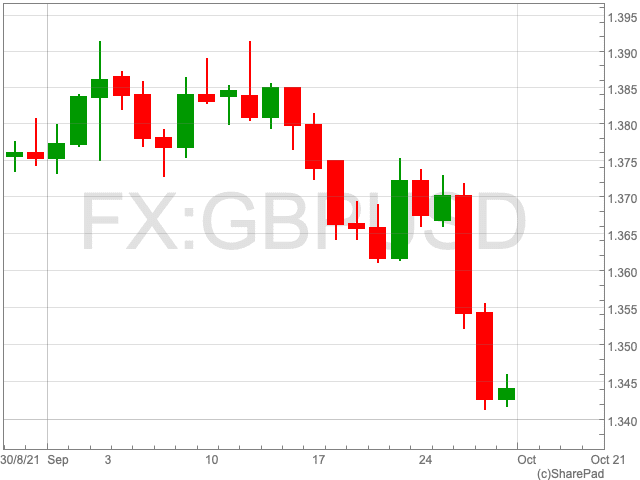
GBP now flat for the year versus US dollar

The pound has fallen to its lowest point against the dollar in 2021 amid fears that the UK could see high inflation and lower growth.

Despite an early interest rate rise being anticipated, the pound is beginning to “behave like an emergency market currency” said a City strategist, as drivers queued up for fuel across the country.

Governor of the Bank of England Andrew Bailey also warned that the economy is seeing worse than expected growth.

“I expect us to be back to the pre-pandemic level in the early part of next year, possibly a month or two later than we thought we would be at the start of August,” Bailey told a European Central Bank panel.

The pound dropped to its lowest level against the dollar since December 2020 amid talk of stagflation.

Having been one of the best performing currencies this year on the back of the vaccine roll-out, sterling is now flat against the dollar over the course of 2021.

“The pound is still suffering from the perception of domestic shortages, higher inflation and the prospect of a winter of discontent,” Neil Jones, head of FX sales at Mizuho Bank, said.

Speed of UK recovery surpasses expectations

0

Bank of England cuts forecast for GDP on labour shortages

The UK economy recovered quicker than expected through April and June as Brits splashed the cash after they were released from lockdowns.

The Office for National Statistics said that GDP rose by 5.5% in Q2 after initial forecasts suggested it would come in at 4.8%.

The surge in GDP was supported by shops reopening with households spending playing a significant role in the 5.5% increase.

Jonathan Athow, deputy national statistician at the ONS, explained the new figures, saying: “The economy grew more in the second quarter than previously estimated, with the latest data showing health services and the arts performing better than initially thought.”

“The revised figures also show households have been saving less in recent years than previously thought.”

“Household saving fell particularly strongly in the latest quarter from the record highs seen during the pandemic, as many people were again able to spend on shopping, eating out and driving their cars.”

In Q2, household spending rose by 7.9%, as the savings ration dropped to 11.7% from 18.4% over the first three months of the year.

However, ongoing supply chain issues, including a shortage of HGV drivers, led to the Bank of England cutting its GDP forecast from 2.9% to 2.1%.

Fidelity International’s investment director, Maike Currie, said that “no-one really knows what is next”. He added: “I think what we can be certain of is that we’ll see under-employment, where employees return to work but possibly not on a full-time basis and that they might need to supplement their income.”

Boohoo sales soar as profits dip

0

Boohoo share price dives in early morning trading

Boohoo, the online fashion retailer, confirmed that it has doubled its market share in the UK and US since the beginning of the pandemic, although its profits dived despite robust investment.

Sales jumped by 20% to £975.9m over six months up to the end of August year-on-year, while profits before tax plunged 64% to £24.6m.

One of the reasons costs were down was increased shipping costs, which exceeded levels seen before the pandemic by £26m.

At the time of writing, the Boohoo share price is down by over 8%.

Additional checks at the border following Brexit saw the company’s profit margins fall from 57.8% to 53.6%, Boohoo said.

“Given Boohoo’s successful customer acquisition over the last 18 months, its revenues look set to continue to grow in the short term, buoyed by these customers buying more expensive products,” Harry Barnick, Senior Analyst at Third Bridge.

“However, investors will be playing close attention to the sustainability of growth in the UK as Boohoo noted Q2 results were impacted by higher returns and the reopening of physical retail.”

“Although Boohoo’s market share has doubled over the last two years, as we head into the all-important Christmas season, the UK market is hotting up, with Chinese competitor, Shein, presenting a real threat to Boohoo’s market share given its price point and broad offer.”

New AIM admission: Peel Hunt floats after profit peaks

Broker Peel Hunt is coming back to AIM two decades after a brief spell on the junior market was ended via a takeover.
Peel Hunt originally joined AIM in February 2000, which was near to the top of the market, and then agreed to a bid at the end of the year. The management buy out of the broker happened in November 2010 when markets were recovering. This suggests that Peel Hunt and its managements have a history of knowing when to float and sell, then buy back at a lower price if the opportunity arises. Peel Hunt has timed both its flotations to coincide with strong stockmarket activity.
Existi...

LoopUp cash call at large discount

Cloud-based conferencing services provider LoopUp (LON: LOOP) is raising cash at a 32% discount to the mid-price of 37p. The offer price of 25p is also a 73.5% discount to the flotation price of 100p back in 2016.
A placing will raise £7m and a PrimaryBid offer will raise additional funds. The acquisition of SaaS-based hybrid training technology business SyncRTC Inc will not take much of the cash because the enterprise cost is £3.26m and £2m of that is in shares at around 37p each.
The rest of the cash will go towards investment in cloud telephony and the reduction of debt
LoopUp has had a rol...

Electric Vehicles and Green Energy Metals Miners with Alan Green

By 2040, mineral demand for Electric Vehicles is predicted to be 21.5mt, the largest of all clean energy technologies. Electricity networks are predicted to demand 13.9mt.

Norway has banned the sales of fossil fuel cars by 2025 but is set to meet that target a lot sooner. Other countries such as Italy still have plenty of space to improve as only 10% of cars sold are currently electric. The UK only recorded 8.4% of new registrations as EVs, according to AutoTrader.

Cobalt, lithium and Nickel are the main metals used in the production of EV batteries.

63kg of Graphite, 53kg of Copper and 39.9kg of Nickel is required in the manufacture of the average eclectic car.

Minerals used in EV, according to the International Energy Agency:

-Copper: 53.2kg

-Lithium: 8.9kg

-Nickel: 39.kg

-Manganese: 24.5kg

-Cobalt: 13.3kg

-Graphite: 66.3kg

Roskill Analysts predict Cobalt demand will rise to 270,000 tonnes per year by 2030, up from 141,000 in 2020.

One of the world’s largest mine is operated by Glencore in the Democratic Republic Congo producing 30,000 tonnes a year.

Nickel consumption totalled 2.5 million metric tonnes in 2020 and is predicted

109kg of Molybdenum is needed per MW of electricity production from Offshore wind.

Companies discussed:

Kavango Resources (LON:KAV) have a number of projects including the Kalahari Suture Zone which is targeting a Nickel-Copper-Platinum resources similar to that of Norilsk in Russia.

Blencowe Resources (LON:BRES) is developing the potentially low-cost Orom-Cross Graphite project in Uganda.

Glencore (LON:GLEN) is the world’s largest Cobalt miner.

Altona Rare Earth (LON:ANR) is explorer focused on Rare Earths that have applications in Clean Energy production.

Power Metal Resources (LON:POW) has a broad portfolio of metals including Lithium exploration in Quebec. The company is planning a number of IPOs for their assets.

Castillo Copper (LON:CCZ) is of course a copper explorer but has recently acquired Lithium assets.

Cadence Minerals (LON:KDNC) operates a range of Lithium projects including a stake in Europe Metal Holdings (LON:EMH)

Panther Metals (LON:PALM) is predominantly a gold play but is developing Coglia Nickel -Cobalt project.

Tertiary Minerals (LON:TYM) has two copper projects and a selection of silver projects.