Cyber Security stands out in July amid disappointing month for equities

0

Saxo, the online trading platform, revealed that its top performing equity-themed basket in July was ‘Cyber Security’, returning 5.1% last month.

An equity basket, according to Saxo, is a collection of stocks thematically identified by the company’s analysts to isolate an area of the market and act as inspiration for investors.

However, July was broadly a bad month for Saxo Group’s equity baskets with only two, ‘Cyber Security’ and ‘Battery’, outperforming the global MSCI World index.

July’s Saxo Group top performing Equity Themed Baskets

Equity Theme BasketJuly Return (%)
Cyber Security5.1%
Battery3.1%
MSCI World (USD)1.8%
India (GDRs)1.3%
Financial Trading-0.2%
Semiconductors-0.4%
Green Transformation-1.2%
Commodity Sector-1.2%
Mega Caps-1.7%
Logistics-2.9%
Crypto & Blockchain-5.0%
Travel-5.6%
MSCI EM (USD)-6.7%
Cannabis-7.1%
NextGen Medicine-7.2%
E-commerce-7.3%
Gaming-8.7%
Bubble Stocks-10.7%
3D Printing-11.1%
China Consumer & Technology-11.9% 

The low performance across the board came about mainly due to concerns over the Delta variant of Covid-19 and its impact on the global economy.

Peter Garnry, Head of Equity Strategy at Saxo Group, said the platform’s Cyber Security basket performed well in July for two key reasons: “The first was a strong earnings momentum for the industry. The second reason is that American President Joe Biden in July signed an official agreement, pledging to strengthen the US’ cyber security efforts and ensure that the country is prepared for future cyber attacks.”

The US 10-year yield fell during July, as did ‘Bubble’ stocks, making it an usual month. At the same time, the earnings season started strong as some of the world’s major companies companies beat estimates. However, global supply chains are still being paced by supply chain challenges.

The worst performing basket of all was ‘China Consumer and Technology’, after the CCP cracked down an certain sectors over fears they were getting too much power.

“We have also recently seen China crack down on its for-profit education industry and its wider technology industry as well as on Chinese listings in the US,” said Garnry. “It seems as though this is due to a desire to move the country’s industry towards other technologies within renewable energy and semiconductors.”

“China is moving away from a strategy of growth at all-costs and instead looks towards more high-end technology development. Global investors, which have recalibrated their exposure to emerging markets and China, sending the China Consumer & Technology basket South.”
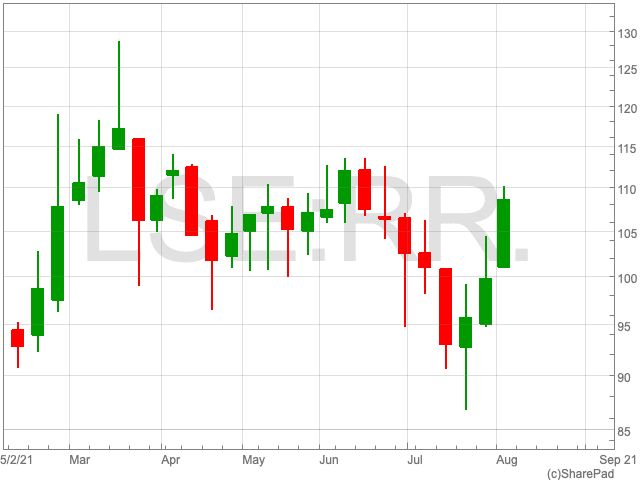
Rolls-Royce share price well positioned to take off again as travel sector recovers

0

Rolls-Royce Share Price

The Rolls-Royce share price (LON:RR) is up by 3.46% on Thursday as the engineering company confirmed it returned to a profit. Unless there are some dramatically unforeseen circumstances, the Rolls-Royce share price will close out its third consecutive week in the black on Friday evening.

The Rolls-Royce share price has struggled throughout 2021 as the outlook for the aviation industry has remained cloudy. Since the beginning of the year, the Rolls-Royce share price is up by 4.90%. Investors will hoping the FTSE 100 company’s recent update, along with the continued easing of restrictions across the world, will bode well for the Rolls-Royce share price.

Return to Profit

Rolls-Royce made a profit for H1, confirming an underlying operating profit of £307m. This compares favourably to the same period a year ago when the engineering company made a £1.63bn loss.

In further positive news, Rolls said it is expecting to turn free cash flow positive during H2. However, its free cash flow target of £750m is not likely to happen until 2022, beyond the initially expected time period.

Warren East, chief executive, said: “We are making disciplined investments in the new opportunities to drive future growth, particularly in net zero power where we are leading the way with innovation and engineering excellence.”

James Andrews, senior personal finance expert at money.co.uk, said: “After 2020 saw an almost £4 billion year loss for Rolls-Royceamidst the COVID-19 pandemic, investors could be forgiven for cheering today’s profit of 114 million (before tax).”

“The company, which makes more money the more long-haul flights take place, is suffering a long Covid recovery as international air travel remains depressed.”

Actions taken early on in the pandemic, including shedding 9,000 staff and selling off part of the firm to free up cash, seemed to have positioned Rolls well to take off again as the travel sector recovers.

“And with share prices less than a third of their 2018, peak several experts rate the stock as a strong medium to long-term prospect,” Andrews said.

Bank of England holds rates at 0.1% despite change of tone

0

MPC says inflation is likely to reach 4% towards the end off 2021

The Bank of England confirmed on Thursday that there may need to be some “modest tightening of monetary policy” over the next two years in order to minimise the potential impact of high inflation.

The Monetary Policy Committee (MPC) said that inflation is likely to reach 4% closer to the end off 2021, alongside a robust recovery, as the committee agreed at its latest meeting that conditions have been met to examine the possibility of hiking interest rates.

However, the MPC does not feel compelled to act with speed by any stretch of the imagination.

The committee voted unanimously to keep interest rates at the historic low of 0.1%, while all but one member out of eight voted to keep the £150bn programme of purchases of government debt in place.

The Bank of England referenced the efficiency of the vaccine roll-out in changing the outlook of the UK economy, as restrictions have been lifted on a number of key industries.

Subsequently, consumer spending bounced back since April, along with output, meaning the need for stimulus is less acute.

Ed Monk, associate director, Personal Investing at Fidelity International, believes the mood at the Bank of England appears to be changing.

“This is yet to translate into any change in monetary policy and rate-setters voted 7-1 to keep rates and asset purchases at their current levels, but the minutes from the August meeting reveal that some members now believe the conditions for some tightening have been met,” said Monk.

“The labour market remains key with recent wage rise and unemployment data turning out stronger than expected. That points to a broad-based rise in demand that may not recede as the economy recovers from the pandemic.”

“While the Bank rate is still likely to remain at its current 0.1% this year, expectations of a future rise have come in somewhat and markets may have to process a quicker return to more normal monetary policy. The Bank may soon have to balance the need to control inflation with the potential for instability created by imposing higher borrowing costs. Younger generations in particular have never experienced high inflation and rising rates, and will be unused to feeling the effects of a rise in the mortgage payments,” said Monk.

Will the Chancellor and Prime Minister’s challenge to pension investors unleash UK ‘investment big bang’?

Prime Minister Boris Johnson and Chancellor Rishi Sunak have penned an open letter calling on UK pension schemes to spur a UK ‘investment big bang’.

The duo issued a call with the aim of igniting “an Investment Big Bang” that would “unlock the hundreds of billions of pounds sitting in UK institutional investors”.

Johnson and Sunak argued in their joint letter that British pensioners are at risk of losing out on more prosperous retirements as their allocations towards investment in long-term UK assets is not big enough.

“The United Kingdom’s economy possesses a rich pool of assets ripe for long-term investment and bolstered by a world-leading research sector, commitment to the green technologies of the future, and British entrepreneurial spirit,” the letter read.

“Yet while global investors, including pension funds from Canada and Australia, are benefiting from the opportunities that UK long-term investments afford, UK institutional investors are under-represented in ownership of these assets.”

Tom Selby, head of retirement policy at AJ Bell, suggested that Johnson and Sunak are banking on retirement investors to deliver an ‘investment big bang’ and power the UK economy back to health.

“Given their long-term focus and scale, defined benefit and automatic enrolment pension schemes might seem ideal candidates to support UK companies. There is also more than a whiff of patriotic fervour in this latest drive to ‘Build Back Better’.”

However, it may not be soo easy for the pair to influence pension investors’ decision making so easily.

“However, just because the PM and Chancellor click their fingers doesn’t mean pension investors will flock to illiquid UK investments in their droves.”

“The reality is that pension scheme trustees have a duty to invest members’ hard-earned retirement pots sensibly, considering various factors including risk appetite, cost and, increasingly, impact on the environment.”

“Institutional investors also need to prioritise diversification when choosing how to put members’ money to work, both in terms of the type of company they invest in and the country in which it resides. Ultimately, the main job of pension schemes is to invest in a way that maximises returns for their members, not in the way the Prime Minister tells them to,” Selby said.

Health, Wealth and Cryptocurrencies with Digital Asset Management’s Sam Buxton

The UK Investor Magazine Podcast is joined by Sam Buxton, CEO and Co-Founder of Digital Asset Management.

DAM is dedicated to making the ownership and management of Digital Assets simple and secure, utilising distributed ledger technologies. Established in 2017 DAM has traded €350+ million from inception to March 2021, and has built a variety of digital asset solutions operating within a regulated framework.

We explore the story behind DAM how they plan to provide a cryptocurrency trading and payments platform that rewards healthy lifestyles with favourable financial products.

DAM are currently raising funds through Crowdcube and Sam discusses how funds will be utilised to achieve Dam’s goals.

Find out more about DAM’s Crowdcube campaign here: crowdcube.com/dam

Construction sector feeling the impact of soaring costs

0

Building materials have generally increased by 10 to 15% this year

The construction sector could see a 10% rise in the cost of materials over the next year as it tries to keep apace with demand for new homes and infrastructure.

A survey conducted by RICS, the Royal Institution of Chartered Surveyors’, of around 500 professionals in the industry, found that 82% of people said a shortage of materials was holding back the market in Q2.

It is the highest number of people that have answered that way since the survey was first conducted in 2012.

Just under two thirds of the survey participants said there were labour shortages, more specifically, bricklayers and carpenters were reported as being hard to come by.

Construction projects have come under pressure, made worse by the pingdemic, as there is a shortage of lorry drivers to carry materials.

Simon Rubinsohn, the institution’s chief economist, said: “Most notably at this point, the availability of building materials stands out as a key problem . . . but almost as significantly, labour and skills are increasingly being cited as obstacles for businesses looking to build out existing commitments or embark on new projects.”

The Builders Merchants Federation revealed that the price of timber is up by up to 100% this year, while building materials in generally have increased by 10 to 15%.

John Newcomb, chief executive of the Builders Merchants Federation, said that issue has caused a number of recent building projects to be cancelled.

“There’s no sign yet in the UK of any of this demand easing off,” he told The Times. “Jobbing builders are still very busy as people are not travelling and are continuing to invest in their own homes, and the government has made clear that it wants to invest in infrastructure. HS2 will create a huge additional constraint on the supply of materials such as cement.”

FTSE 100 treading water ahead of Bank of England update

0

Thursday appears to be a calm day for markets as investors look to the Bank of England to confirm how and when it will begin tapering stimulus measures.

The FTSE 100 is up by 0.048% to 7,127.30 with strength in utilities and real estate being offset by weakness in miners and consumer non-cyclicals.

“WPP was the biggest riser on the FTSE 100 thanks a resurgence in global marketing spend,” comments Russ Mould, investment director at AJ Bell. “Companies have been quick to ramp up advertising activity, either to remind consumers or businesses about their goods and services post-lockdowns, or because economic recovery has provided a tailwind to invest in new growth initiatives.”

“On the US markets last night, everyone was talking about Robinhood whose shares soared just days after a disappointing start to life on the stock market. The stock ended 50% higher after a very volatile session, but pre-market indicative prices for Thursday would suggest it won’t have another day of gains.”

FTSE 100 Top Movers

Mondi (2.95%), Rolls-Royce (2.88%) and WPP Group (2.19%) are leading the way on the FTSE 100 on Thursday.

At the other end, at the bottom three of the UK index is Lloyds (-2.93%), Rio Tinto (-2.34%) and Anglo American (-2.07%).

Uber delivers loss as company aims to bring drivers back to platform

0

Uber share price under pressure during after-hours trading

Uber (NYSE:UBER) confirmed last night that its losses surpassed expectations as the company stepped up its efforts to entice drivers back to the platform.

However, the online taxi service is regaining some of its momentum following the pandemic, as its revenue more than doubled compared to a year ago, while its ride-hailing service saw a 105% rise.

Uber’s revenue now stands at $3.93bn, however, its share price came under pressure during after-hours trading, shedding 6.2%.

Uber’s home delivery service is still growing at an accelerated pace, suggesting that some pandemic-induced habits, such as staying indoors, die hard.

In an effort to weather the storm of the pandemic, Uber ploughed money into its delivery services. This includes the acquisition of companies, including Drizly and Postmates.

Disputes are ongoing regarding the treatment of drivers who feel they are not being commensurated appropriately.

Uber drivers recently went on strike across the US in an effort to pressure the firm to improve their working conditions.

CEO Dara Khosrowshahi said Uber will continue to incentivise more drivers to join the platform.

The company even said it would provide a free course with Rosetta Stone through a partnership with the language learning company.

Mike Ashley to be replaced by future son-in-law as the CEO of Sports Direct

0

Ashley plans to remain on the board as an executive director

Mike Ashley, the founder of Sports Direct, has announced that he will be stepping down from his position at the head of the company.

Ashley also confirmed that he will be passing the baton on to his son-in-law-to-be.

Discussions are underway for Michael Murray to succeed the Newcastle United FC owner, the board of Frasers Group confirmed today. He appears set to take the reins on 1 May 2022.

Despite Ashley stepping down as chief executive, he plans to remain on the board as an executive director.

Having founded Sports Direct in 1982, the mogul owns 64% of the company.

Murray, who is the fiancé of Ashley’s daughter Anna, presently works for Frasers as ‘head of elevation’. His role entails modernising its stores.

A statement by the company said: “The group’s elevation strategy is transforming the business and receiving positive feedback from consumers and our brand partners, especially on projects such as the new Oxford Street Sports Direct which opened in June 2021.”

“The board consider it appropriate that Michael leads us forward on this increasingly successful elevation journey.”

Frasers Group is now worth around £3bn and has almost 1,000 stores.

The FTSE 250 company’s share price is down by 0.57% was the news broke on Thursday. However, over the past 12 months it added 133.04%.

Savills profits soar amid rush to buy before end of stamp duty holiday

Savills earned 36.4p per share, up from 3.9p the year before

Savills (LON:SVS) revealed on Thursday that its profit soared during the first half of the financial year, as demand for its transaction advisory services rose to record-highs.

The company’s pre-tax underlying profit rose by £52.9m, from £13.2m a year ago, to £66.1m.

The company’s revenue took a similar path, rising to £932.6m during the six-month period to 30 June, up from £141.2m in comparison to the year before.

People to rushed to buy homes as the stamp duty holiday came to an end, causing the property advisory company to post such results.

The stamp duty holiday has buoyed the property market during the pandemic, with greater demand for property and surging housing prices.

GoodMove, the property buyer, carried out research which found that 39% of Brits took advantage of the stamp duty holiday when buying their home during the past year. It is estimated that they made savings of up to £15,000.

Commenting on the results, Mark Ridley, Group Chief Executive of Savills plc, provided a summary:

“I am delighted that our strategy of maintaining full operating strength and high levels of client service through the pandemic has proven successful through the progressive recovery of many markets in which we operate. We have a strong balance sheet and are focused on continuing to develop our global businesses through the recovery period, maintaining a first class service to our clients and safeguarding our staff,” said Ridley.

“Our Transactional businesses have benefited from improving sentiment in most markets, although travel restrictions still represent an obstacle to cross-border capital deployment. In particular, our Residential Transaction business delivered an exceptionally strong performance in the first half albeit we expect activity to return to more normal levels, particularly in the UK, during the second half of the year compared with a strong comparative period in H2 2020.”

The Savills share price is up by 3.97% during the morning session on Thursday, as the company earned 36.4p per share, up from 3.9p the year before.