Persimmon sales surpass pre-pandemic levels amid housing boom

Persimmon full-year dividend payment to come in at 235p

During the first half of the year Persimmon’s (LON:PSN) sales went above levels seen before the pandemic as the company reaped the benefits from a booming housing market.

The FTSE 100 company confirmed that its revenues came to £1.84bn during H1 of 2021, above the figure of £1.75bn seen over the same period of time in 2019.

The UK house builder’s sales were as low as £1.2bn during the first half of 2020.

Persimmon also bought 10,000 new plots of land at 48 sites, it reported, along with a forward order book amounting to £1.82bn. The group also holds £1.3bn in cash on its balance sheet.

The group also confirmed it is bringing forward its planned dividend payment of 110p to 13 August, while over the course of the entire year shareholders will receive a 235p payout.

“Pre-Covid Persimmon had to adopt a ‘less is more policy’, a series of issues with build quality leading it to dial down temporarily on the number of homes built to ensure purchasers weren’t left unsatisfied,” says Russ Mould, investment director at AJ Bell.

“So, investors will be relieved the housebuilder has now been able to ramp up build volumes to pre-pandemic levels without apparently compromising on quality.”

“This follows up on the recent agreement with the competition authorities to support customers who have encountered issues with leasehold properties. After the scandals over wonky house builds and executive pay, Persimmon is making strides towards being a better corporate citizen.”

“It’s easy to be generous when your pockets are full so there should be little surprise that with more than £1 billion of cash Persimmon is accelerating capital returns to shareholders. However, Persimmon is also buying up land at attractive valuations, laying the foundations for future profitable growth.”

The Persimmon share price is down by 4.07% pre-lunchtime on Thursday to 2,945p.
WH Smith raises guidance and buys a number of Dixons stores

0

WH Smith sales are recovering as Covid-19 restrictions ease

WH Smith (LON:SMWH) announced on Thursday that its sales are recovering as Covid-19 restrictions ease, causing the firm to raise its guidance for the full-year.

Another reasons for its improved outlook is its acquisition of of a number of former Dixons stores.

WH Smith bought 17 Dixons stores at sites, including major UK airports, which the company expects will deliver sales at around £60m per year.

The group’s total revenue came to 62% of 2019 levels in the 18 weeks to July 3.

“In Europe, where travel restrictions have been eased in recent weeks, we are seeing a gradual improvement as passenger numbers begin to recover,” the company said. “Outside of North America and Europe, our international business is seeing broadly similar trends to UK air, with passenger numbers significantly down versus 2019.”

“Dixons pulling out of the airport retail market has left WH Smith with an opportunity to increase its market share of selling overpriced adapters for foreign electrical sockets and headphones to replace the ones you left down the back of the sofa when packing to go on holiday,” said Russ Mould, investment director at AJ Bell.

“We all know these types of products can be bought cheaper online but there will always be a market for that last-minute purchase at the airport.”

“WH Smith’s contract win to open new stores in various UK airports is not only a chance to swoop in the gap left by Dixons’ departure but also a chance to roll out its InMotion brand which it acquired in 2018 when it bought North America’s largest airport-based electronics retailer.”

Domestic and business travel is picking up in the US, which might explain why WH Smith says it expects to raise its earnings expectations for the full year thanks to a stronger showing from its North American operations.

The WH Smith share price is down by 1.61% on Thursday to 1,623p.

Miners and banks weigh down the FTSE 100 on Thursday

0

The FTSE 100 fell by 1.36% on Thursday to 7,053 with miners and banks the principal sectors weighing on the index.

This suggests that investors have started to worry again about the strength of the economic recovery says Russ Mould, investment director at AJ Bell.

“You know it’s a bad day when only six stocks in the FTSE 100 are in positive territory. So much for the celebratory mood from last night’s England football win,” Mould said.

“Miners’ fortunes are heavily tied to commodity prices and the cost of metals and minerals is typically determined by supply and demand for industrial projects around the world.”

“Banks are also heavily influenced by economic activity. A strong period of growth means there could be greater opportunities to lend money to businesses and such a backdrop might also point to rising interest rates which increases the chance for the banking sector to make higher profit margins. If the economic outlook is not as strong, then investors start to go off banks for fear that it will be harder for them to push up earnings,” said Mould.

A pullback in the oil price is also bad for the FTSE 100 given how oil producers Royal Dutch Shell and BP are major constituents of the stock index and a decline in their share prices acts as a drag on the UK market.

In Asia, Hong Kong’s Hang Seng fell by just under 3% as Chinese tech stocks experienced a major sell-off amid fears of further regulatory interference.

“This year we’ve already had a big fine for Alibaba for violating anti-monopoly rules and more recently Chinese authorities told app stores to remove ride-hailing group Didi from their platforms, saying it illegally collected users’ personal data,” Mould said.

“China is clearly flexing its muscles and investors in this space should have already braced themselves for regulatory interference after the move on Alibaba.”

FTSE 100 Top Movers

Entain (1.85%), Just Eat (1.31%) and Ocado (0.22%) were the three companies leading the FTSE 100 on Thursday out of a handful in the green.

At the other end, Anglo American (-3.15%), Natwest (-2.98%) and Persimmon (-2.96%) made the biggest losses during the morning session on the FTSE 100.

Entain raises guidance as Brits return to bookies

0

Entain’s growth in the US hinges on regulation opening up on a state-by-state basis

Entain (LON:ENT), owner of Ladbrokes, increased its expected earnings for the full-year as it confirmed its revenues increased during Q2 on the easing of Covid-19 restrictions.

The FTSE 100 company said re-opened store volumes increased to just 10% below pre-pandemic levels, during the six month period from 1 January to 30 June.

Throughout the UK’s national lockdowns, Entain’s revenues were hit badly, however, the company said there has been ‘encouraging’ signs across retail as restrictions have been eased.

“Our platform provides us with a significant opportunity to align our business better with our customers and increasingly deliver a wider breadth of exciting products, content and experiences as the worlds of media, entertainment and gaming converge,” CEO Jette Nygaard-Anderson said.

“Over the last 4 years, Entain has been aggressively pursuing an acquisition strategy. Although its most recent offer for Tabcorp was rejected, Entain looks likely to table additional offers as it seeks to grow inorganically,” said Harry Barnick, Senior Analyst at Third Bridge.

“Whilst all eyes are on Entain’s potential acquisition targets, Entain itself may be back in the cross-hairs of MGM. Our experts say that once some froth has come off the market it is more a matter of when, rather than if, another bid is made for the sports betting and gambling company,” Barnick added.

Entain’s growth in the US hinges on regulation opening up on a state-by-state basis. New York looks promising but California remains challenging due to its strong tribal ties.

“The major operators, including Entain, Fandual and Draftkings are buying market share in the US to drive growth. They are haemorrhaging cash in the fiercely competitive market. The partnership with MGM helps Entain with these costs in the US because of access to better technology which can improve cost per acquisition.”

“Although Entain benefits from its proprietary stack in the US, BetMGM suffers from weaker branding when compared to peers like Fandual and Draftkings, which are both well established in the US market.”

B&M sales fall following outstanding year

0

Seven 7 new B&M UK stores opened during the first quarter while four closed

B&M (LON:BME) confirmed on Thursday that its revenue grew by 3.1% during Q1 on a constant currency basis.

The variety store company delivered two-year like-for-like revenue growth of 21.3% compared to pre-pandemic levels of FY20. On a one-year basis, like-for-like revenues were down by 4.4%.

Seven new B&M UK stores opened during the first quarter, while four closed.

Sales were up and down throughout Q1, supported by a boost in demand for gardening products, which aided sales at the end of the last financial quarter and the beginning of the new one.

Amisha Chohan, equity research analyst at Quilter Cheviot commented on the ‘natural’ decline in B&M’s sales.

“As an essential retailer, B&M was a standout winner from the Covid-19 pandemic, with group EBITDA up 83% to £626m,” said Chohan.

“Q1 UK like-for-like sales fell by 4.4%, compared with the 33% growth last year, but this isn’t really too surprising given the tough comparators and the fact that the economic reopening will spread demand across the retail sector and particularly to those places that have been closed recently.”

“B&M’s first quarter revenues suffered from a pull-forward of demand for gardening and outdoor products, and into this quarter revenue in this area has taken a hit due to the poor weather. The wet weather in June is believed to have reduced like-for-like sales by 12%.”

“That said, B&M’s discounter business model is still appealing, and it has retained new customers made during the lockdowns. However, as a Covid winner, it is only natural that earnings will fall after such a successful year.”

B&M European Value Retail share price is down by 2.91% on Thursday to 560.80p.

Greatland Gold confirms appointment of Christopher Toon as CFO

Toon will join in a non-board role and will begin on Monday 12 July 2021

Greatland Gold (AIM:GGP), the precious and base metals exploration and development company, announced the appointment of Christopher Toon as chief financial officer on Thursday.

Toon will join in a non-board role and will begin on Monday 12 July 2021.

He has previously overseen the development of fast-growing mining businesses, including senior finance roles Sakari Resources, Aquila Resources, Iluka Resources and most recently with Sandfire Resources.

This is since he began his career as an accountant at PwC.

Shaun Day, chief executive officer of Greatland Gold plc, heaped prais on Toon ahead of his appointment: “We are delighted to welcome Christopher as our new CFO. An experienced and respected operator, Christopher brings considerable expertise in guiding publicly quoted mining companies through periods of rapid growth and transformation. This skillset will be an immense asset to Greatland as we progress Havieron up the value curve and develop the wider business.”

Commenting on his appointment, Christopher Toon said: “Greatland is regarded across Australia as one of the most exciting and dynamic companies in the natural resources sector. Underpinned by its world-class flagship asset, tier one partner and exploration profile, the business is now entering a key growth phase and is well placed to scale at speed. I look forward to working with Shaun, the Board and the wider team to support these ambitious plans.”

As part of his appointment, Christopher Toon will receive up to 2,000,000 performance shares subject to the achievement of certain performance criteria, Greatland Gold confirmed.

The Greatland Gold share price is up by 1.63% on Thursday to 18.09p per share.

New standard listing: Wise

Cross-border payments business Wise chose to join the standard list through a direct listing where the share price is determined by the opening auction on the London market. This took until just after 11am and the starting price was 800p. There was significant trading in the following hour.
The share price ended the first day of trading at 880p, which values the A shares at £8.75bn. There were 61.74 million shares traded during the day. That should have been worth more than £500m.
There are two classes of shares and that is why this is a standard rather than a premium listing. The class A shar...

New AIM Admission: Saietta Group

Saietta has raised nearly £33m to complete the development of its aerial flux motor technology and build a production facility for the motors. The strategy is to focus predominantly on e-motorcycles, particularly in Asian markets.  
Saietta is already talking to four out of the top five motorcycle manufacturers in India. It is also talking with manufacturers in China.
Existing shareholders raised £2.2m through the placing. The share price ended the first day of trading at 125.5p, having reached 131p at one point.
Saietta is valued at more than £100m and it has minimal revenues. The instit...

Cora Gold share price flies after company discovers ‘world class’ intersection in Mali

0

Cora Gold Share Price

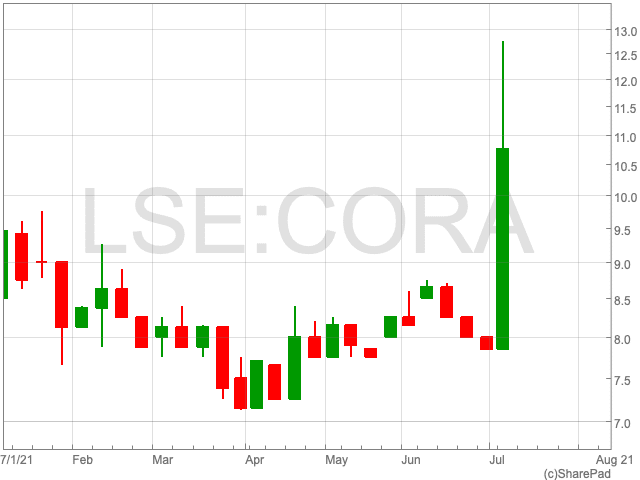
The Cora Gold share price (LON:CORA) is soaring on Wednesday, up by 37.50% heading into the afternoon session as the gold-focused company announced its latest drilling results. It is the first price move of such a sudden nature in approximately a year as the Cora Gold share price has been trading sideways since the beginning of 2021. Year-to-date the AIM-listed firm is up by 25%, largely down to the move today, which followed on from the announcement from its Sanankoro Gold Project in the south of Mali.

Drilling Results

Cora Gold found a “world class intersection” while drilling at the Sanankoro gold project in Southern Mali.

The company said it has been encouraged by its results to date with good widths and high-grade results in generally shallow oxides ore.

The company said that results at Zones A and C further reinforce the mineable quality of the Sanankoro gold structures. Highlights from Zone A include 19m @ 31.56 g/t Au from 65m, while the intercept began 50m below existing pit shell at Zone A.

At Zone C it reported 14m @ 8.54 g/t Au from 115m, in addition to three other intercepts.

Bert Monro, CEO of Cora, expressed delight at the results which caused the Cora Gold share price to rocket: “This drill programme continues to go from strength to strength. 19m @ 31.56 g/t Au is by far the most significant drill hole that Cora has ever drilled. This hole sits outside the existing inferred resource pit shell, starting 50m deeper than the current resource pit shell, so offers even greater upside to the Sanankoro Gold Project. This programme is continuing to deliver very high-grade oxide drill results from shallow depths, offering significant economic potential for the upcoming resource and DFS.”

“Zones A and C were historically lower grade than Selin, but these results demonstrate that there is potential for better grades in these deposits. The Company is aiming to complete the 35,000m drill programme over the next month with a resource update due to follow once all the assay results have been received.”

There could be further news on the Cora Gold share price once this has taken place.